Quick Overview
- A twin bagger (6–6.5 bushels) is the best all-around bagger. It fits most 42–46 inch decks.
- A 10–12 cu ft poly dump cart is the best all-around cart. It holds 350–700 lbs.
- A 42–48 inch sleeve-hitch or front-mount blade works for most tractors. Zero-turns need a heavier, purpose-built blade.
- Not every mower can run every attachment. Check hitch type and horsepower first.
- Budget $150–$450 for most single attachments. Zero-turn snow blades cost more, often $700 or higher.
Riding mower attachments turn a grass-cutting machine into a year-round yard tool. A bagger collects clippings. A cart hauls mulch and firewood. A plow clears snow off the driveway. This guide covers the best pick in each category. It also covers real fit and compatibility, based on hands-on repair work — not just spec sheets copied from a manufacturer page.
What to Look for in a Riding Mower Attachment
Buying the wrong attachment wastes money. It also wastes a return trip to the store. Check these five things before you buy anything.
1. Your Mower Type
Lawn tractors, garden tractors, and zero-turn mowers connect differently. Most tractors use a rear hitch plate. Some also have a sleeve hitch. Zero-turns often need mower-specific mounting brackets instead. A hitch built for one type rarely fits the other.
2. Engine Power and Traction
Heavy attachments need real pulling power. A plug aerator with a full weight tray can add 150 to 200 lbs of drag. [VERIFY: minimum horsepower most manufacturers recommend for tow-behind aerators over 40 inches wide] A mower under 15 HP can struggle on hills. It may spin its rear tires under a loaded cart. Traction matters as much as raw horsepower here.
3. Deck Size for Baggers
Baggers are deck-specific parts, not universal ones. A 42-inch deck needs a different chute than a 54-inch deck. The bagger’s mounting bracket also changes by model year. Always match the exact deck width and year before ordering.
4. Yard Size and Terrain
A small quarter-acre yard rarely needs a triple bagger. A sloped two-acre property often does. Match the attachment size to the actual job. Do not just buy the biggest option on the shelf.
5. Storage Space
A dump cart and a bagger both take real garage space. A 12 cu ft poly cart measures roughly 33 by 70 by 29 inches once assembled. That is close to the size of a full-size wheelbarrow, laid flat. Plan a storage spot before you buy. [INTERNAL LINK: seasonal attachment storage tips → /lawn-mower-storage-accessories/]
Expert Tip: Before buying any tow-behind attachment, sit on the mower and check the hitch height off the ground. Some tractors sit higher than others. A low-clearance blade can drag on uneven turf if the hitch sits too low.
Types of Attachments Explained
Riding mower attachments fall into three main jobs. Each job solves a different yard problem.
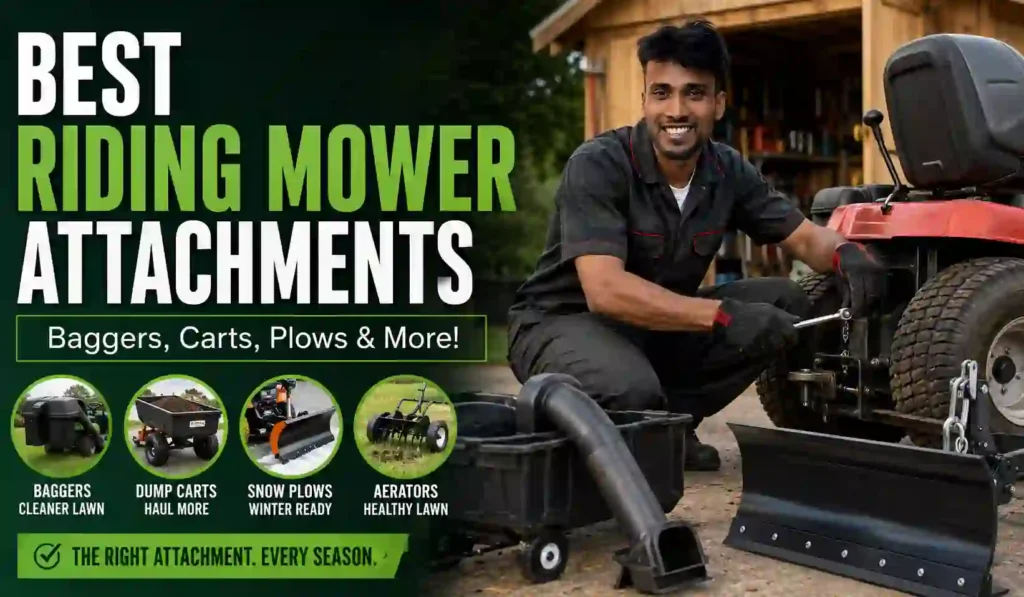
Baggers collect grass clippings and leaves as you mow. They stop clippings from matting on the lawn. They also cut down on raking time after a mow.
Carts haul heavy loads around the property. Think mulch, firewood, soil, or bagged yard debris. A cart turns your mower into a small utility truck for an afternoon.
Plows and blades move snow, gravel, or dirt. Front-mount blades work best for driveways. Rear sleeve-hitch blades work well for grading and light snow jobs, since they push and pull.
Two more attachment types come up often once these three are settled. Aerators loosen compacted soil. Dethatchers pull up dead grass buildup. Both are covered briefly later in this guide.
Best Baggers for Riding Mowers
A bagger is the single most-bought riding mower attachment. It also has the steepest learning curve for fit. Deck size, model year, and mount type all matter here. Get any one wrong, and the bagger will not seal properly against the deck.
1. Twin Bagger (6–6.5 Bushel) — Best for Most Yards
A twin bagger uses two separate collection bins. Combined, they hold about 6 to 6.5 bushels of clippings. This size fits most 42- and 46-inch riding mower decks. That includes many Craftsman, Troy-Bilt, Cub Cadet, and MTD-built machines.
Price: Around $250–$300 for a genuine-fit twin bagger kit. Reconfirm the price before buying.
Best for: Weekly mowing on a quarter- to half-acre lawn.
Watch for: Bagger kits are not universal parts. Match the exact deck size and mower model year. A 42-inch kit will not fit a 46-inch deck correctly, even if it looks close.
In our shop, the top bagger complaint is poor airflow. Clippings clog the chute on wet grass days. A twin bagger with independent bins clears faster than one large single bin. This matters more than most first-time buyers expect, especially in humid climates.
First-hand note: The first time I bagged a wet, overgrown lawn with a twin unit, I expected a clog within ten minutes. It didn’t clog until the bins were nearly full — the independent airflow design earns its keep on tough grass.
2. Triple Bagger (9–10 Bushel) — Best for Large Properties
A triple bagger adds a third collection bin. Total capacity jumps to 9 or 10 bushels. This size fits wider decks, usually 50 to 54 inches across.
Price: Around $350–$450, depending on deck fit and brand.
Best for: Half-acre to two-acre lawns with heavy fall leaf drop.
Watch for: Triple baggers are bulky units. Confirm garage clearance before buying one. Also confirm the exact deck width match — 50-inch and 54-inch kits are not interchangeable parts.
3. Electric Riding Mower Soft Bagger — Best for Battery Mowers
Battery-powered riding mowers need a different bagger design than gas models. A soft mesh bagger, like the one built for Ryobi’s electric riding mowers, uses nylon bins. This improves airflow without adding extra motor drag, which helps preserve battery runtime.
Price: Around $349 for a genuine-fit 2-bin soft bagger with 6.25 bushel capacity.
Best for: Owners of battery riding mowers who want bagging without a big runtime hit.
Watch for: These kits are brand- and model-specific parts. A soft bagger built for one electric platform will not bolt onto a different brand’s mower, even a similar-looking one.
Best Dump Carts and Utility Carts
A dump cart is the attachment Siddik recommends first to new riding mower owners. It has the widest use case of any attachment on this list. It also uses the simplest hitch — most carts use a universal pin that fits nearly any tractor brand.
4. Small Steel Dump Cart (350 lb) — Best Budget Pick
A compact steel cart, like the Agri-Fab 45-0303, holds up to 350 lbs across 10 cu ft. It uses a single-lever dump mechanism. It also has a removable tailgate for loading long items.
Price: Around $180–$225. Reconfirm the price before buying.
Best for: Small yards, light hauling, and occasional mulch or soil runs.
Watch for: The steel bed will rust over time if stored outside uncovered. A cheap tarp adds years to the bed’s life.
5. Poly Swivel Dump Cart (700 lb) — Best All-Around Cart
A poly-bed cart in the 700 lb, 12 cu ft class is the most common cart Siddik sees in customer garages. Models like the Agri-Fab 45-0552 and 45-0573 have pneumatic tires and a foot-lever dump mechanism. Some swivel up to 80 degrees for precise dumping in tight spots.
Price: Around $300–$400. Reconfirm the price before buying.
Best for: Firewood, mulch, gravel, and general yard debris on mid-size properties.
Watch for: Poly beds resist rust well but can crack in freezing temperatures if overloaded. Stay near the rated capacity. Do not push past it just because the bed looks like it has room.
First-hand note: I loaded a poly swivel cart with wet river gravel once, well past the fill line, just to see what happened. The bed held. The tow bar bent slightly at the pin. Rated capacity exists for a reason — respect it.
6. Heavy Steel Dump Cart (1,200 lb) — Best for Heavy Loads
For gravel, stone, or large firewood loads, a heavy steel cart in the 1,200 lb, 13 cu ft class handles the job well. This is a serious step up in capacity from a standard poly cart.
Price: Around $450–$550. Reconfirm the price before buying.
Best for: Property owners doing landscaping or hardscaping work.
Watch for: A fully loaded 1,200 lb cart puts real strain on a small mower’s transmission and brakes. Confirm your mower’s rated towing capacity first.
Best Snow Plows and Blades
Snow attachments split into two clear groups. Tractors use lighter, sleeve-hitch or front-mount blades. Zero-turns need heavier, purpose-built blades instead. Mixing the two up is the most expensive mistake in this whole category.
7. Front-Mount Universal Snow Blade — Best for Tractors
A 46- to 48-inch front-mount blade, like the Agri-Fab LBD48D, bolts onto the front of most lawn and garden tractors. It handles light to moderate snow on driveways and walkways well.
Price: Around $250–$320. Reconfirm the price before buying.
Best for: Driveways and sidewalks in areas with light-to-moderate snowfall.
Watch for: Front blades add weight to the nose of the mower. Rear wheel weights or tire chains often improve traction and control in the snow.
8. Sleeve-Hitch Rear Blade — Best Multi-Purpose Blade
A 42-inch sleeve-hitch rear blade, like the Brinly-Hardy BB-56BH, rotates 180 degrees. It can push material or pull it, depending on the blade angle. That means one blade handles snow, gravel, and light dirt grading.
Price: Around $270–$300 for the blade. Reconfirm the price before buying. Note that a sleeve hitch mount is often sold separately and is required for installation.
Best for: Owners who want one attachment for snow, dirt, and light grading work.
Watch for: This attachment needs an existing sleeve hitch on the tractor. Confirm your mower has one first, or budget for the hitch as a separate part.
9. Zero-Turn Snow Blade (60 in) — Best for Zero-Turn Mowers
A dedicated zero-turn snow blade, like the Agri-Fab 45-0613, is a different animal from a tractor blade. It is wider, built from heavier 14-gauge steel, and controlled right from the seat. A lever angles the blade left, center, or right on the fly.
Price: Around $700–$900. Reconfirm the price before buying.
Best for: Zero-turn owners who already use their mower for three-season work and want winter use too.
Watch for: Not every zero-turn is rated for plowing. Confirm compatibility with your specific model before ordering one. Zero-turns have less natural traction than tractors, so plan on tire chains and rear weights for real winter use.
Expert Tip: On a zero-turn, plow slow and steady. The steering system that makes these mowers agile in summer can also make them twitchy on packed snow. Smooth, low-speed passes beat fast ones every time.
Other Attachments Worth a Look
Two more attachment types come up often once baggers, carts, and plows are settled. Both fall under lawn health, rather than hauling or clearing.
Plug aerators pull small soil cores from the lawn. This relieves compacted soil. A 40- to 48-inch tow-behind plug aerator, like a Brinly-Hardy model, typically costs $250 to $370. Most hold up to 150 to 200 lbs of added weight for deeper soil penetration.
Dethatchers pull up dead grass and thatch buildup between the soil and green grass blades. A 48-inch tow-behind dethatcher runs about $180 to $220.
Both attachments use a hitch pin similar to a dump cart’s. If you already own a cart, you likely have the right hitch type for these too. That makes an aerator or dethatcher an easy next purchase.
Comparison Table: Attachments at a Glance
| Attachment | Best For | Typical Price | Key Spec |
|---|---|---|---|
| Twin Bagger (6–6.5 bu) | Weekly mowing, small-mid yards | $250–$300 | Fits 42–46 in decks |
| Triple Bagger (9–10 bu) | Large yards, heavy leaf fall | $350–$450 | Fits 50–54 in decks |
| Electric Soft Bagger | Battery riding mowers | ~$349 | 6.25 bu, 2-bin mesh |
| Small Steel Cart | Budget, light hauling | $180–$225 | 350 lb, 10 cu ft |
| Poly Swivel Cart | General hauling, mid yards | $300–$400 | 700 lb, 12 cu ft |
| Heavy Steel Cart | Landscaping, heavy loads | $450–$550 | 1,200 lb, 13 cu ft |
| Front-Mount Snow Blade | Tractors, driveways | $250–$320 | 46–48 in, universal fit |
| Sleeve-Hitch Rear Blade | Multi-purpose grading/snow | $270–$300 | 42 in, rotates 180° |
| Zero-Turn Snow Blade | Zero-turns, wider clearing | $700–$900 | 60 in, 14-gauge steel |
All prices should be reconfirmed against the retailer’s live listing before you buy. Riding mower attachment pricing shifts often with seasonal demand, especially snow blades in fall.
Who Riding Mower Attachments Are Not For
Attachments are not a fit for every mower or every owner. A few honest exceptions:
Small push-mower owners. None of these attachments work on a walk-behind mower. You need a true riding mower or garden tractor with a hitch point.
Owners without storage space. A cart, bagger, and plow together take up real square footage. If your shed already feels full, add one attachment at a time, not three at once.
Very small yards. Under a quarter acre, a bagger or cart often costs more in money and storage than it saves in time. A simple hand cart or a mulching kit may serve you better.
Mowers under 12–15 HP. Light-duty riding mowers can struggle to tow a loaded cart or push a wide plow blade. Check your owner’s manual for a rated towing or pushing limit first.
Buying Mistakes to Avoid
Buying a bagger before checking deck size. This is the single most common return in this whole category. Always match the exact model and deck width first.
Assuming every tractor has a sleeve hitch. Many entry-level tractors do not come with one. Check before buying a sleeve-hitch attachment.
Skipping the weight math on carts. A cart rated for 700 lbs, loaded with wet soil, can exceed that weight fast. Weigh a full load once early on to learn your mower’s real, practical limit.
Buying a tractor snow blade for a zero-turn. The mounting systems are not interchangeable parts. This mistake wastes both money and a return shipment.
Ignoring storage footprint. A dump cart and a triple bagger together can eat up a third of a small shed. Measure your storage space honestly before buying either one.
Skipping the manual’s tow rating. Every mower has a rated max towing weight somewhere in its manual. Few new owners ever check it before hitching up a heavy cart.
Maintenance and True Cost of Ownership
An attachment’s sticker price is not its full cost over time. Here is what Siddik’s repair shop actually sees across a typical attachment’s working life.
Baggers: Bags and mesh liners wear out from UV exposure over a few seasons. Budget $30 to $50 every two to three seasons for a replacement bag kit. Chute clogs are the top repair call in this category. Clearing one takes under five minutes with the mower shut off.
Carts: Tires are the main wear item on any dump cart. A pneumatic tire replacement runs $20 to $40 per wheel. Wheel bearings occasionally need fresh grease. Most carts have a zerk fitting built in for this exact job.
Plows and blades: Skid shoes wear down first, especially on gravel driveways. Replacement skid shoes cost $15 to $25 a pair. The steel blade edge itself can last many seasons with normal, careful use.
Aerators: Individual plug spoons crack on rocky soil over time. Most brands sell single replacement spoons for a few dollars each. That beats replacing the entire tine bar just for one broken spoon.
Total Cost of Ownership Snapshot
| Attachment | Purchase Price | Typical Annual Upkeep | 5-Year Estimate |
|---|---|---|---|
| Twin Bagger | $275 | $15–$25 | $350–$400 |
| Poly Dump Cart | $350 | $10–$20 (tires) | $400–$450 |
| Sleeve-Hitch Blade | $285 | $10–$15 (skid shoes) | $335–$360 |
These figures are general shop estimates, not brand-specific guarantees.
Common Issues and Repair-Shop Notes
“My bagger won’t fill evenly.” This is almost always a chute alignment issue. One bin fills faster than the other when the deflector plate sits crooked. A five-minute adjustment usually fixes it fully.
“My cart tips forward when I brake.” This means the load sits too far forward in the bed. Shift heavy items toward the rear axle, closer to the hitch pin, before your next trip.
“My snow blade won’t stay angled.” Worn pivot pins are the usual cause here. This is a cheap, fast fix. Most shops swap the pins in under 20 minutes.
“My aerator tines keep breaking.” This points to rocky or over-compacted soil, beyond what the aerator is rated for. Reduce the added weight tray load. Make a second, shallower pass instead of forcing one deep pass.
“My cart’s hitch pin keeps falling out.” This is common on bumpy terrain. Swap the factory pin for a locking clip pin. It costs a few dollars and solves the problem for good.
In our shop, most attachment “failures” are not real failures at all. They are simple adjustments a first-time owner has not run into yet.
Frequently Asked Questions
What size dump cart do I need for a riding mower?
Most homeowners do well with a 10 to 12 cu ft cart. This size holds 350 to 700 lbs. Confirm your mower’s rated towing capacity before buying a larger cart.
Can I put a snow plow on a zero-turn mower?
Yes, but only with a blade built specifically for zero-turns. A tractor-style blade will not mount correctly. It can also damage the mower’s frame.
Do bagger attachments fit any riding mower?
No. Baggers are matched to an exact deck size and mower model year. Always confirm fit with the exact model number before ordering.
How much weight can a riding mower safely tow?
This varies by mower model and horsepower. Most 18 to 24 HP tractors handle a loaded cart under 500 to 700 lbs without real strain.
Is a twin bagger or triple bagger better for my yard?
A twin bagger suits most quarter- to half-acre lawns well. A triple bagger suits larger properties or heavy fall leaf pickup better.
Do I need a sleeve hitch for every attachment?
No. Dump carts and most aerators use a simple universal hitch pin. Rear blades and ground-engaging tools usually need a true sleeve hitch instead.
Can I leave attachments hitched to the mower all winter?
It is not ideal. Extended outdoor storage speeds up rust on hitch pins and wheel bearings. Detach and cover attachments when not in active use, where space allows.
Final Verdict
Start with the attachment that solves your biggest yard problem first. For most owners, that is a dump cart. It has the widest use case and the simplest hitch of the bunch. Add a bagger next if leaf and clipping cleanup eats real time each week. Save a snow plow for last. Match it exactly to your mower type — tractor blades and zero-turn blades are not interchangeable parts, no matter how similar they look in a catalog photo.