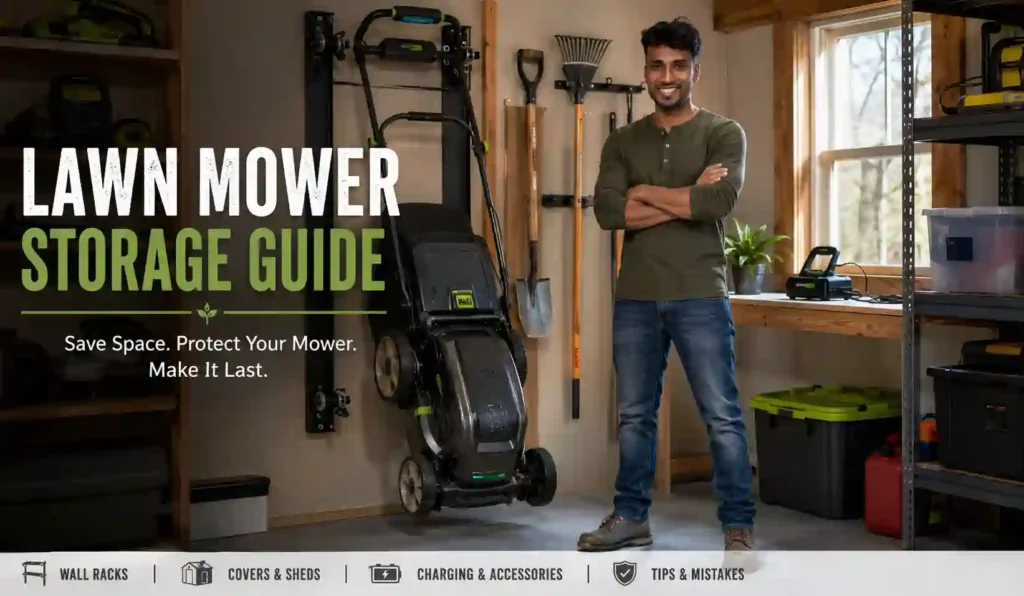
For most one-car garages, a wall-mounted vertical mower rack ($30-$60) is the best overall pick because it clears 3-4 square feet of floor space and works with both gas and electric push mowers under 65 lbs. If you park a riding mower or zero-turn outside, a hard-shell storage shed ($400-$900) beats a cover alone. Battery mower owners should prioritize a dedicated charging shelf over a rack, since the charger and cables need a fixed, ventilated spot away from moisture.
Table of Contents
- How to Think About This Purchase
- Types of Storage Accessories Explained
- Top Picks by Use Case
- Buying Mistakes to Avoid
- Maintenance and Total Cost of Ownership
- Frequently Asked Questions
How to Think About This Purchase
The right storage accessory depends on four things: what kind of mower you own, how much floor or wall space you have, whether the mower lives indoors or outdoors, and how much handling the accessory requires every time you mow. Skip straight to a product list and you’ll likely buy something that doesn’t fit your deck width or your garage stud spacing.
Mower Type and Power Source
Gas mowers need ventilated storage and enough clearance to tip them for blade access without spilling fuel or oil. A sealed plastic bin traps fumes and is a fire-code problem in many areas.
Battery and electric mowers don’t have fuel to worry about, but the battery pack itself is sensitive to temperature. [VERIFY: most lithium-ion mower battery manufacturers recommend storage between 50-77°F] Storing a battery mower in an uninsulated shed through a hard winter shortens pack life faster than almost anything else owners do wrong.
Riding mowers and zero-turns need either a dedicated shed, a carport, or serious floor space in a garage bay. None of the wall-rack solutions below apply to them.
Yard and Garage Space
Measure before you shop. A typical one-car garage wall between the door and a side wall is usually 24-30 inches wide once you account for a workbench or shelving unit. That’s enough for one vertical mower rack but not two side by side. If you’re storing a push mower and a snow blower or trimmer in the same footprint, a multi-tool rack system beats buying separate racks.
Indoor vs. Outdoor Storage
Indoor storage (garage, shed with a solid floor) protects against rust and UV damage. Outdoor storage under a cover invites moisture underneath the cover itself, which is often worse than no cover at all if the mower deck sits directly on wet grass or soil.
In our shop, the mowers that come in with the worst deck rust are almost never the ones stored bare outdoors year-round. They’re the ones stored under a snug-fitting cover on grass, where condensation gets trapped against the metal with nowhere to evaporate. A raised surface, like a scrap of plywood, a plastic pallet, or a purpose-built storage pad, matters more than the cover itself if the mower has to stay outside.
Budget
Storage accessories range from a $15 mower cover to a $900 resin storage shed. Most homeowners with a single push or self-propelled mower and an existing garage or shed only need a $30-$80 rack, hook set, or charging shelf, not a full shed.
Types of Storage Accessories Explained
Wall-Mounted Vertical Mower Racks
These bolt into wall studs and hold the mower upright by the deck or handle, freeing the floor space the mower used to occupy. Weight capacity typically ranges from 65 to 100 lbs, which covers most push and self-propelled mowers but not riding mowers.
Ceiling Hoist and Pulley Systems
A pulley system lifts the mower off the floor entirely using a rope-and-pulley mechanism anchored to ceiling joists. These work well in garages with high ceilings and no wall space, but they require more setup time and aren’t ideal for mowers you use multiple times a week, since raising and lowering takes a minute or two each trip.
Freestanding Storage Sheds and Cabinets
Resin or metal sheds sit outside and hold a mower plus trimmers, edgers, and hand tools. This is the right call for riding mowers, zero-turns, or households without garage space at all. The category the site’s Storage & Accessories hub covers in depth includes sizing these correctly against your specific mower’s footprint.
Mower Covers
A fitted cover protects against UV fading, bird droppings, and light rain when a mower must live outside temporarily. Covers are not a substitute for a shed or garage if the mower sits outside year-round: ground moisture wicks up through most cover fabrics over time.
Charging Docks and Shelves (Battery Mowers Only)
A simple wall shelf at outlet height keeps the charger, spare battery, and cables organized and off a garage floor where they’re vulnerable to moisture and impact. Some brands sell branded charging stations; a generic sturdy shelf works just as well.
Multi-Tool Storage Racks
These combine hooks, a mower cradle, and slots for trimmers, rakes, and hoses on one wall panel. Best for garages storing a full yard-tool set rather than just a mower.
Storage Pads and Ground Mats
A rigid plastic or rubber pad placed under a mower kept outside or in an unfinished shed lifts the deck off bare soil or concrete that stays damp. These run $20-$40 and solve a problem covers alone can’t: moisture wicking up from below rather than rain falling from above. Pair a pad with a cover rather than treating either one as a complete solution on its own.
Top Picks by Use Case
Best Overall: Wall-Mounted Steel Mower Rack
A steel wall rack with a padded cradle, rated for mowers up to 80 lbs, runs about $45-$55 at most hardware retailers and on Amazon as of this writing. It mounts to two wall studs with lag bolts (included hardware is usually adequate, but longer bolts are worth adding if your drywall is thicker than standard). Installation takes about 20 minutes with a stud finder and a drill.
Good fit for: Push and self-propelled mowers under 80 lbs, garages with open wall space between studs.
Not a good fit for: Riding mowers, garages with plaster walls instead of drywall over studs (anchors alone won’t hold the weight long-term).
Best for Small Garages: Ceiling Pulley Hoist
A basic rope-and-pulley hoist system costs $30-$50 and lifts mowers up to 100 lbs to the ceiling, clearing the wall entirely. It’s the right choice when wall space is already committed to shelving, a workbench, or a second vehicle’s mirror clearance.
Good fit for: Garages with high ceilings (8+ feet) and no available wall space.
Not a good fit for: Anyone who mows more than twice a week. The raise/lower cycle adds friction to a routine that should be quick.
Best for Riding Mowers and Zero-Turns: Resin Storage Shed
A resin shed sized for riding mowers (roughly 8×6 feet or larger) runs $600-$900 depending on brand and size, based on current retail pricing that should be reconfirmed close to purchase since resin shed pricing shifts with seasonal promotions. Look for a model with a reinforced floor rated for the mower’s weight plus foot traffic, not just a garden-tool shed repurposed for the job.
Good fit for: Riding mowers, zero-turns, households without garage space.
Not a good fit for: Renters or anyone who might relocate within 2-3 years. Sheds this size are a permanent yard fixture once assembled.
Best Budget Option: Fitted Mower Cover
A polyester or vinyl fitted cover costs $15-$25 and is the right call for short-term outdoor protection: a few weeks between mowing seasons, or a mower that briefly lives on a covered patio.
Good fit for: Temporary outdoor storage, supplementing an existing shed or garage spot.
Not a good fit for: Year-round outdoor storage on grass or dirt. Moisture wicks up from the ground regardless of the cover.
Best for Battery Mowers: Wall Charging Shelf
A basic 18-24 inch wall shelf near a GFCI outlet, paired with a small storage bin for the charger and spare battery, costs $20-$35 for the shelf and hardware. This matters more than most buyers expect: batteries stored loose on a garage floor are exposed to temperature swings and accidental impact far more than a mounted shelf.
Good fit for: Any battery or electric mower, especially in regions with cold winters.
Not a good fit for: Gas mowers. There’s no charging need, so a standard rack is more useful.
Best for Mixed Tool Storage: Multi-Tool Wall Panel
A slat-wall or pegboard-style panel with a mower cradle built in, plus hooks and bins for trimmers, edgers, and hand tools, costs $60-$100 for a starter panel and runs higher as you add accessory hooks. This is the pick for households treating one wall as the entire yard-equipment command center rather than solving the mower alone.
Good fit for: Garages storing a mower plus 3 or more other yard tools regularly.
Not a good fit for: A one-tool household. The cost premium over a basic rack isn’t worth it if you’re only hanging a mower.
Comparison Table: Storage Accessories at a Glance
| Accessory | Best For | Price Range | Weight/Size Limit |
|---|---|---|---|
| Wall-mounted steel rack | Push/self-propelled mowers | $45-$55 | Up to 80 lbs |
| Ceiling pulley hoist | Small garages, high ceilings | $30-$50 | Up to 100 lbs |
| Resin storage shed | Riding mowers, zero-turns | $600-$900 | Fits mowers up to ~54-inch deck |
| Fitted mower cover | Temporary outdoor protection | $15-$25 | Fits most push/self-propelled decks |
| Wall charging shelf | Battery/electric mowers | $20-$35 | Charger + 1-2 batteries |
| Storage pad/ground mat | Outdoor storage, unfinished sheds | $20-$40 | Fits most mower footprints |
| Multi-tool wall panel | Full yard-tool storage | $60-$100+ | Mower plus 3+ other tools |
Buying Mistakes to Avoid
Guessing at wall stud spacing instead of measuring. A rack rated for 80 lbs will still pull out of drywall if it’s anchored with plastic anchors instead of bolted into studs. Use a stud finder before buying anything that mounts to a wall.
Buying a cover instead of solving the storage problem. A cover slows down UV fading and rain exposure, but it does not stop rust from ground contact or protect against freeze-thaw cycles the way a garage or shed does. Treat covers as a supplement, not a solution.
Ignoring battery storage temperature. In our shop, one of the most common reasons battery mowers come in early is a pack that spent a winter in an unheated shed and lost significant runtime capacity. A charging shelf inside an insulated space adds real battery life over a few seasons.
Sizing a shed to the mower alone. Buyers consistently undersize sheds by forgetting they’ll also want to store a trimmer, gas can, and hand tools in the same space. Add at least 20% to the footprint you think you need.
Coiling a pull-cord starter mower’s cord too tightly against the storage rack. This is a small thing that causes real damage. A cord wound too tight or bent at a sharp angle against a rack edge fatigues the cord and the recoil spring faster than normal use would.
Maintenance and Total Cost of Ownership
A wall rack or hoist system has essentially no ongoing maintenance cost beyond an occasional bolt tightening check once a year. A resin shed needs hinge and latch hardware replaced roughly every 3-5 years in most climates. Expect $15-$30 per hardware replacement, based on typical resin shed hinge and latch part pricing.
For battery mower owners specifically, the “storage” decision has a direct cost impact most buyers don’t connect: a battery pack stored improperly and needing early replacement typically costs $150-$300, which is more than every accessory in this guide combined. A $25 wall shelf that keeps the charger and battery in a stable, moderate-temperature spot is cheap insurance against that cost.
Gas mower owners should budget for fuel stabilizer ($8-$12 per bottle, lasts a season) as part of the storage routine, not a separate maintenance task. Fuel left untreated over winter storage is one of the most common reasons a mower won’t start in spring.
Storage accessories themselves rarely need repair, but the mower’s handling during storage and retrieval causes wear that owners don’t connect back to how the mower is stored. A rack that forces the mower to be lifted at an awkward angle every time, for example, tends to loosen handle bolts and stress the folding handle hinge on mowers that have one. When comparing racks, a lower lift height and a wider cradle opening usually mean less strain on the mower over years of use, even if the price is a few dollars higher than the cheapest option.
How We Researched This Guide
Pricing and weight ratings referenced in this guide were checked against current retail listings and manufacturer spec sheets as of the last-updated date above. Storage and repair observations reflect patterns Siddik has seen across his mower repair work in Milan, not a formal study, and should be read as practical experience rather than statistical research.
Frequently Asked Questions
What is the best way to store a lawn mower in a small garage?
A wall-mounted vertical rack is the best option for a small garage because it clears the mower off the floor entirely while using only a 2-foot-wide section of wall. It works for push and self-propelled mowers up to about 80 lbs and installs directly into wall studs.
Can I store a lawn mower outside year-round?
You can, but a mower left outside year-round on grass or dirt will rust faster even under a cover, since moisture wicks up from the ground. If outdoor storage is the only option, place the mower on a raised pallet or storage pad and use a breathable cover rather than a sealed tarp.
Do battery-powered mowers need special storage?
Yes. Battery packs lose capacity faster when stored in temperature extremes, so a battery mower should be kept somewhere insulated, ideally between 50-77°F, with the charger and battery on a dedicated shelf rather than the garage floor. [VERIFY: confirm current manufacturer-recommended storage temperature range, as it can vary by brand]
How much weight can a wall-mounted mower rack hold?
Most residential wall-mounted mower racks are rated for 65-100 lbs, which covers the vast majority of push and self-propelled mowers. Riding mowers and zero-turns are too heavy and too large for any wall-mounted rack and need floor-level storage instead.
Is a storage shed worth it for just one push mower?
Usually not. A shed makes the most sense once you’re storing a riding mower, or a mower plus several other yard tools that don’t fit a garage. For a single push or self-propelled mower with existing garage access, a $45-$55 wall rack solves the space problem for a fraction of the cost.
How do I keep gas out of the way while storing a mower indoors?
Run the tank down close to empty before long-term storage, or add fuel stabilizer if the mower will sit for more than a month. Store the mower in a ventilated area, never in a sealed bin, and keep any spare gas cans in an approved container away from the mower itself, not stacked next to it.