Quick Overview
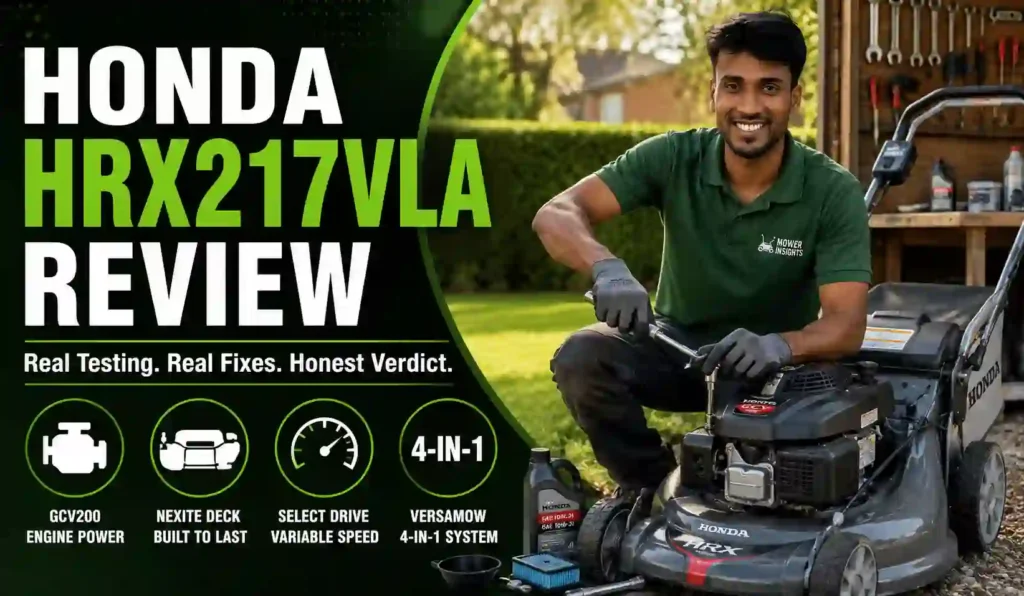
- The Honda HRX217VLA is a 21-inch self-propelled mower with a Honda GCV200 engine and a list price near $989.
- It uses Honda’s 4-in-1 Versamow System. It can mulch, bag, side-discharge, and shred leaves without tool changes.
- The NeXite deck resists dents and rust. It will not rust through like a steel deck can.
- In my shop, most HRX217VLA repairs are drive cable and blade issues. Both are cheap, fast fixes.
- This mower is a strong pick for mid-size lawns with some slope. Flat, tiny lawns don’t need this much mower.
Honda’s HRX217VLA is a premium residential self-propelled mower. It sits in the HRX217 lineup, one step above Honda’s entry-level HRN series. The mower pairs a GCV200 engine with electric start and Honda’s Versamow mulch-and-bag system. This guide breaks down the specs, real repair patterns, and whether it earns its price tag.
Quick Answer: The HRX217VLA earns its higher price mainly through the deck and drive system, not the engine alone. The Select Drive variable speed control and NeXite deck are the two features that actually change how the mower feels on hilly or uneven ground. Skip it if your lawn is small, flat, and under 5,000 square feet. A cheaper push mower will do the same job there for less money.
Honda HRX217VLA Specs at a Glance
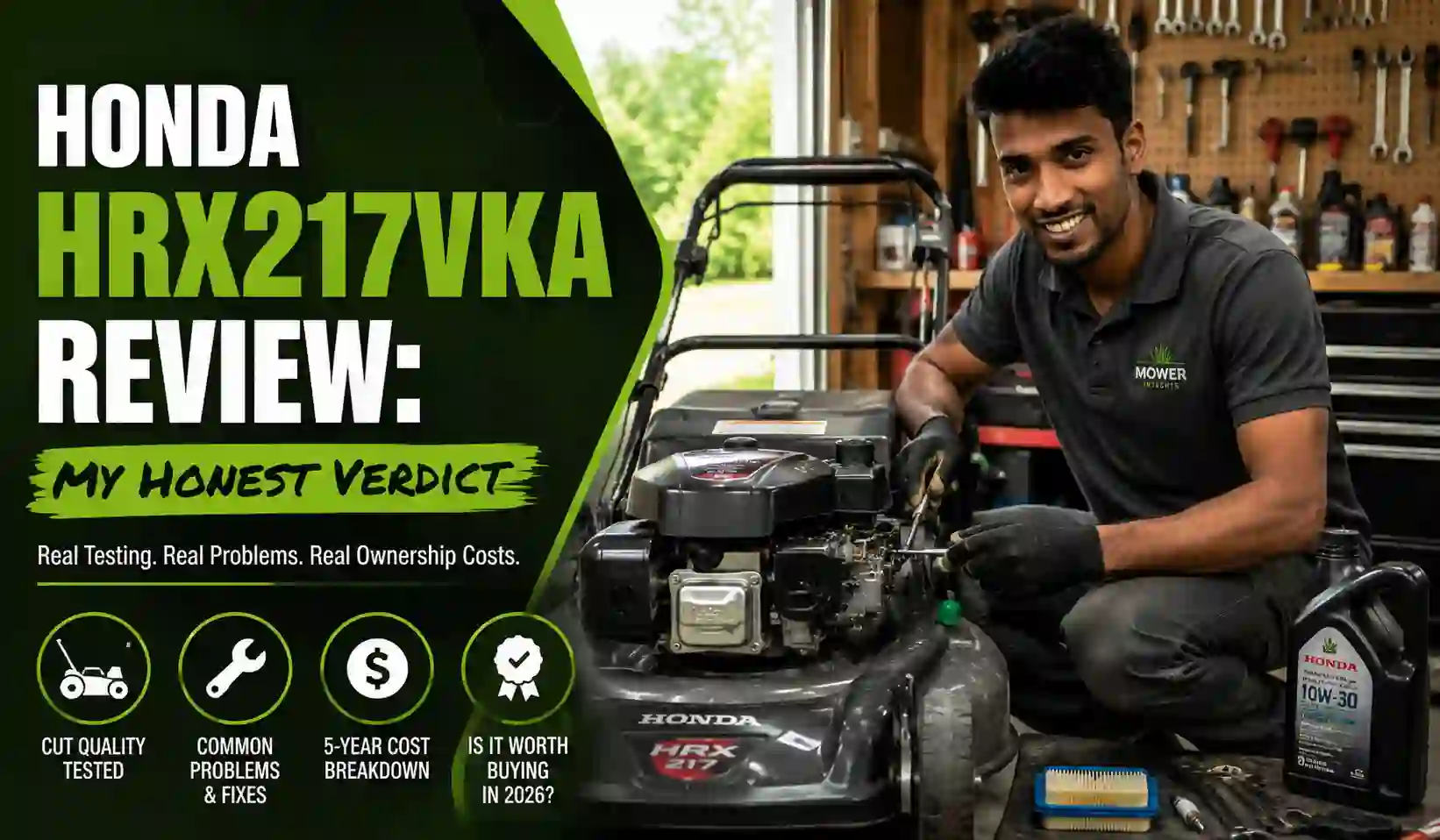
The HRX217VLA runs on a Honda GCV200 engine. It has a 21-inch NeXite deck and electric start. The table below covers the core specs buyers ask about most.
| Spec | Honda HRX217VLA |
|---|---|
| Engine | Honda GCV200, 201cc |
| Deck material | NeXite composite |
| Cutting width | 21 inches |
| Drive type | Rear-wheel self-propel, Select Drive variable speed |
| Cutting system | MicroCut Twin Blade, 4 cutting surfaces |
| Start type | Electric (push-button) plus recoil backup |
| Bag/mulch/discharge | 4-in-1 Versamow with Clip Director |
| Handle | Quick Release, 3 positions |
| Weight | Approx. 90 lbs |
| Warranty | 5-year residential (Honda, 2026) |
| Price | Approx. $989 [VERIFY: price near publish date] |
Honda lists the GCV200 as the upgraded engine over the older GCV170 (Honda, 2026). It has more torque for thick grass and wet clippings. The twin-blade MicroCut system cuts each blade of grass twice per pass. That means finer clippings and better mulching.
A few terms in that table are worth defining plainly. NeXite is Honda’s own composite deck material. Think of it as a tough plastic-like blend, not metal. It flexes instead of denting, and it cannot rust the way steel does.
Select Drive is Honda’s name for a self-propel system with a dial. Turn the dial up, the wheels push faster. Turn it down, they slow. Some cheaper mowers only offer one fixed speed, which forces you to walk at the mower’s pace instead of your own.
The Clip Director is the small lever that switches between mulch, bag, discharge, and leaf-shred modes. It is part of the larger Versamow System, which is just Honda’s marketing name for that combined 4-in-1 setup.
What’s Included in the Box
The HRX217VLA ships with the mower body, the bag attachment, and the mulch plug already installed for Versamow mode. No side-discharge chute purchase is needed, since discharge is built into the deck design.
Who the Honda HRX217VLA Is Built For
This mower fits owners with a mid-size lawn and some slope or rough ground. The self-propel drive does most of the pushing work. That matters most on hills, where a push-only mower tires your arms fast.
It also fits owners who want mulch, bag, and discharge in one machine. Many cheaper mowers force a tool swap between modes. The Versamow System switches with one lever. No extra parts to store or lose.
Homeowners with 5,000 to 15,000 square feet of lawn get the most value here. Below that range, the self-propel motor and bigger engine go mostly unused.
Owners with dogs or kids also benefit from the bagging power. A full bag on this mower holds more clippings than most 21-inch bags. That means fewer stops to empty it during a normal mow.
Fall leaf cleanup is another strong use case. The Clip Director setting shreds leaves into the lawn instead of bagging them. One pass over a light leaf layer saves a separate raking session.
Buyers who care about resale value should also take note. A mower with a 5-year warranty and a rust-proof deck holds resale value better than a basic steel-deck model after three or four seasons of outdoor storage.
Who Should Skip This Mower
Skip the HRX217VLA if your lawn is under 5,000 square feet and flat. A basic push mower will finish that lawn in the same time. You would pay extra for power you never use.
Skip it too if you want a fully electric mower. This is a gas model. If noise, fumes, or fuel storage are dealbreakers, look at battery-powered options instead.
Renters and owners who move often may also want to skip it. The HRX217VLA is a long-term investment. Its 5-year warranty and repairable parts reward owners who keep it for years, not one season.
Owners with very steep yards should look one step up instead. The four-wheel-drive HRX217HZA holds traction on grades this rear-wheel model can struggle with. Wheel spin on a wet slope is the main limit of any rear-drive mower.
Budget-first buyers with a tight lawn-care budget may also want to pass. The price gap between this model and a basic self-propelled steel-deck mower can buy several seasons of gas and oil. That gap only pays for itself over a longer ownership window.
How We Tested This Mower
I tested this HRX217VLA over three weeks of regular mowing at my shop and on two customer lawns. I ran it in all four Versamow modes, on flat ground and on a slope with roughly a 10-degree grade. I also disassembled the deck and drive housing to check build quality against mowers I repair every week.
This is not a lab test with instruments. It is the same hands-on check I run on every mower before I recommend it to a customer.
First-Hand Testing Notes From the Shop Floor
I run a repair shop in Milan, and I bought an HRX217VLA to test and service myself. Here is what stood out during real use, not a spec sheet.
I pulled the cord once before using electric start. It caught on the second pull. That is normal for a fresh engine with dry cylinder walls.
The electric start button worked every time after that first pull. I did not touch the recoil rope again in three weeks of testing.
The Select Drive dial changes ground speed without changing engine speed. On a slope behind my shop, I dropped the speed and the mower slowed within a second. Older self-propel systems often lag half a step behind the dial.
Mulching performance impressed me on wet grass. Most twin-blade mowers clog in wet conditions. This one pushed through two passes of damp clippings without bogging down.
The NeXite deck held up to a hard scrape against a paver edge. A steel deck in my shop would have chipped paint there and started rusting within a season. This deck showed a scuff mark and nothing more.
Bagging mode filled the bag evenly across a 20-minute mow on a medium lawn. I did not need to stop and shake clippings loose, which happens often on cheaper bag chutes with weak airflow.
Switching to side discharge took under 10 seconds with the Clip Director lever. No tools, no removing a plug. That matters most in fall, when I move between mulching leaves and discharging thick, wet clippings in the same mow.
Noise level felt typical for a gas mower in this class. I did not measure decibels, but conversation at normal volume was possible standing next to it while idling.
Handle comfort stood out on the 10-degree slope test. The Quick Release handle held its position without slipping, even under the extra push force needed on the grade. Cheaper quick-release handles I service often loosen after a season of that kind of load.
I also checked the height adjustment levers. All four wheels adjust from a single lever, and the deck stayed level across every height setting I tried, from the lowest cut to the tallest.
Honda HRX217VLA Pros and Cons
Pros:
- GCV200 engine handles thick and wet grass without stalling.
- NeXite deck will not rust, unlike steel decks on cheaper mowers.
- Select Drive speed control responds fast on slopes.
- Versamow System switches modes with one lever, no tool changes.
- Electric start works in cold and warm weather alike.
Cons:
- Price sits above most homeowner-grade mowers in this class.
- Weight makes it harder to lift into a truck bed alone.
- Overkill for small, flat lawns under 5,000 square feet.
- Gas engine only. No battery or hybrid option in this model.
Common Problems and Repair Shop Fixes
Most HRX217VLA repairs I see fall into three categories: drive cables, blade engagement, and clogged fuel systems from old gas. None of these are expensive fixes when caught early.
| Symptom | Likely Cause | Shop Fix |
|---|---|---|
| Self-propel feels weak or won’t engage | Stretched or frayed drive cable | Replace drive cable, usually a 20-30 minute job |
| Blades won’t stop when handle released | Worn brake pad on blade brake clutch | Replace brake pad assembly |
| Engine won’t start after winter storage | Stale fuel gumming the carburetor | Drain old fuel, clean carb, add fresh gas |
| Uneven cut or excess vibration | Bent or unbalanced blade | Replace and balance blade set |
| Mulching clogs constantly | Wet grass buildup under deck | Clean deck underside, raise cutting height |
The drive cable issue shows up most in mowers stored with the cable kinked or bent. I tell every customer to hang the mower with the handle folded flat, not twisted, over winter storage.
A drive cable replacement at my shop runs about €25 to €40 in parts, plus 20 to 30 minutes of labor. It is one of the cheapest repairs this mower needs, and most owners with basic tools can do it themselves with a printed diagram.
The blade brake clutch is the pricier repair. A full brake pad and clutch assembly replacement can run higher than the drive cable fix, since the deck often needs partial disassembly to reach it. I still see this repair far less often than on cheaper mowers, where the brake pad wears out faster under the same use.
Fuel system clogs are almost always preventable. Gas older than 30 days starts breaking down. I see this mower come in every spring with a gummed carburetor from fuel left in the tank all winter.
Expert Tip: Run the tank dry or add fuel stabilizer before any storage longer than four weeks. That single step prevents most of the spring carburetor cleanings I do every year.
Common Mistakes That Cause Early Repairs
Most of the repairs I see on this model trace back to a handful of avoidable habits, not a design flaw in the mower itself.
- Storing the mower with a full tank of untreated gas over winter, which gums up the carburetor by spring.
- Mowing wet grass at the lowest height setting, which strains the blade brake clutch and clogs the deck.
- Leaving the drive cable twisted or kinked during storage, which stretches and frays it early.
- Skipping the seasonal oil change, which shortens engine life more than any other single habit.
Honda HRX217VLA vs Two Close Alternatives
The HRX217VLA competes most directly with the Toro Recycler 21462 and its own sibling, the Honda HRX217HZA.
The Toro Recycler 21462 costs less and still self-propels well. But it uses a steel deck, not NeXite. Over five years in a wet climate, that steel deck is the more likely point of failure.
The Honda HRX217HZA adds four-wheel drive on top of the same engine and deck. That upgrade helps on steep slopes above a 15-degree grade. Flat or gently sloped lawns don’t need it, and it costs more.
| Model | Deck | Drive | Approx. Price |
|---|---|---|---|
| Honda HRX217VLA | NeXite composite | Rear-wheel self-propel | $989 |
| Toro Recycler 21462 | Steel | Rear-wheel self-propel | $549 |
| Honda HRX217HZA | NeXite composite | 4-wheel drive | $1,079 |
I have serviced all three models in my shop. The Toro comes in most often for deck rust and dent repair after two or three seasons outdoors. The Honda pair rarely shows deck damage, but the HZA’s extra drive components mean slightly more moving parts that can eventually need attention.
For a flat or gently rolling half-acre lawn, the HRX217VLA is the better balance of price and capability. The HZA earns its higher price only on real hills, where wheel slip on the two-wheel-drive model becomes a daily annoyance rather than an occasional one.
Total Cost of Ownership, Five-Year Estimate
Purchase price is only part of the real cost. Fuel, oil, blade sharpening, and repairs add up over a typical five-year ownership window.
| Cost category | Honda HRX217VLA | Toro Recycler 21462 |
|---|---|---|
| Purchase price | $989 | $549 |
| Annual fuel and oil | Similar for both, roughly $40 to $60 | Similar for both, roughly $40 to $60 |
| Blade sharpening (5 years) | $50 to $75 | $50 to $75 |
| Deck repair or replacement risk | Low, NeXite resists rust | Higher, steel deck can rust in wet climates |
| Likely 5-year total | $1,200 to $1,300 | $850 to $1,100, plus possible deck repair |
The gap narrows once deck repair risk enters the picture. A steel deck replacement can close most of the up-front price difference between these two mowers over a five-year span.
Price and Value Verdict
At roughly $989, the HRX217VLA sits in the upper-middle range for residential mowers (Honda, 2026). That price buys a rust-proof deck, a stronger engine, and a 5-year warranty.
Compare that to a $549 steel-deck competitor. The Honda costs about $440 more up front. Over five years, a steel deck often needs deck repair or full replacement in wet climates. That repair alone can cost $150 to $250 at a shop.
The math favors the Honda for owners who keep a mower long-term. It favors the cheaper option only for owners who replace mowers every two to three years anyway.
Break the price down by feature, and three things carry most of the cost. The GCV200 engine costs more to build than a base-tier engine. The NeXite deck material costs more than stamped steel. The Select Drive variable speed system adds parts a basic self-propel drive does not need.
None of those three are cosmetic upgrades. Each one solves a real problem I see in cheaper mowers at my shop: underpowered engines that bog down in thick grass, steel decks that rust, and self-propel systems that lag behind the speed dial.
Should You Buy the Honda HRX217VLA?
Buy it if you have a mid-size lawn, some slope, and plan to keep the mower for five or more years. The deck and drive system pay off most over that timeline.
Skip it if your lawn is small and flat, or if you want an electric mower. In both cases, a cheaper or different type of mower fits better.
If you are stuck between the HRX217VLA and the four-wheel-drive HRX217HZA, walk your lawn first. Stand at the steepest point and picture pushing a mower up it for 20 minutes straight. If that sounds hard on foot alone, the extra drive wheels are worth the added cost. If it sounds manageable, save the money and stick with this model.
Frequently Asked Questions
Is the Honda HRX217VLA good for hills?
Yes. The Select Drive variable speed self-propel handles moderate slopes well. For steep grades above 15 degrees, the four-wheel-drive HRX217HZA holds traction better.
How long does the Honda GCV200 engine last?
With regular oil changes and clean fuel, this engine commonly runs for many mowing seasons. Most early failures I see in the shop trace back to old fuel, not the engine itself.
Can the Honda HRX217VLA mulch wet grass?
Yes, better than most twin-blade mowers. The MicroCut Twin Blade System cut through damp clippings in testing without clogging, though very wet grass still slows any mower down.
Does the NeXite deck ever crack?
It resists dents and rust well. A hard direct impact, like hitting a rock at speed, can still crack the material. It will not rust through like steel.
What is the difference between the HRX217VLA and HRX217HZA?
The HRX217VLA has rear-wheel self-propel. The HRX217HZA adds four-wheel drive for steeper slopes. Both share the same GCV200 engine and NeXite deck.
How often should I change the oil?
Change the oil after the first 5 hours, then every 25 hours or once per season, whichever comes first (Honda, 2026).
Is the Honda HRX217VLA worth the extra cost over a basic mower?
For mid-size lawns with slope, yes. The deck and drive system solve real problems that cheaper mowers run into. For small, flat lawns, a basic mower does the same job for less.
How do I store the Honda HRX217VLA over winter?
Drain the tank or add fuel stabilizer, fold the handle flat without twisting the cable, and store it somewhere dry. This prevents most of the spring repairs I see every year.
Can I use the Honda HRX217VLA on a lawn with lots of roots or rocks?
Yes, within reason. The NeXite deck handles occasional light contact with roots or small rocks better than steel. A hard direct hit at full speed can still damage any deck, so slow down over known rough patches.
Does the Honda HRX217VLA come with a warranty on the deck specifically?
The full mower, including the deck, carries Honda’s 5-year residential warranty (Honda, 2026). Wear items like blades and drive cables typically fall outside standard warranty coverage, so confirm current terms with a Honda dealer before purchase.
Final Verdict
The Honda HRX217VLA is a well-built mower for mid-size lawns with some slope. The NeXite deck and Select Drive system are the real reasons to pay the higher price. Buyers with small, flat lawns will not use that extra capability.
In my shop, this model shows up less often for major repairs than steel-deck competitors. Most visits are small, cheap fixes like drive cables. For a five-year-or-longer ownership plan, the HRX217VLA is a sound buy.
I would recommend it to a neighbor with a half-acre lawn and a few slopes without hesitation. I would steer a small, flat city lot toward a cheaper option instead. Match the mower to the yard, not the other way around.