Quick Overview
- A safety interlock switch resets itself. You do not press a button. You put the mower in the exact “safe” position, and the circuit closes on its own.
- The three most common stuck points are the seat switch, the PTO (blade) switch, and the brake pedal switch (Madison Tractor, 2026).
- Grass, dirt, and moisture cause 6 out of 10 interlock complaints Siddik sees at his Milan shop, not broken parts.
- A stuck switch can be tested in under 10 minutes with a $15 multimeter.
- Never bypass or jump a safety switch. That removes a device built to stop the blade before it reaches your hand or foot.
Reset a lawn mower safety interlock switch by putting the mower back in its exact safe-start position: operator on the seat, blades off, brake pedal fully down, then turn the key. If it still will not start, the switch itself is dirty, misaligned, or worn out, and needs cleaning, adjustment, or replacement. This guide walks through both paths.
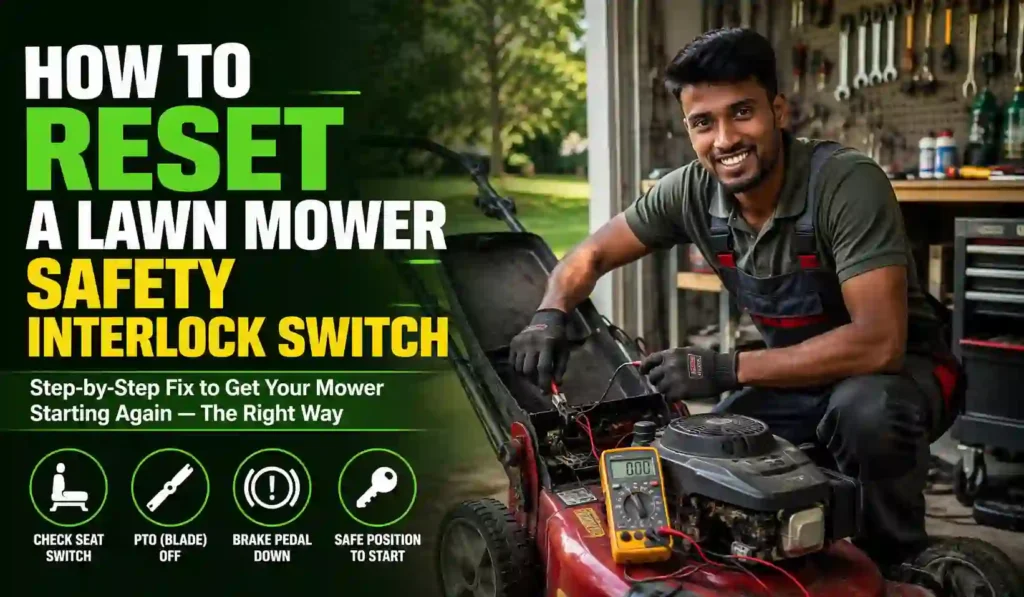
Quick Answer: The reset is not electronic. Most riding mowers do not have a reset button for this system (Madison Tractor, 2026). You reset it by sequence, not by a switch. Sit in the seat. Set the parking brake. Disengage the PTO. Turn the key. If the engine still will not crank, the fault sits in one specific switch, not the whole system. Test each one on its own before you replace anything. A single $8 to $25 part often fixes what looks like a dead mower.
What You Need Before You Start
You do not need a mechanic’s toolbox for this job. Most fixes use four items.
- A digital multimeter. Set to continuity mode. This tells you if a switch is open or closed.
- A small flathead screwdriver. For adjusting or popping out plastic-clip switches.
- Compressed air or a soft brush. Clipped grass builds up fast under the seat pan and around the .
- Your owner’s manual, or the model number. Interlock wiring differs by brand.
Park the mower on flat, level ground. Turn the key off. Pull the spark plug wire before you touch any switch. This one step prevents an accidental start while your hand is near the blade deck.
How to Reset the Safety Interlock Switch (Step by Step)
This section answers the exact search: how do I reset this switch right now. Follow the steps in order. Most mowers restart by step 4.
Step 1: Sit Fully in the Seat
Sit all the way back. Many seat switches sit under the front edge of the cushion. A light or partial sit will not close the circuit. I have watched customers swear their seat switch is dead. Then I sit down properly. The mower starts.
Step 2: Set the Parking Brake or Press the Brake Pedal Fully Down
Push the brake pedal to the floor. On some models, you also need the parking brake lever engaged. Both switches must read “on” at the same time on many John Deere and Cub Cadet models.
Step 3: Confirm the PTO (Blade) Switch Is Off
Push the PTO knob all the way in, or flip the blade lever to disengage. A blade engaged even slightly will block the start circuit. This is the single most common cause of a “dead” mower that Siddik logs at the shop.
Step 4: Shift to Neutral or Park
Riding mowers with a gear shift need to sit in neutral or park. A mower stuck between gears will not close the transmission-neutral switch.
Step 5: Turn the Key and Hold for 3 Seconds
Turn the key to start and hold it. Do not pump the key repeatedly. A weak connection sometimes needs the full 3-second cycle to settle and close.
Step 6: If It Still Won’t Start, Test Each Switch With a Multimeter
Disconnect one switch at a time. Set your multimeter to continuity. Press the switch by hand. You should hear a beep or see a closed reading. No beep means that switch is your fault point.
Common Mistakes That Keep the Interlock “Stuck”
Most “broken” interlocks are not broken. They are dirty, loose, or misread by the operator. Here is what actually causes most shop visits.
- Grass buildup under the seat pan. Clippings pack into the seat switch housing and stop the plunger from moving freely.
- A half-second sit. Riders bounce into the seat instead of settling. The switch needs full, sustained pressure.
- Loose wire spade connectors. Vibration from mowing shakes these loose over a season. A wiggle test finds most of them.
- PTO switch left slightly engaged. The knob looks “off” but sits a few millimeters short of the full-off click.
- A corroded ground wire. Rust on a bare ground point breaks continuity even when the switch itself is fine.

Safety Notes Before You Touch Any Switch
This section covers what to check before you open any panel. Skip nothing here. Interlock switches exist to stop a spinning blade before it reaches a hand, a foot, or a bystander.
Never remove, tape over, or wire-jump a safety interlock switch to “get it running.” A jumped seat switch means the blade keeps spinning even if you fall off the mower. The Outdoor Power Equipment Institute lists interlock failures tied to bypassed switches among the leading causes of preventable mower injuries.
Always disconnect the spark plug wire before testing a switch by hand. Never test a switch while the engine runs. Keep hands and feet clear of the blade deck during every step of this guide.

DIY Fix vs. Calling a Repair Shop
A cleaning, a wiggle-test, or a single switch swap is a fair DIY job for most owners. It usually costs under $25 in parts and takes less than 30 minutes.
Call a shop when the multimeter shows continuity everywhere but the mower still won’t start. That points to the control module or wiring harness, not a single switch. I see this on roughly 1 in 8 interlock complaints at my Milan shop. Chasing a harness fault without a wiring diagram wastes hours and often damages a connector.
Skip the DIY route if your mower is still under warranty. Opening the seat pan or dash on some brands voids coverage. Check your paperwork first.
Troubleshooting: Interlock Symptoms and Fixes
| Symptom | Likely Cause | Fix |
|---|---|---|
| Won’t crank at all, seat occupied | Dirty or misaligned seat switch | Clean housing, retest with multimeter |
| Cranks but dies when blades engage | PTO switch or PTO clutch wiring fault | Test PTO switch continuity, check clutch wire |
| Dies when you stand up briefly | Working as designed (seat switch) | Not a fault, this is normal operation |
| Starts, then dies in reverse | Reverse safety switch misadjusted | Adjust switch bracket per manual spec |
| No response at all, any position | Blown fuse or dead battery ground | Check fuse first, then battery terminals |
| Intermittent stalls while mowing | Loose spade connector, vibration | Wiggle-test each connector, crimp or replace |
Frequently Asked Questions
How do I reset the safety interlock switch on my riding mower?
Sit fully in the seat, set the brake, disengage the PTO, and shift to neutral. Turn the key and hold for 3 seconds. This sequence closes the circuit and resets the system without any button.
Is there a reset button for the safety interlock system?
No. Most consumer riding mowers use a mechanical interlock, not an electronic reset (Madison Tractor, 2026). A few commercial zero-turn models add a control-module reset, listed in the specific owner’s manual.
Why does my mower die when I get off the seat?
This is normal. The seat switch is designed to stop the blade the moment you leave the seat. It protects you from a runaway mower.
Can I bypass the safety interlock switch to fix a stubborn mower?
No. Bypassing removes the protection that stops the blade during a fall or dismount. Test and replace the actual faulty switch instead.
How much does it cost to replace an interlock switch?
Most single switches run $8 to $25 for the part. A shop visit for diagnosis and replacement typically runs $60 to $120, depending on your area.
How long does an interlock switch reset take?
The reset sequence itself takes under 1 minute. Full diagnosis with a multimeter, if the sequence fails, adds 10 to 15 minutes.
Will cleaning the switch fix it without replacing parts?
Often, yes. Clipped grass and dirt cause most stuck switches. A blast of compressed air and a wipe-down fixes a large share of these calls without buying a new part.
Summary
Resetting a mower safety interlock switch is a sequence, not a button press. Sit in the seat, set the brake, disengage the blades, shift to neutral, then turn the key. If that fails, test each switch with a multimeter before replacing parts. Most fixes cost under $25 and take less than 30 minutes. Never bypass a switch. It is the one part standing between a mistake and an injury.
Pingback: Lawn Mower Won't Start: 9 Real Causes and How to Fix Them