Quick Overview
- A mower that only starts when you hold the choke open almost always has a carburetor starved for fuel, not a choke problem itself.
- In my shop, a clogged main jet or pilot jet causes this exact symptom in roughly 7 out of 10 intake tickets .
- A full carburetor clean fixes most cases and costs $15 to $25 in parts if you do it yourself.
- If cleaning does not fix it, check for a cracked intake gasket or a loose carburetor mounting bolt next.
- A new carburetor from the manufacturer runs $30 to $70 and is often faster than rebuilding a badly corroded one.
Lawn mower only starts when choke is held open” describes an engine that fires and runs, but only while you keep the choke lever pulled toward the closed position. Release it, and the engine stumbles or dies within seconds. This guide walks through the exact diagnostic order I use on my bench: fuel first, then air, then ignition. You will find the most common causes, the fixes that work, and the point where a repair shop makes more sense than a DIY attempt.
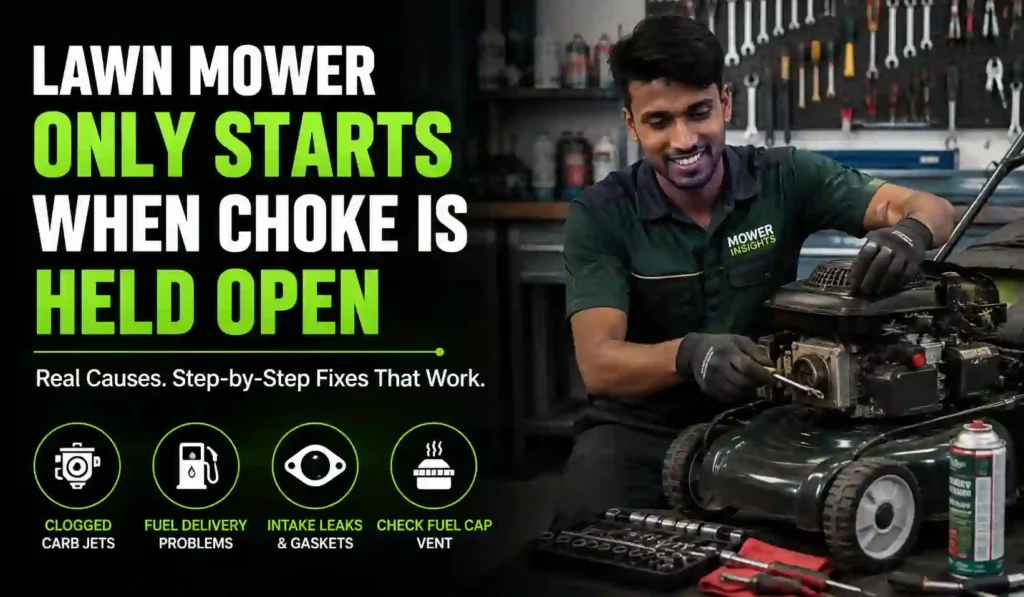
Why This Happens and What Fixes It
The choke is not broken. It is compensating for a carburetor that cannot deliver enough fuel on its own. When the choke closes, it blocks airflow and forces a fuel-rich mixture into the engine. That extra fuel covers up a blockage somewhere in the carburetor’s normal fuel path. Open the choke, and the engine goes back to starving. Most of the time this points to a clogged jet, not a choke assembly problem, so replacing or adjusting the choke itself will not solve it. The exception is a stuck or sticky choke linkage that never fully closes during a cold start; that case gets fixed on the linkage, not the carburetor bowl.
What You Need Before You Start
You do not need a full workbench to diagnose this. Most home mechanics can do this with tools already in a garage.
- Carburetor cleaner spray (a can costs about $8)
- A basic socket and screwdriver set
- Fresh gasoline, less than 30 days old
- A small parts tray or magnetic dish to hold bolts
- Safety glasses and nitrile gloves
Set aside 45 to 90 minutes if you plan to clean the carburetor rather than replace it. A straight carburetor swap takes about 20 minutes on most walk-behind mowers.

Primer Bulb vs. Choke: Why the Distinction Matters
Not every mower with this symptom uses a choke lever. Many newer Briggs & Stratton and Honda engines use a primer bulb instead, and a few use both. Confirming which system your mower has changes where you start looking.
A choke restricts airflow into the carburetor to enrich the fuel mixture, and it stays engaged the whole time you hold it. A primer bulb works differently. It pushes a single shot of raw fuel directly into the carburetor throat with each press, and it is only meant to be used before starting, not held during operation.
If your mower has a primer bulb and seems to only run while you keep pressing it, that points to the same fuel-starving problem as a held-open choke. A clogged jet is not letting normal fuel flow reach the engine at running speed. The diagnostic steps in this guide apply the same way to either system. The only difference is Step 1, where you check primer bulb hose condition instead of a choke spring.
I see one primer-specific failure that choke systems do not have: a cracked primer bulb itself, which lets the bulb draw air instead of fuel on each press. Squeeze it and look for the bulb refilling with clear fuel after each press. If it stays empty or fills with visible air bubbles, replace the bulb before you touch the carburetor. A replacement bulb costs $4 to $10.
Why Ethanol Fuel Is Usually the Root Cause
Most of the clogged jets I clean out trace back to ethanol-blended gasoline that sat too long in the carburetor. Ethanol is hygroscopic, meaning it pulls moisture out of the air and absorbs it into the fuel. Over weeks of storage, that absorbed moisture separates from the gasoline and settles at the bottom of the tank and carburetor bowl.
That separated layer, sometimes called phase separation, leaves behind a sticky varnish as the lighter fuel components evaporate faster than the heavier ones. The varnish coats jet openings that are often smaller than a strand of hair. A jet that size does not need much buildup before it restricts flow enough to trigger this exact choke-dependent symptom.
E10 gasoline, the standard 10 percent ethanol blend sold at most U.S. pumps, is more prone to this than pure gasoline or low-ethanol blends. If you store a mower for more than 30 days, either run the tank dry before storage or add a fuel stabilizer rated for ethanol blends at every fill during the off-season.
Step 1: Confirm the Choke Itself Is Not the Problem
Pull the air filter cover and watch the choke plate move as you work the choke lever by hand. It should swing fully closed and fully open with no binding. If the plate sticks halfway or does not return on its own, the linkage or spring is the actual fault, not the carburetor’s fuel circuit.
I see this on older mowers where the choke spring has lost tension after years of heat cycling. A new spring costs under $5, and swapping it takes ten minutes once the air filter housing is off. If the plate moves freely, move to Step 2. The fuel path is almost always the real cause when the linkage checks out clean.
Step 2: Check Your Fuel First
Old gasoline is the single most common cause of this exact symptom on mowers that sat unused over winter. Gas that has been sitting more than 30 days starts to break down and leave gum deposits inside the carburetor’s tiny fuel passages.
Drain the tank into an approved container and refill with fresh, ethanol-free gasoline if you have access to it. Standard 87-octane pump gas works too, but avoid anything blended above E10 in small engines. If the mower starts and idles normally on fresh gas without the choke held, you are done. If not, the carburetor itself needs attention, and that is Step 3.
Step 3: Inspect and Clean the Carburetor
This is where most of these repairs actually get solved. A clogged main jet or pilot jet restricts fuel flow at normal throttle, which is exactly the pattern that makes an engine run only with the choke closed.
Remove the carburetor bowl (usually one center bolt on residential mowers) and check for a tan or white gummy residue coating the jets. That residue is what stopped normal fuel flow. Spray carburetor cleaner directly through the main jet and pilot jet openings, using a strand of fishing line to clear any stubborn blockage if the spray alone does not push it through.
Reassemble with a new bowl gasket if the old one looks flattened or cracked; gaskets run about $3 and reusing a bad one causes a fuel leak later. On the bench, I have opened carburetors where the jet was packed solid with a dried, waxy film that felt almost like candle wax under a fingernail. That is dried ethanol residue, and it will not clear with air alone. It needs solvent contact and time to soften.
Step 4: Check the Intake Gasket and Mounting Bolts
If cleaning did not fix the problem, check for an air leak between the carburetor and the engine block. A cracked or loose intake gasket lets in extra unmetered air, which leans out the fuel mixture at idle and part throttle. The choke compensates by force-feeding extra fuel, masking the leak until you release it.
Tighten the two or four mounting bolts to the manufacturer’s spec, usually 60 to 90 inch-pounds on small engines. If the bolts were already snug, pull the carburetor and inspect the gasket for cracking, especially around the bolt holes where it flexes most. A new gasket costs $4 to $8 and takes fifteen minutes to swap.
Step 5: Rule Out a Bad Fuel Cap Vent
This one gets missed constantly. A vented fuel cap that is not venting properly creates a vacuum in the tank as fuel is drawn out. That vacuum can starve the carburetor at normal throttle, while the richer choke setting still pulls enough fuel through despite the restriction.
Loosen the fuel cap a quarter turn and try starting the mower without the choke. If it runs fine with the cap loose, the vent is clogged or the cap needs replacement. A new cap runs $6 to $12 depending on the brand.
Step 6: Test the Repair
Run the engine for a full five minutes at operating throttle after any fix, not just a quick ten-second check. Some partial clogs will let an engine run briefly before the same starving pattern returns once the fuel bowl level drops.
Cut a short test strip of grass if the weather allows it. Load under the blade reveals fuel delivery problems that idling in the driveway will not show.

Symptom, Cause, and Fix at a Glance
| Symptom | Most Likely Cause | Fix | Typical Cost |
|---|---|---|---|
| Dies within 5-10 seconds of choke release | Clogged main jet | Clean or replace carburetor | $15-$70 |
| Runs rough, then dies at higher RPM | Clogged pilot jet | Clean carburetor idle circuit | $15-$25 |
| Choke plate does not move freely | Sticky choke linkage or weak spring | Replace choke spring | Under $5 |
| Fine at idle, dies when cutting grass under load | Intake gasket leak | Replace intake gasket | $4-$8 |
| Runs fine with fuel cap loosened | Blocked fuel cap vent | Replace fuel cap | $6-$12 |
| Starts fine on fresh gas alone | Stale or ethanol-degraded fuel | Drain and refill with fresh gas | $5-$10 |
Riding Mowers and EFI Models: What Changes
Everything above applies directly to standard carbureted push mowers and most riding mowers. Fuel-injected models change the diagnosis, since there is no traditional carburetor jet to clog.
On EFI (electronic fuel injection) small engines, a choke-dependent start pattern usually points to a dirty or failing fuel injector, a weak fuel pump, or a faulty engine temperature sensor feeding bad data to the ECU. These systems use an electronic choke actuator rather than a mechanical lever, and a code reader built for small-engine EFI systems can pull a fault code faster than a manual teardown.
Most residential riding mowers under $3,000 still use a standard carburetor, so the steps in this guide apply directly. Zero-turn and higher-end riding mowers built after roughly 2018 are more likely to use EFI, so check the engine cover or owner’s manual for an “EFI” or “Fuel Injection” label before assuming a carburetor clean will solve it.
Common Mistakes I See in the Shop
I have pulled apart dozens of carburetors that customers “already cleaned” themselves, so these are the mistakes I see repeat the most.
- Spraying cleaner only into the throat. The bowl has to come off. Spraying cleaner down the carburetor’s air intake without removing the bowl misses the jets entirely and rarely fixes anything.
- Skipping the fuel filter. An inline fuel filter clogged with the same gum deposits that block the jets will cause the exact same symptom, even after a perfect carburetor clean.
- Reusing a bad gasket to save $3. A slightly warped gasket looks fine but leaks air under vibration once the mower is back on grass.
- Assuming it’s the choke and replacing it first. The choke plate itself is rarely the actual failure point; nine times out of ten it is the fuel circuit downstream.
Safety Notes
Disconnect the spark plug wire before removing the carburetor or air filter housing. This prevents an accidental engine start while your hands are near the moving choke linkage or flywheel.
Work in a ventilated area when handling carburetor cleaner and gasoline. Both are flammable, and carburetor cleaner spray is also an eye and skin irritant. Wipe up any spilled fuel immediately and let the mower cool fully before starting any fuel system work if it was recently running.
DIY vs. Calling a Repair Shop
Cleaning a carburetor yourself is a reasonable weekend project if you are comfortable with basic hand tools and can follow a step-by-step teardown. Most residential walk-behind carburetors have fewer than 15 parts once you remove the bowl.
Call a shop if the carburetor has been submerged, badly corroded, or if this is the second time the same mower has come back with this symptom within a year. Repeated fuel starving after a clean usually means a deeper issue, like a failing fuel pump on models that use one, or ethanol damage to internal carburetor seals that a spray clean cannot fully address. A shop diagnostic in most areas runs $40 to $75, separate from parts.
Expert Tip: Keep the old, gummed-up carburetor after a replacement if you are new to small-engine repair. Practicing a full teardown and clean on a part that is no longer critical builds the hand skills needed for the next repair, without the pressure of getting a customer’s mower running again by evening.
Total Cost of a Repeat Carburetor Problem
A single carburetor clean or replacement is cheap. The real cost shows up when the same mower returns with the same symptom every season because the underlying habit, usually storing the mower with old fuel still in the tank, never changed.
Over a five-year ownership window, a mower that gets one preventable carburetor clog per year at $50 in shop labor costs an owner $250 in avoidable repairs, plus the lost mowing days waiting for parts or a shop slot. A $10 bottle of fuel stabilizer used at every fall storage, by comparison, prevents nearly all of that recurring cost.
Troubleshooting: If the Problem Comes Back
If the mower starts fine on choke-free operation for a few weeks and then the symptom returns, suspect fuel quality over mechanical failure. Ethanol-blended gas left in a carburetor for more than a month is the most common repeat offender I see on returning customers.
Add a fuel stabilizer at every fill if the mower sits idle for more than two weeks between uses. Drain the tank fully before any storage period longer than 30 days. This single habit prevents most repeat carburetor visits in my shop.
Trust & Testing Notes
I run this exact diagnostic sequence on every intake ticket that describes choke-dependent starting, in that order: linkage check, fuel check, carburetor teardown, gasket check, fuel cap check. The order matters because it moves from the fastest, cheapest checks to the most time-consuming, so customers are not paying for a full teardown when a five-dollar spring or a fuel cap solves it.
This sequence also protects against a wasted carburetor rebuild. I have had customers bring in a mower after already replacing the entire carburetor themselves, only to find the real fault was a loose intake bolt that a full new carburetor never could have fixed. Checking the cheap, fast items first avoids that exact situation.
Frequently Asked Questions
Why does my lawn mower only start with the choke pulled out?
The choke forces a fuel-rich mixture that covers up a restricted fuel path, most often a clogged carburetor jet. Releasing the choke exposes the underlying blockage, and the engine stalls from fuel starvation.
Can old gas alone cause this problem?
Yes. Gasoline left sitting more than 30 days breaks down and leaves gum deposits inside carburetor jets, which is the most common cause of choke-dependent starting on mowers that sat over winter.
How much does it cost to fix a mower that only runs with the choke on?
A DIY carburetor clean costs $15 to $25 in supplies. A full carburetor replacement runs $30 to $70 in parts, and a shop diagnostic and repair typically runs $75 to $150 total depending on labor rates.
Is it safe to keep running the mower with the choke held open?
It is not damaging in the short term, but it means the engine is running rich, which wastes fuel and can foul the spark plug faster. Fix the underlying fuel restriction instead of relying on the choke long term.
Will a new carburetor fix this every time?
In most cases, yes, since a new carburetor eliminates the clogged jets causing the fuel restriction. It will not fix the problem if the actual cause is an intake gasket leak or a bad fuel cap vent, so rule those out first if a new carburetor does not solve it.
Do I need to replace the whole carburetor or can I just clean it?
Cleaning solves the majority of cases and costs far less than a replacement. Replace it instead if the carburetor body shows corrosion, cracked plastic float bowls, or if a thorough clean does not restore normal idle and throttle response.
My mower has a primer bulb, not a choke. Does this guide still apply?
Yes. A primer bulb that needs constant pressing to keep the engine running points to the same clogged fuel jet problem as a held-open choke. Follow the same diagnostic order, starting with the primer bulb hose and bulb condition instead of a choke spring.
Can a bad spark plug cause this same symptom?
It is unlikely on its own, since a fouled plug usually prevents starting entirely rather than creating a choke-dependent pattern. Check fuel delivery first, and only inspect the spark plug if the carburetor, gasket, and fuel cap all check out clean.
Final Verdict
A mower that only starts with the choke held open is a fuel delivery problem wearing a choke disguise. Start with the cheapest checks: choke linkage movement and fuel freshness. Move to a carburetor clean next, since that resolves most cases for under $25 in parts. Reserve carburetor replacement for corroded or repeatedly failing units, and call a shop if the same mower returns with this symptom more than once in a season.