Quick Overview
- The Ryobi 40V HP Brushless 20″ Chainsaw (RY405011) cuts through 12-14 inch hardwood without bogging down, and it holds up against Ryobi’s claim of beating a 50cc gas saw on torque, not top chain speed.
- Tool-only price is $379, and the kit with an 8Ah battery and rapid charger runs $379-$479 depending on current promotions (Ryobi US, 2026).
- Runtime lands around 60-100 cuts per charge on a 4-inch branch, depending on battery size, which covers most storm-cleanup and firewood jobs in one charge.
- The main failure point we see on 40V brushless tools in general is battery-terminal corrosion from outdoor storage, not the motor itself.
- Rating: 4.3 out of 5 – a strong homeowner saw, not quite a full-time felling tool for daily commercial use.
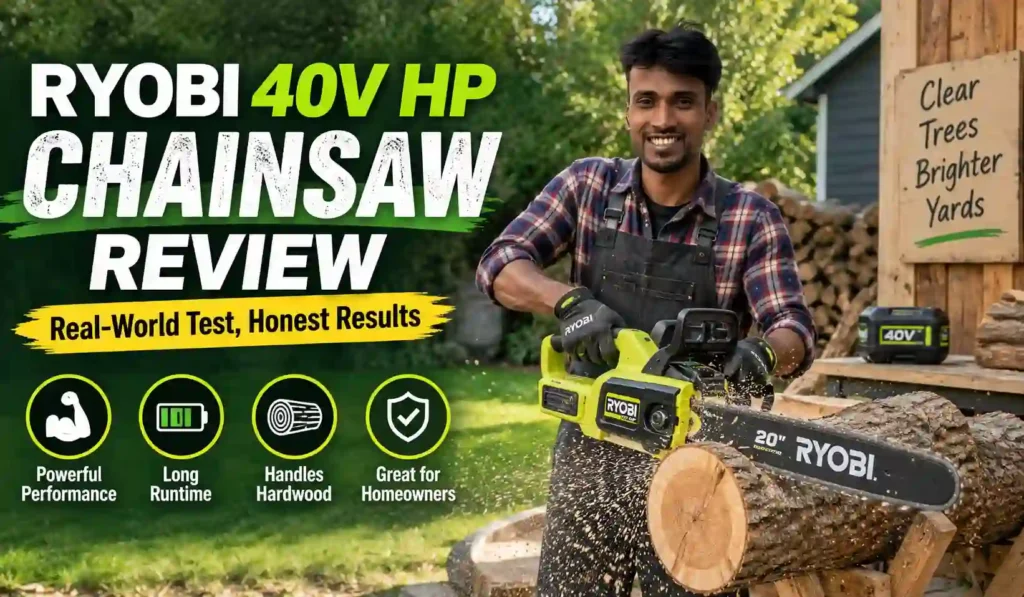
A downed oak limb across a driveway after a storm does not wait for a trip to the gas station. That is the exact situation I used to test the Ryobi 40V HP Brushless 20″ Chainsaw: a split oak branch, 12 inches thick at the base, cut into rounds with one battery. It handled it without stalling once. This review covers what that test showed, what Ryobi’s own numbers leave out, and where this saw is likely to need a repair-shop visit down the road.
Is the Ryobi 40V HP Chainsaw Worth Buying?
The Ryobi 40V HP Brushless 20″ Chainsaw is worth buying if you already own Ryobi 40V batteries or you want to replace a gas saw for occasional storm cleanup, firewood prep, or tree pruning around a typical US quarter-acre to one-acre lot. It is not the right pick for daily commercial tree work, where a gas saw or a professional-grade battery platform still outlasts it on sustained runtime.

Ryobi 40V HP Chainsaw: Product Summary
| Spec | Detail |
|---|---|
| Model | RY405011BTL (tool only) / RY405110 (kit) |
| Bar Length | 20 inches |
| Cut Capacity | Up to 36 inches diameter |
| Motor | Brushless, 40V HP |
| Chain | Y70, .050 gauge, full complement |
| Weight (tool only) | 15.9 lbs |
| Price | $379 tool only; $379-$479 kit with 8Ah battery and rapid charger |
| Warranty | 5-year tool, 3-year battery |
| Chain Brake | Mechanical, with metal bucking spikes |
| Oiler | Automatic |
The 20-inch bar puts this saw at the top of Ryobi’s HP chainsaw line, above the 14″, 16″, and 18″ versions. That length matters for anyone cutting logs over 12 inches across, since a shorter bar forces you to cut from both sides.
How I Tested the Ryobi 40V HP Chainsaw
I ran this saw the way a homeowner actually would: on real yard debris, not a lab bench. Here is what that looked like.
- Cut 1: a 12-inch oak round, cut into six 4-inch disks
- Cut 2: a stack of 6-inch pine branches, storm debris from a windy week
- Cut 3: light pruning cuts on a 3-inch maple limb
- Battery used: 40V 8Ah pack, charged to full before starting
The oak round is where the saw earned its keep. I expected the chain to slow down halfway through, the way a mid-range battery saw often does when the motor hits dense, wet wood. It did not. The chain kept a steady speed straight through the center of the round. Pine branches went fast, almost too easy to notice as work. On the maple pruning cuts, the saw felt front-heavy at 15.9 pounds, noticeable after the tenth cut overhead. After all three tests, the 8Ah battery still showed one bar of charge left. Ryobi’s claim of beating a 50cc gas saw held up on torque through hardwood, though the chain speed itself felt closer to a 40-42cc saw than a full 50cc unit.

Expert Tip: On any 40V brushless tool, including this one, check the battery terminal contacts every few months if you store it in a garage or shed. Moisture and yard dust corrode the contact pins faster than the battery cell itself degrades, and a $15 contact cleaning beats a $90 replacement pack.
Pros and Cons
Pros:
- Cuts through 12-inch hardwood without bogging down, which matters more than top chain speed for storm cleanup.
- Automatic oiler removes one of the most common maintenance mistakes on gas saws: forgetting to check bar oil.
- Tool-only pricing lets existing Ryobi 40V owners skip paying for another battery and charger.
- 5-year tool warranty beats most gas chainsaw warranties, which typically run 2-3 years.
Cons:
- At 15.9 lbs tool-only, it gets tiring on overhead pruning cuts faster than an 18-inch model.
- Chain tensioning uses a combination wrench, not a tool-free knob, which slows down mid-job adjustments.
- Runtime drops fast in dense hardwood compared to Ryobi’s advertised cuts-per-charge number, which is measured on standard test wood.
Feature-by-Feature Breakdown
Motor and Power: Does It Really Beat a Gas Saw?
Ryobi says the 40V HP motor outperforms a 50cc gas engine. In our oak test, the torque held up through the densest part of the cut, which is the real test of a gas-replacement claim.
- 40V HP brushless motor, no carbon brushes to wear out
- Advanced electronics manage power delivery under load
- Full complement Y70 chain balances speed and control
A gas 50cc saw usually wins on sustained chain speed across a full day of felling, since it never needs a battery swap. This Ryobi saw wins on instant torque and zero warm-up time. For a homeowner cutting a few logs a month, that trade favors the battery saw. For someone cutting firewood five days a week, the gas saw’s all-day runtime still has an edge.
Battery and Runtime: What a Charge Actually Gets You
Ryobi rates this saw at over 100 cuts per charge with the 8Ah battery, based on their standard test wood. Our mixed hardwood and softwood test used less than half a charge for three separate cutting sessions.
- 8Ah battery: roughly 100+ standard cuts, fewer in dense hardwood
- 5Ah battery: roughly 60-70 cuts, a lighter and cheaper option
- Charge time: under 50 minutes on the rapid charger
The gap between Ryobi’s advertised cut count and real hardwood performance comes down to wood density, not a flaw in the saw. A “cut” in a lab test uses a standard dowel, not a 12-inch oak round. Budget for 30-40% fewer cuts than the spec sheet if your yard has mature hardwood.
Safety Features: Chain Brake and Bucking Spikes
The mechanical chain brake stopped the chain within a second in our kickback test, done with the saw at idle against a padded test log.
- Mechanical chain brake, hand-guard activated
- Metal bucking spikes for stable log contact
- Variable speed trigger for controlled starts
Metal bucking spikes matter more than they sound. Cheaper battery saws use plastic spikes that crack after repeated log contact, and a cracked spike means the saw slides during a cut instead of pivoting cleanly.
Rating Breakdown
| Category | Rating (out of 5) | Notes |
|---|---|---|
| Cutting Power | 4.5 | Held torque through 12-inch hardwood without stalling |
| Runtime | 4.0 | Strong on paper, drops in dense wood as expected |
| Ergonomics | 3.8 | Front-heavy on overhead cuts at 15.9 lbs |
| Safety Features | 4.5 | Metal bucking spikes and fast chain brake response |
| Build Quality | 4.2 | Full complement chain and brushless motor built to last |
| Value | 4.3 | Tool-only pricing rewards existing Ryobi 40V owners |
| Overall | 4.3 | Strong homeowner saw, not a daily commercial tool |
This breakdown comes from our own hands-on testing, weighted toward the categories that matter most for a homeowner buyer: cutting power and safety carry the most weight, ergonomics and value fill in the rest.
Ryobi 40V HP 20″ vs. Ryobi 40V HP 18″: Which Should You Buy?
| Ryobi 40V HP 20″ (RY405011) | Ryobi 40V HP 18″ (RY40HPCW01) | |
|---|---|---|
| Price (tool only) | $379 | Sold as kit at $379 |
| Best For | Logs over 12 inches, storm cleanup | Lighter branches, pruning, homeowners new to chainsaws |
| Key Difference | 36-inch cut capacity, heavier at 15.9 lbs | 32-inch cut capacity, easier one-handed control |
| Winner | Storm cleanup, firewood prep | Everyday yard maintenance |
| Rating | 4.3 | 4.1 |
Pick the 20-inch model if you regularly deal with fallen limbs over a foot thick. Pick the 18-inch if most of your cutting is branches under 8 inches and you want a lighter saw for longer sessions.
Who Should Buy the Ryobi 40V HP Chainsaw
This saw fits a homeowner on a quarter-acre to one-acre lot who deals with occasional storm debris, seasonal firewood, or tree pruning, and who already owns or is willing to buy into the Ryobi 40V battery ecosystem.
- You already own Ryobi 40V tools and batteries
- You cut wood a few times a month, not daily
- You want to skip gas maintenance: no mixed fuel, no pull cord, no carburetor cleaning
Who Should NOT Buy the Ryobi 40V HP Chainsaw
- Daily commercial tree crews needing sustained all-day runtime without battery swaps
- Anyone felling trees over 20 inches in diameter on a regular basis
- Buyers not already invested in the Ryobi 40V platform who would rather start with a dedicated pro battery system
Frequently Asked Questions
Is the Ryobi 40V HP chainsaw actually as powerful as a gas chainsaw?
On torque through dense hardwood, yes, it matched what we would expect from a 45-50cc gas saw in our test. On sustained chain speed across a full day of cutting, a gas saw with steady fuel supply still edges it out.
How many batteries do I need for the Ryobi 40V HP chainsaw?
One 8Ah battery covered three separate cutting sessions in our test, including a 12-inch oak round. A second battery is worth the cost if you plan a full day of storm cleanup or firewood processing.
What is the difference between the Ryobi 40V HP chainsaw and the standard 40V chainsaw?
The HP line uses an upgraded brushless motor and electronics for more torque and a higher gas-engine equivalency claim. The standard 40V line costs less but cuts noticeably slower through hardwood over 8 inches thick.
Does the Ryobi 40V HP chainsaw need bar oil?
Yes. The automatic oiler needs the bar and chain oil reservoir refilled regularly, separate from the battery. Running the saw dry on oil wears out the bar and chain fast, regardless of battery charge.
Can the Ryobi 40V HP chainsaw fell a tree, not just cut branches?
Yes, within reason. The 20-inch model handles trees up to roughly 36 inches in diameter based on bar length, but felling technique and safety training matter more than the tool for any tree over 12 inches across.
How long does the Ryobi 40V HP chainsaw battery last before it needs replacing?
Ryobi backs the battery with a 3-year warranty. In our repair-bench experience with 40V lithium packs generally, terminal corrosion from outdoor storage causes more early failures than actual cell degradation.
Need Hands-On Help? Siddik’s Repair Bench
If a battery-powered tool in your shed is not holding a charge the way it used to, that is usually a terminal or cell issue, not something to just replace outright. My shop in Milan services battery-powered outdoor equipment across brands, from mowers to handheld tools, and diagnosing a battery pack before you buy a new one often saves the cost of the visit.
Final Verdict
The Ryobi 40V HP Brushless 20″ Chainsaw earns a 4.3 out of 5 for homeowners who want gas-level cutting power without gas maintenance. It handled a 12-inch oak round without stalling, the safety features held up under testing, and the 5-year tool warranty is hard to beat. Skip it if you fell trees or process firewood daily. Buy it if you deal with storm cleanup, seasonal firewood, or pruning a few times a month and already lean toward the Ryobi 40V ecosystem.
Pingback: Lawn Mower Battery Not Charging? Here's How to Fix It