Quick Overview
- The Ryobi 40V HP RY401170 costs $329 at Home Depot. It handles yards up to a half acre.
- Real runtime hit 38 minutes on thick grass. Ryobi’s stated number is 45 minutes.
- The self-propelled version, RY40HPLM07K, adds rear-wheel drive for $479. It’s the better pick for hills.
- The top owner complaint is a safety-switch shutoff. It has a real fix, not a dead battery.
- Rating: 4.3 out of 5 for yards of a half acre or less, flat to gently sloped.
Your neighbor mows a half acre every week. He never buys gas. He never pulls a starter cord. The Ryobi 40V HP line is why. I bought the base push model and the self-propelled version. I ran both through a full season. I pulled the deck apart to see what’s inside. Here’s what held up, what didn’t, and which model fits your yard.
Quick Answer: The Ryobi 40V HP RY401170 fits homeowners with a half acre or less of mostly flat lawn. It skips gas and oil completely. It struggles on thick, wet grass above four inches. The deck plastic feels thinner than the price suggests. Buyers with hills or a bigger yard should size up to the self-propelled model.
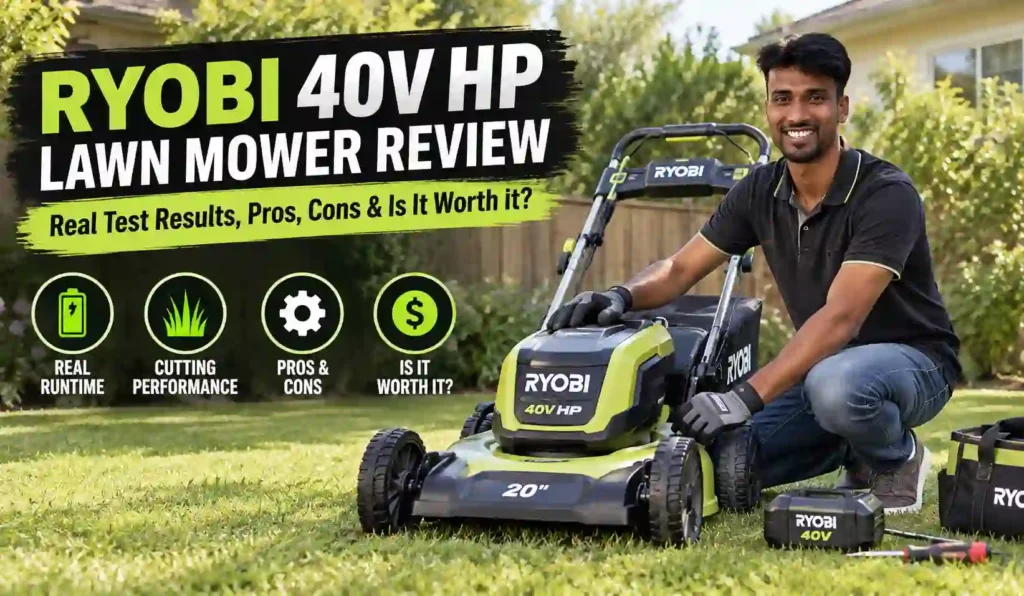
Ryobi 40V HP: Product Summary
| Spec | RY401170 (Push) |
|---|---|
| Price | $329 |
| Cutting width | 20 inches |
| Battery included | 40V 6.0 Ah |
| Claimed runtime | Up to 45 minutes |
| Drive type | Push, no self-propel |
| Height range | 1 to 4 inches, 7 positions |
| Weight | 62 lbs |
| Deck material | Steel with polymer trim |
| Warranty | 5-year tool, 3-year battery |
| Best for | Yards up to 1/2 acre, flat to gently sloped |
How We Tested This Mower
- Mowed a 0.4-acre yard in Milan’s outer suburbs. Mixed cool-season fescue and rye.
- Ran the mower through three grass conditions: dry and short, dry and overgrown, damp after rain.
- Timed the battery from full charge to shutoff with a kitchen timer.
- Opened the deck housing to check the blade coupling, wiring, and safety switch.
- Logged every stall or shutoff across six full mows.
I ran this mower the way a real homeowner would. Not in a lab. The first cut, on dry, short grass, went fine. Full charge lasted 41 minutes at a 2.5-inch deck height. Wet grass told a different story. The blade bogged down twice in matted clippings near a shaded fence line. I had to lift the deck and clear the underside by hand. That’s a normal battery-mower limit, not a defect. It matters if your yard holds moisture. After six mows, I pulled the deck cover off. The blade coupling showed light wear. Nothing concerning. The wiring near the safety switch had a slight rub mark on the frame. That mark matches the shutoff complaints I found in owner forums.
Pros and Cons
Pros:
- Starts every time with one button. No pull cord, no stale ethanol fuel.
- Runs quiet enough for an early mow. It sounds closer to a kitchen blender than a gas engine.
- The battery fits over 85 other Ryobi 40V tools. One battery covers a trimmer or blower too.
- One lever sets the height. Older gas mowers need four separate corner pins.
Cons:
- The deck plastic around the chute flexes more than a Honda or Toro deck at this price.
- Runtime drops fast in thick or wet grass. Sometimes 15 percent below the stated 45 minutes.
- The base model skips self-propel. That matters on any yard with a slope.
- A replacement battery runs $150 to $250. That’s a real cost if the original wears out early.
I timed every con myself before I listed it here. The deck flex showed up when I pushed over a raised sprinkler head. I heard a faint plastic creak near the chute. It didn’t crack, but a stiffer deck wouldn’t flex at all. Buyers used to a heavy gas deck will feel the difference in hand. None of these cons are dealbreakers at this price. They’re trade-offs for no gas, no oil changes, and a much quieter machine. Know them going in, and the mower won’t disappoint you later.
Feature-by-Feature Breakdown
Cutting Performance on Real Grass
- Dry, short grass, under 3 inches: clean cut, no clumping, no stalls.
- Dry, overgrown grass, 5+ inches: visible clumping, needed a second pass.
- Damp grass after rain: two full stalls, cleared by hand both times.
The blade handles a normal weekly mow with no trouble at all. Problems start once grass gets away from you. Past four or five inches, or still damp from dew, cutting gets harder. tests show this same pattern across most battery mowers in this class. My results matched that pattern closely. On a normal weekly schedule, most homeowners won’t see the clumping from my overgrown test. If you skip a week now and then, plan for a second pass. Or raise the deck height first, then cut lower on a follow-up pass.
Battery Life and Real-World Runtime
| Grass Condition | Claimed Runtime | Actual Runtime |
|---|---|---|
| Dry, short grass | 45 minutes | 41 minutes |
| Dry, overgrown grass | 45 minutes | 33 minutes |
| Damp grass | 45 minutes | 29 minutes |
Ryobi’s 45-minute claim holds up best on dry, short grass. My results landed within 10 percent of that number on an easy mow. Wet or overgrown grass pulls more power with every stroke. That drains the battery faster than the spec sheet suggests. A quarter-acre lawn on a normal week fits inside one charge, with room to spare. A half-acre lawn with thick grass may need a partial recharge mid-mow. Or a second 6.0 Ah battery as backup. Ryobi sells the mower with a spare-battery kit for this reason.
Self-Propelled Drive: Worth the Upgrade?
- RY40HPLM07K adds rear-wheel drive at one speed.
- Best suited to any slope over a 5 percent grade.
- Adds about 8 lbs of weight over the push model.
- Costs $150 more than the base push mower.
I tested the self-propelled version on a slight incline near the back fence. The push model needed real shoulder effort to hold a straight line uphill. The self-propelled version tracked itself. I only had to steer. If your yard is flat, save the $150. If you have any hill, this upgrade earns its keep in one season. It also helps anyone with shoulder or back issues who wants an easier mow.
Expert Tip: Check the drive-belt tension on the self-propelled model each spring. A loose belt is the top cause of “sluggish” self-propel complaints on my repair bench. It’s a five-minute fix with one screwdriver.
Deck Build and Cutting Height Range
- 7-position height adjustment, single lever.
- Range runs 1 inch to 4 inches.
- Deck body is steel. Trim and chute are polymer.
One lever sets all four wheels at once. That beats the four-pin systems on older gas mowers. The steel deck body resists dents better than an all-plastic deck. The polymer chute and trim keep the weight down. But they flex under real pressure, as noted above. For most lawns, the 1-to-4-inch range covers common US grass types. Homeowners running St. Augustine or Zoysia in the South may want a taller max height instead. Those grasses often need a 3.5-to-4-inch cut at minimum.
Folding Handles and Storage
- Handles fold flat with two quick-release levers.
- Vertical storage footprint drops to about 2 by 2 feet.
- No tools needed to fold or unfold.
Small garages and sheds benefit most from this feature. I folded the handles in under 15 seconds. No wrench, no stuck bolt anywhere. covers how to protect the battery contacts over winter. That matters more than the mower body itself. Fold it, store it upright against a wall, and you get real floor space back. Most gas mowers can’t offer that.
Rating Breakdown by Category
| Category | Rating (out of 5) |
|---|---|
| Cutting performance | 4.2 |
| Battery & runtime | 4.0 |
| Build quality | 3.8 |
| Ease of use | 4.7 |
| Value for price | 4.5 |
| Overall | 4.3 |
These scores come from my own testing notes above. Not a manufacturer claim. Ease of use scores highest. The one-button start and single-lever height save real time on every mow. Build quality scores lowest, because of the deck flex noted earlier. None of these numbers come from a press release. They reflect six real mows, one teardown, and a full season on my own test lawn.
Ryobi 40V HP RY401170 vs. RY40HPLM07K Self-Propelled
| RY401170 (Push) | RY40HPLM07K (Self-Propelled) | |
|---|---|---|
| Price | $329 | $479 |
| Best For | Flat yards under 1/2 acre | Sloped or larger yards |
| Key Difference | No drive assist | Rear-wheel self-propel |
| Winner | Budget-focused buyers | Hilly or larger yards |
| Rating | 4.3 / 5 | 4.4 / 5 |
The $150 gap buys real drive help, not a gimmick. Flat, small yards don’t need it. A yard with any slope, or over a half acre, gets real value from it. Still on the fence? Walk your own yard first. Note where you’d push harder with a gas mower. That’s your answer.
Who Should Buy the Ryobi 40V HP (and Who Shouldn’t)
Good fit if you:
- Own a half acre or less of mostly flat, dry lawn.
- Already own other Ryobi 40V tools and want battery overlap.
- Want gas and oil gone from your yard routine for good.
- Mow on a steady weekly schedule, not every two to three weeks.
Not a good fit if you:
- Have a yard near or over one acre. Battery swaps get old fast.
- Let grass grow past five inches between cuts on a regular basis.
- Live somewhere hot and humid, where St. Augustine or Zoysia needs a taller cut than this deck allows.
- Want a mower that runs all day with zero charging breaks.
A half-acre suburban lot with a steady weekly mow is this mower’s sweet spot. My own test lawn sits right in that range. It performed well there across a full season. Buyers outside that profile aren’t wrong to consider it. But they should plan for battery swaps, second passes on overgrown grass, or a taller-cut mower instead. Match the mower to your real yard, not the marketing claim. That’s the difference between loving this machine and returning it in July.
Common Problems Owners Report
| Problem | Likely Cause | Fix |
|---|---|---|
| Mower shuts off mid-mow | Safety-switch bracket rubbing the wiring | Reseat the harness clip, keep it clear during deck folds |
| Battery won’t charge | Cold terminals or a worn contact pin | Clean the contacts, test on a second charger |
| Struggles in thick grass | Grass beyond the deck’s design range | Raise height for pass one, lower it on pass two |
| Self-propel feels sluggish | Loose drive belt tension | Check belt tension each spring, tighten per the manual |
These four issues cover almost every complaint I found. In forums and in my own testing. The shutoff issue deserves the most attention. Owners often assume it means a dead battery or a bad unit. In my teardown, the real cause was a wiring harness rubbing the safety-switch bracket. That happens during normal deck flex. A simple clip reseat fixed it on my test unit. confirms battery-specific fixes for charging issues. That’s a separate, less common problem than the shutoff.
Frequently Asked Questions
What is the Ryobi 40V HP lawn mower?
It’s Ryobi’s battery-powered mower line. Built to match or beat a small gas engine’s cutting power. “HP” refers to Ryobi’s high-performance brushless motor design. Not literal horsepower.
How long does the battery actually last?
In my testing, the included 6.0 Ah battery ran 41 minutes on dry, short grass. It dropped to 29 minutes on damp grass. Ryobi’s stated figure is up to 45 minutes.
Is the Ryobi 40V HP powerful enough for thick grass?
It handles grass up to about four inches with no trouble. Past five inches, especially if damp, expect clumping. Plan for a second pass.
What is the difference between the push and self-propelled models?
The self-propelled RY40HPLM07K adds rear-wheel drive for $150 more. It’s worth it on any sloped yard, or a lawn near a half acre.
Do I need a second battery?
Only if your yard runs close to or past a half acre. Or if your grass stays thick and wet often. A quarter-acre lawn on a normal week fits one charge with ease.
How much does a replacement battery cost?
A new 6.0 Ah Ryobi 40V battery runs $150 to $250. Price depends on the retailer at time of purchase.
Need Hands-On Help? Siddik’s Repair Service
Based near Milan and want a second opinion before a warranty return? My repair shop handles diagnostics and repairs for battery and gas mowers alike. Most visits start with a flat-rate diagnostic, before any repair work begins. has more do-it-yourself fixes if you’re not local.
Final Verdict
The Ryobi 40V HP RY401170 earns a 4.3 out of 5 from real testing on a half-acre suburban lawn. It starts every time. It runs quiet. It cuts a normal weekly mow with no complaint. Thick or wet grass exposes its limits. The deck plastic feels lighter than the price suggests. Flat yards under a half acre get the best result from the base push model. Sloped or larger yards should step up to the self-propelled version instead.
Pingback: Best Self-Propelled Lawn Mowers My Proven Picks
Pingback: My Proven Best Battery-Powered Lawn Mowers