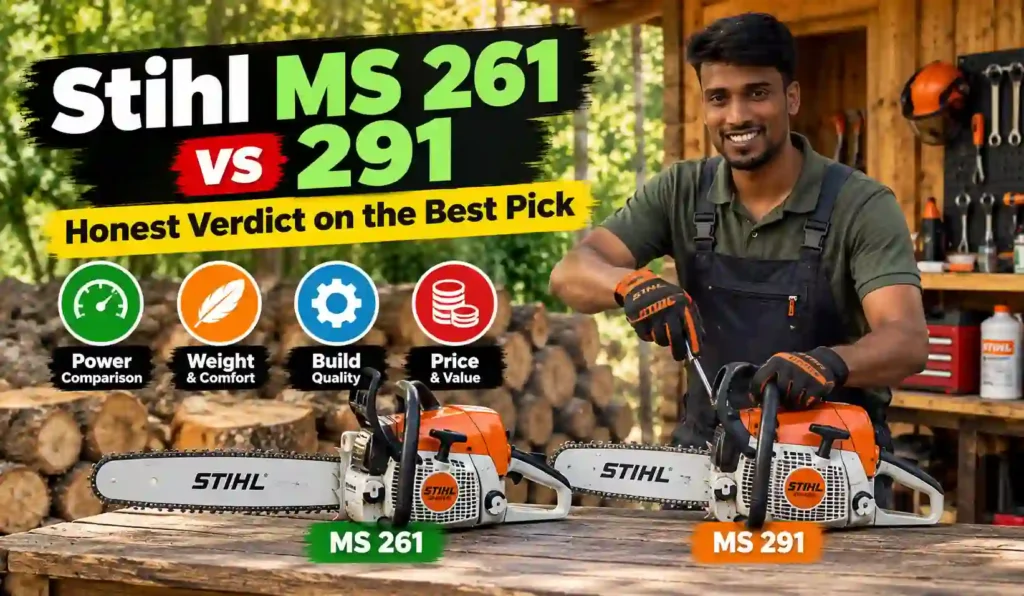
Stihl MS 261 vs 291 is the choice facing every buyer who wants a mid-size saw for firewood, storm cleanup, and yard work. Both saws cost under $800, both use the same chain pitch, and both look alike on a dealer wall. But they are built for different jobs.
This guide compares the two saws side by side, explains what each difference costs or saves you, and ends with a clear pick for each type of buyer.
Quick Answer
Buy the MS 261 if you cut often, run the saw for hours at a time, or want a saw that lasts decades. It is lighter, slightly more powerful, easier to start, and built with a magnesium crankcase. Buy the MS 291 if you cut a few cords of firewood a year, want to save about $110, and can live with extra weight and plainer features.

In short, the MS 261 is the better saw. The MS 291 is the better deal for light use.
What to Look for in the Stihl MS 261 vs 291 Decision
Six things decide this choice: engine power, weight, starting effort, build quality, upkeep, and price. Everything else on the spec sheet is a detail.

Here is how each factor plays out in plain terms:
- Power decides how fast the saw cuts through hardwood like oak or hickory.
- Weight decides how tired your arms feel after an hour of cutting.
- Starting effort decides whether you enjoy using the saw or dread pulling the cord.
- Build quality decides how many seasons the saw lasts before parts wear out.
- Upkeep decides how often you stop to clean, tighten, or tune.
- Price decides whether the saw is worth the gap over its rival.
A saw can win on paper and still lose in your hands. A few extra cc means little if the saw tires you out first. Keep your own yard and cutting habits in mind as you read.
The Saws You Are Actually Choosing Between
You are choosing between a professional-grade 50cc saw and a farm-grade 55cc saw. The names hide a wrinkle, though. In the US, “MS 261” can mean two different saws.
The base MS 261 uses a compensating carburetor. The MS 261 C-M adds M-Tronic, Stihl’s electronic engine management. A simple check helps: the C-M has a three-position switch. Many online comparisons mix these two up, so confirm the exact model before you pay.

| Model | Displacement | Power | Powerhead weight | Fuel system |
|---|---|---|---|---|
| MS 261 | 50.2 cc | 4.0 bhp (3.0 kW) | 10.8 lbs | Compensating carburetor |
| MS 261 C-M | 50.2 cc | 4.0 bhp (3.0 kW) | 10.8 lbs | M-Tronic electronic control |
| MS 291 | 55.5 cc | 3.76 bhp (2.8 kW) | 12.3 lbs | Standard carburetor |
Powerhead weight means the saw without bar, chain, or fuel. Treat the weight figures as the starting point, because a bar and chain add roughly 2.7 lbs.
The MS 291 also comes in a C-BE version. It adds easier starting and a tool-free chain tensioner, but it weighs more and costs more. This guide focuses on the standard MS 291, since that is the model most buyers compare.
Key Buying Factors for the Stihl MS 261 vs 291
Each factor below opens with the answer, then lists what each saw gives you and what it costs you.
Engine Power: Does the Bigger Engine Win?
No. The MS 261 makes more power from the smaller engine. It is rated at 4.0 bhp from 50.2 cc, while the MS 291 makes 3.76 bhp from 55.5 cc. That is about 6% more power from an engine about 10% smaller.
A dealer-shop bench test measured the MS 261 at roughly 14,450 rpm and the MS 291 at roughly 13,000 rpm with no bar and chain fitted. A higher rev ceiling means the chain moves faster through wood.
- MS 261 pros: More power, higher revs, faster cuts in hardwood.
- MS 261 cons: A smaller engine gives up some low-end grunt on very large logs.
- MS 291 pros: Larger displacement feels strong when pushing through big rounds.
- MS 291 cons: Lower power rating, and the extra size adds weight rather than speed.
For most cutting jobs, the MS 261 is quicker. Think of it like a small turbocharged car beating a larger, lazier engine.
Weight and Fatigue: How Much Does 1.5 Pounds Matter?
It matters a lot over a full day. The MS 261 powerhead weighs 10.8 lbs and the MS 291 weighs 12.3 lbs, a gap of about 14%. With a bar and chain fitted, a dealer-shop weigh-in put the MS 261 at 13.49 lbs and the MS 291 at 14.87 lbs.
You will hardly notice 1.4 lbs on a single branch. You will notice it after two hours of limbing a fallen oak, when your arms hold the saw away from your body.
- MS 261 pros: Lighter, better balanced, easier on shoulders and wrists.
- MS 261 cons: None worth naming on weight alone.
- MS 291 pros: Extra mass can feel steady when bucking logs on the ground.
- MS 291 cons: Heavier in the air, which tires you faster during overhead or one-handed work.
The power-to-weight ratio tells the same story. Stihl lists the MS 261 at 1.6 kg per kW and the MS 291 at 2.0 kg per kW. Lower is better.
Build Quality: Magnesium vs Plastic
The MS 261 is built tougher. Its crankcase is magnesium alloy, and it uses a metal sprocket cover and an anodized aluminum muffler. The MS 291 uses a polymer housing and a plastic sprocket cover.
Magnesium is light and stiff, and it handles heat and hard knocks well. Plastic is cheaper and lighter to make, but it flexes and cracks sooner under rough treatment.
- MS 261 pros: Stronger housing, metal cover, and better heat handling for long sessions.
- MS 261 cons: Metal parts cost more to replace if you damage them.
- MS 291 pros: Plastic parts are cheap to replace and do not dent.
- MS 291 cons: The housing and cover wear faster with rough use or hard drops.
Based on Siddik’s hands-on workshop experience, broken plastic covers and worn housings are a common reason mid-range saws come in for repair. Pro-grade housings tend to survive longer.
Starting Effort: Why the MS 261 Is Easier to Pull
The MS 261 starts with less effort. It has a decompression valve and an ElastoStart handle. The MS 291 has neither, so the pull feels stiffer and snappier.
A decompression valve lets some cylinder pressure escape while you pull. That makes the cord lighter for the first pulls. ElastoStart is a spring in the handle that absorbs the sharp jerk of the first compression stroke.
A dealer-shop bench test described the MS 291 pull as “chunky” and the MS 261 as smooth. If you start the saw ten times in an afternoon, you feel that difference.
- MS 261 pros: Easier cord pull, less snap on the wrist, friendlier for smaller or older users.
- MS 261 cons: More parts that could need service over the saw’s life.
- MS 291 pros: Simpler starting parts, fewer things to fail.
- MS 291 cons: Harder pull, which tires the arm and discourages quick start-and-stop work.
Fuel System: M-Tronic vs Carburetor
Here the choice splits three ways. The base MS 261 has a compensating carburetor, which adjusts fuel flow as the air filter clogs. The MS 261 C-M uses M-Tronic, which also adjusts for temperature, altitude, and fuel quality. The MS 291 uses a standard carburetor.
M-Tronic removes most tuning. You pull the cord, and the saw adjusts itself. That helps if you cut in changing weather, such as a cold Minnesota morning followed by a warm afternoon.
- MS 261 C-M pros: Self-adjusting, steady power, no carburetor tuning.
- MS 261 C-M cons: Costs more, and an electronic module is harder to fix at home.
- Base MS 261 pros: Self-compensating carburetor handles dirty filters well.
- Base MS 261 cons: Does not adjust for weather or fuel type like M-Tronic.
- MS 291 pros: A basic carburetor is easy for any small-engine shop to service.
- MS 291 cons: May need occasional tuning as temperature and altitude change.
Air Filter and Cleaning: How Often Will You Stop?
The MS 261 needs less filter attention. It uses a high-capacity HD2 filter with a snap-lock cover. The MS 291 uses a fleece filter behind a cover held by Torx screws, so you need a tool to open it.
Both saws use pre-separation, which throws heavy dust out before it reaches the filter. Even so, a fleece filter clogs faster in sawdust-heavy work like firewood cutting.
- MS 261 pros: Tool-free access, longer filter life, less downtime.
- MS 261 cons: HD2 filters cost more to replace.
- MS 291 pros: Fleece filters are cheap and easy to find.
- MS 291 cons: Needs a Torx wrench in the field, and clogs sooner in dusty work.
An HD2 filter is sold as an upgrade for the MS 291, so you can close part of this gap later.
Oiling and Bar Nuts: Small Features That Add Up
The MS 261 gives you more control. It has an adjustable oil pump, a 9.13 oz oil tank, and captive bar nuts that cannot fall off. The MS 291 has a preset oil flow, an 8.12 oz tank, and standard nuts you can lose in the grass.
Adjustable oil lets you give a long bar or dry hardwood more lubrication. That saves chains and bars from heat wear. Captive nuts save you from hunting for a dropped nut in leaf litter.
- MS 261 pros: Adjustable oiling, larger oil tank, nuts stay attached.
- MS 261 cons: Slightly more to learn for a first-time owner.
- MS 291 pros: Set-and-forget oiling is simple for beginners.
- MS 291 cons: Cannot adjust oil for long bars or dry wood, and loose nuts are easy to lose.
Bar Length and Chain Compatibility
Both saws take the same .325″ chain pitch, and the same guide bars fit both. The recommended bar range for each is 16 to 20 inches. An 18-inch bar is the sweet spot for both saws.
A 20-inch bar works but puts more load on a 50cc engine. Many owners on public forums settle on 16 or 18 inches for the MS 261 because the saw feels balanced and quick. A shorter bar also cuts faster and costs less to replace.
- MS 261 pros: Rim sprocket is cheaper to replace and lets you swap pitches.
- MS 261 cons: A 20-inch bar slows the engine more than a 16-inch bar does.
- MS 291 pros: Larger engine pulls a 20-inch bar a bit more comfortably.
- MS 291 cons: Drum sprocket is replaced as a whole unit, which costs more.
Choose Based on Your Needs
The right saw depends on how often you cut and how big the wood is. Use this section to match your situation to a pick.
Small Yard With Occasional Cutting
Pick the MS 291. If you trim storm damage twice a year, the $110 savings matters more than extra features. A 16-inch bar keeps the weight manageable.
Firewood Cutter Burning 3 to 5 Cords a Year
Pick the MS 261. You will pull the cord hundreds of times a season, and the lighter weight and easier start pay back every weekend. An 18-inch bar handles most split-ready rounds.
Budget Buyer With a Hard Ceiling
Pick the MS 291. It still uses a respected engine and the same chain as its rival. Add an HD2 filter later if the fleece filter bothers you.
First-Time Chainsaw Owner
Pick the MS 261 if you can stretch the budget, since easier starting and a smoother pull build confidence. Choose the MS 291 if cost is the main limit and a dealer can show you how to start it safely. Wear chaps, eye and ear protection, and gloves with either saw.
Heavy-Duty or Professional User
Pick the MS 261 C-M. M-Tronic keeps power steady through a full workday, and the magnesium body takes the abuse. The MS 291 is not built for daily commercial work.
Features You Actually Need
These features make a real difference, and the MS 261 has more of them:
- A decompression valve, because it makes starting easier every single time.
- An anti-vibration system, which both saws include, to reduce hand fatigue.
- A side-access chain tensioner, which both saws include, for quick adjustments.
- A chain brake with Quickstop, which both saws include, for kickback safety.
- A pre-separation air filter, which both saws include, to slow filter clogging.
Nice-to-have features include ElastoStart, an adjustable oil pump, captive bar nuts, and an HD2 filter. Each one saves a little time or a little hassle.
Features You Can Skip
You can skip M-Tronic if you cut in steady weather and enjoy simple saws. It adds cost, and a well-tuned carburetor works fine for most homeowners.
You can also skip the C-BE version of the MS 291 unless starting effort is a serious concern for you. It adds weight and price, and for a few dollars more you can often buy an MS 261 instead.
A 20-inch bar is another item many buyers do not need. A 16 or 18-inch bar is lighter, faster, and cheaper, and it handles most backyard trees.
Price and Value: Is the MS 261 Worth $110 More?
Yes, for anyone cutting more than a few hours a year. Current US dealer pricing puts the MS 261 at about $759.99 and the MS 291 at about $649.99, a gap of $110. Prices may vary by retailer and change over time.
The MS 261 C-M costs more again. As a MowerInsights estimate, expect roughly $100 to $200 above the base MS 261, depending on the bar length and dealer.
| Tier | Saw | Typical price | What you get |
|---|---|---|---|
| Budget | MS 291 | About $650 | 55cc engine, plastic housing, basic starting |
| Mid-range | MS 261 | About $760 | Magnesium body, easy starting, HD2 filter |
| Premium | MS 261 C-M | MowerInsights estimate: $860 to $960 | Everything above, plus M-Tronic |
Spread over ten years of use, the $110 gap is $11 a year. That buys a lighter saw, easier starting, and a stronger body. For light-duty owners who cut once a season, the MS 291 is still a fair deal.
Common Buying Mistakes
Most mistakes come from reading the name and not the spec sheet. Watch for these:
- Buying the wrong MS 261. The base model and C-M look similar. Check for the three-position switch if you want M-Tronic.
- Choosing a 20-inch bar by default. A longer bar slows a 50cc engine and adds weight. An 18-inch bar is better for most people.
- Assuming bigger cc means more power. The 50.2 cc MS 261 outpowers the 55.5 cc MS 291 on paper and in the shop.
- Ignoring weight. One and a half pounds sounds small until you cut for two hours.
- Skipping safety gear. A chainsaw is a risk for beginners. Chaps, a helmet with face screen, ear protection, and gloves are not optional.
- Overpaying for features you will not use. If you cut twice a year, the C-M may be more saw than you need.
Maintenance and Long-Term Cost
The MS 261 costs a bit more up front and a bit less over time. Its HD2 filter lasts longer, its captive nuts do not get lost, and its metal housing resists wear. The MS 291 costs less today but needs more small fixes as it ages.
Both saws need the same basic upkeep: fresh mixed fuel, a sharp chain, a clean air filter, and regular bar oil. Here is what to expect each year for a typical homeowner:
| Item | MS 261 | MS 291 |
|---|---|---|
| Air filter | Clean every few uses, replace as needed | Clean more often, cheap to replace |
| Sprocket | Replace the rim only | Replace the whole drum |
| Chain and bar | Same .325″ parts | Same .325″ parts |
| Spark plug | Easy access | Easy access |
| Carburetor tuning | Rarely (C-M never) | Occasionally |
Use fresh fuel mixed to Stihl’s recommended ratio. Old gas is the top reason a saw refuses to start after winter storage. In Northern zones, drain the tank before storing the saw for the cold months.
Recommended Specifications
Match the saw and bar to your wood size and how long you cut. This table gives a simple starting point.
| User type | Best saw | Bar length | Why |
|---|---|---|---|
| Light yard work | MS 291 | 16 in | Low cost, easy to handle |
| Firewood, weekend use | MS 261 | 18 in | Lighter, quicker cutting |
| Firewood, 5+ cords a year | MS 261 C-M | 18 in | Steady power, less tuning |
| Storm cleanup, big limbs | MS 261 | 18 in | Balance and speed on mixed wood |
| Daily professional work | MS 261 C-M | 16 to 18 in | Durability and consistent power |
Frequently Asked Questions
Which is better, the Stihl MS 261 or the MS 291?
The MS 261 is the better saw. It has more power, lower weight, easier starting, a magnesium body, and a better air filter. The MS 291 is the better choice only if budget matters more than features.
Is the Stihl MS 291 a professional saw?
No. Stihl positions the MS 291 for farm and homeowner use, and the MS 261 for professional work. The MS 291 can handle regular firewood cutting, but it is not built for all-day commercial use.
Does the MS 261 have more power than the MS 291?
Yes. The MS 261 is rated at 4.0 bhp and the MS 291 at 3.76 bhp, even though the MS 261 has a smaller 50.2 cc engine. The MS 261 also revs higher in shop tests.
What is the difference between the MS 261 and MS 261 C-M?
The C-M adds M-Tronic, an electronic system that adjusts the fuel mix for temperature, altitude, and fuel quality. The base MS 261 uses a compensating carburetor. Both share the same engine size and power rating.
Can I use the same chain and bar on both saws?
Yes. Both saws use .325″ pitch chain, and the same guide bars fit both models. Match the bar length to your saw and check the drive link count when you buy a replacement chain.
What bar length is best for the MS 261 and MS 291?
An 18-inch bar is the best all-round choice. A 16-inch bar is lighter and faster for limbing and small trees. A 20-inch bar works but puts extra load on the engine.
Is the extra $110 for the MS 261 worth it?
For most people who cut regularly, yes. The savings on the MS 291 are real, but the MS 261 saves effort and repair time. Light-duty owners who cut a few times a year can save the money.
Is the MS 291 hard to start?
It can feel stiffer than the MS 261. The MS 291 has no decompression valve and no ElastoStart handle. A fresh plug, clean filter, and fresh fuel help a lot.
Final Buying Advice
Buy the MS 261 for regular firewood, storm work, and any job over an hour. Choose the C-M version if you cut in changing weather or want zero carburetor tuning. Buy the MS 291 if you cut a few times a year and want the lowest price from a trusted brand. Whichever saw you pick, add an 18-inch bar, keep the chain sharp, and wear full safety gear.
Why Trust This Guide
Siddik Kazi repairs and services outdoor power equipment in his own workshop, so the notes on wear, filters, and starting come from tools that arrive on his bench. That includes two-stroke engines like the ones in these saws.
The specs and weights come from the manufacturer’s published figures, the dealer prices come from current US listings, and the loaded weights and RPM readings come from an independent dealer-shop bench test. The ratings and picks are MowerInsights’ own editorial judgment.