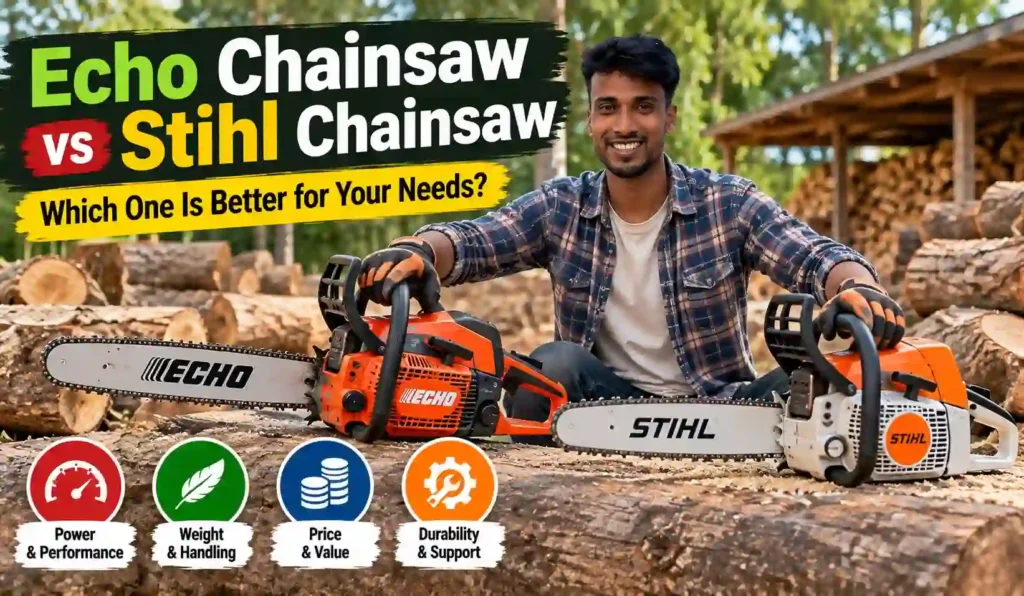
Echo chainsaw vs Stihl chainsaw is the brand question I hear most from homeowners, and the right answer depends on how often you cut. Both brands build good saws. They aim at different buyers.
Echo leans toward lighter, easier-starting, lower-priced saws for yard and firewood work. Stihl leans toward long engine life, a strong dealer network, and saws that hold their value. This guide compares both brands so you can pick the saw that fits your yard, your woodpile, or your work crew.
Quick Answer
Buy an Echo if you cut a few hours a month, want a lighter saw, and want to spend less. Buy a Stihl if you cut every week, want dealer support close by, or plan to keep the saw for 10 years or more.
For most homeowners with a small to mid-size yard, the Echo chainsaw vs Stihl chainsaw choice is close, and either brand will do the job. The gap shows up in daily use and in long-term cost. Pros who cut all day usually pick Stihl.
What to Look for Before Buying: Echo Chainsaw vs Stihl Chainsaw
Six things decide this purchase: engine size, weight, how often you cut, price, parts and dealer access, and warranty. Match those to your own work, not to a brand name.
Here is how I weigh them with customers:
- Engine size (measured in cubic centimeters, or cc) tells you how much wood the saw can handle.
- Weight decides how tired your arms are after an hour.
- Cutting frequency decides whether durability or price matters more.
- Parts access decides how long a repair takes.
- Warranty tells you how much risk the maker takes on.
Brand matters less than picking the right size. A 40cc saw from either brand will struggle on a 24-inch oak. A 60cc saw from either brand is too heavy for trimming limbs all day.
Echo Chainsaw vs Stihl Chainsaw: Types and Options
Both brands sell gas saws in three size groups, plus battery saws. The table below shows a close match in each group, with typical prices (MowerInsights estimates, rounded).
| Type | Echo example | Stihl example | Best for |
|---|---|---|---|
| Small gas (30-35cc) | CS-310, about $250 | MS 170, about $250 | Light limbing, yard cleanup |
| Mid gas (40-50cc) | CS-400 and CS-501P, about $340 to $450 | MS 250 and MS 271, about $430 to $520 | Firewood, storm cleanup |
| Large gas (55cc and up) | CS-590 Timber Wolf, about $580 | MS 391, about $650 | Big trees, daily cutting |
| Battery | Echo 56-volt saws, $250 to $450 | MSA 140 C-B, $300 to $400 | Quiet, light jobs near homes |
Stihl’s MS 170 is a 30.1cc saw that weighs about 8.6 lb without bar and chain. The MS 271 and MS 291 are 50.2cc saws at about 12.3 lb. These are Stihl’s own listed figures.
Gas saws give the most power and run until the tank is empty. Battery saws start at the push of a button and make little noise, but they cut less wood per charge.
Buying Factors That Matter Most
Seven factors separate these two brands in real use. Each one below shows what each brand does well and where it falls short.
Power and Cutting Speed
Stihl saws in the same cc class usually cut a little faster in hard wood, and Echo’s larger saws are competitive. Power depends on engine size first and brand second.
- Echo pro: the 59.8cc CS-590 Timber Wolf is a strong saw for its weight. Some owners find it lighter than a Stihl in the same size class.
- Echo con: the small homeowner saws feel underpowered with a long bar.
- Stihl pro: the MS 250 and MS 271 hold their speed well in oak and hickory.
- Stihl con: you pay more per cc, and the lightest models are small engines.
Weight and Handling
Echo saws tend to be lighter for their size, which helps if you cut for short sessions. Stihl saws can feel heavier, but they balance well in the hand.
For example, Stihl’s 59cc MS 311 powerhead weighs about 14.1 lb, while Echo’s 59.8cc CS-590 weighs about 12 lb (approximate). Two pounds matters on the tenth log of the day.
- Echo pro: lighter saw, less arm fatigue on long limbing jobs.
- Echo con: lighter builds can mean more vibration at full throttle on some models.
- Stihl pro: good anti-vibration design on mid and pro models.
- Stihl con: heavier overhead work.
Starting and Ease of Use
Echo’s starter system is built to cut pull effort, and its models are easy for new owners to fire up. Stihl’s electronic fuel systems start well when the saw is tuned, but they are less forgiving of old fuel.
- Echo pro: easy pull, simple controls for first-time buyers.
- Echo con: carburetors still need clean, fresh fuel to run right.
- Stihl pro: some models start with low pull effort and run smooth once warm.
- Stihl con: more settings and parts, so more that can go wrong if fuel sits.
Durability and Engine Life
Stihl is the better pick for daily cutting. In my repair work, mid and pro Stihl saws take heavy hours well, and Echo’s pro saws are solid too. The cheaper Echo homeowner saws are built for lighter use.
- Stihl pro: designed for daily trade use, and holds up through hard seasons.
- Stihl con: not immune to fuel problems or bar and chain wear.
- Echo pro: good value for a few hours a week.
- Echo con: lower-end saws are not built for daily cutting.
Price and Resale Value
Echo costs less to buy. Stihl costs more but often sells for more when you resell it. For one-time yard jobs, the Echo saves money up front. For a saw you will keep and sell later, Stihl closes the gap.
- Echo pro: lower buy price in most size classes.
- Echo con: lower resale value.
- Stihl pro: strong used-market demand.
- Stihl con: higher price, and accessories and oil cost more.
Parts, Dealers, and Repairs
Stihl is sold mostly through independent dealers, so help and parts are local. Echo is sold through dealers and home centers, and parts are easy to find online.
- Stihl pro: a dealer can service the saw in person.
- Stihl con: fewer places to buy, and prices are firm.
- Echo pro: wide availability and many online parts sources.
- Echo con: some dealers are far apart in rural areas.
Warranty and Support
Echo and Stihl both back their saws with a written warranty, and terms differ by model and by home or commercial use. Echo is known for a long warranty on consumer saws, and Stihl is typically shorter on homeowner models. Check the current manual for your exact saw.
- Echo pro: a long consumer warranty on many saws.
- Echo con: commercial coverage is shorter than home coverage.
- Stihl pro: dealer handles the claim in person.
- Stihl con: shorter home warranty on some models.
Choose Based on Your Needs: Echo Chainsaw vs Stihl Chainsaw
Pick by use, not by logo. The right saw in this Echo chainsaw vs Stihl chainsaw match-up changes with yard size and work type.
- Small yard, a few limbs a year: Echo CS-310 or Stihl MS 170. The Echo usually costs less.
- Large yard, storm cleanup, 2 to 4 cords of firewood a year: Stihl MS 250 or MS 271, or Echo CS-501P. This is the closest matchup in the whole lineup.
- Heavy firewood or farm use, 10+ cords a year: Stihl MS 391 or Echo CS-590. Stihl holds up better to daily cutting.
- Budget buyers: Echo. The saw costs less and the warranty is strong.
- Beginners: Echo’s easy-pull saws are friendly, and Stihl’s dealer help is a big plus if you want hands-on setup.
- Heavy-duty or trade users: Stihl. Daily hours and dealer service matter more than the price.
Features You Actually Need
These features are worth paying for on any saw:
- A chain brake that stops the chain fast on kickback. Both brands include one.
- A bar length that matches your wood. Pick one 2 inches longer than the biggest log you cut.
- Anti-vibration handles, especially on saws over 45cc.
- A tool-less or easy chain tension system.
- An air filter that is simple to clean.
Nice to have: a side-access chain tensioner, a clear fuel window, and a primer bulb.
Features You Can Skip
Skip these unless your work really needs them:
- A 20-inch or longer bar on a saw under 45cc. It slows the chain and strains the engine.
- Pro-grade models if you cut less than a few hours a month.
- Heated handles. They are for pros in cold weather, and they raise the price.
- Matching branded accessories when generic ones work. Keep the bar oil and fuel mix right instead.
Price and Value
Budget buyers pay about $250 to $350 for a good Echo or Stihl small saw, mid-range buyers pay $340 to $520, and pro buyers pay $580 and up. These are MowerInsights estimates. Prices may vary by retailer and change over time.
| Tier | Price range | What you get |
|---|---|---|
| Budget | $250 to $350 | 30-40cc, light use |
| Mid-range | $340 to $520 | 40-50cc, weekly use |
| Premium | $580 and up | 55cc and up, daily use |
Value comes down to hours of use. If you cut 20 hours a year, an Echo wins on cost. If you cut 200 hours a year, Stihl’s longer engine life and resale price make up the gap.
Common Buying Mistakes
These are the mistakes I see most often when buyers compare an Echo chainsaw vs Stihl chainsaw:
- Buying too big. A heavy 60cc saw is tiring for trimming.
- Buying too small. A 30cc saw with an 18-inch bar will bog down.
- Choosing by brand loyalty, not by weight and engine size.
- Ignoring local dealer help. A great saw is no help if you cannot get it serviced.
- Skipping safety gear: chaps, helmet, eye and ear protection, and gloves.
- Using old fuel. Stale gas harms carburetors on both brands.
Maintenance and Long-Term Cost
Both brands cost about the same to keep running if you maintain them. Plan on $40 to $80 a year for chain sharpening, bar oil, fuel mix, spark plug, and air filter.
Maintenance tasks for either saw:
- Sharpen the chain every few tanks, or when it makes dust instead of chips.
- Clean the air filter after each use in dusty work.
- Mix fuel fresh, at the ratio in your manual (most saws use 50:1).
- Drain the fuel tank before storing for more than a month.
- Check the bar groove and flip the bar to even out wear.
Stihl parts cost a bit more and come through dealers. Echo parts are cheaper and easy to buy online. Over 5 years, the total cost is close for light users, and Stihl pulls ahead for heavy users who resell.
Recommended Specifications
Match engine size and bar length to the wood you cut. These are MowerInsights recommendations.
| User type | Engine size | Bar length | Example saws |
|---|---|---|---|
| Light yard use | 30-35cc | 12-16 in | Echo CS-310, Stihl MS 170 |
| Firewood and storms | 40-50cc | 16-18 in | Echo CS-501P, Stihl MS 250 or MS 271 |
| Heavy or daily use | 55cc and up | 18-24 in | Echo CS-590, Stihl MS 391 |
Frequently Asked Questions
Is Echo better than Stihl?
Echo is better for budget buyers and light users. Stihl is better for daily use and dealer support. Neither brand wins every category.
Does Stihl make Echo chainsaws?
No. Stihl and Echo are separate companies. Stihl is German and builds many US saws in Virginia Beach, Virginia. Echo is owned by Yamabiko, a Japanese company, and builds many North American saws in Lake Zurich, Illinois.
Which lasts longer, an Echo chainsaw or a Stihl chainsaw?
For daily use, Stihl usually lasts longer. For weekend use, both can last many years with fresh fuel and regular care.
Which is lighter, an Echo chainsaw vs Stihl chainsaw in the same engine size?
Echo tends to be lighter in the same cc class. The difference is about 1 to 2 lb on larger saws. That adds up over a long day.
Are Echo and Stihl chains and bars interchangeable?
Chains are interchangeable if the pitch, gauge, and number of drive links match. Bars are brand-specific because the mounting holes differ. Check the numbers stamped on your bar before buying.
Which brand is best for a beginner?
Echo is easier to start and cheaper, so it suits most beginners. A Stihl is a better pick if a nearby dealer can walk you through setup and service.
Are battery saws worth it?
Battery saws from either brand are good for light work near homes. They are quiet and start with a button, but they are not for heavy firewood.
Final Buying Advice
In the Echo chainsaw vs Stihl chainsaw choice, buy Echo for light to mid use and tight budgets. Buy Stihl for weekly or daily cutting, dealer service, and resale value. If you are unsure, pick the size first, then check which brand has a dealer near you.
Why Trust This Guide
Siddik Kazi runs a lawn mower and small-engine repair shop in Italy, so the durability and maintenance notes come from real workshop work. This guide combines hands-on repair experience, manufacturer spec sheets, and a review of existing coverage. Prices and weights are rounded estimates.