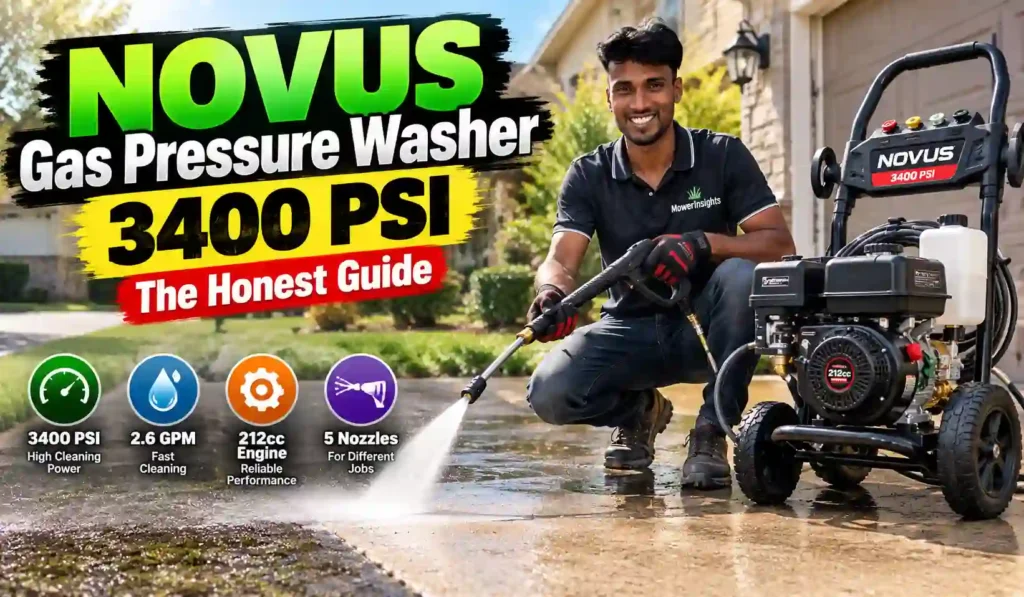
The NOVUS gas pressure washer 3400 psi is a 212cc engine-driven cleaner that pushes out up to 3,400 pounds per square inch of water pressure at 2.6 gallons per minute. Most people start looking at it when a garden hose and a scrub brush stop working on a stained driveway, a gray fence, or a grimy deck. This guide explains what the machine is, how it works, what it can and cannot clean, and what to check before you spend money on one.
Quick Answer
Model NV3400PWG is a mid-range, homeowner-grade machine. It has a four-stroke engine, an axial cam pump, a 30 ft hose, five quick-connect nozzles, and a 0.53-gallon soap tank. The maker lists it at $399.99 with a 2-year limited warranty for home use. Pressure is fixed, so nozzle choice and spray distance set the force.
What Is the NOVUS Gas Pressure Washer 3400 PSI?
The NOVUS gas pressure washer 3400 psi is a portable, gasoline-powered pressure washer sold under model number NV3400PWG by Novus Performance Products, a company based in Jackson, Wisconsin. It is built for home and light property cleaning. The maker lists decks, driveways, fences, siding, cars, and patio furniture as typical jobs.
A pressure washer takes ordinary water from a garden hose and raises its pressure with a pump. PSI (pounds per square inch) measures how hard the water pushes on each square inch of a surface. GPM (gallons per minute) measures how much water comes out. Both numbers matter, and the next section shows how they combine.
The 3,400 PSI figure is a maximum rating. The nozzle you pick decides how much of that force lands on a small spot. A narrow nozzle concentrates it, and a wide one spreads it out.
For context, one major tool brand’s own FAQ places 2,800 to 4,000 PSI in the heavy-duty range, suited to jobs like cleaning concrete. That puts this machine near the top of what most homeowners need. It is strong enough for stubborn grime on hard surfaces, and strong enough to damage soft ones if used carelessly.
How Does the NOVUS Gas Pressure Washer 3400 PSI Work?
The engine spins a pump, the pump squeezes incoming garden-hose water to very high pressure, and that water travels through the hose and wand to a nozzle. The nozzle shapes the spray. Here is the path water takes, step by step.
- Water enters the pump. You connect a garden hose to the inlet. The maker lists a minimum inlet pressure of 40 PSI and a maximum inlet water temperature of 104°F.
- The engine turns the pump. The 212cc engine is connected straight to the pump, which retailers describe as a direct drive.
- The axial cam pump compresses the water. Inside, several small pistons sit around the shaft. An angled plate on the shaft pushes them in and out in turn, which forces water out at high pressure.
- Water moves through the hose. A 30 ft high-pressure hose carries it to the spray gun and a 21-inch wand.
- The nozzle shapes the spray. A smaller opening or narrower angle puts more force on a smaller area.
- Detergent is drawn in when you want it. The built-in soap tank feeds a siphon hose. The maker says to use the black soap nozzle to apply detergent, then switch nozzles to rinse.
- Safety systems watch the engine and pump. The engine shuts off automatically when oil runs low, and retailer spec tables list a thermal protector for the pump.
PSI, GPM, and Cleaning Units
Cleaning units (CU) are PSI multiplied by GPM, and many pressure washer makers use them to compare machines. The formula gives one number that reflects both force and water volume.
For this model, 3,400 PSI x 2.6 GPM equals 8,840 CU. Some retailer listings show 2.5 GPM instead, which would give 8,500 CU. The manufacturer’s own product page states 2.6 GPM, so this guide uses that figure.
Why does flow matter? Force loosens dirt, but water volume carries it away. Two machines with the same PSI can clean at different speeds if one has a higher GPM.
Main Components of the NOVUS Gas Pressure Washer 3400 PSI
The machine has six parts that matter to a buyer: the engine, the pump, the hose and gun, the nozzles, the soap tank, and the frame. Each is covered below with the numbers the maker publishes.
Engine
The engine is a 212cc, four-stroke, air-cooled, overhead valve (OHV) design with a horizontal shaft and a recoil (pull-cord) start. The manufacturer lists the engine model as W210F. It has a 0.79-gallon fuel tank, which the spec sheet rounds to 0.8 gallons (3 liters).
Fuel must be fresh regular unleaded gasoline with an octane rating of at least 87 and no more than 10% ethanol. Oil is SAE 10W-30, and the engine holds 20.3 fluid ounces (0.6 liter). A bottle of engine oil comes in the box. The listed spark plug is an NGK BPR7ES or equivalent (F7RTC Torch), with a gap of 0.030 inch (0.7 to 0.8 mm).
Pump
The pump is an axial cam type, and the maker calls it maintenance-free. In plain words, it is a sealed unit with no routine oil changes in the maker’s description. In general, axial cam pumps are replaced as a complete unit rather than rebuilt when they wear out.
Hose, Gun, and Wand
The package includes a trigger handle, a 21-inch wand, and a 30 ft PVC hose with an abrasion-resistant outer layer. A detergent siphon hose and an operator’s manual come with it. The maker says assembly takes under 5 minutes: you attach the handle, the gun holder, and the hose hook.
Nozzles
Five quick-connect nozzles snap onto the wand. The maker describes their uses like this, and the notes column adds a caution from general pressure washing practice.
| Nozzle | Color | Maker’s Description | Caution |
|---|---|---|---|
| 0° | Red | Maximum power for tough stains | Can etch concrete and cut wood, siding, and tires |
| 15° | Yellow | Heavy cleaning on brick, decks, dirt | Can gouge soft wood if held too close |
| 25° | Green | Patios, fences, lawn gear, boats | General-purpose starting point for hard surfaces |
| 40° | White | Gentle rinse for cars, siding, furniture | Safest for delicate surfaces |
| Soap | Black | Applies detergent before rinsing | Low pressure, cleans nothing by force |
Soap Tank
The onboard tank holds 0.53 gallon (2 liters). The maker says to use only detergents made for pressure washers. Household cleaners and bleach mixes can damage seals and are not approved for the tank.
Frame and Wheels
The frame is steel with a powder-coated finish. The 10-inch flat-free wheels cannot go flat, and they roll over gravel, grass, and concrete. The unit weighs 62 lb (28 kg) and measures about 32.7 inches long, 19.3 inches wide, and 37.1 inches high. Shipping weight is higher, at 72 lb.
Specs and Defining Characteristics
The table below puts the NOVUS gas pressure washer 3400 psi numbers in one place, taken from the manufacturer’s published specifications.
| Spec | Value |
|---|---|
| Model | NV3400PWG |
| Max pressure | 3,400 PSI |
| Max flow | 2.6 GPM (9.8 L/min) |
| Cleaning units | 8,840 CU |
| Engine | 212cc, 4-stroke, air-cooled OHV |
| Start type | Recoil |
| Pump | Axial cam, direct drive |
| Fuel tank | 0.79 gal (about 3 L) |
| Oil | SAE 10W-30, 20.3 fl oz |
| Hose length | 30 ft |
| Wand length | 21 in |
| Soap tank | 0.53 gal (2 L) |
| Nozzles | 0°, 15°, 25°, 40°, soap |
| Max inlet water temperature | 104°F |
| Weight | 62 lb |
| Warranty | 2-year limited (home use) |
Beyond the numbers, five traits define this machine:
- The pressure is not adjustable, according to a retailer spec table, so nozzles do all the control work.
- The pump is a direct-drive axial cam unit, which keeps the design simple and the price low.
- Low-oil shutdown stops the engine before damage from running without oil.
- The soap tank is built in, so you do not need a separate bottle or foam attachment.
- The maker offers free technical support by phone at 800-409-7802 and by email.
Benefits and Advantages of the NOVUS Gas Pressure Washer 3400 PSI
The main benefit is high cleaning power without needing an outlet. The sections below cover what that means in daily use.
Strong Enough for Hard, Stained Surfaces
At 8,840 CU, this machine handles oil spots, moss, and ground-in grime on concrete and brick faster than a typical electric unit. Electric models usually top out at lower PSI, and the highest gas models reach higher PSI and GPM than most electric ones. That is the main reason people choose gas.
Works Anywhere a Hose Reaches
A gas engine needs no power cord. You can wash a fence at the back of a lot or a boat trailer in a gravel drive with only a spigot and a gas can.
Ready to Use Out of the Box
Nozzles, gun, wand, hose, and engine oil come in the box. The soap tank saves a purchase and a step. That makes it a practical first gas washer for someone who has only used electric.
Easy to Move
The steel frame, trolley-style handle, and 10-inch flat-free wheels make it manageable at 62 lb on level ground. Flat-free wheels also remove one small maintenance chore.
Built-In Engine Protection
Low-oil shutdown matters because many small-engine failures start with low oil. The machine stops itself instead of running until the engine locks up.
Price Within Reach
The maker lists the machine at $399.99. Street prices across major US retailers run from about $300 to $350. Prices may vary by retailer and change over time. That places it below most triplex-pump models, which usually cost more.
Limitations and Disadvantages of the NOVUS Gas Pressure Washer 3400 PSI
This machine has real limits, and a few of them can change a buying decision. Here they are plainly.
- No pressure adjustment. You cannot turn a dial down for a delicate job. A 0° nozzle on the wrong surface will damage it in seconds.
- Not CARB compliant. One major retailer’s spec table lists it as not compliant with California Air Resources Board (CARB) rules. California and some other states restrict sales of non-compliant small engines, so check your state before ordering.
- Heavy and manual. At 62 lb with a recoil start, it is harder to lift into a truck bed or carry up steps than an electric washer.
- Gas upkeep. You need fresh fuel, oil checks, and a spark plug and air filter now and then. Electric washers need none of that.
- Noise and exhaust. Gas engines are loud and give off carbon monoxide, so you must use it outdoors and wear ear protection.
- Not for daily commercial work. The maker’s warranty covers 90 days, not 2 years, for any use other than ordinary home use.
- Short owner track record. One large retailer listing shows 14 ratings averaging 4.1 out of 5. Three of those are 1-star, and several of the written reviews carry an incentivized-review label. That is too small a sample to prove long-term reliability.
- Unpublished figures. The maker does not list a noise level or a runtime per tank.
Factors to Consider Before You Buy
Before buying, check five things: what you will clean, your water supply, your state’s rules, your willingness to maintain a gas engine, and the total cost. Each one can rule this machine in or out.
Surfaces You Plan to Clean
Concrete, brick, and stone take 3,400 PSI well with a 25° or 15° nozzle. Wood decks, vinyl siding, painted wood, cars, and window screens need the 40° nozzle and more distance. If most of your work is delicate, a machine with adjustable pressure may suit you better.
Water Supply
The pump uses 2.6 GPM, so your spigot and hose must supply at least that much. Here is a simple bucket test: time how long a 5-gallon bucket takes to fill. If it fills in under 2 minutes, the supply matches the pump rate.
The maker’s spec sheet also lists a minimum supply flow of 6.3 GPM, which is higher than the pump’s own flow. That number looks odd, so check the operator’s manual for the correct figure. For that higher figure, the bucket should fill in under 50 seconds.
Where You Live
If you live in California, confirm that the machine can legally ship and be used there. Cold climates add another factor: water left in a pump can freeze and crack it, so you need an indoor spot for winter storage.
Upkeep and Storage
The warranty holder must do the maintenance the manual requires. Wear items such as the spark plug and air filter are not covered. Fuel left in the tank through a long storage period can gum up the carburetor, so add stabilizer or run the tank dry first.
Price and Warranty
The list price is $399.99, and sale prices at major US retailers run from about $300 to $350. Prices may vary by retailer and change over time.
The 2-year limited warranty covers defects in materials and workmanship for ordinary home use. It starts on the purchase date and applies only to the original owner. For any other use, coverage drops to 90 days. Warranty parts ship by standard method at no charge, but you pay to transport the machine.
Common Problems and Misconceptions
Most trouble with machines like this one comes from fuel, water supply, and trapped air, not from the pump itself. The table covers the usual symptoms, and the myths below it clear up what buyers often get wrong.
Common Problems
| Problem | Likely Cause | What to Do |
|---|---|---|
| Engine will not start | Old fuel, choke in the wrong position, low oil triggering shutdown, fouled spark plug | Check oil on level ground, use fresh fuel, set the choke, inspect the plug |
| Engine runs, pressure is weak | Clogged nozzle, air in the pump, weak water supply, kinked hose | Clear the nozzle, run water through the gun first, run the bucket test, straighten the hose |
| Pulsing spray | Air in the system or low supply | Shut off the engine and purge the hose with water only |
| No soap flow | Wrong nozzle, empty tank, blocked siphon hose | Fit the black soap nozzle, refill, clear the hose |
| Leak at a connection | Worn O-ring or loose fitting | Replace the O-ring and hand-tighten |
Common Misconceptions
- “3,400 PSI hits the surface at 3,400 PSI.” That figure is the maximum the pump can build. A wide nozzle spreads the force, which lowers the impact on any one spot.
- “More PSI always cleans faster.” Flow matters too. Cleaning units, not PSI alone, give the fairer comparison.
- “The soap tank cleans with detergent at full pressure.” Detergent flows only with the black soap nozzle at low pressure. High pressure through the other nozzles does not draw soap.
- “Maintenance-free means no care.” The pump has no routine oil change in the maker’s description. It still needs clean water, a steady supply, and freeze protection, and the engine needs regular care.
- “I can run it for a minute without squeezing the trigger.” Water trapped in the pump heats up. The thermal protector helps, but you should not rely on it.
- “Any fuel will do.” The engine allows up to 10% ethanol. Higher blends are not approved.
Practical Tips for Safe, Effective Use
Run the machine outdoors, wear eye and ear protection, and start with the widest nozzle. These habits prevent most injuries and most surface damage. The tips below follow the order of a normal job.
Before You Start
- Check engine oil and fuel on level ground.
- Connect the hose and wand, then turn the water on.
- Squeeze the trigger until the stream is steady. This pushes air out of the pump.
- Never run gas-powered equipment in a garage or other closed space. U.S. consumer safety guidance warns that engine exhaust carries carbon monoxide, which can kill.
While You Spray
- Start with the 40° white nozzle and a fair distance from the surface. Move closer only if the dirt does not lift.
- Keep the wand moving in overlapping strokes. Holding still in one spot can scar concrete or wood.
- Work top to bottom on siding and fences so dirty water does not run over finished areas.
- Test a hidden spot first on any painted or soft surface.
- Never point the nozzle at people, pets, or your own feet. Medical and safety guidance warns that a high-pressure jet can inject water and debris under the skin, and that this is an emergency even if the wound looks small.
- Use only detergent made for pressure washers in the soap tank.
After You Finish
- Turn off the engine, shut off the water, and squeeze the trigger to release trapped pressure.
- Let the engine cool before moving or storing it.
- Drain water from the hose and wand.
- For storage longer than a month, add fuel stabilizer or run the tank dry.
- In freezing climates, store the machine indoors.
Comparison With Other NOVUS Models and Pump Types
Within the maker’s own line, the NOVUS gas pressure washer 3400 psi sits between a 3,100 PSI model and a 3,500 PSI model that share the same 212cc engine. The differences are small, so price often decides.
| Model | Max Pressure | Max Flow | Engine | Cleaning Units |
|---|---|---|---|---|
| NV3100PWG | 3,100 PSI | 2.5 GPM | 212cc | 7,750 |
| NV3400PWG | 3,400 PSI | 2.6 GPM | 212cc | 8,840 |
| NV3500PWG | 3,500 PSI | 2.6 GPM | 212cc | 9,100 |
The line also includes an NV4400PWG with a 420cc engine and 4,400 PSI, built for heavier work.
The pump type matters as much as the PSI number. In general industry terms, the two common choices compare like this.
| Feature | Axial Cam Pump (this model) | Triplex Pump (found on pricier models) |
|---|---|---|
| Typical price | Lower | Higher |
| Service life | Shorter, built for home use | Longer, built for frequent use |
| Repair approach | Usually replaced as a unit | Often rebuildable |
| Best fit | Weekend and seasonal jobs | Frequent or commercial jobs |
Some models in this PSI class also add adjustable pressure, a longer hose, or a hose reel. The NOVUS machine leaves those out, which is part of how it holds its price.
FAQs
What can the NOVUS gas pressure washer 3400 psi clean?
It cleans driveways, patios, decks, fences, siding, cars, and patio furniture, according to the maker. Hard surfaces like concrete and brick take the higher-pressure nozzles. Wood, vinyl, and vehicles need the 40° nozzle and more distance.
Is the NOVUS gas pressure washer 3400 psi rated at 2.5 or 2.6 GPM?
The maker’s own product page states 2.6 GPM. Some retailer titles say 2.5 GPM, so the listings do not all match. Use 2.6 GPM as the manufacturer’s figure and confirm in the operator’s manual.
Can I adjust the pressure on the NOVUS gas pressure washer 3400 psi?
No. A retailer spec table lists adjustable pressure as “No.” You control the force by changing nozzles and by how far the tip is from the surface.
What fuel and oil does it need?
It needs fresh regular unleaded gasoline, at least 87 octane with no more than 10% ethanol. The engine takes SAE 10W-30 oil, 20.3 fluid ounces. A bottle of oil is included in the box.
How long is the warranty?
The warranty is 2 years for ordinary home use, and 90 days for any other use. It covers defects in materials and workmanship and applies only to the original owner. Spark plugs and air filters are wear parts that you pay for.
How heavy is it, and is it easy to move?
It weighs 62 lb according to the maker. The 10-inch flat-free wheels and trolley-style handle make it easy to roll on level ground. Lifting it into a truck or up steps takes two hands and some effort, or a second person.
Is it legal to use in California?
One retailer spec table lists it as not CARB compliant. California restricts small engines that lack that approval, so check with the seller and your state’s rules before you order.
How much does it cost?
The maker lists it at $399.99. Sale prices at major US retailers run from about $300 to $350. Prices may vary by retailer and change over time.
Final Takeaway
The NOVUS gas pressure washer 3400 psi is a straightforward homeowner machine. It gives 8,840 cleaning units, a 30 ft hose, five nozzles, a soap tank, and a 2-year home-use warranty at a price near $300 to $400. Its weak points are fixed pressure, non-CARB status, and a short owner track record. It fits people who clean hard surfaces a few times a year and are willing to do basic engine upkeep. Buyers who mostly clean delicate surfaces, live in California, or work daily should look at other machines.

Why Trust This Guide
MowerInsights.com is run by Siddik Kazi, who repairs and services lawn mowers and other small engines in his own workshop. This guide itself draws on the manufacturer’s published specs and warranty terms, spec comparisons across major US retailer listings, and the small set of owner ratings available. It does not describe hands-on testing of this unit.
Pingback: How to Store Lawn Mower Fuel Long-Term: 7 Steps From a Repair Shop