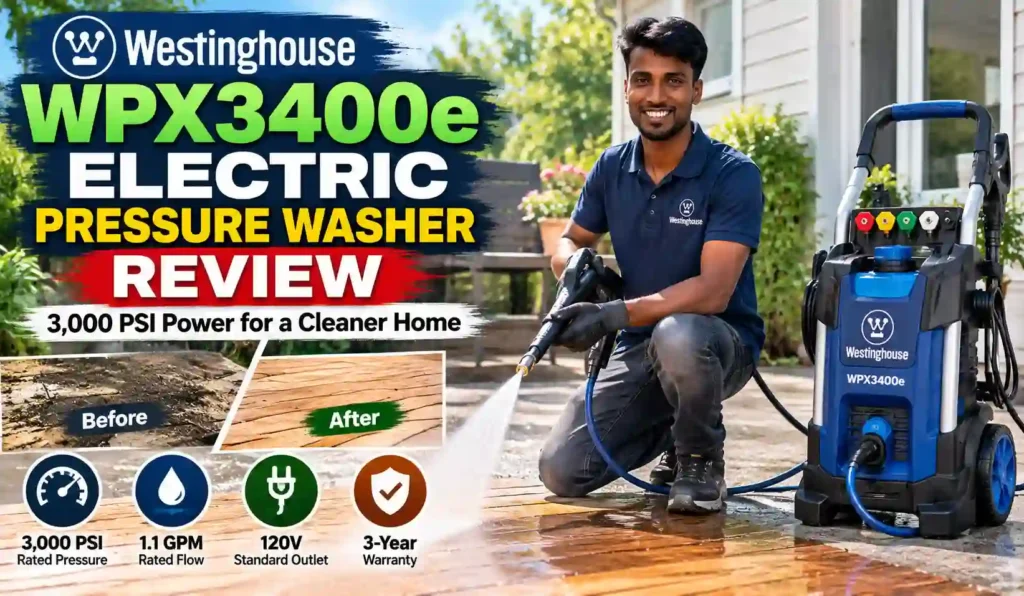
Westinghouse WPX3400e electric pressure washer review: this is a 120-volt, cold-water machine rated at 3,000 PSI and 1.1 gallons per minute (GPM), sold for $449 by the manufacturer. It plugs into a normal outlet and runs without gas, oil, or a carburetor to gum up over winter. If you have a deck, a patio, a car, and some siding to clean, it is built for that job. If you have a long driveway to strip every spring, read the performance section before you buy.
Quick Verdict
Overall score: 8.5/10
The Westinghouse WPX3400e electric pressure washer review comes down to this: it is one of the strongest corded electric washers a homeowner can buy for the money, with a real 3,000 PSI working pressure, a brushless motor, and a 3-year residential warranty. Its limit is water flow, not pressure. At 1.1 GPM rated flow, large flat areas take longer than they would with a gas unit.
- Good for: homeowners cleaning decks, fences, siding, patio furniture, cars, and small to mid-size concrete areas.
- Not good for: daily or contractor use, and big driveways where speed matters most.
- Price: $449 (manufacturer list price). Prices may vary by retailer and change over time.
- Top pro: 3,000 rated PSI from a standard household outlet, with no fuel to store.
- Top con: rated flow of 1.1 GPM makes large concrete jobs slower than on a gas washer.
Key Specifications
This table in our Westinghouse WPX3400e electric pressure washer review lists the manufacturer’s published numbers for the WPX3400e.
| Specification | WPX3400e |
|---|---|
| Max pressure / max flow | 3,400 PSI / 2.0 GPM (flow measured at the lowest pressure setting) |
| Rated pressure / rated flow | 3,000 PSI / 1.1 GPM |
| Motor | 120V AC brushless, 13 amps |
| Pump | Axial cam, 3-piston, with Total Stop System |
| Power cord | 35 ft with GFCI plug |
| High-pressure hose | 25 ft, nylon braided, M22 quick-connect |
| Nozzles | 5 quick-connect tips: 0°, 15°, 25°, turbo, soap |
| Soap tank | 0.45 gal (1.7 L), onboard |
| Wheels | 10-inch never-flat wheels, steel frame |
| Weight | 42.7 lb (dry) |
| Dimensions | 26.5 x 18.5 x 38 in |
| Warranty | 3 years residential, 1 year commercial |
| Price | $449 |
Two numbers matter most. The 3,400 PSI and 2.0 GPM figures cannot happen at the same time, because the maximum flow is reached at the lowest pressure. The rated figures, 3,000 PSI and 1.1 GPM, are the ones to plan around. Multiply them and you get 3,300 cleaning units (PSI times GPM), a simple way to compare washers.
Key Features
- Brushless motor. The motor has no carbon brushes to wear out, which matters because brush wear is a common failure point on cheaper electric washers.
- Axial cam pump with Total Stop System. The pump needs no oil changes, and the motor shuts off when you release the trigger, which reduces heat and wear.
- Onboard soap tank. The 0.45 gallon tank draws detergent automatically when the black soap tip is attached.
- Quick-connect nozzle tips. Five tips snap on and off without tools, and a storage panel on the frame holds them.
- M22 fittings. Surface cleaners, foam cannons, and undercarriage cleaners that use M22 connections fit this machine.
Design and Build Quality
For build quality, this Westinghouse WPX3400e electric pressure washer review starts with the frame. The WPX3400e has a steel frame, two 10-inch never-flat wheels, and a hand-truck shape that tips back on its wheels like a dolly. The frame is the strongest part of the machine, and it protects the motor and pump from bumps. The plastic panel that holds the nozzle tips is the weakest part.
At 42.7 pounds, the unit is light for a 3,000 PSI washer. A gas washer with similar claims, such as the gas WPX3400, weighs 67 pounds. You can lift this one into a truck bed or carry it up a few deck steps without help.
Plastic Parts and Fit
Owner reviews on retailer listings describe a few fit problems. One owner received a unit with a broken screw anchor behind the tip-storage panel and fixed it with a bolt and lock nut. Another reported minor damage to the plastic panel and the gun handle on arrival. A third wrote that the axle was not drilled for its locking pin.
These are shipping and assembly flaws, not signs of a weak pump or motor. Still, they show that the plastic trim is thinner than the steel frame. Check the panel and wheel pins as you unbox.
Hose and Gun
The 25-foot hose is nylon braided and rated for the pressure, but one owner described it as stiff plastic that keeps curling back to its coiled shape. Westinghouse calls it an easy-coil hose, so expect it to need a few uses to relax. The spray gun and wand are metal, and the wand extends.
What worked
- Steel frame protects the pump and motor.
- 10-inch wheels roll over cracked concrete and lawn edges without catching.
- Hooks on the frame store the hose, gun, and wand, so the unit packs away as one piece.
What didn’t
- The plastic tip-storage panel and some fasteners feel lighter than the rest of the unit.
- The high-pressure hose is stiff out of the box.
Design and Build Quality: 8.0/10
Best for: owners who move the washer often and store it in a garage or shed.
Performance
In this Westinghouse WPX3400e electric pressure washer review, performance is the main question. The WPX3400e cleans well at 3,000 PSI, and the pressure is enough for oil stains, mildew, moss, and old dirt on wood and concrete. The limit is flow. With 1.1 GPM rated, it rinses away loosened dirt more slowly than a gas washer that delivers 2.6 GPM.
Pressure breaks dirt loose. Flow carries it away and covers ground. A forum owner who switched between electric and gas units noted that flow does most of the cleaning work on large surfaces, which fits the numbers: the gas WPX3400 claims 2.6 GPM, about 30 percent more water than this model’s 2.0 GPM maximum.
Cleaning Decks, Patios, and Siding
On wood and composite decking, a 25-degree tip works as a starting point, held about 12 inches from the surface. Owners with composite decking and large patios report that the washer lifts years of grime in a single pass with the turbo tip. Wood fibers can fray at 3,000 PSI, so avoid the 0-degree tip on decks and siding.
Cleaning Concrete
Concrete is where the gap to gas shows up. One owner could not remove moss from concrete steps with the 25-degree tip, and another said it does not match gas power, though it is the strongest electric washer they could find. Others report clean garage floors, including epoxy-coated floors, and clean driveways. A small surface cleaner attachment on the M22 outlet helps here, because it spreads the water in a flat circle and keeps the work even.
Pressure Build-Up
One owner noted that pressure takes a few seconds to build after you pull the trigger. This is normal for a washer with a Total Stop System, because the motor stops when you release the trigger and restarts when you squeeze.
What worked
- 3,000 PSI is enough to clean decks, fences, siding, vehicles, and grimy concrete.
- The turbo tip speeds up work on stubborn spots.
- Owners report clean results on garage floors and patio stone.
What didn’t
- Rated flow of 1.1 GPM slows large concrete jobs.
- Moss and deep stains on concrete can need extra passes or a surface cleaner.
Performance: 8.5/10
Best for: residential cleaning projects under about 500 square feet at a time.
Motor and Power Performance
The brushless 13-amp motor runs on a regular 120-volt outlet and draws about 1,560 watts (120 volts times 13 amps). That is close to the limit of a standard 15-amp household circuit, which handles about 1,800 watts. Plug the washer into its own circuit, and do not run a space heater or a freezer on the same line.
The 35-foot GFCI cord and 25-foot hose give you about 60 feet of reach from the outlet, plus the length of the wand. A long extension cord can drop voltage and strain the motor. If you need more distance, use a heavy-gauge outdoor cord rated for the amperage and keep it as short as possible.
Noise and Fumes
An electric motor is quieter than a gas engine and puts out no exhaust. Several owners describe it as noticeably quieter than their old gas units, and one replaced a 14-year-old Greenworks and found the new machine quieter again. Hearing protection is still a good idea close to any pressure washer.
Reliability of the Pump
The axial cam pump is sold as maintenance-free. Rating data from two large retailer listings, with more than 12,000 combined ratings, shows 79 to 80 percent five-star scores and about 3 percent one-star and two-star scores. The retailer notes that some reviews may be incentivized, so treat the numbers as a trend rather than proof.
The negative reviews that stand out are failures: one owner said the unit stopped pressurizing after three or four light uses, and another reported a stop after about 1.5 hours. A third said the first unit was defective, was replaced quickly, and the second works well. Early failures are rare, but they happen, and the 3-year warranty matters for that reason.
What worked
- Brushless motor with no brushes to replace.
- Quiet compared with gas washers, and no fumes.
- A 13-amp draw works on a standard outlet.
What didn’t
- The draw is close to a 15-amp circuit limit, so sharing a circuit risks a tripped breaker.
- A small number of owners report early pump or pressure failures.
Motor and Power Performance: 8.5/10
Best for: buyers who want gas-like pressure without gas maintenance.
Ease of Use
Ease of use is a strength in this Westinghouse WPX3400e electric pressure washer review. Setup is the easiest part of owning this washer. Owner reviews describe assembly in under 15 minutes, with minimal tools. Attach the handle and wheels, screw in the inlet and high-pressure hoses, connect the garden hose, squeeze the trigger until water flows, then switch on the motor. The quick-connect tips snap into the wand without tools.
Soap Tank
The built-in soap tank is a plus, but one owner found it hard to fill, because the tank sits directly under the pump and about two inches below it. A small funnel solves the problem. Soap applies only through the black soap tip at low pressure, which is standard for pressure washers.
Moving and Storing
The hooks on the frame hold the hose and wand. The unit stands upright and tips back on its wheels. With the weight at 42.7 pounds, one person can handle it, and it fits in a corner of a garage.
Safety Features
A trigger lock prevents accidental spraying, the GFCI plug cuts power if it detects a fault, and the Total Stop System stops the motor when the trigger is released.
What worked
- Fast assembly with basic tools.
- Tips swap in seconds.
- Hose and wand store on the frame.
What didn’t
- The soap tank is awkward to fill without a funnel.
- Pressure takes a moment to rise after each trigger pull.
Ease of Use: 9.0/10
Best for: first-time pressure washer buyers and anyone moving up from a garden hose nozzle.
Maintenance
Ownership cost matters in a Westinghouse WPX3400e electric pressure washer review. The WPX3400e needs far less upkeep than a gas washer, because there is no engine oil, spark plug, air filter, or carburetor. A forum owner who switched from gas cited gummed-up carburetors after periods of disuse as the reason to go electric. That problem does not exist here.
After Each Use
- Turn off the motor and the water supply, and squeeze the trigger to release the pressure.
- Disconnect the garden hose and run the pump for a few seconds to clear water, then stop.
- Coil the hoses, hang the wand, and wipe the unit.
Seasonal Care
- Inlet screen. Check the screen where the garden hose connects and rinse out grit, because debris can starve the pump.
- Nozzle tips. Clear clogged tips with a small pin, since a blocked orifice raises pressure and strains the pump.
- Quick-connect O-rings. Look for cracks if you notice leaks at the gun or wand.
- Winter storage. In cold parts of the country, store the washer indoors above freezing, and drain it, because trapped water can crack a pump when it freezes. Do not run the pump dry for more than a few seconds.
Parts
Westinghouse publishes a replacement parts list for the WPX3400e, plus a user manual and a warranty document, on its product page. Having a parts list available is useful if a hose or O-ring wears out after the warranty ends.
What worked
- No oil, fuel, or engine parts to service.
- Published manual and parts list.
What didn’t
- Freezing damage is a risk in cold climates if you store it in an unheated space.
- The pump is not designed for owner repair.
Maintenance: 8.5/10
Best for: people who use a pressure washer a few times a year and do not want fuel stored in the garage.
Pros and Cons
The pros and cons in this Westinghouse WPX3400e electric pressure washer review come from the specs and owner feedback.
| Pros | Cons |
|---|---|
| 3,000 rated PSI from a standard household outlet | Rated flow of 1.1 GPM slows large concrete jobs |
| Brushless motor and maintenance-free axial cam pump | 13-amp draw leaves little room on a 15-amp circuit |
| Light at 42.7 lb, with 10-inch never-flat wheels | Plastic tip-storage panel and some fasteners feel thin |
| Quiet, with no fumes or fuel to store | Soap tank is awkward to fill without a funnel |
| Five quick-connect tips and M22 accessory fittings | A small number of owners report early pump failures |
| 3-year residential warranty | Not intended for daily or commercial work |
The con that should change some buyers’ decisions is the flow. If most of your work is a large driveway or a long sidewalk, the lower GPM adds real time to each job, and a gas washer will finish sooner.
Comparison: Electric WPX3400e vs Gas WPX3400
The closest alternative is Westinghouse’s own gas model with the same 3,400 PSI headline. The two are different machines with different strengths.
| Category | Electric WPX3400e | Gas WPX3400 |
|---|---|---|
| Price | $449 | From $349 |
| Best for | Decks, siding, cars, small concrete jobs, quiet use | Large driveways and long, flat surfaces |
| Key difference | 120V brushless motor, 2.0 max GPM, 42.7 lb | 212cc gas engine, 2.6 GPM, 67 lb |
| Winner | Easy storage and low upkeep | Cleaning speed on big areas |
| Rating | 8.5/10 | Not rated by MowerInsights |
The gas model claims 2.6 GPM, so it moves more water, but it weighs 67 pounds, needs fuel, and needs the engine upkeep that a gas unit demands, including fuel stabilizer and carburetor care after storage. The Westinghouse gas model’s listed price starts lower, but the electric unit avoids fuel, oil, and engine repair. For owners who clean a few times a year, the electric model usually costs less to own.
A lower step in the line, the WPX3000e, uses an induction motor and 1.76 max GPM. It suits lighter jobs, but the WPX3400e has the brushless motor and the higher flow.
Who Should Buy the WPX3400e?
After this Westinghouse WPX3400e electric pressure washer review, the answer is clear: the WPX3400e fits a US homeowner who wants strong cleaning power without gas. It suits these situations well:
- Typical suburban lot. A quarter-acre yard with a deck, patio, fence, and vinyl siding is the sweet spot.
- Humid or shaded climates. Mildew and algae build up fast in the Southeast and Pacific Northwest, and 3,000 PSI removes them with a soap pass and a rinse.
- Garage or shed storage. At 42.7 pounds with no fuel, it stores easily and does not leave a gas smell.
- Car and truck washing. A foam cannon with an M22 fitting works with this machine.
- HOA-bound owners. Quiet operation and no exhaust are a plus on a close lot.
Who Should Avoid the WPX3400e?
This Westinghouse WPX3400e electric pressure washer review found the WPX3400e is the wrong tool in a few cases.
- Large driveways. If you clean more than about 1,000 square feet of concrete at a time, a gas washer with 2.6 GPM or more will finish much faster.
- Contractors and pressure-washing businesses. The commercial warranty is only 1 year, and the unit is designed for residential duty cycles.
- Homes with no outdoor outlet. The washer needs a GFCI-protected 120-volt outlet within about 60 feet of the work area.
- Homes with an overloaded circuit. A 13-amp draw can trip breakers if the outlet shares a circuit with other loads.
Price and Value
For price, this Westinghouse WPX3400e electric pressure washer review uses the manufacturer’s list. Westinghouse lists the WPX3400e at $449. Retail listings have shown it closer to $399 in some cases, which is a MowerInsights estimate based on listings seen during research. Prices may vary by retailer and change over time.
At $449, the washer delivers a brushless motor, a 3,000 PSI working pressure, five tips, a soap tank, and a 3-year residential warranty. That is a strong feature set for the category. A cheaper washer will usually give up either the pressure or the pump quality, and a gas unit with the same pressure will cost more to run and store.
Budget for a few add-ons if you have large surfaces. A surface cleaner for concrete is the most useful, and a longer hose adds reach. One owner replaced the stock 25-foot hose with a 50-foot Westinghouse hose and added a foam cannon and a short gun.
Warranty and Support
The warranty is a key part of any Westinghouse WPX3400e electric pressure washer review. Westinghouse backs the WPX3400e with a 3-year limited residential warranty that covers service, labor, and parts, and a 1-year limited warranty for commercial use. The manufacturer says each unit is functionally tested at the factory.
Support information on the Westinghouse site includes a product registration page, manuals and documents, a service center finder, and a customer care page. Westinghouse also posts replies to owner reviews and lists a customer support line at 1-855-944-3571 and an email address on its public responses. A few owners wrote that it took effort to reach support, so register the washer when you buy it and keep your receipt.
Read the warranty PDF before you buy, because limited warranties often exclude freeze damage, running the pump dry, and commercial use.
FAQs
Is the Westinghouse WPX3400e electric pressure washer review score worth trusting?
The 8.5/10 score in this Westinghouse WPX3400e electric pressure washer review comes from manufacturer specifications and owner-feedback analysis, not hands-on testing. It is based on the numbers: 3,000 rated PSI, 1.1 rated GPM, a 3-year warranty, and owner ratings near 4.7 out of 5.
Is the Westinghouse WPX3400e worth it?
Yes, for most homeowners. At $449 it gives you a brushless motor and 3,000 rated PSI without gas, oil, or fuel storage. It is not worth it if you clean large driveways often, because the 1.1 GPM rated flow slows that job.
How much pressure does the WPX3400e really deliver?
It delivers 3,000 PSI rated pressure at 1.1 GPM. The 3,400 PSI figure is a maximum, and the 2.0 GPM maximum flow occurs at the lowest pressure setting. The two maximums do not happen together.
Is the WPX3400e as strong as a gas pressure washer?
It matches many gas washers on pressure but not on flow. The gas WPX3400 claims 2.6 GPM, so it moves more water and cleans large areas faster. For decks, siding, cars, and small concrete jobs, the electric unit performs well.
Can the WPX3400e clean a driveway?
Yes, but it is slower than a gas washer. Owners report clean driveways, though one could not remove moss from concrete steps with the 25-degree tip. A surface cleaner attachment on the M22 outlet speeds up flat concrete.
Does the WPX3400e need a special outlet?
No. It uses a standard 120-volt outlet and draws 13 amps, which is about 1,560 watts. Use a circuit that is not shared with other large loads, and use the included 35-foot GFCI cord or a heavy-gauge outdoor extension cord.
What tips come with the WPX3400e?
It comes with five quick-connect tips: 0 degree, 15 degree, 25 degree, turbo, and soap. Use the 25-degree tip as a safe starting point on decks and siding, and avoid the 0-degree tip on wood or painted surfaces.
How long is the WPX3400e warranty?
The warranty is 3 years limited for residential use and 1 year limited for commercial use, according to the manufacturer. It covers service, labor, and parts under the terms in the published warranty document.
Final Verdict
The Westinghouse WPX3400e electric pressure washer review ends at 8.5/10. The WPX3400e is a strong home washer: 3,000 rated PSI, a brushless motor, easy assembly, and a 3-year warranty for $449. Its best use is cleaning decks, siding, cars, and patios on a normal suburban lot. Buyers who clean large driveways every season, run a cleaning business, or lack a good outdoor outlet should look at a gas model with higher flow instead.
Why Trust This Guide
MowerInsights.com is run by Siddik Kazi, who repairs and services lawn mowers and outdoor power equipment in a repair shop in Milan, Italy. That workshop experience is where the maintenance and failure-point advice in this guide comes from.
Sources and methodology: this review uses the manufacturer’s published specifications, manual, and warranty terms, plus analysis of owner feedback on major US retailer listings. It is not based on hands-on testing.