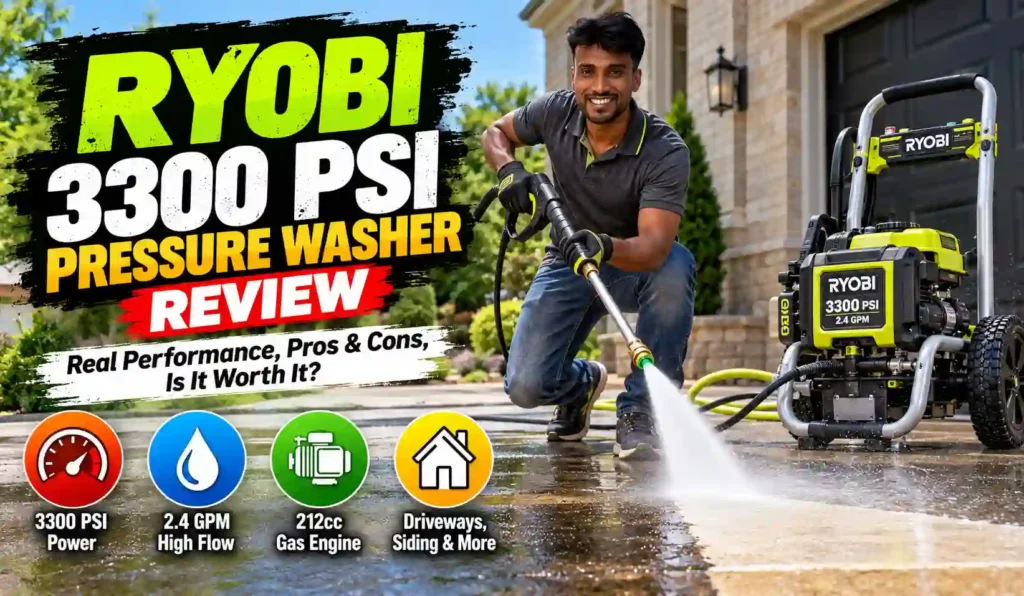
Ryobi 3300 PSI pressure washer shoppers want one answer: does a $399 gas machine have the power to clean a concrete driveway and a second-story wall? The RY80589 pairs a 212cc engine with 3300 PSI, 2.4 GPM, and a 0.95-gallon fuel tank. This review covers its build, cleaning power, engine, ease of use, and upkeep. It also compares the machine with two close Ryobi alternatives so you can decide quickly.
Quick Verdict
The Ryobi 3300 PSI pressure washer scores 7.9 out of 10. It delivers heavy-duty residential cleaning power at a mid-range price. It is heavy, though, and it does not come with a surface cleaner or a Honda engine.
| Item | Verdict |
|---|---|
| Overall score | 7.9/10 |
| Good for | Homeowners with concrete driveways, brick walkways, decks, and two-story siding |
| Not good for | Apartment dwellers, anyone who needs a light, quiet machine, and daily commercial use |
| Price | $399 |
| Top pro | 3300 PSI and 2.4 GPM, a high flow rate that cleans large areas quickly |
| Top con | It weighs about 65 lb and has no surface cleaner in the box |
Prices may vary by retailer and change over time.
Key Specifications
| Specification | Detail |
|---|---|
| Model number | RY80589 |
| Engine | 212cc gas engine with idle-down technology |
| Maximum pressure | 3300 PSI |
| Flow rate | 2.4 GPM |
| Fuel tank | 0.95 gallon |
| Hose | 35 ft non-marring high-pressure hose |
| Nozzles | Four quick-connect nozzles: soap, 25°, 40°, and second-story |
| Frame and wheels | Hand truck frame with 12-inch flat-free wheels |
| Weight | About 65 lb |
| Water type | Cold water only |
| Included in the box | Trigger handle, metal spray wand, engine lubricant, operator’s manual |
| Warranty | 3-year limited |
| Price | $399 |
Key Features
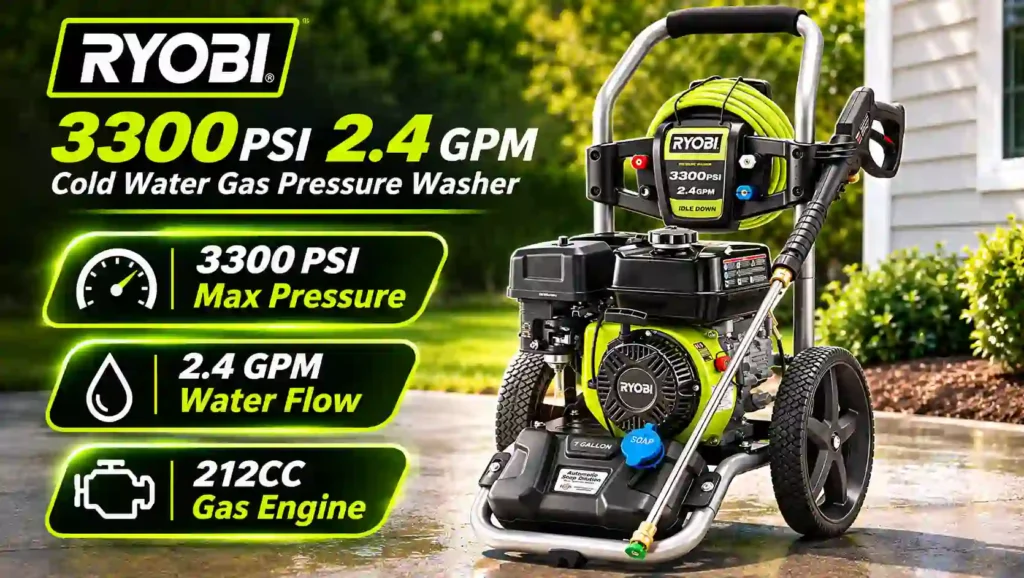
- The 212cc engine produces 3300 PSI and 2.4 GPM, which Ryobi rates for siding, brick, driveways, sidewalks, and second stories.
- Idle-down technology slows the engine when you release the trigger, which saves fuel and cuts noise.
- A 0.95-gallon fuel tank is large for this price class, so you stop to refuel less often.
- The included second-story nozzle gives extra reach for upper walls and hard-to-reach spots.
- Onboard storage holds all four nozzles, and the flat-free wheels never need air.
Design & Build Quality
The RY80589 has a practical, homeowner-friendly design. It uses a hand truck frame, two 12-inch flat-free wheels, and an onboard rack for all four nozzles. At about 65 lb, it is a few pounds lighter than Ryobi’s Honda-powered 3300 PSI model at 68 lb and its 3200 PSI model at 74 lb. Flat-free tires cannot go soft while the washer sits in a garage. Ryobi does not publish the frame material or the pump type for this model, so judge durability by the layout and the warranty, not by a spec line.
Frame, Wheels, and Storage
The hand truck layout lets you tilt the washer back and roll it like a dolly. The large wheels help on gravel, lawn edges, and curbs.
What worked
- The 12-inch flat-free wheels roll over uneven ground and never lose air pressure.
- The hand truck frame makes it easy to tilt and wheel the unit across a yard.
- All four nozzles store on the machine, so none get lost in the garage.
- The non-marring hose will not scuff painted siding or a car finish.
What didn’t
- At about 65 lb, lifting it into a truck bed or up porch steps takes two people.
- Ryobi does not list the pump type or frame material, which makes long-term durability harder to judge from the spec sheet.
Design & Build Quality: 8.0/10
Best for: Homeowners who roll the washer across a driveway or lawn and store it in a garage or shed.
Ryobi 3300 PSI Pressure Washer Performance
The Ryobi 3300 PSI pressure washer is rated for siding, brick, driveways, sidewalks, and second-story walls. Its 2.4 GPM flow matters as much as the pressure. Pressure loosens dirt, and flow rinses it away, so higher flow covers more ground per minute. Multiply PSI by GPM and you get about 7,920 cleaning units, a common way to compare machines. Ryobi’s 3000 PSI electric model scores about 3,300 on the same math. These are rated numbers, not lab measurements.
Pressure, Flow, and Cleaning Units
Cleaning units are a quick way to see how much work a machine can do. The table below uses Ryobi’s published ratings.
| Washer | Max PSI | Flow (GPM) | Cleaning units (PSI x GPM) |
|---|---|---|---|
| Ryobi RY80589 (gas) | 3,300 | 2.4 | 7,920 |
| Ryobi RY802925 (gas) | 2,900 | 2.5 | 7,250 |
| Ryobi RY143011 (electric) | 3,000 | 1.1 | 3,300 |
The RY80589 has more than twice the cleaning units of the 3000 PSI electric washer. That gap shows up as faster rinsing on large, flat surfaces like driveways.
Nozzles and Spray Patterns
The washer ships with four quick-connect nozzles. A smaller degree number means a narrower, harder stream.
- The 25° nozzle handles general cleaning on concrete, brick, and sidewalks.
- The 40° nozzle is the safer choice for siding, wood decks, and vehicles.
- The soap nozzle drops the pressure so detergent can flow onto a surface.
- The second-story nozzle extends your reach for upper walls and gutters.
What worked
- A 7,920 cleaning-unit rating puts it in the heavy-duty residential class.
- The 2.4 GPM flow clears dirt off big flat surfaces faster than a 1.1 GPM electric washer.
- The four-nozzle kit has no 0° tip, which lowers the risk of etching wood or stripping paint by accident.
What didn’t
- There is no surface cleaner in the box. Ryobi sells a 15-inch gas surface cleaner for $69.97, and a driveway job goes much faster with one.
- Without a 0° or turbo nozzle, stubborn spots like rust stains need an extra purchase. Ryobi’s turbo nozzle costs $29.97.
- The 3300 PSI rating can damage soft wood and some vinyl if you hold the wand too close.
Performance: 8.5/10
Best for: Driveways, brick patios, and siding on larger homes.
Engine Performance & Runtime
The 212cc engine is the power source behind the 3300 PSI rating. It has a larger displacement than the 187cc Honda engine in Ryobi’s other 3300 PSI model. The 0.95-gallon tank is the main runtime feature, and idle-down technology slows the engine between spray bursts. Ryobi does not publish a runtime in minutes, so your actual time per tank depends on how often you pull the trigger. Plan on at least one refill during a full driveway-and-siding session.
Fuel Tank and Idle-Down
Fuel tank size and idle-down decide how long you can work before stopping.
What worked
- The 0.95-gallon tank is large for a machine at this price, so you refuel less often.
- Idle-down technology cuts engine speed when you release the trigger, which saves fuel and reduces noise.
- The kit includes engine lubricant, so you can fill the crankcase for the first start without a separate trip to the store.
- The 212cc displacement gives the pump a stronger engine to work with than the 187cc engine in the Honda version.
What didn’t
- Ryobi does not publish a minutes-per-tank figure for this model.
- It uses a Ryobi engine, not a Honda one. Ryobi’s Honda-powered 3300 PSI model carries a separate 2-year engine warranty, and this listing shows only the 3-year limited warranty.
- Gas pressure washers are loud under load, so wear hearing protection.
Engine Performance & Runtime: 8.0/10
Best for: Owners who clean large areas in one session and want fewer fuel stops.
Ease of Use
The Ryobi 3300 PSI pressure washer is easy to use once it is assembled, but it is not the easiest machine to start and move. You attach the wheels and handle, connect a garden hose, and pull the cord. Ryobi lists no electric start, so expect a pull cord. Nozzles click in without tools. The 35-foot hose reaches a long way, and a garden hose adds more. The weight is the main limit.
Setup and Starting
Follow the same order every time to protect the pump.
- Connect the garden hose and turn the water on fully.
- Squeeze the trigger until water flows steadily, which clears air from the pump.
- Check the oil level and fuel, then start the engine.
- Click in the nozzle you need and test it on a hidden spot.
Running the pump without water can damage it quickly. Always start the water first.
What worked
- Quick-connect nozzles change in seconds with no tools.
- The 35-foot hose reaches a driveway and most of a two-story house from one spot.
- The metal spray wand and trigger handle come in the box, so setup needs only basic hand tools.
- Onboard storage keeps the nozzles with the machine.
What didn’t
- A pull cord can take several tugs on a cold start, and it is a chore for some users.
- Ryobi lists a soap nozzle but no onboard detergent tank, so check how detergent feeds before buying a specific soap.
- At about 65 lb, moving it up steps or into a vehicle is a two-person job.
Ease of Use: 7.5/10
Best for: Owners comfortable with a pull-start engine and a machine that stays on flat ground.
Maintenance
A gas pressure washer needs more care than an electric one, but the routine is short. Check the engine oil before every use, clean or replace the air filter on schedule, and add fuel stabilizer before storage. Ryobi lists replacement parts and service centers for the brand, so parts are easy to find. Ryobi’s pump protector costs $9.97 and helps guard the pump during cold storage.
Routine Upkeep
These tasks keep a small gas engine and pump running for years.
What worked
- A dipstick check before each use takes seconds and prevents the most common engine problems.
- Ryobi sells a pump protector for $9.97, which is cheap insurance for a cold climate.
- Replacement parts and service centers are listed on Ryobi’s support pages.
- A 3-year limited warranty covers early defects.
What didn’t
- Gas engines need oil checks, air filter care, fuel stabilizer, and winter storage steps that an electric washer never needs.
- A low oil level, a dirty air filter, or blocked cooling fins are the usual reasons a small gas engine runs hot and shuts down. Set the oil level with the dipstick, not by the amount in the bottle.
- Stale fuel can gum up the carburetor, so drain or stabilize the tank before long storage.
Maintenance: 7.5/10
Best for: Owners who already maintain a gas lawn mower or generator and will add the washer to the same routine.
Pros & Cons
The table below combines every finding from the testing sections.
| Pros | Cons |
|---|---|
| 3300 PSI and 2.4 GPM, about 7,920 cleaning units | No surface cleaner in the box, and it costs $69.97 extra |
| 0.95-gallon tank gives longer runs between refuels | No published runtime per tank |
| Four quick-connect nozzles, including a second-story nozzle | No 0° or turbo nozzle for stubborn spots |
| 12-inch flat-free wheels and a hand truck frame | About 65 lb is hard to lift into a truck or up steps |
| 35-foot non-marring hose protects painted surfaces | Pull-start engine and louder than any electric washer |
| 3-year limited warranty at $399 | Ryobi engine, with no separate engine warranty listed |
The con that most often changes a buyer’s decision is the missing surface cleaner. If you plan to clean a large driveway, add $69.97 to the price. Its weight is the second concern for buyers who cannot lift 65 lb.
Ryobi 3300 PSI Pressure Washer vs Close Alternatives
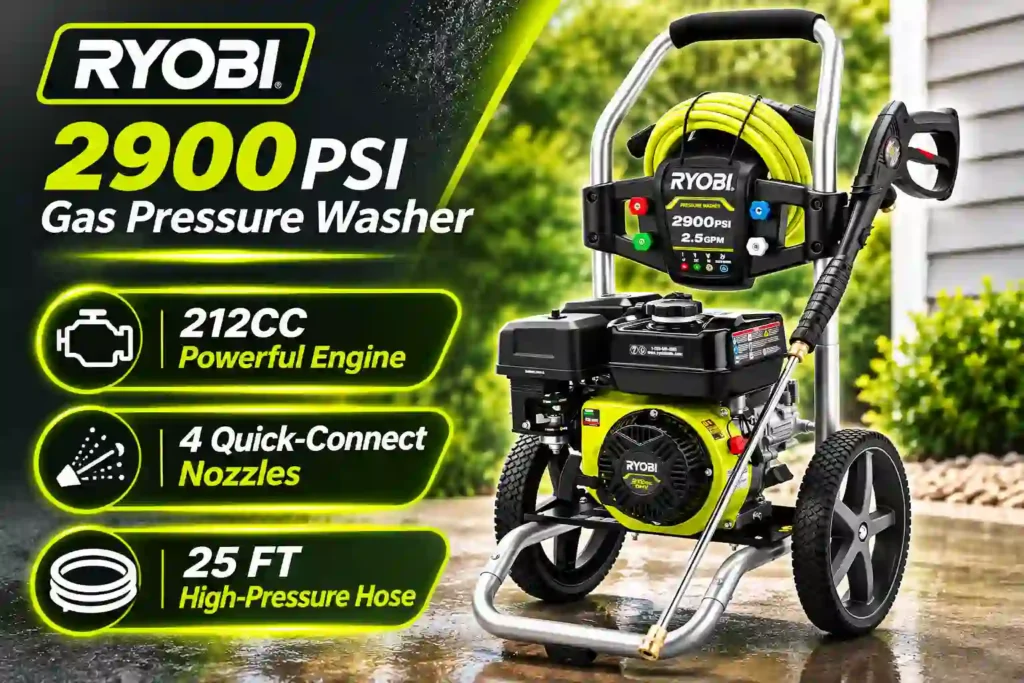
The Ryobi 3300 PSI pressure washer sits between Ryobi’s cheaper 2900 PSI gas model and its pricier Honda-powered 3300 PSI model. The table compares all three. Ratings for the two alternatives are MowerInsights estimates based on spec comparison.
| Washer | Price | Best For | Key Difference | Winner | Rating |
|---|---|---|---|---|---|
| Ryobi RY80589 (3300 PSI, 2.4 GPM, 212cc) | $399 | Large driveways and two-story siding | Highest PSI at a mid-range price, 0.95-gallon tank | Best overall balance | 7.9/10 |
| Ryobi RY802925 (2900 PSI, 2.5 GPM, 212cc) | $329 | Budget buyers who still want gas power | Lower PSI, 25-foot hose, about 59 lb | Best price | 7.5/10 (estimate) |
| Ryobi 3300 PSI Honda model (2.4 GPM, 187cc) | About $519 | Owners who want a Honda engine | Honda GC190 engine, 2-year engine warranty, 68 lb | Best engine reputation | 8.0/10 (estimate) |
The 2900 PSI model costs $70 less and has slightly higher flow at 2.5 GPM. For most driveway work the gap in cleaning power is small, so it is the better pick if you want to save money. The Honda model costs about $120 more. Pay that premium only if a Honda engine and a separate engine warranty matter to you.
Who Should Buy?
The Ryobi 3300 PSI pressure washer suits homeowners with large hard surfaces and tough dirt.
- You own a two-car or larger concrete driveway that collects oil, mud, and algae.
- You live in a humid area such as the Southeast or Gulf Coast (USDA zones 7 to 10) where algae and mildew build up on siding and walkways every year.
- You clean a two-story house and want the second-story nozzle and long hose.
- You want gas power at about $399 and prefer a bigger fuel tank to fewer features.
- You already own a garden hose with steady water pressure and a flat place to store a 65 lb machine, so you can use the washer without extra setup.
Who Should Avoid?
Skip this washer if its weight, noise, or upkeep do not fit your home.
- You live in an apartment or a home with a small patio. A light electric washer is easier to store and far quieter.
- You live where an HOA enforces strict noise hours. Gas engines are loud under load.
- You cannot lift about 65 lb. A rolling electric model or the lighter 2900 PSI gas model may suit you better.
- You want a Honda engine with its own engine warranty. Ryobi’s Honda-powered 3300 PSI model is the better fit.
Price & Value: Is the Ryobi 3300 PSI Pressure Washer Worth It?
The Ryobi 3300 PSI pressure washer costs $399, and it is good value for the power it gives. That price buys 3300 PSI, 2.4 GPM, a large tank, and a 3-year limited warranty. Prices may vary by retailer and change over time.
Cost per cleaning unit shows the value clearly. These figures are estimates based on list prices and rated PSI and GPM.
| Washer | Price | Cleaning units | Cost per cleaning unit |
|---|---|---|---|
| Ryobi RY802925 (gas) | $329 | 7,250 | About 4.5 cents |
| Ryobi RY80589 (gas) | $399 | 7,920 | About 5.0 cents |
| Ryobi Honda model (gas) | About $519 | 7,920 | About 6.6 cents |
| Ryobi RY143011 (electric) | $429 | 3,300 | About 13 cents |
The RY80589 delivers more than twice the cleaning power per dollar of the 3000 PSI electric model. Add the $69.97 surface cleaner and your total is about $469. That is still less than the Honda model before accessories.
Warranty & Support
The Ryobi 3300 PSI pressure washer comes with Ryobi’s 3-year limited warranty. Ryobi lists a separate 2-year engine warranty only for its Honda-powered 3300 PSI model, not for this one. Read the full terms and exclusions on Ryobi’s warranty page before you buy.
Ryobi’s published support options include:
- A Rapid Repair claim process with a 14 business day turnaround.
- A service center locator for authorized repairs.
- Replacement parts and parts diagrams on Ryobi’s parts site.
- A customer service line at 1-800-525-2579, plus product registration through a MyRYOBI account.
Register the washer after you buy it so Ryobi can send product updates and keep your purchase on file.
FAQs
Is the Ryobi 3300 PSI pressure washer good for driveways?
Yes. Ryobi rates the Ryobi 3300 PSI pressure washer for driveways and sidewalks. Its 3300 PSI and 2.4 GPM give about 7,920 cleaning units. For fast results on a large driveway, add a surface cleaner, which costs $69.97 extra.
What engine does the Ryobi 3300 PSI pressure washer use?
The RY80589 uses a 212cc Ryobi gas engine with idle-down technology. Ryobi also sells a separate 3300 PSI model with a 187cc Honda GC190 engine. The two have different prices, weights, and warranties, so check the model number before you buy.
How long does the Ryobi 3300 PSI pressure washer run on a tank?
Ryobi does not publish a runtime in minutes. The tank holds 0.95 gallon, and idle-down technology cuts fuel use between spray bursts. Your time per tank depends on how often you hold the trigger down.
What fuel does the Ryobi 3300 PSI pressure washer need?
Use fresh regular unleaded gasoline. Ryobi’s guidance for its gas washers is regular unleaded with no more than 15 percent ethanol. Confirm the exact limit in your operator’s manual before you fill the tank.
Is 3300 PSI too strong for my deck or siding?
It can be if you use the wrong nozzle. Use the 40° nozzle on wood and siding, hold the wand at a distance, and test a hidden spot first. Keep the 25° nozzle for concrete and brick.
Does the Ryobi 3300 PSI pressure washer come with a surface cleaner?
No. The kit includes a trigger handle, metal spray wand, four nozzles, a 35-foot hose, and engine lubricant. A 15-inch gas surface cleaner is sold separately for $69.97.
Can the Ryobi 3300 PSI pressure washer use hot water?
No. Ryobi sells it as a cold water pressure washer. Hot water can damage the pump and seals, so use a cold garden hose supply only.
What is the difference between the RY80589 and the Honda version?
The RY80589 has a 212cc Ryobi engine, a 0.95-gallon tank, and a $399 price. The Honda model has a 187cc Honda GC190 engine, a 2-year engine warranty, a heavier 68 lb frame, and costs about $519. Pick the Honda model only if a Honda engine matters to you.
What should I do if the engine shuts down while spraying?
Check the oil level with the dipstick first, because low oil is a common reason for a shutdown. Then clean the air filter and clear debris from the cooling fins. Let the engine cool, and make sure the water supply is steady.
Final Verdict
The Ryobi 3300 PSI pressure washer earns 7.9 out of 10. It is the best use case for homeowners with large concrete driveways and two-story siding who want gas power at $399. Its 2.4 GPM flow, 0.95-gallon tank, and second-story nozzle make long cleaning sessions easier. Look elsewhere if you cannot lift about 65 lb, need a quiet machine, or want a Honda engine with its own engine warranty. Buy the 2900 PSI model to save $70.
Why Trust This Guide
MowerInsights.com is run by Siddik Kazi, who repairs and services small gas engines at his own repair shop in Milan, Italy. That workshop experience shapes the maintenance advice in this review.
The scores and comparisons here come from Ryobi’s published specifications, price lists, and warranty terms, plus a side-by-side comparison with closely related Ryobi models. This review contains no hands-on test measurements.