A mower flywheel key broken after a rock or stump strike is one of the most common reasons a mower suddenly refuses to start. The engine may kick the pull cord back at your hand, backfire, or spin with no useful spark. This guide shows you how to tell if the key is the problem, why it breaks, and how to replace it safely at home.
Quick Answer
Yes, a mower flywheel key broken (sheared) is a common cause of a no-start, kickback, or backfire that begins right after the blade hits something hard. The key is a small soft-metal part that locks the flywheel to the crankshaft. When it shears, the ignition timing shifts. The fix is to pull the flywheel, confirm the damage, and install a new key made for your engine. Check the blade and crankshaft for bends while you are in there.
What Does a Flywheel Key Do, and Why Does It Break?
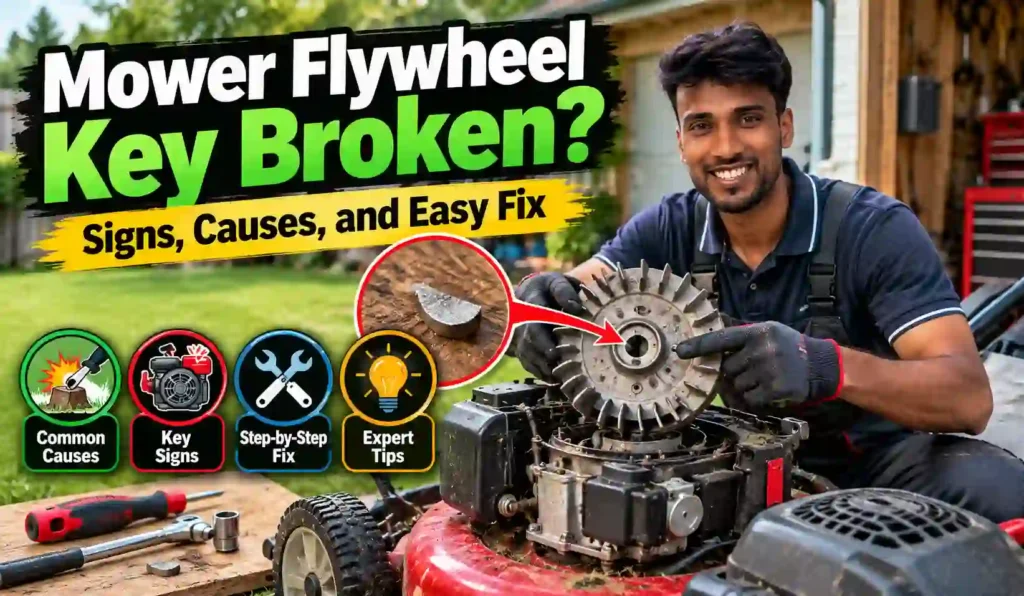
The flywheel key is a small, soft metal piece that sits in a slot between the flywheel and the crankshaft. It holds the flywheel in one exact position so the magnets on it fire the spark at the right moment. It is made soft on purpose, so it breaks before the crankshaft does.
Think of it like the shear pin on a boat propeller. The pin is cheap and easy to replace. The propeller shaft is not. When the blade stops dead against a rock, the sudden twisting force goes straight to the key, and the key gives way first.
Once the key shears, the flywheel can rotate a small amount on the crankshaft. That shifts the timing of the spark. The engine may then fail to start, fire at the wrong time, or push back against the starter rope.
Signs of a Mower Flywheel Key Broken After an Impact
The strongest sign is timing: the trouble starts right after the blade hit a rock, stump, curb, or buried object. A mower that ran fine, hit something, and now will not start points to the key before it points to the carburetor.
Look for these signs:
- The engine will not start at all after the blade strike.
- The pull cord snaps back toward the engine or yanks your hand (kickback).
- The engine backfires through the exhaust or carburetor.
- The engine starts hard and runs rough, then stalls.
- The engine sounds like it is trying to fire but never catches.
Use this table to separate a key problem from other common no-start causes:
| Symptom | Points to the flywheel key | Points somewhere else |
|---|---|---|
| Started after hitting an object | Yes | Less likely |
| Pull cord kicks back hard | Yes | Rare with fuel problems |
| Good spark, fuel reaching the plug, still no start | Yes, spark timing may be off | Check air filter and compression |
| Slow decline over weeks, no impact | Unlikely | Stale fuel, dirty carburetor, worn plug |
| Engine floods or smells of raw fuel | Possible | Choke, carburetor, or needle valve |
Note that a spark test alone does not clear the key. A sheared key can still produce a spark, just at the wrong moment. The only sure check is to remove the flywheel and look at the key.
Mower Flywheel Key Broken: Main Causes
A mower flywheel key broken usually comes down to one of six causes. Knowing which one applies helps you stop it from happening again.
Blade Strike on a Hard Object
A hard blade strike is the number one cause. The blade stops suddenly, and the force shears the key. This is the key doing its job. To check for this cause:
- Look at the blade for fresh dents, nicks, or a bend.
- Ask yourself if the mower hit anything recently, even months ago.
- Spin the blade by hand (with the spark plug wire off) and watch for wobble.
Loose Flywheel Nut
A flywheel nut that backs off lets the flywheel rock on the crankshaft. That rocking can chew up the key and the keyway. To check for this cause:
- Look for a flywheel nut that turns by hand or feels loose.
- Look for shiny wear marks or a peened (flattened) edge on the key.
Bent Blade or Bent Crankshaft
A heavy impact can bend the blade, the crankshaft, or both. A bent crankshaft makes the flywheel sit crooked, which wears the key again even after you replace it. To check for this cause:
- Remove the blade and hold a straight edge along it to look for a bend.
- Look at the crankshaft end for visible wobble while turning it by hand.
Damaged Keyway
The keyway is the slot cut into the crankshaft and flywheel. If it is burred or widened, the new key will not hold. Minor burrs can be filed smooth. Real wear means a new flywheel or crankshaft. To check for this cause:
- Run a fingernail along the slot edges and feel for raised metal.
- Set the flywheel on the crankshaft with no key and check for rocking.
Wrong or Hard Replacement Key
A key made of harder metal does not shear when it should. Then the force goes to the crankshaft, which costs far more to fix. A key that is the wrong size also slips. To check for this cause:

- Compare the new key to the old one by length, width, and thickness.
- Buy the key by your engine model number, not by guessing.
Partial Shear That Gets Worse Later
A key can crack in an impact yet hold timing long enough for the engine to run. Weeks or months later, vibration finishes the job and the mower stops starting. This is why a mower can run fine after a blade change and fail later. To check for this cause:
- Think back over the mower’s history, including impacts from the past season.
- Inspect the key whenever the flywheel is off for any reason.
Mower Flywheel Key Broken: Step-by-Step Fix
Replacing a sheared key means removing the flywheel, swapping the key, and putting everything back with the right torque. Plan on about an hour for a push mower if you have the tools. One riding-mower repair guide rates the job at 60 minutes or less.
Tools you need: socket set, flywheel puller, torque wrench, flywheel holder or strap wrench, work gloves, and a new key made for your engine model.
Safety first: disconnect the spark plug wire and tuck it away from the plug. On a riding mower, also disconnect the negative battery cable. Let the engine cool. Wear gloves, because flywheel fins and blade edges are sharp.
- Get the right key first. Find your engine model and type number on the engine. Match the new key to it. Engine makers sell keys through dealers and parts lookup tools.
- Remove the shroud. Take off the blower housing or top cover. On many engines this means a few bolts and, on riding mowers, the air filter housing. Keep each bolt with its part.
- Release any flywheel brake or clutch. If your engine has a flywheel brake, remove the cover and unhook the outer end of the brake spring. If it has a clutch, remove it per the engine manual.
- Lock the crankshaft. Hold the flywheel with a strap wrench or flywheel holder. Some people jam the piston with a length of nylon rope fed through the spark plug hole. If you use rope, leave a tail out so you can pull it free later.
- Remove the flywheel nut and washer. Turn it counterclockwise with the right socket. Remove any fan or screen sitting under it.
- Pull the flywheel. Thread the nut back on a few turns so the flywheel cannot fly off. Fit the flywheel puller to the threaded holes, and tighten each puller bolt a little at a time, evenly, until the flywheel pops free. Never hit the flywheel with a hammer. Even a small crack makes it unsafe, and a cracked flywheel must be replaced.
- Inspect everything. Lift off the flywheel and look at the old key. A sheared key is bent, offset, or in pieces. Check the keyway for burrs and file off minor ones. Check the flywheel and crankshaft for cracks, broken fins, or damage. Place the flywheel on the shaft with no key and make sure it does not rock.
- Install the new key. Set the key in the crankshaft slot until it is seated flush. Debris in the slot will stop it from sitting properly, so clean the slot first. Slide the flywheel on and line up its keyway with the key.
- Set the coil gap. Check the air gap between the ignition coil and the flywheel against your engine manual. Some repairers use a thin card as a gauge, but the manual spec is the safe choice.
- Torque the flywheel nut to spec. Torque varies by engine, so look it up. As one example, a riding-mower repair guide for a common engine type lists 100 ft-lbs. Do not copy that number for your mower. Then refit the shroud, brake spring, spark plug, and wire. Pull the rope out of the cylinder if you used one.
After the repair, start the mower and watch for smooth running. If the engine still kicks back or runs rough, the timing may be off, or another fault may be present.
Important Tips
A few habits make a mower flywheel key broken repair last longer:
- Buy two keys and keep the spare in your garage. A key costs little, and having one ready saves a trip mid-season.
- Take photos before and after each disassembly stage. They make reassembly faster and catch misplaced parts.
- Always use the engine maker’s torque spec. An under-tightened nut lets the flywheel rock, which can break the next key.
- Inspect the blade and crankshaft any time the key has sheared. A bent blade left on the mower can break the new key right away.
- Keep the flywheel fins and the area under the shroud clean. Packed grass hides cracks.
- Sharpen and balance the blade each season. An unbalanced blade vibrates and adds stress to the key.
Common Mistakes
These errors turn a mower flywheel key broken repair into a bigger job:
- Using a steel bolt or hardened key. It will not shear in the next impact, so the crankshaft takes the hit instead.
- Hammering the flywheel to free it. This can crack it. Use a puller.
- Skipping the crankshaft check. A bent shaft makes the replacement fail.
- Guessing the key size. A wrong-size key slips.
- Ignoring the coil gap. A bad gap gives weak spark even with perfect timing.
- Forgetting to disconnect the spark plug wire. A flywheel that turns by accident can cause injury.
When to Get Professional Help
Stop and take the mower to a repair shop if any of these apply:
- The crankshaft looks bent, or the blade adapter wobbles when you turn the shaft.
- The flywheel is cracked or has broken fins.
- The keyway is wide, rounded, or damaged beyond light filing.
- You do not have a flywheel puller or a torque wrench and do not want to buy them.
- The new key shears again soon after the repair.
- The engine still will not start after a correct key swap.
Related Questions
Can a mower run with a broken flywheel key?
Sometimes, but badly. With a mower flywheel key broken only part way, the engine may still start and run rough. Timing is off, so you may see backfiring, weak power, or hard starting. It can also fail completely later. Replace the key rather than running it that way.
Why does my mower kick back when I pull the cord?
Kickback means the spark is firing too early, so the piston is pushed backward against the starter. A sheared flywheel key is a leading cause when it starts after an impact. Stop pulling the cord, because a hard kickback can hurt your hand or arm.
How do I know if the crankshaft is bent after hitting something?
Remove the blade and turn the crankshaft by hand. A bent shaft shows visible wobble at the blade end. You can also lay a straight edge along the blade to check for a bend. If you see either, have a shop measure it before you run the engine.
Is the flywheel key the same on push mowers and riding mowers?
The job is the same, but the parts are not. Each engine uses its own key size, and riding mower engines are often larger with a higher torque spec. Always match the key to your engine model number.
FAQs
How long does it take to replace a mower flywheel key?
Most home repairers finish in about an hour. One riding-mower repair guide lists 60 minutes or less. Add time if the flywheel is stuck or you need to find a puller.
Is a mower flywheel key broken repair expensive?
The part is inexpensive, according to engine manufacturer guidance. The main cost is labor if you pay a shop. Rates vary by shop and region, so ask for a quote before dropping the mower off.
Can I use a steel key instead of the soft one?
No. The key must be softer than the crankshaft so it fails first. A hard steel substitute can turn a cheap repair into a bent crankshaft the next time the blade hits something.
Do I need a flywheel puller?
A puller is the safe method on most engines. Some people free a loose flywheel by hand, but that approach can damage the flywheel. Never strike it with a hammer.
Should I keep a spare flywheel key?
Yes, especially if your yard has rocks, roots, or stumps. Owners who hit objects often replace the key several times over the life of a mower. A spare takes a minute to store and can save you a weekend.
What if the engine still will not start after a new key?
Check the coil gap, the spark plug, the fuel, and the air filter next. Also look for a bent crankshaft or a flywheel that sits crooked. If all of that checks out, take it to a shop for a timing and compression check.
Final Answer
A mower flywheel key broken after an impact is a simple, low-cost fix if you catch it early. The key shears to protect the crankshaft, which is why a no-start, kickback, or backfire right after a blade strike points to it. Pull the flywheel, confirm the damage, and install a new key made for your engine. Torque the nut to spec, and check the blade and crankshaft for bends. If the shaft is bent or the keyway is worn, a repair shop is the better choice.
Why Trust This Guide
This guide on a mower flywheel key broken problem comes from MowerInsights.com, which is run by Siddik Kazi, who also operates a lawn mower repair service in Italy. That workshop work is where the repair knowledge in these guides comes from. Reviewed by Siddik Kazi.
Sources and methodology: this guide draws on engine manufacturer guidance on inspecting flywheel keys, parts-supplier repair guides for flywheel key replacement, and owner discussions in repair forums. Torque values and coil gaps are not given here because they vary by engine, so always follow your own engine manual.