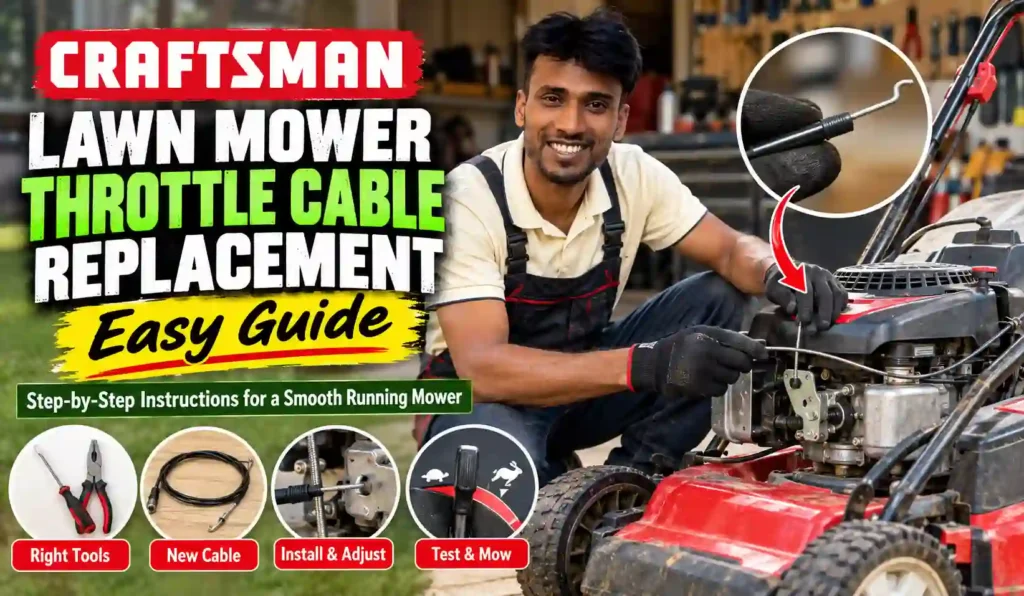
Craftsman lawn mower throttle cable replacement is a 30 to 60 minute job that most homeowners can finish with a screwdriver and a pair of pliers. The throttle cable is the thin steel wire inside a plastic sleeve that links the speed lever on your handle to the engine. When it stretches, frays, or snaps, the lever moves but the engine does not respond.
This guide covers walk-behind Craftsman push mowers, where most throttle cable failures happen. Each step stands on its own, so you can jump to the one you need.
Quick Answer
To complete a Craftsman lawn mower throttle cable replacement, disconnect the spark plug wire, photograph the cable routing, unhook the old cable at the handle lever and at the engine, and pull it out of its guides. Route the new cable along the same path, hook both ends, then set the tension with the lever in the fast position and tighten the housing clamp. Reconnect the spark plug and test the fast, slow, and stop positions before you mow. A matching aftermarket cable usually costs about $9 to $20, and a genuine OEM cable about $20 to $30. Prices may vary by retailer and change over time.
What You’ll Need for Craftsman Lawn Mower Throttle Cable Replacement
You need basic hand tools, one correct replacement cable, and a few small supplies. Most Craftsman push mowers use common fasteners, so you rarely need special tools. Gather everything before you start so you are not hunting for a screwdriver with the handle half apart.
Tools
- Phillips screwdriver and a flathead screwdriver
- Needle-nose pliers, for pulling cable ends out of small holes
- Socket set or wrench set, usually 3/8 inch to 1/2 inch, for the cable clamp and handle bolts
- Spark plug socket, only if you want to remove the plug instead of the wire
- Flashlight or work light
Parts
- One replacement throttle cable, also sold as an engine zone control cable
- New cable clips or ties, if the old ones are cracked
- A new cable clamp screw, only if the old one is stripped
Materials
- Clean rags
- A small tray or cup for screws
- Safety glasses and work gloves
- Light machine oil or silicone spray for the cable ends
- Masking tape and a marker to label the cable ends
Safety First
The main danger during a Craftsman lawn mower throttle cable replacement is an accidental engine start. A mower that kicks over while your hand is near the blade or the linkage can cause a serious cut. Follow these rules every time.
- Pull the spark plug wire off the plug and tuck it away from the plug. This is the single most important safety step.
- Let the engine cool for at least 15 minutes if you just ran it. Mufflers stay hot long after the engine stops.
- Keep the mower upright if you can. If you must tip it, tip it with the air filter and carburetor facing up so oil and fuel do not run into the air filter or cylinder.
- Wear safety glasses. Cable ends and springs can fly out when released.
- Never put your hands near the blade. Treat it as live even with the plug wire off.
Common mistake: tipping the mower the wrong way. A carburetor-down tip can flood the air filter with oil and cause hard starting and smoke later.
Before You Start
You should confirm the cable is actually the problem before you buy parts. A Craftsman lawn mower throttle cable replacement fixes lever problems, but other faults look similar from the handle.
What the Throttle Cable Does
A throttle cable is a push-pull wire. When you move the lever on the handle, the wire slides inside its sleeve and moves a small lever on the engine. On most Craftsman push mowers, that engine lever controls how far the carburetor opens, which sets engine speed. Think of it like a bicycle brake cable, except it controls engine speed instead of a brake.
Many Craftsman models use a single-lever “zone control.” One lever has positions for fast, slow, and stop, and some models add a choke position. On these mowers, the same cable also moves the stop contact that shuts off the ignition. This is why a bad cable can stop the engine from starting or from shutting down.
Signs the Throttle Cable Is Bad
- The handle lever feels loose, floppy, or has no resistance.
- The lever moves but the engine speed stays the same.
- The engine runs only at full speed no matter where the lever sits.
- The engine will not shut off when you move the lever to stop.
- The wire is visibly rusted or has broken strands at the ends.
Which Cable Is Which
Craftsman push mowers can have three different cables near the handle, and mixing them up is a common error.
| Cable | What It Controls | Where It Ends |
|---|---|---|
| Throttle or engine zone control cable | Engine speed and stop position | Engine control bracket |
| Blade stop or safety cable | Blade engagement when you squeeze the bail bar | Blade brake or engine kill |
| Drive or traction cable | Self-propelled wheel drive | Transmission |
This guide covers the first cable only. Riding mowers use a longer accelerator cable, so check the model manual for those.
Step 1: Find Your Model Number
Your model number tells you which cable fits. Look for a sticker or stamped plate on the mower deck, usually near the rear wheel or under the engine shroud. Craftsman push mowers often have numbers that start with 917 followed by a six-digit code, such as 917.376480.
Write the full number down, and take a clear photo of the sticker. If the sticker is worn off, note the engine brand and model number from the engine shroud as a backup. A parts lookup can use either.
Pro tip: photograph the sticker before you start cleaning the deck. Scrubbing it with a wet rag is the fastest way to lose the numbers.
Step 2: Buy the Correct Replacement Cable
A Craftsman lawn mower throttle cable replacement needs a cable that matches your model, not just the brand name. Enter your model number in a parts lookup, or compare the part number on the old cable if it is printed on the sleeve. Cables listed as compatible with many Craftsman push mowers carry numbers such as 158152, 176556, and 162778, but fit depends on your exact model.
Check these three details before you pay:
- Type: the part should be a throttle or engine zone control cable, not a blade stop cable.
- Length: replacement cables are often listed around 51 to 54 inches, and a few inches of difference changes how the cable routes and how it sets up.
- End fittings: the shape of the metal end at the engine and at the lever should match the old cable.
Aftermarket cables usually cost about $9 to $20. A genuine OEM cable usually costs about $20 to $30.
Common mistake: ordering by length alone. Two cables of the same length can have different end fittings and will not connect to your lever.
Step 3: Disconnect the Spark Plug Wire
Pull the rubber boot straight off the spark plug. Grip the boot, not the wire, and twist gently as you pull. Fold the wire back and tuck it away from the plug so it cannot spring back and touch the metal.
For extra protection, remove the plug with a spark plug socket. You can check its condition while it is out.
Pro tip: put a piece of masking tape across the plug wire so you can see at a glance that it is disconnected.
Step 4: Photograph and Trace the Cable Routing
Taking photos of the old cable routing saves more time than any other step. The cable usually runs from the handle lever down along the handle tube, passes through clips or guides, drops to the deck, and ends at the engine.
Take photos from three angles: the lever end at the handle, the middle section with each clip visible, and the engine end close up. Then trace the path with your finger, count the clips, and note which side of the handle tube each one sits on.
Common mistake: relying on memory. A cable that crosses the handle in a new spot can bind in tight turns and wear out in one season.
Step 5: Release the Cable at the Handle Lever
Start at the top. The cable ends in a small metal fitting that sits in a slot or hole on the lever assembly. Depending on the model, you may need to remove one or two screws to open the lever cover, or you may be able to see the fitting from the side.
- Move the lever to the slow position so the cable has the most slack.
- Remove the cover screws if there are any and set them in your tray.
- Look at how the cable end is seated. It is usually a barrel, a Z-bend, or a small loop.
- Lift or slide the end out of the lever, using needle-nose pliers if the fit is tight.
- Slip the cable sleeve out of its holder at the top of the handle.
Pro tip: if the end is stuck, a drop of penetrating oil and a minute of waiting does more than force.
Step 6: Release the Cable at the Engine
The engine end is where the cable is clamped and hooked. Look near the carburetor and air filter for a small bracket with a screw clamp holding the cable sleeve. The cable wire continues past the clamp and hooks onto a small lever called the throttle control lever.
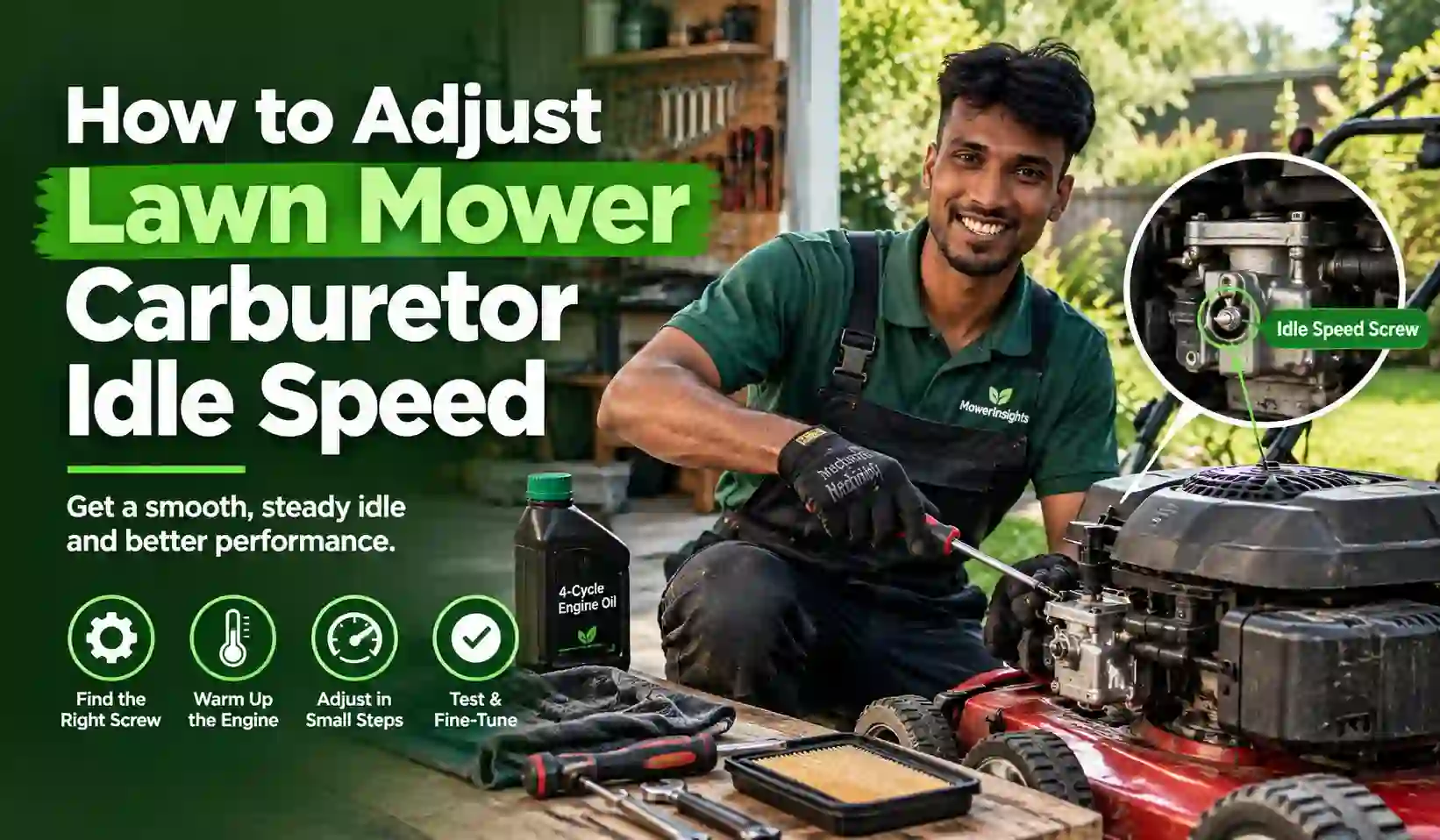
Before you loosen anything, take one more photo of the engine end. Note where the lever sits, which hole the wire uses, and where the clamp holds the sleeve.
Remove the Clamp and the Wire End
- Loosen the clamp screw with a screwdriver or a small wrench. Do not remove it fully, or you may lose it in the engine.
- Slide the cable sleeve out of the clamp.
- Unhook the wire end from the control lever by turning it and lifting it out of the hole.
- Pull the cable free of the bracket.
Some engines use a spring on the control lever. If a spring is attached, note how it is hooked before you let go. The spring must go back in the same position.
Common mistake: loosening the wrong screw. The carburetor mounting bolts and governor linkage look similar. Only loosen the screw that clamps the cable sleeve.
Step 7: Pull the Old Cable Out of Its Guides
With both ends free, remove the old cable from the handle. Open each plastic clip with a screwdriver or pry it with your fingers, and work the cable out one clip at a time. Keep the clips and note where each belongs.
Slide the cable down and out. Do not yank. If the old cable broke, remove the two broken halves separately.
Pro tip: lay the old cable on the floor beside the mower. Keeping it nearby gives you a length and shape reference for the rest of the job.
Step 8: Compare the Old and New Cables
Lay the new cable next to the old one before you install it during your Craftsman lawn mower throttle cable replacement. Check the total length, the sleeve length, the wire length that sticks out at each end, and the shape of the end fittings. A mismatch is far easier to fix now than after the cable is routed.
If the Cable Is Too Long or Too Short
A cable that is too short will not reach and must be replaced. Do not cut, stretch, or splice a throttle cable. The wire inside is a set length and the sleeve is part of the adjustment.
Common mistake: assuming a longer cable can be trimmed. Cutting the sleeve removes the stop that holds it in the clamp.
Step 9: Route the New Cable
Route the new cable along the same path as the old one. Use your photos as a guide. Start at the engine end and work toward the handle, or the other way if the handle path is simpler on your model. Keep the cable in the same clips and on the same side of the handle tube.
Leave all clips open until the cable is in place, then snap them closed one at a time. Gentle, wide curves work best. Sharp bends make the lever stiff and shorten cable life.
Check for Pinch Points
Fold the handle down if your mower has a folding handle and check that the cable has slack when the handle moves. If the cable gets tight when the handle folds, the route is wrong. The wire should not touch the blade housing, the muffler, or any hot or moving part.
Pro tip: put a light coat of silicone spray or machine oil on the wire ends before routing. It helps the cable slide and slows rust.
Step 10: Hook Up the Handle End
Connect the lever end first. Move the lever to the fast position, since this is the most common position to set the cable from. Seat the cable end in the lever hole or slot the same way the old one sat. Fit the sleeve into its holder and replace the cover and screws.
Test the lever by hand. It should move smoothly from fast to stop with light, even resistance. If it feels rough or catches, the end may not be fully seated, or the route may have a sharp bend. Leave the engine clamp loose for now, because you need slack to set the tension in the next step.
Common mistake: forcing the cable end into the wrong hole. If the end does not seat easily, stop and check the old photos.
Step 11: Hook Up the Engine End and Set the Tension
Setting the tension is the most important part of Craftsman lawn mower throttle cable replacement. Too loose and the engine will not reach full speed. Too tight and the engine may stay at high speed, or the stop position may not work.
Follow these steps with the handle lever in the fast position:
- Hook the cable wire end into the engine control lever, the same hole the old cable used.
- Slide the cable sleeve into the bracket and rest it in the clamp, but do not tighten the screw.
- Push the engine control lever to its fully open (fast) stop, so the throttle is wide open.
- Pull the cable sleeve gently away from the engine until the slack is gone, with no strain on the wire.
- Hold the sleeve in that spot and tighten the clamp screw firmly.
Check the Stop Position
Move the handle lever to stop. On a zone control model, the engine control lever should touch the stop contact or reach the end of its travel. If it falls short, the engine may keep running when you try to shut it off. If this happens, loosen the clamp, slide the sleeve slightly, and retighten.
Pro tip: make small changes. Moving the sleeve by an eighth of an inch changes the lever position more than you expect.
Step 12: Test the Throttle Before You Mow
A final test of your Craftsman lawn mower throttle cable replacement catches problems before you are standing behind a running mower. Do this in an open area with the mower on level ground and the blade area clear.
- Put the spark plug back and reconnect the plug wire, pressing it on firmly until you feel it seat.
- Set the lever to fast and start the mower as usual.
- Move the lever from fast to slow. The engine should drop to idle smoothly.
- Move the lever back to fast and confirm that the engine speeds up.
- Move the lever to stop and confirm that the engine shuts off within a few seconds.
- Repeat the full cycle twice to confirm the setting is steady.
If anything fails, shut the engine off, disconnect the plug wire, and go back to Step 11. Most problems come from a clamp that is a fraction of an inch off.
Common mistake: skipping the stop test. A mower that will not shut off with the lever is unsafe, even if it seems to run well.
Common Problems and Mistakes in Craftsman Lawn Mower Throttle Cable Replacement
These are the mistakes that cause the most trouble after a replacement. Use the table to match your symptom to the likely cause.
| Problem | Likely Cause | Solution |
|---|---|---|
| Engine runs only at full speed | Cable too tight, or the end is in the wrong hole | Loosen the clamp, reset the tension with the lever at fast, and check the hole |
| Engine will not reach full speed | Cable too loose, or the sleeve has slipped in the clamp | Pull the sleeve to remove slack and retighten the clamp |
| Engine will not shut off | Control lever does not reach the stop contact | Adjust the sleeve position so the lever travels fully to stop |
| Lever feels stiff or catches | Sharp cable bend, dirt, or a pinched cable | Reroute with wide curves and clean the bracket |
| Cable pops out of the lever | End not fully seated, or the wrong fitting | Reseat the end and confirm the fitting matches the old one |
| Cable rubs the engine or deck | Route differs from the original | Return the cable to the factory path and secure it in the clips |
Troubleshooting Your Craftsman Lawn Mower Throttle Cable Replacement
If the new cable is installed and the mower still does not respond correctly, work through the three most likely failure points below. Disconnect the spark plug wire each time before you touch the linkage.
The Engine Speed Does Not Change When You Move the Lever
First, watch the engine control lever while a helper moves the handle lever. If the cable wire moves but the engine lever does not, the end fitting has slipped out of its hole. Reseat it and check that any small retaining clip is in place.
If the engine lever moves but the engine speed stays the same, the problem is past the cable. Look for a disconnected governor spring or a stuck carburetor throttle plate.
The Engine Runs Too Fast or Surges
A cable that is too tight pulls the control lever beyond its normal position and keeps the throttle partly open. Loosen the clamp, put the handle lever at slow, and check that the engine lever sits at the idle stop. Then reset the tension at fast as in Step 11.
If the engine surges even with good cable tension, a dirty carburetor or old fuel is the likely cause.
The Engine Will Not Start or Will Not Stop
On a zone control mower, a cable set too loose may leave the stop contact touching the ignition. The engine then has no spark and will not start. A cable set too tight may keep the contact away at stop, so the engine keeps running. Both problems come from the sleeve position in the clamp. Adjust the clamp until fast and stop both work.
Expert Tips
These habits make a Craftsman lawn mower throttle cable replacement last longer.
- Replace the cable before it breaks. A cable that has become stiff or frayed will fail soon, and a break often happens while you are mowing.
- Oil the wire ends once or twice each season with a drop of light oil. This keeps moisture from rusting the wire inside the sleeve.
- Keep the old cable until the new one works. It is your length and fitting reference if something does not match.
When to Call a Professional
Stop your Craftsman lawn mower throttle cable replacement and get help if you see any of the problems below. They go beyond a cable and are safer to fix with a trained technician.
- The engine will not shut off at stop even after a careful tension adjustment. This is a safety issue.
- The governor spring is missing, stretched, or unhooked, and you are not sure where it attaches.
- The clamp screw hole on the engine bracket is stripped and will not hold the sleeve.
- The handle lever assembly is cracked or broken, not just the cable.
- Fuel is leaking near the carburetor, or you smell gas after the job.
FAQs
How long does a Craftsman lawn mower throttle cable replacement take?
Most homeowners finish a Craftsman lawn mower throttle cable replacement in 30 to 60 minutes. This is a MowerInsights estimate.
How much does a Craftsman lawn mower throttle cable replacement cost?
A replacement throttle cable usually costs about $9 to $20 for an aftermarket part and about $20 to $30 for a genuine OEM part. Prices may vary by retailer and change over time.
Can I skip a step in a Craftsman lawn mower throttle cable replacement?
You can skip the optional ones, such as oiling the wire ends, but not the safety steps, the photos, or the final tension and stop test.
What if my Craftsman lawn mower throttle cable replacement still doesn’t work?
Check that the end fittings are seated and the clamp is set with the lever at fast. If both are correct, look at the governor spring and carburetor linkage, since those parts can cause the same symptoms. A cable that is the wrong type or length will also fail to work, so compare it with the old one again.
How do I know if my mower needs a throttle cable or a zone control cable?
On many Craftsman push mowers they are the same part. A mower with a single lever that has fast, slow, and stop uses a zone control cable, which is sold as an engine zone control or throttle cable. Check your model number and match the cable type and fittings to the old one.
Final Takeaway
Craftsman lawn mower throttle cable replacement comes down to four things: the right cable, clear photos of the routing, a disconnected spark plug, and a careful tension setup with the lever at fast. Test fast, slow, and stop before you mow. Stop and get help if the engine will not shut off or the governor spring is out of place. With the right part, the job usually takes under an hour.
Why Trust This Guide
MowerInsights.com is run by Siddik Kazi, who repairs and services lawn mowers at his own shop in Italy. That workshop experience shapes what this Craftsman lawn mower throttle cable replacement guide warns about, such as routing errors and loose clamps. Reviewed by Siddik Kazi.
Sources and methodology: this guide draws on manufacturer-style parts listings and cable specifications, an analysis of owner feedback about throttle cable replacement on Craftsman push mowers, and a review of existing coverage to find gaps. Prices are MowerInsights estimates. Check your mower’s manual and model number before you buy a part.