How to remove stripped lawn mower blade bolt is the question you face when the socket spins, the corners look round, and the blade will not budge. It happens when someone uses the wrong wrench, or when rust locks the threads in place. The bolt can nearly always come out with the right tool and some patience.
This guide gives 12 steps, ordered from the easiest fix to the last resort. Start at Step 1 and stop the moment the bolt turns. Skipping ahead can damage the bolt more and make the job harder.
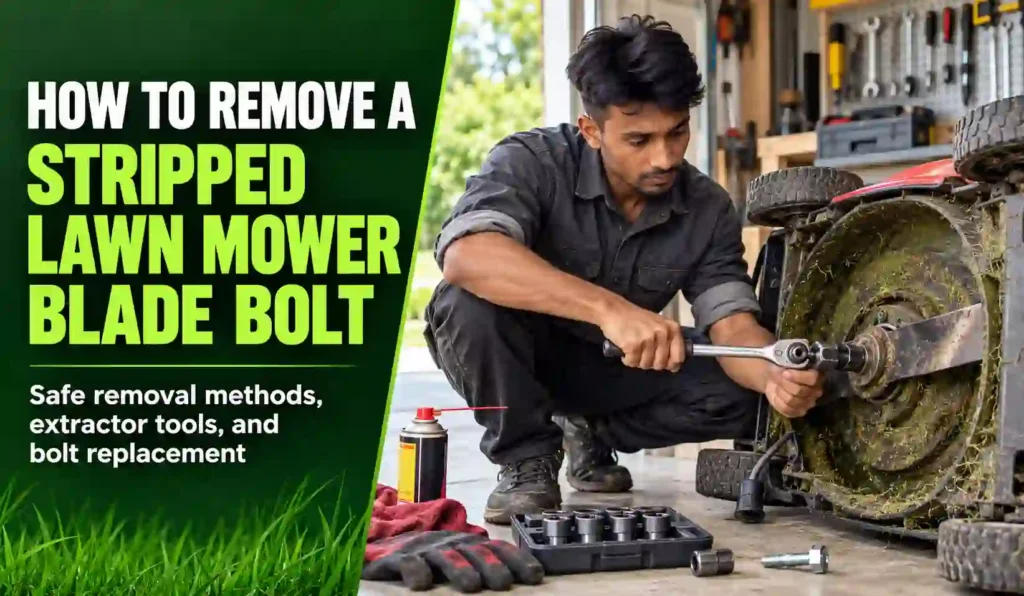
Quick Answer: How to Remove Stripped Lawn Mower Blade Bolt
The fastest way to remove a stripped lawn mower blade bolt is to soak it in penetrating oil, then grip the damaged head with a 6-point socket or a bolt-extractor socket and pull with a breaker bar. If that fails, file the head to a smaller size, clamp it with locking pliers, or drill it out with a left-hand drill bit. Always pull the spark plug wire first and lock the blade with a block of wood. The sections below show how to remove stripped lawn mower blade bolt jobs of every kind, from mild rust to a snapped head.
What You Need Before You Start
You need basic hand tools for most stripped blade bolts, plus a few extras for stubborn ones. Gather everything first so you are not hunting for a tool while the mower sits tilted on its side. The list below is split into tools, parts, and materials. These items cover every method in this guide on how to remove stripped lawn mower blade bolt problems.
Tools
- 6-point socket that fits the bolt head (common sizes are 9/16 inch and 5/8 inch)
- Breaker bar or a long 1/2-inch drive ratchet
- Hammer and a center punch
- 2×4 wood block to lock the blade
- Bolt-extractor socket set with spiral flutes
- Metal file, or an angle grinder with a cutting disc
- Locking pliers
- Drill with left-hand drill bits and bolt extractors
- Torque wrench for the new bolt
- Wire brush, safety glasses, and thick gloves
Parts
- New blade bolt that matches the maker’s spec
- New washers, including any cup-shaped (Belleville) washer
- New blade, if yours is bent or worn thin
Materials
- Penetrating oil
- Anti-seize compound
- Clean rags and degreaser
Safety First: Protect Yourself Before You Touch the Blade
Disconnect power before you touch the blade, because a small turn of the engine can spin it. Pull the spark plug wire on a gas mower, or remove the battery on a cordless one. Then put on gloves and safety glasses for the whole job.
- Pull the spark plug boot off and tuck it away from the plug.
- Remove the battery from a cordless mower, or unplug a corded one.
- Run the tank low before you tilt the mower to cut down on spills.
- Tilt the mower with the spark plug, air filter, and carburetor facing up, so oil and fuel do not flood the air intake.
- Never hold the blade with your hand. Use a wood block.
- Keep sparks and flames away from fuel vapor. Grinders and torches both throw heat.
- On a riding mower, lift the deck with ramps or jack stands. A jack alone is not enough.
- Spend five minutes on safety before you start how to remove stripped lawn mower blade bolt work, because a slipped wrench next to a sharp blade can cut a hand.
- Keep kids and pets out of the work area while the mower is tilted.
Before You Start: How to Remove Stripped Lawn Mower Blade Bolt the Smart Way
Name the problem before you pick a method. The word “stripped” can mean a rounded head, a rusted bolt, or damaged threads. Each one needs a different fix, and the right first move saves time.
| Problem | What You See | Best First Move |
|---|---|---|
| Rounded head | Corners look worn, socket slips | Steps 6 to 8 |
| Rusted solid | Head looks fine, bolt will not turn | Steps 4 to 6 |
| Rounded and rusted | Both problems at once | Steps 4 to 9 |
| Damaged threads | Bolt turns but never backs out | See the Troubleshooting section |
| Snapped bolt | Head is gone, stub remains | Steps 10 and 11 |
Four things round most blade bolts: a 12-point socket, an adjustable wrench, rust that grips the threads, and a bolt tightened far past its spec. Knowing the cause helps you avoid a repeat.
This table shows how the 12 steps for how to remove stripped lawn mower blade bolt compare, so you can see what each method asks of you.
| Steps | Method | Skill Level | Extra Tools |
|---|---|---|---|
| 4 and 5 | Penetrating oil and taps | Easy | Hammer, oil |
| 6 and 7 | 6-point socket, smaller socket, extractor socket | Easy to medium | Breaker bar, extractor sockets |
| 8 and 9 | File flats, locking pliers, cut a slot | Medium | File, pliers, rotary tool |
| 10 | Weld on a nut or grind the head off | Hard | Welder or angle grinder |
| 11 | Left-hand drill bit and extractor | Hard | Drill, extractor set |
Check three more things before you start.
First, check the thread direction. Most walk-behind mowers use a standard right-hand thread, so you turn counterclockwise to loosen. On decks with more than one blade, one spindle may use a reverse thread, so read your manual.
Second, find the torque spec. Service guidance from one major mower maker lists 30 ft-lbs for a typical walk-behind blade bolt. Other common service specs run from 35 to 50 ft-lbs. Your manual has the exact number.
Third, take a photo of the blade. You want to remember which side faces up when it goes back on.
Step 1: Make the Mower Safe to Work On
Make the mower safe first, because every other step puts force on the blade. This is step one of how to remove stripped lawn mower blade bolt jobs, and no later method works safely without it. Pull the spark plug wire, or remove the battery on a cordless model. Tilt the mower so the spark plug, air filter, and carburetor face up.
Set the mower on a flat, firm surface. If it rolls, block the wheels. On a riding mower, raise the deck on ramps or stands and check that it cannot shift.
Common mistake: Tilting the mower with the air filter facing down. Oil can run into the filter and the carburetor, and the mower may smoke or refuse to start later.
Step 2: Lock the Blade So It Cannot Spin
A blade that turns when you pull on the bolt wastes your force and can hurt you. Wedge a 2×4 block between one end of the blade and the inside of the deck. The block should sit firm, with no wiggle.
Check the lock before you pull
Push on the blade by hand with the wire already off. If it moves, reset the block. A solid lock lets you use full force on the wrench.
Pro tip: If you plan to use an impact wrench, the lock still helps. It keeps the blade from bouncing against the deck.
Step 3: Clean the Bolt and Check the Thread Direction
A clean bolt gives your socket a better bite. Scrape grass, dirt, and rust off the head and the washer with a wire brush. Wipe away oily grime with a rag and degreaser.
Look at the bolt and the spindle for an arrow or marking that shows the loosening direction. If you see none, use your manual. Most walk-behind blades loosen counterclockwise when you look at the bolt head from below.
Common mistake: Turning a reverse-thread bolt the wrong way. You tighten it harder and may snap it, so confirm the direction first.
Step 4: Soak the Bolt With Penetrating Oil
Rust is the main reason a bolt stays stuck, and penetrating oil is the fix. Every plan for how to remove stripped lawn mower blade bolt starts with oil, because it does the quiet work while you wait. Spray the head, the washer gap, and any exposed threads. Let it sit for at least 30 minutes, and overnight if the bolt is badly rusted.
A light spray lubricant helps a little. A product made to creep into rust works better. Spray again every hour or so if you cannot wait overnight.
Pro tip: Tilt the mower so the oil runs toward the threads instead of off the deck. Wipe off extra oil afterward so it does not drip onto belts or the engine.
Step 5: Shock the Rust Loose With Taps
Rust forms a hard crust around the threads, and a few hard taps can crack it. Strike the center of the bolt head 3 to 4 times with a hammer. The shock lets the oil creep deeper into the threads.
Try a small turn the wrong way
Try a tiny turn in the tightening direction first. Even a small movement can break the rust bond. Then spray again and wait before you try loosening.
Common mistake: Hitting the bolt so hard that it bends the crankshaft end or the deck. Use firm taps, not swings.
Step 6: Try a 6-Point Socket and a Breaker Bar
A 6-point socket grips the flat sides of the head, while a 12-point socket grips the corners and slips. Pick the exact size, seat it fully, and pull with a breaker bar or a long-handle ratchet. If you only try one method for how to remove stripped lawn mower blade bolt, make it this one with a clean 6-point socket. Pull in a smooth, steady push instead of a jerk.
If you own an impact wrench, try it now. Its fast hammering action often shakes a rusted bolt free. Keep the wrench square to the bolt so it does not skip off the head.
Pull smoothly, do not jerk
- Seat the socket all the way onto the head before you pull.
- Keep the breaker bar level so the socket does not tilt off the bolt.
- Push with steady body weight, not a sudden yank.
- Stop if the socket starts to slip, and move to Step 7.
Pro tip: Use a longer bar before you reach for a hammer. More leverage is safer than more impact.
Step 7: Tap On a Smaller Socket or Use an Extractor Socket
A rounded head often accepts a socket that is one size smaller, if you drive it on. Choose a 6-point socket slightly smaller than the head. Tap it on with a hammer until it bites the metal, then turn it with the breaker bar.
Pick the right size
- Try sockets one size down from the nominal head size, such as 1/2 inch on a 9/16-inch head.
- The socket should need a few light taps to start. If it slides on easily, it is too loose.
- Check that the socket sits straight, with no tilt, before you pull.
Use a bolt-extractor socket
A bolt-extractor socket has spiral flutes inside. When you turn it counterclockwise, the flutes dig into the rounded head and tighten their grip. This is often the quickest way to handle how to remove stripped lawn mower blade bolt jobs when the head is still tall enough.
Common mistake: Using an old, worn socket. A damaged socket slips and rounds the bolt even more.
Step 8: Reshape the Damaged Head With a File
If the corners are gone, you can make new ones. Use a metal file to cut two flat sides on the head, parallel to each other. Then fit an open-end wrench or a smaller socket over the new flats.
One repair video shows a 9/16-inch head being filed down so a 1/2-inch socket fits. Filing is slow, but it is a reliable answer to how to remove stripped lawn mower blade bolt when a socket will not bite. The head only needs to be a clean hex shape again. File slowly, and test the fit often.
Pro tip: Soak the bolt in oil first. A flat-sided head plus a rust-free thread gives the best chance of turning without slipping.
Step 9: Grip It With Locking Pliers or Cut a Slot
Locking pliers can clamp onto a head that has a little material left. Set the jaws as tight as possible and lock them. Then turn the pliers counterclockwise with steady force. Both tricks handle how to remove stripped lawn mower blade bolt problems without special tools.
If the head is too flat for pliers, cut a slot across it with a rotary tool or a hacksaw. The slot should be about 1/8 inch deep. Then use a flat screwdriver bit in a breaker bar or an impact driver to turn it.
Common mistake: Cutting the slot too shallow. The screwdriver pops out and rounds the slot, so cut deep enough to hold.
Step 10: Weld On a Nut or Grind the Head Off
These two options are for stubborn bolts. If you can weld, fuse a nut or a short bar onto the damaged head. The heat also helps break the rust, and a socket now grips the new nut. Empty the fuel tank, clear the area, and clamp the welder ground close to the bolt.
If you cannot weld, grind the head off. This removes all clamping force, so the blade comes free. You are then left with a short stub of bolt in the threaded hole.
Soak the stub in oil for a day or more. Then try to grip it with locking pliers. If it will not budge, go on to Step 11.
Common mistake: Grinding into the crankshaft or spindle face. Stop as soon as the head separates from the shank.
Step 11: Drill the Bolt With a Left-Hand Bit and Use an Extractor
This is the most dependable answer to how to remove stripped lawn mower blade bolt when the head is gone. A left-hand drill bit cuts in reverse, so the drilling itself can back the bolt out. Tool makers often advise starting with a left-hand bit before any extractor. Punch a dimple in the center of the bolt, then set your drill to reverse at the slowest speed.
Drill a pilot hole
Start with a small bit and work up to a larger one. Keep the drill straight and let the bit do the cutting. If the bolt spins free, you are done.
Use the extractor
If the bolt stays put, tap the extractor into the hole. Turn it counterclockwise with a wrench, not a drill. Use steady force and stop if it feels like it will snap.
Common mistake: Forcing an extractor. These tools are hard and brittle, and a broken piece is harder to drill than the bolt.
Step 12: Install the New Bolt the Right Way
After you finish how to remove stripped lawn mower blade bolt, the new bolt deserves the same care. A fresh bolt and correct torque keep the next removal easy. Clean the threads in the spindle or crankshaft with a brush. Put the blade on with the sail (curved edge) facing up toward the deck, then add the washers in the original order. If your mower has a cup-shaped washer, set its outer rim toward the blade.
Tighten with a torque wrench to the number in your manual. Many walk-behind mowers call for 30 to 50 ft-lbs. A thin film of anti-seize on the threads can help, but some makers want dry threads, so check your manual first.
Pro tip: Replace the bolt and washers any time the old ones were rounded or rusted. A new set costs little compared with doing this job twice.
Common Problems and Fixes
This table covers the issues that most often stop how to remove stripped lawn mower blade bolt jobs. Match your symptom to the likely cause, then use the fix.
| Problem | Likely Cause | Solution |
|---|---|---|
| Socket slips on the head | 12-point socket or worn corners | Switch to a 6-point socket or an extractor socket |
| Blade turns while you pull | Blade is not locked | Wedge a 2×4 between the blade and deck |
| Head snaps off | Too much force on a rusted bolt | Drill the stub with a left-hand bit |
| Bolt turns but will not back out | Damaged or cross-threaded threads | Pull the blade while turning, then see Troubleshooting |
| Extractor breaks inside the bolt | Forcing a brittle tool | Use a carbide bit or ask a shop for help |
| Nothing moves after the soak | Deep rust in the threads | Soak longer, tap, and try heat on the surrounding metal |
Troubleshooting: What to Do If the Fix Does Not Work
If the bolt still holds after Step 11, one of three problems is usually the cause. These are the last hurdles in how to remove stripped lawn mower blade bolt cases. Each has its own fix, listed below.
The bolt turns but never comes out
This means the threads are damaged, often in the crankshaft or the adapter. Try pulling the blade down while you turn the bolt slowly. If it comes out in pieces or with metal shavings, the threads need repair.
A machine shop can bore out the hole and install a thread insert. On some mowers, replacing the crankshaft adapter or the spindle is cheaper than repairing the old part.
The extractor snapped inside the bolt
A broken extractor is hard steel, and a normal drill bit will not cut it. Do not keep drilling and ruin your bits. A carbide bit may work, but at this point a machine shop is usually faster.
Nothing moves, even after all steps
Heat can break the last of the rust. Heat the metal around the bolt, not the bolt head, so the surrounding metal expands. Use short bursts and let it cool before you try again. Heating and cooling the metal cracks the rust bond, and the oil can then reach the threads.
Use heat only when the tank is empty, the area is wiped clean of fuel, and a fire extinguisher is within reach. Keep the flame off the crankshaft seal and any plastic. If you feel unsure, skip this step and visit a shop.
Expert Tips for Stripped Blade Bolts
Use these habits so you never need to learn how to remove stripped lawn mower blade bolt again. They follow standard repair practice.
- Use a 6-point socket for every blade bolt, every time.
- Never use an adjustable wrench or pipe wrench on a blade bolt. Both round the corners.
- Replace the bolt and washers whenever you change or sharpen the blade.
- Use a torque wrench to tighten the bolt. Guessing leads to bolts that are too tight or too loose.
- Spray the bolt with penetrating oil a day before you plan to remove it.
- Buy the new bolt and washers before you start, so the mower is not stuck in pieces over a weekend.
- Write the torque spec on the deck with a paint marker so you never have to look it up again.
- Check the blade bolt at the start of each mowing season for rust or a loose fit.
When to Call a Professional
Call a shop when the next step needs tools or skills you do not have. Knowing when to stop is part of how to remove stripped lawn mower blade bolt safely. A mower shop can often finish the job in less time than you will spend fighting it. These signs mean it is time to stop:
- The crankshaft threads are stripped or the crank end is damaged.
- The blade hit something hard and the crankshaft may be bent.
- The extractor snapped and the stub is below the surface.
- You do not have a welder or drill and do not want to buy them.
- A riding mower spindle is seized and will not turn.
FAQs
How to remove stripped lawn mower blade bolt the fastest way?
Soak it in penetrating oil, then try a bolt-extractor socket or a smaller 6-point socket tapped onto the head. Pull with a breaker bar. This works on most rounded bolts without any cutting or drilling.
Can I use an impact wrench to remove a stripped blade bolt?
Yes, an impact wrench often works well on rusted bolts because the hammering action breaks the rust bond. Use it with a 6-point socket or an extractor socket. Do not use it on a head that is already badly rounded, because it can finish the damage.
Which way do I turn a lawn mower blade bolt to loosen it?
Most walk-behind mowers use a right-hand thread, so you turn counterclockwise to loosen. Some multi-blade decks use a reverse thread on one spindle. Check your manual to be sure.
Does WD-40 work on a stuck blade bolt?
A light spray lubricant helps a little, but a product made to creep into rust works better. Soaking the bolt overnight beats a quick spray, so give the oil time. Reapply it a few times if the bolt is badly rusted.
How tight should a lawn mower blade bolt be?
It depends on your mower. Service guidance from one major maker lists 30 ft-lbs for a typical walk-behind, and other common specs run from 35 to 50 ft-lbs. Use a torque wrench and the number in your manual.
What if the bolt snapped off?
Soak the stub in oil, then try locking pliers if enough is sticking out. If not, drill it with a left-hand bit and use an extractor. If threads are damaged, a machine shop can install a thread insert.
Final Takeaway
How to remove stripped lawn mower blade bolt comes down to giving your tool a better grip. Soak the bolt, use a 6-point socket, and try an extractor socket or a smaller socket before you cut or drill. File, clamp, weld, or drill only when the easy steps fail. Replace the bolt, torque it to spec, and your next blade change should go smoothly.
Why Trust This Guide
Siddik Kazi runs a lawn mower repair service in Milan, Italy, and this guide reflects the kind of jobs that come through a repair shop. Reviewed by Siddik Kazi.
This guide draws on mower-maker service guidance, tool-maker instructions for extractors and left-hand drill bits, and a review of shared owner repair discussions. Torque numbers are examples from common models, so always use your own manual.