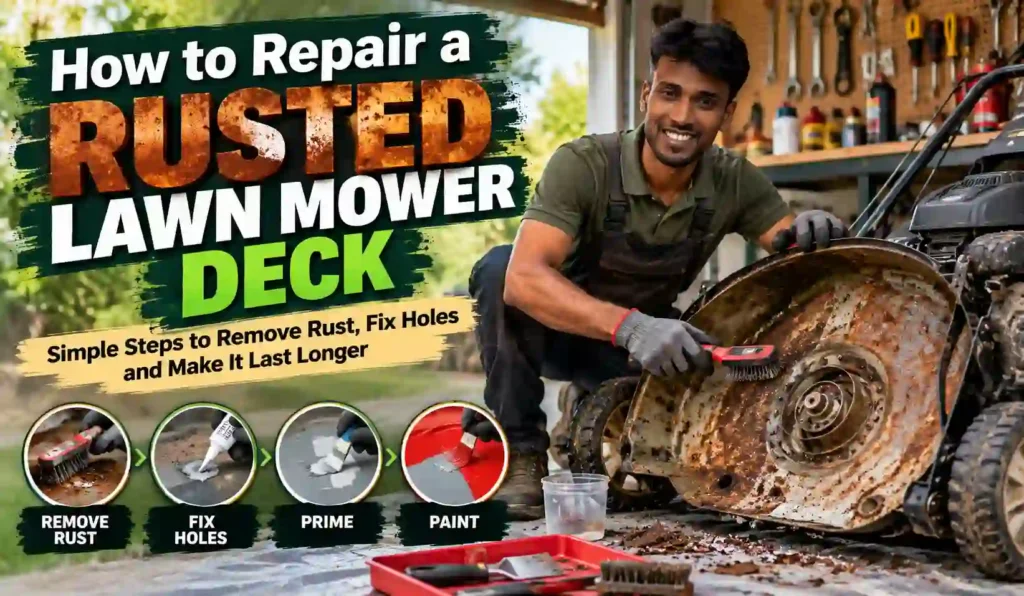
You can repair a rusted lawn mower deck in a weekend when the rust sits on the surface or has only eaten small holes. A deck that stays damp under wet grass clippings, or sits under a tarp all winter, will rust within a few seasons. Most surface rust needs a wire brush, rust converter, primer, and paint, which together cost well under $50.
Deep rot is a different job. If the metal near the blade spindles or the engine mount has gone thin, no paint will fix it. This guide shows you how to tell the difference, then walks you through every step of the repair.
Quick Answer
To repair a rusted lawn mower deck, pull the spark plug wire, scrub off loose rust with a wire brush, wipe away grease, and brush on rust converter. Fill small holes with metal epoxy, weld a steel patch over bigger ones, then prime and paint with rust-resistant paint.
Surface rust takes a few hours of work plus one to two days of drying. Holes wider than 0.6 inches (1.5 cm) need a welded patch. If the steel around the blade spindles is thin or cracked, replace the deck instead.
What You Need to Repair a Rusted Lawn Mower Deck
A surface-rust job needs a wire brush, degreaser, rust converter, primer, paint, and basic safety gear. Hole and crack repairs add metal epoxy or a welder. Gather everything first.
Tools
- Wire brush, about $5 to $10, for loose rust and flaking paint
- Plastic scraper or stiff nylon brush for caked-on grass
- Socket set and adjustable wrench for the deck and blade bolts
- Angle grinder with a flap wheel, about $50 to $150, only for heavy rust or welding prep
- Paint brush or foam brush for rust converter
- Locking pliers, file, and chipping hammer if you plan to weld
- Tin snips, a metal nibbler, or a grinder cutting disc to cut patch plates
- Sheet metal welder (about $200 to $500) or flux-core MIG welder (about $300 to $600) for large holes and cracks
Parts
- Steel patch plates, 14 gauge, for holes too big for epoxy
- Fresh deck bolts or hardware if the old ones are rusted through
- A new blade if the old one is pitted or bent
Materials
- Degreaser and paint thinner
- Clean rags
- Rust converter
- Metal epoxy for small holes
- Rust-resistant primer, about $5 to $15
- Rust-resistant paint, about $10 to $20
- Tarp to catch rust flakes
- Gloves, safety glasses, and a dust mask
Prices may vary by retailer and change over time. Welding adds a shield, gloves, and a coat, roughly $85 to $230 together.
Safety First Before You Repair a Rusted Lawn Mower Deck
Before you repair a rusted lawn mower deck, disconnect the spark plug wire, deal with the fuel, and put on gloves and eye protection. A mower that starts by accident near the blade causes serious injuries, and these steps remove that risk in five minutes.
- Disconnect the spark plug wire and tuck it away from the plug. On a riding mower, disconnect the battery too.
- Drain the fuel if you will tip or flip the mower. If you must tip it, tilt it so the air filter and carburetor face up, and check your owner’s manual first.
- Work in open air or a ventilated garage. Rust converter, paint thinner, and primer all give off fumes.
- Wear safety glasses and gloves. Wire brushing throws rust flakes and wire bristles.
- Wear a dust mask when grinding. Rust dust and old paint dust are not something to breathe.
- Keep fuel and rags away from sparks. Grinding and welding throw hot sparks, so remove the fuel tank or work on a deck that is off the mower.
- Support the mower on solid blocks. Concrete or wood blocks on flat ground are safer than a jack alone.
Before You Start: Repair or Replace?
Repair the deck when the rust is on the surface or the holes sit away from the blade spindles and engine mount. Replace the deck when the metal near those parts is thin, cracked, or crumbling. The deck shell protects you from thrown debris, so a weak deck near the blade is a safety problem, not just a looks problem.
| Damage | What It Looks Like | Best Action |
|---|---|---|
| Surface rust | Orange dust and light flaking, metal still solid | Wire brush, rust converter, prime, paint |
| Heavy scale or pitting | Rough, bubbled steel, but no holes | Grinder or wire wheel, converter, prime, paint |
| Small holes | Under 0.6 inches (1.5 cm) across | Metal epoxy, then prime and paint |
| Large holes away from the spindles | Bigger than 0.6 inches, solid steel around the edges | Welded steel patch |
| Cracks | Thin splits that grow over time | Drill ends, grind a V, weld |
| Thin or crumbling metal near spindles or mounts | Screwdriver sinks in, spindle plate flexes | Replace the deck |
Cost matters too. A replacement push mower deck can cost up to $200, a riding mower deck often runs $300 to $1,000, and a zero-turn mower deck can cost $400 to $2,500. Old or discontinued decks can be hard to find at any price.
One home metal fabricator who patched a 42-inch riding mower deck with steel plates reported about two hours of work. That time is cheap next to a $400 deck, as long as the metal around the patch is sound.
Step 1: Disconnect the Spark Plug and Stabilize the Mower
Before you repair a rusted lawn mower deck, park the mower on flat, solid ground and pull the spark plug wire off the plug. This single move keeps the engine from firing while you work. On a riding mower, also disconnect the battery and set the parking brake.

Block the wheels or support the frame so nothing can roll. If you will tip a push mower, drain the fuel first and tilt the mower with the air filter and carburetor facing up.
Pro tip: Clip a bright piece of tape to the spark plug wire. It reminds you the wire is off, and you will not forget to reconnect it later.
Step 2: Clean Grass, Mud, and Grease Off the Deck
Remove all caked grass, dirt, and oil before you repair a rusted lawn mower deck. You cannot judge the damage until the metal is visible, and grass packed against steel holds moisture and speeds up rust.
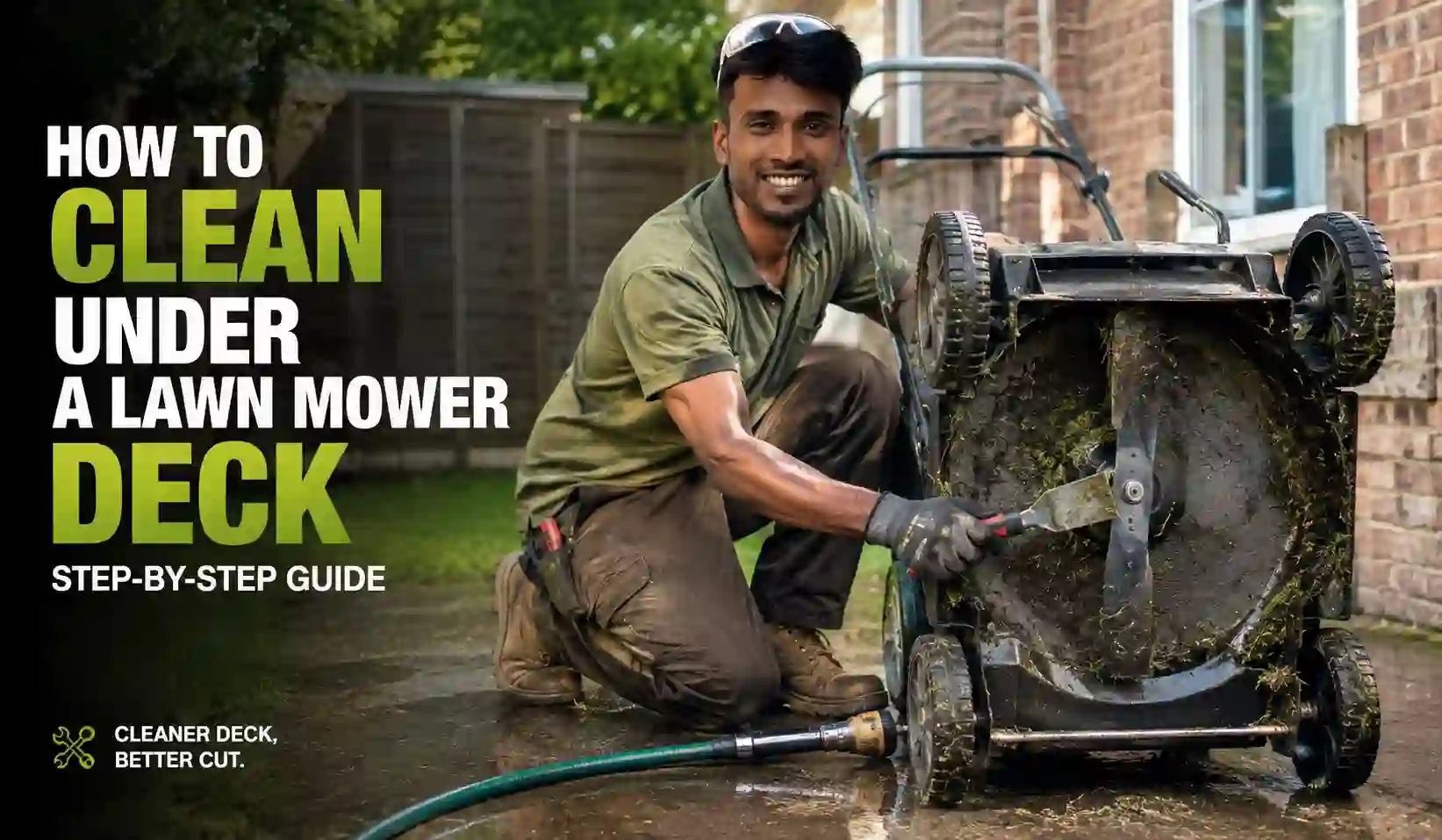
Use a plastic scraper or stiff nylon brush for packed grass. Spray the area with a degreaser, let it sit a few minutes, then rinse with a hose. Pay extra attention to the underside, where most deck rust starts.
Common mistake: Using a screwdriver or putty knife to chip off grass. Sharp tools scratch the paint and create new places for rust to start.
Step 3: Get Access to the Underside of the Deck
To repair a rusted lawn mower deck properly, you need to reach the underside, where grass and moisture sit longest. On a push mower, tip the mower with the air filter up. On a riding mower or zero-turn, lower the deck to its lowest setting and follow your owner’s manual to remove it.
Disengage the blades, take the drive belt off the engine pulley, remove the lift links or pins, and slide the deck out. Photograph the belt path first, since riding and zero-turn decks have more parts to reinstall.
Pro tip: A deck that is off the mower lets you wire brush, grind, and weld without fuel, wiring, or the engine in the way.
Step 4: Scrape and Wire Brush Off Loose Rust and Paint
To repair a rusted lawn mower deck that lasts, brush off every flake of loose rust and peeling paint until the surface feels solid under the bristles. Paint and primer only stick to a firm surface, and anything left loose will lift the new coating within weeks.
Lay a tarp underneath to catch flakes. Use a wire brush for light rust. For thick scale or pitted steel, use an angle grinder with a flap wheel, and wear eye protection and a dust mask.
- Brush the underside, the top, the edges, and the discharge chute.
- Remove all flaking paint around the rust, not just the rust itself.
- Stop when no more material comes off with firm brushing.
Common mistake: Painting over rust that is still flaking. The coating bonds to the rust, not the metal, and peels off in sheets.
Step 5: Check How Deep the Rust Goes
Press the tip of a screwdriver into dark and bubbled spots with moderate force. Solid steel resists, while rotten steel feels soft or punches through. This quick test tells you whether you have a paint job, a patch job, or a replacement job.
Mark every hole and soft spot with a paint marker. Then check the high-stress areas:
- Around the spindle mounting plates, where the blade shaft bolts to the deck
- Around the engine mounting area on push mowers
- Along the deck edges and any welded seams
Soft metal in those spots means the deck should be replaced. Holes elsewhere can be patched.
Pro tip: Flex the deck gently by hand. A shell that bends easily near a spindle plate has lost too much metal.
Step 6: Degrease and Dry the Bare Metal
Wipe the cleaned deck with paint thinner on a rag to remove the oil and grease that soap and water miss. Any repair a rusted lawn mower deck needs, from converter to paint, fails on oily metal.
Let the deck dry completely, in sun or a dry garage. Water trapped in pits and seams turns into fresh rust under new paint.
Common mistake: Skipping the thinner wipe because the metal “looks clean.” Invisible oil is the top reason fresh paint peels.
Step 7: Apply Rust Converter to Surface Rust
Brush rust converter onto every area that still shows rust. Rust converter is a liquid that neutralizes rust chemically and leaves a hard, dark surface that is ready for primer. Many converters dry in about 15 minutes, but follow the label on your product.
- Pour a small amount into a separate cup, so you never dip a dirty brush into the main container.
- Brush a thin, even coat over the rusted spots.
- Watch for the color change to dark gray or black, which means it is working.
- Let it dry fully before the next step.
Skip the converter on clean, bare, shiny metal. It only works on rust, so bare steel goes straight to primer.
Pro tip: Wear gloves. Rust converter stains skin and clothing.
Step 8: Fill Small Holes With Metal Epoxy
To repair a rusted lawn mower deck with small holes, fill any hole under 0.6 inches (1.5 cm) with metal epoxy. Even a tiny hole lets moisture into the steel around it, so treat every pinhole you find.
- Rough up the metal around the hole with the wire brush or sandpaper.
- Mix the epoxy exactly as the package says.
- Press it into the hole from the top side, and smooth it level with the deck.
- Let it cure for the full time on the label, then sand it flush.
Some owners use a fiberglass resin kit on mid-size holes. The mixed resin sets in only a few minutes, and the cured patch hardens in about 20 minutes, so mix small batches. Resin handles heat and vibration worse than steel, so keep it away from the blade path and the engine mount.
Common mistake: Using epoxy on a hole bigger than 0.6 inches. It cracks out, and you do the job twice.
Step 9: Weld or Patch Larger Holes and Cracks
Cover large holes with a welded steel patch, and repair cracks by drilling, grinding, and welding. If you do not have a welder and the skill to use it, skip this step and take the deck to a shop. This is the hardest step.
How to Repair a Rusted Lawn Mower Deck With Large Holes
- Make a cardboard template of each hole. Cut it bigger than the hole, so the patch overlaps solid steel on every side.
- Label every template and the deck spot it belongs to with matching numbers.
- Trace the template on 14 gauge steel and cut it out with snips, a nibbler, or a grinder cutting disc.
- Bend the patch to match the deck curve. A finger brake, a workbench edge, and a hammer all work.
- Paint the back of the patch before you weld it.
- Clamp the patch in place and weld it with short beads on the lowest heat setting that melts the steel.
Steel much thicker than 14 gauge is hard to cut and bend. Thinner steel is flimsy and rusts through quickly. If an edge is too thin to weld, a short piece of steel rod or a bolt with the head cut off can fill the gap and give the weld something solid to grab.
How to Repair Cracks in a Mower Deck
- Drill a 1/8-inch hole at each end of the crack to stop it from spreading.
- Grind a V-shaped groove along the crack, so the weld can penetrate fully.
- Fill the groove with a stick welder or MIG welder.
- Grind the weld flush so the deck sits flat when reassembled.
Pro tip: Remove the fuel tank and all fuel before you weld near the deck. Sparks and gasoline vapor do not mix.
Step 10: Prime the Entire Repair
Coat every repaired and bare spot with rust-resistant primer, and extend it a little onto sound paint. Primer grips the steel and holds the paint, so skipping it shortens the life of any repair a rusted lawn mower deck gets.
Dry times differ by product, so check the can. These are typical ranges:
| Primer Type | Touch Dry | Wait Before Painting |
|---|---|---|
| Fast-drying | 10 to 30 minutes | About 2 hours |
| Standard | 1 to 4 hours | 1 to 4 hours |
| Heavy-duty or high-build | Several hours | Up to 24 hours to cure |
Apply thin, even coats. A thick coat sags and stays soft underneath for days.
Common mistake: Priming damp metal on a humid day. In the Southeast and along the Gulf Coast, wait for a dry morning and keep the deck out of the dew.
Step 11: Paint the Deck With Rust-Resistant Paint
Finish with two thin coats of rust-resistant paint on the top, the underside, and the edges. Paint seals the primer from moisture and grass acid. The underside matters most, because that is where rust returns first.
Let each coat dry as directed on the can. Spray paint that is fast-drying needs about 24 hours to cure before you reassemble the deck. Oil-based or enamel paint needs about 48 hours.
- Paint the underside, even though nobody sees it.
- Cover the welds and the edges of patches completely.
- Do not paint the blade bolt threads or the spindle shaft.
Pro tip: Once a year, when the underside is clean and dry, look for bare spots and touch them up with spray paint. A small touch-up now prevents a large repair later.
Step 12: Reassemble the Deck and Test Mow
Bolt the deck back on, check every fastener, and test the mower on a dry day. This last step proves your effort to repair a rusted lawn mower deck worked. Reconnect the spark plug wire last, after your hands and tools are clear of the blade.
- Reinstall the deck and reconnect the belt, following your photo.
- Inspect the blade. Replace it if it is pitted, bent, or thin from rust.
- Tighten the blade bolt to the specification in your owner’s manual.
- Refuel the mower, reconnect the battery on a riding mower, then reconnect the spark plug wire.
- Mow a short strip of grass and check the cut, the discharge, and the vibration.
Watch where the grass goes. A hole in the deck can change the airflow, and clippings may spit out of the side instead of into the bag. If that stops after the patch, the repair worked.
Common mistake: Reusing a rusted blade on a freshly repaired deck. A pitted blade cuts poorly and wears the new paint.
Common Problems After You Repair a Rusted Lawn Mower Deck
Most problems after a deck repair trace back to damp metal, missed rust, or a patch that was too small. Use this table to find the cause and fix.
| Problem | Likely Cause | Solution |
|---|---|---|
| Paint peels in sheets within weeks | Paint applied over oil, damp metal, or flaking rust | Strip the area, degrease, prime, and repaint |
| Orange spots return | Rust left in pits, or the underside was never treated | Re-brush, apply converter, prime, and repaint |
| Epoxy patch pops out | Hole too large, or the surface was not roughened | Weld a steel patch instead |
| Weld burns through | Metal too thin, or heat too high | Lower the heat, overlap onto thicker metal, add a rod filler |
| Grass spits out the side | Hole or leak in the deck changes airflow | Patch the hole, then check the blade |
| Deck vibrates after repair | Bent blade, damaged spindle, or loose bolts | Stop mowing, inspect the blade and spindle, and retighten bolts |
Troubleshooting When You Repair a Rusted Lawn Mower Deck
If the repair fails, find which layer failed: the metal, the patch, or the coating. The three most common failure points each have a simple fix.
The Rust Converter Did Not Change Color
If the rust still looks orange after the converter dries, the rust was too thick or the converter was too thin. Brush off the loose layer again, apply a second coat, and let it dry fully. Wait for a dark, hard surface.
The Patch Cracks or Pulls Away
A patch that cracks usually sits on weak metal. Grind the area back until you reach thick, solid steel, then weld a larger patch with more overlap. If solid metal is far from the hole, the deck is likely at the end of its life.
The Mower Vibrates or Cuts Unevenly
Vibration after a repair rarely comes from the paint. Check the blade for a bend, the spindle for a bad bearing, and the deck for level. A bent spindle needs replacing.
Expert Tips to Keep Your Deck From Rusting Again
A repaired deck lasts years when you keep it dry and clean. These habits protect your work:
- Rinse and dry after mowing. Wet clippings pack against steel and hold moisture for days.
- Use a plastic scraper, never a screwdriver. Scratches in the paint start new rust.
- Store the mower inside. In Northern states, keep it off damp concrete over winter. If you must store it outside, use a breathable cover.
- Paint the back of every patch and bare spot before it goes on the deck. Hidden steel rusts first.
When to Call a Professional
Call a repair shop when the damage is near a spindle, when cracks keep spreading, or when you cannot weld safely. A shop can weld in a new patch or tell you honestly that you should not repair a rusted lawn mower deck this far gone.
Stop and get help if you see any of these:
- Thin, crumbling metal around the spindle plates or engine mount
- Cracks that return after you weld them
- A deck shell that bends easily by hand
- A bent deck that makes the cut uneven even with a good blade
- No welder, no welding skills, or no safe place to weld
Frequently Asked Questions
Can you repair a rusted lawn mower deck?
Yes, you can repair a rusted lawn mower deck at home. Surface rust is easy to fix with a wire brush, rust converter, primer, and paint. Small holes can be filled with metal epoxy, and larger holes can be patched with welded steel. Deck damage near the blade spindles is the exception, because thin metal there makes a repair unsafe.
How long does it take to repair a rusted lawn mower deck?
A surface-rust repair takes a few hours of hands-on work. Add one to two days for the primer and paint to cure, since oil-based or enamel paint can need 48 hours. A welded patch repair adds about two hours of cutting, fitting, and welding per deck, based on one home fabricator’s report.
What is the best paint for a rusted mower deck?
Use rust-resistant primer first, then rust-resistant paint made for metal. Spray paint goes on easily in thin coats, while oil-based or enamel paint gives a harder finish but cures longer.
Is metal epoxy strong enough to fix a hole in a mower deck?
Metal epoxy works for holes under 0.6 inches (1.5 cm) in areas away from the blade and engine mount. For anything bigger, a welded steel patch holds up far better. Epoxy and fiberglass patches also handle heat and vibration worse than steel.
Is it cheaper to repair or replace a rusted mower deck?
A surface-rust repair costs under $50 in supplies. A replacement deck can cost up to $200 for a push mower, $300 to $1,000 for a riding mower, and $400 to $2,500 for a zero-turn. Repair is cheaper when the steel around the damage is sound.
How do I stop my mower deck from rusting again?
Rinse the deck, dry it, and store the mower inside after you mow. Never scrape the underside with sharp tools. Touch up chipped paint once a year, and cover the mower with a breathable cover if you must store it outdoors.
Final Takeaway
You can repair a rusted lawn mower deck at home when the steel around the damage is solid. Scrub off loose rust, degrease, apply rust converter, patch the holes, then prime and paint the top and underside. Allow one to two days for the coatings to cure.
Replace the deck when the metal near the blade spindles or engine mount is thin or cracked. Surface rust repairs cost under $50 and give the mower years of extra life.
Why Trust This Guide
Siddik Kazi runs a lawn mower repair service in Italy, and this guide draws on the kind of deck, blade, and rust problems that come through a repair workshop. Reviewed by Siddik Kazi.
Sources and methodology: This guide was built from manufacturer-style repair instructions, published repair write-ups from home metalworkers, and automotive-parts maintenance advice on rust treatment. Drying times, hole sizes, and costs come from those published sources and are approximate. Always follow the label on each product and the owner’s manual for your mower.