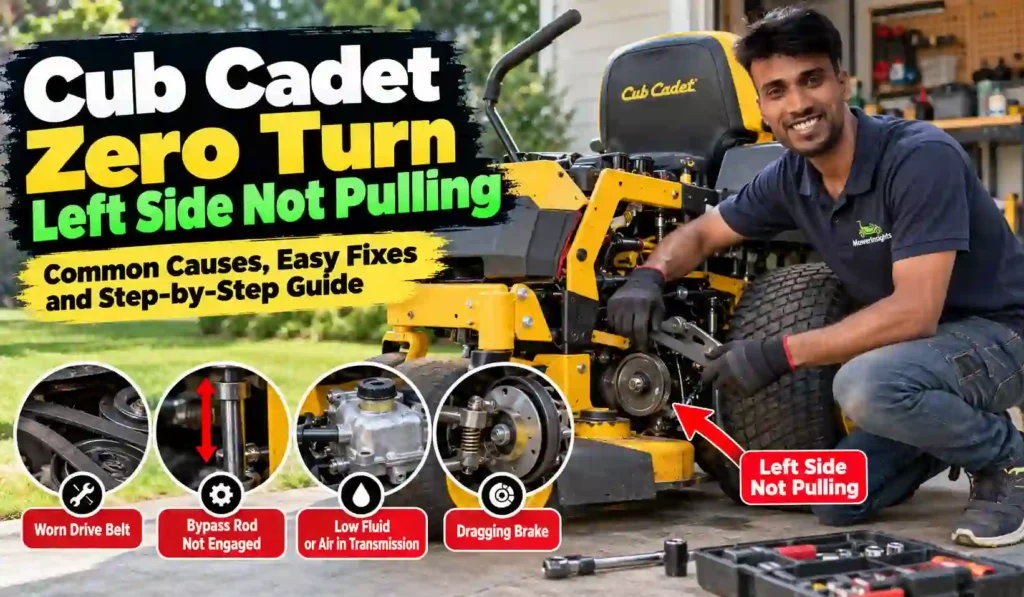
Cub Cadet zero turn left side not pulling means the left drive wheel gets less power than the right, or none at all. The mower creeps, pulls hard to one side, or spins in a circle. In most cases the cause is a worn drive belt, a bypass rod left out, or air in the left transmission.
Most owners can fix these at home with basic hand tools. This guide ranks the causes from most common to least common and gives a quick test for each.
Quick Answer
If your Cub Cadet zero turn left side is not pulling, check three things first, in this order:
- Make sure the left bypass rod is pushed fully in (drive position).
- Inspect the drive belt for cracks, glazing, or slipping under load.
- Check the left transmission for low fluid or trapped air, then purge it.
If all three are fine, check the left brake, the tire pressure, and the left hub key. A weak or failed left transmission pump is the last suspect, and it needs a technician.
Why Is Your Cub Cadet Zero Turn Left Side Not Pulling?
A Cub Cadet zero turn has two separate drive systems, one for each rear wheel. Each wheel has its own hydrostatic transmission (a sealed pump and motor that uses oil pressure to turn the wheel). The engine spins both pumps through a belt.
Your left and right levers control each pump separately. When the left side loses power, the right side keeps driving, and the mower turns left or pulls in a circle. So the problem sits somewhere in the left path: belt, pump, oil, brake, or wheel hub.
Think of it like two people pulling a wagon. If the person on the left lets go or gets tired, the wagon swings toward the weak side. Your job is to find out why that one side is tired.
One detail trips up many owners. A mower that turns left but not right has a weak left side, not a weak right side. The wheel that still drives is the strong one, and the stalled one is the problem.
Common Causes of a Cub Cadet Zero Turn Left Side Not Pulling
The causes below are ordered by how often they come up and how easy they are to check. Start at the top and work down.
Worn or Slipping Drive Belt
A worn drive belt is the most common reason for a weak left side. The belt wraps around the engine pulley and both transmission pulleys. On many zero turns the belt path means one side starts to slip before the other, and owners often report the left side giving out first.
Signs of a bad belt:
- Cracks or frayed edges on the underside
- A shiny, glazed surface
- Burning-rubber smell under load
- Power that fades on slopes or in thick grass
Replace a worn belt with the exact factory part. Belt length matters. A belt that is slightly too long slips sooner, and one that is too short strains the pulleys.
Left Bypass Rod Not Fully Pushed In
The bypass rods let you push the mower by hand with the engine off. Pulling a rod out opens a valve that lets the wheel freewheel. If the left rod is left out or only half seated, the left wheel gets little or no drive.
This is a free fix that takes ten seconds. Push the left rod all the way in and test again before you touch anything else.
Air or Low Fluid in the Left Transmission
Air trapped inside a hydrostatic transmission makes the wheel feel weak, jerky, or dead. It often happens after the mower sat for months, after a long tow, or after the bypass rods were used. Low fluid causes the same symptoms.
Purging (also called bleeding) pushes the air out. The exact steps differ by model, so follow your owner’s manual. Do not guess at the fluid type, because the wrong oil can damage the pump.
Overheating Transmission
A transmission that works for a while and then fades is often running hot. Each transmission has a small cooling fan with plastic blades. A stick or clump of debris can break blades, and the pump then overheats on the left side first.
Look above each transmission and count the fan blades. Clear grass and dirt from the fins, and run the engine at full throttle while mowing so the fans spin fast enough.
Dragging Brake or Parking Brake Linkage
A brake that does not fully release makes the left wheel feel heavy and slow. Stuck pads, a bent brake rod, or a loose linkage are the usual culprits.
Test it with the rear raised on jack stands and the engine off. Spin each rear wheel by hand. If the left wheel is much harder to turn than the right, the brake or the hub is dragging.
Uneven Tire Pressure
Different pressures change the tire’s rolling diameter, which makes the mower pull to one side. This is a mild symptom, not a dead wheel. Check your owner’s manual for the correct pressure and set both rear tires to match.
Sheared Hub Key or Loose Wheel Hub
A small key locks each wheel hub to its axle. If the key shears, the axle turns but the wheel does not. The engine and the transmission sound normal, yet the left wheel sits still.
With the wheel raised, run the mower at low speed and watch the hub. If the axle spins while the wheel stays put, the key or hub is the problem.
Weak or Failing Left Transmission
If the belt, rods, fluid, brake, and hub all check out, the left transmission itself may be worn. Internal seals and pump parts wear over time, especially on older machines that never had a fluid service.
A failing unit often whines, vibrates, or loses power as it warms up. This repair usually means replacing the transmission, so confirm everything above first.
How to Fix a Cub Cadet Zero Turn Left Side Not Pulling
Follow these steps in order to fix a Cub Cadet zero turn left side not pulling. Park on level ground, set the parking brake, turn off the engine, remove the key, and disconnect the spark plug wire before you reach under the mower.
Step 1: Check the Bypass Rods
Push both bypass rods fully in. Start the mower, release the parking brake, and test the left side at low speed. If the left wheel now drives, you are done.
Step 2: Inspect the Drive Belt
Remove the belt cover and look at the whole belt. Press on it. A belt that feels hard, cracked, or glossy needs replacing. Also check the idler pulley and the tensioner arm for wobble or a seized bearing.
Step 3: Check Tire Pressure
Measure both rear tires with a gauge. Match them to the number in your manual.
Step 4: Test for a Dragging Brake
Raise the rear on stands and spin each wheel by hand. Compare the effort. Free up or adjust the brake linkage if the left side is tight.
Step 5: Check Fluid and Purge Air
Check the transmission fluid level against your manual. Top up only with the specified fluid. Then follow the manual’s purge procedure for your model. A typical purge runs each wheel forward and reverse several times with the rear off the ground, then repeats until the left wheel drives with full strength.
Step 6: Check Cooling Fans and Fins
Look for missing fan blades above both transmissions. Blow out grass and dirt from the fins. Replace any damaged fan.
Step 7: Check the Hub Key
With the wheel off the ground, watch whether the axle and wheel turn together. Replace a sheared key and tighten the hub to the manual’s specification.
Step 8: Adjust Tracking
If the mower still drifts slightly, find the tracking adjustment near the base of the steering levers. Park on level ground, make a small change on the side opposite the direction it pulls, and test drive. Repeat in small steps.
Important Tips
- Test one change at a time. If you replace the belt and purge the system together, you will not know which fixed it.
- Keep the engine at full throttle while mowing. The transmission fans need the speed to cool the pumps.
- Write down your belt part number once you find the right one, so you never buy a near match.
- Clean the transmission fins after every few mows in dry grass or leaf season.
- Never use a generic oil. Follow the fluid type in your manual.
Common Mistakes
- Replacing the transmission before checking the belt and bypass rods. Those two cost far less and cause most cases.
- Using a belt that is close but not exact. A small length error leads to slipping within a few weeks.
- Skipping the purge after a fluid top-up. Air stays trapped and the weak side returns.
- Pulling the bypass rod and forgetting to push it back in.
- Working under a mower held up only by a jack. Always use jack stands.
When to Get Professional Help
Stop and call a service technician if any of these apply:
- The left side fails again after a new belt and a full purge.
- The transmission whines, shudders, or leaks oil.
- Fluid looks milky, dark, or smells burnt.
- The axle spins freely and the hub parts are damaged.
- You are not comfortable lifting the mower or working near the drive system.
A hydrostatic transmission repair often needs special tools and clean conditions. Dirt inside the unit can ruin a new pump quickly.
Related Questions
Why Does My Cub Cadet Zero Turn Pull to the Left?
A mower that pulls left usually has uneven tire pressure, a tracking misadjustment, or a stronger right transmission. If the left wheel is the weak one, the mower drifts toward it. Check tire pressure first, then adjust tracking.
Why Does My Cub Cadet Zero Turn Only Go Forward on One Side?
A single wheel that drives forward but not back often points to air in the transmission or a worn pump. Purge the system and retest. If the problem stays, the transmission needs inspection.
Why Does My Zero Turn Lose Power After 30 to 45 Minutes?
Heat is the usual cause. A damaged cooling fan, clogged fins, or old fluid can overheat a transmission until it fades. Let it cool, clean the fins, and check the fan blades.
How Do I Know if the Drive Belt Is Slipping?
A slipping belt squeals, smells like burnt rubber, or lets the wheel stall under load. You can also see a shiny surface on the belt sides. Replace it with the exact factory part.
FAQs
What causes the left side of a zero turn mower to stop pulling?
The most common causes are a worn drive belt, a bypass rod left out, air in the transmission, or a dragging brake. Less often, a sheared hub key or a failing transmission is to blame.
How do I know if the problem is the belt or the transmission?
Check the belt first because it is cheaper and more likely. If the belt is in good shape and the left side still has no drive after a purge, the transmission is the next suspect. A belt problem usually affects both sides under heavy load, while a transmission problem stays on one side.

Can I drive a zero turn with a weak left wheel?
You can, but it is not a good idea. A slipping belt can burn out, and a struggling transmission can overheat and fail. Fix the cause before the next mow.
Do I need to purge the transmission after changing the fluid?
Yes. Air enters the system whenever fluid is drained or topped up, and trapped air makes the wheel weak. Follow your manual’s purge steps for your model.
How much does it cost to fix a zero turn left side that is not pulling?
A bypass rod or tire pressure fix costs nothing. A belt is a small parts cost. A transmission replacement is the most expensive repair, so rule out the cheap causes first.
Final Answer
A Cub Cadet zero turn left side not pulling nearly always comes down to the belt, the bypass rod, or air in the left transmission. Check those three in that order, then move to the brake, the tire pressure, and the hub key. If the left side still fails after a belt change and a full purge, have a technician look at the transmission.

Why Trust This Guide
MowerInsights.com is run by Siddik Kazi, who also operates a lawn mower repair and maintenance service in Italy. The troubleshooting order in this guide reflects the kind of faults that reach a repair bench most often.