Quick Answer
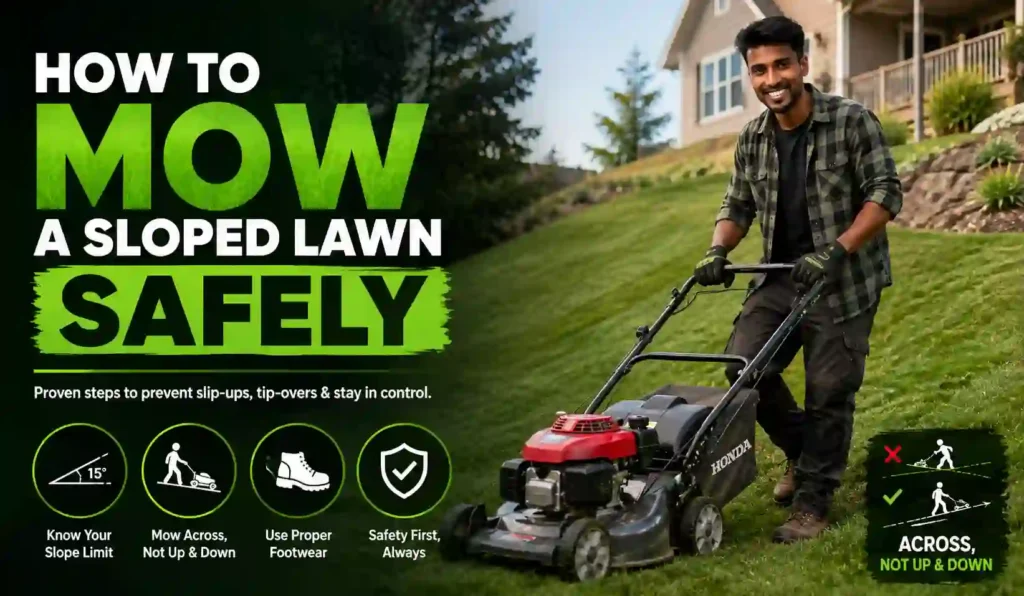
Mow across a hill with a push mower. Do not go up and down. Keep the mower below you. Stop if the hill is steep. Over 15 degrees is too steep. That is about a 27% grade. A riding mower needs the flipped rule. Drive straight up and down. Do not drive across a hill on a riding mower. It can roll. Wear shoes with deep tread. Mow dry grass only. Do not reach under the deck. The blade may still spin. If a slope tops 20 to 25 degrees, skip the mower. Use a string trimmer instead.
What You Need Before You Start
You need a few key items first. Do not just grab a mower. Do not just walk up the hill. Get set up right. It keeps you safe.
- Shoes with cleats or deep tread. Plain sneakers slide fast on wet cut grass.
- A level and a tape. Or use a level app on your phone. Check the true grade first. Do this before you mow.
- A push mower with a drive switch, if the hill is not flat. Front-wheel mowers dig in. They are hard to steer on a hill.
- A riding mower rated for hills, but only up to its limit. Check the book that came with it. Look for a slope sticker near the seat.
- Safety glasses and ear plugs. These help most on long gas mower runs. Wear them each time.
How to Measure Your Slope in Five Minutes
Most people guess at slope steepness. The guess is often wrong. A hill that feels mild often tops 15 degrees. A real check takes five minutes. It ends the guesswork. It gives you a real number.
Step 1: Find your steepest spot. Walk the hill. Look for the steepest part by eye.
Step 2: Set a level at the base. Point one end up the hill. Touch the other end to the ground.
Step 3: Measure the rise. Center the bubble first. Then measure the height from the level’s high end down to the ground. A 12-inch rise over a 4-foot level equals a 25% grade. That is close to 14 degrees.
Step 4: Check your grade against this table.
| Grade | Approx. Degrees | Mowing Guidance |
|---|---|---|
| Under 15% | Under 8.5° | Any mower type, standard technique |
| 15-25% | 8.5-14° | Push mower only, mow across the slope, extra caution |
| 25-33% | 14-18° | Push mower only, consider a string trimmer instead |
| Over 33% | Over 18° | String trimmer or professional slope-mowing service only |
Most home mower brands set a top limit. It sits near 15 degrees for riding units. Push mowers get a bit more room. This shifts by model (Consumer Product Safety Commission, or CPSC, 2024).
Step-by-Step: Mowing a Sloped Lawn with a Push Mower
Step 1: Mow Across the Slope, Not Up and Down
Walk the mower side to side. Go left to right. Then go right to left. Move up the hill in rows. Or move down in rows. This keeps your body stable. It stops the mower. It will not roll back onto your feet if you slip.
Step 2: Keep the Mower Below You on the Slope
Stand a bit above the mower at all times. Do this even on a mild slope. The mower may lose grip. It may roll back. You want space between it and your legs.
Step 3: Overlap Each Pass by 2-3 Inches
Overlap more than you would on flat ground. Wheels can drift a few inches on a hill. Gaps in the cut show more on a slope. The light hits the grass at a new angle there.
Step 4: Slow Down on the Steepest Third
Cut your pace by half on the steepest part. Most slips happen right here. Footing is worst here too. This is where a slip hurts the most.
Step 5: Let Go of the Bar If You Slip
Every push mower since 1980 has a bar. It is a safety bar (Consumer Product Safety Commission, or CPSC, 1982). Let go, and the blade stops. This takes about three seconds. If you slip, let go all the way. Do not grip the mower with one hand to stay up.
Step-by-Step: Mowing a Sloped Lawn with a Riding Mower
Step 1: Drive Straight Up and Down, Never Across
This rule flips from push mowing. It trips up many people. A riding mower is wide. It sits high off the ground. It can roll to the side more than a push mower. A drive across a hill puts weight on the low-side wheels. That raises roll risk a lot.
Step 2: Check Your Mower’s Slope Limit
Every riding mower has a top slope rating. It is often 10 to 15 degrees. This shifts with the model. It also shifts with deck width (Outdoor Power Equipment Institute, or OPEI, 2023). [VERIFY: current OPEI slope rating range for residential riding mowers] Going past this mark is the top cause of rollovers.
Step 3: Skip Turns on the Slope Itself
Turn only on flat ground. Do this at the top or at the bottom. Do not turn mid-hill. A turn shifts weight to one side. This happens right when the mower has the least grip.
Step 4: Go Downhill Slow, Never in Neutral
Keep the gear engaged the whole way down. Coasting in neutral kills engine drag. The mower can speed up fast. This can happen on any real grade.
Step 5: If You Start to Slide, Steer Downhill
This sounds odd, but it works. The mower may slide to one side. Steer straight down the hill. Do not steer toward flat ground. This lines up the wheels with the slide. It cuts roll risk (OPEI, 2023).
Common Mistakes That Cause Tip-Overs and Injuries
In four years on the bench, most bent decks trace back to three mistakes. It is rarely bad luck. It is a pattern. Once you see it, it is easy to avoid.
Mistake 1: Mowing wet grass on a hill. Wet grass kills grip fast. This is true even under 10 degrees. Wait for the lawn to dry. This is often a few hours past dawn dew.
Mistake 2: Going up and down a steep hill with a push mower. This is a top cause of leg harm. It is a top cause of foot harm too. This comes from mower harm data (Consumer Product Safety Commission, or CPSC, 2024). [VERIFY: current CPSC lawn mower injury statistics before publishing] A slip on a straight-up path sends the mower right back at you.
Mistake 3: Ignoring your mower’s real slope limit. People think, “if it can climb it, it’s fine.” A mower can climb past its rated limit. That does not mean it stays put. Belts wear fast this way in our shop. The belt slips again and again. It tries to hold grip on too steep a grade. That slip makes heat. The heat glazes the belt in a season or two.
Mistake 4: Wearing the wrong shoes. Sandals, worn sneakers, and smooth-sole boots show up a lot in slope harm cases. Cleated or deep-tread shoes cost under $80. [VERIFY: adjust to accurate currency and price range for target market] They cut slip risk in a real way.
Safety Notes and Gear
Wear shoes with deep tread or cleats each time you mow a hill. Not just on the steep days. Add safety glasses near gravel or loose bits. A blade can throw small rocks up the hill at you.
Never mow a hill in low light. Shadows hide dips. Shadows hide grade shifts too. These are hard to spot, even in full sun. Wait for good light. It is worth the wait.
Clear the hill of sticks, rocks, and toys first. Walk the hill once before you start. A blade can hit that debris. It can kick the mower to one side at the worst time.
Keep kids and pets off the hill while you mow. Not just at a safe range. Keep them off the hill fully. A mower can roll down a hill fast. It is faster than most people think.
When to DIY vs When to Call a Professional
Mow it yourself if the grade sits under 25%. That is about 14 degrees. Your mower must be rated for that ground. This fits most home yards. Think hilly front lawns. Think mild back slopes too. Most people fall into this group.
Call a pro slope crew if the grade tops 33%. That is about 18 degrees. Also call one if the hill stays wet most of the day. Or call one if it stays shaded most of the day. Or call one if your own footing is not solid. Pro crews use tools built for hills. Think remote mowers. Think harness-based trim work too. These tools are not worth buying for one yard.
Try a string trimmer for a 25% to 33% grade. This works if you skip the pro route. It is slower. But it drops the tip-over risk. It drops the roll risk too.
Troubleshooting: What to Do If Something Goes Wrong Mid-Mow
| Problem | Likely Cause | Solution |
|---|---|---|
| Mower wheels spin without moving forward | Wet grass or grade exceeds the mower’s traction limit | Stop right away, back off the slope on foot, wait for grass to dry, or switch to a trimmer |
| Push mower drifts sideways during a pass | Uneven ground or a worn rear wheel | Slow down, overlap more between passes, check the wheel bearings after |
| Riding mower feels unstable mid-turn | Turning while still on the slope instead of flat ground | Stop, back straight downhill to level ground, then finish the turn |
| Engine stalls partway up a slope on a gas mower | Fuel starvation from the tank tilting past the carburetor’s design limit | Restart on flatter ground, skip that grade with that model going forward |
| Drive belt slipping or squealing on inclines | Belt glazing from repeat traction loss on a slope steeper than the mower’s rating | [VERIFY: whether a specific belt replacement interval applies] Get the belt checked, since slope strain cuts its life span a lot |
Frequently Asked Questions
What is the maximum slope you can safely mow with a push mower?
Most push mowers can be safely operated on slopes up to about 25% grade (roughly 14 degrees) when mowed across the slope rather than up and down. Beyond that, traction and footing both become unreliable, and a string trimmer is the safer tool.
Can you mow a hill with a riding mower?
Yes, but only up to the manufacturer’s rated slope limit, typically 10-15 degrees depending on the model, and only by driving straight up and down the slope rather than across it. Exceeding the rated limit significantly increases rollover risk.
Why do you mow across a slope with a push mower but up and down with a riding mower?
Push mowers are narrow and operator-controlled on foot, so mowing across the slope keeps the operator’s footing stable and prevents the mower from rolling backward into their legs. Riding mowers have a wider wheelbase and higher center of gravity, so driving across a slope shifts weight onto the downhill wheels and increases the chance of a sideways rollover.
Is it dangerous to mow wet grass on a slope?
Yes, mowing wet grass on any slope over roughly 10 degrees significantly increases slip risk, even for experienced operators. Wait until the grass is fully dry before mowing sloped sections, regardless of mower type.
What shoes should you wear to mow a sloped lawn?
Wear closed-toe shoes with a deep tread or cleated sole rather than sneakers or sandals. Smooth-soled or open footwear is a leading contributor to slips and mower-related foot injuries on inclined lawns.
How do I know if my slope is too steep to mow at all?
If your slope measures over roughly 33% grade (about 18 degrees) using a level and tape measure, skip mowing it with any powered mower and use a string trimmer or hire a professional slope-mowing service instead.
Pingback: Best Lawn Mowers for Hills and Slopes in 2026