Quick Overview
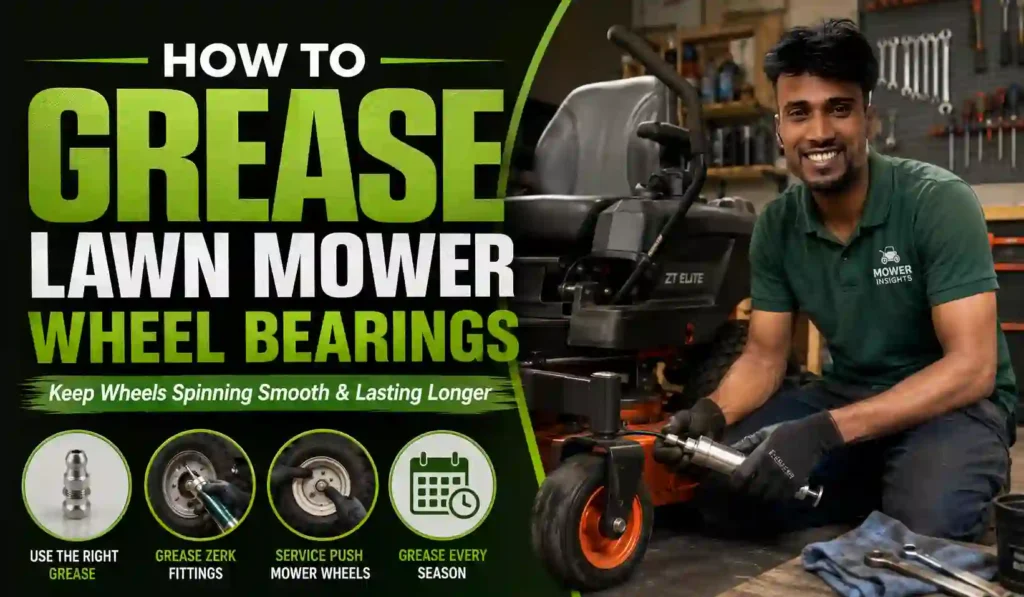
- Riding mowers and zero-turns have a grease fitting called a zerk. Push a grease gun onto it and pump 2 to 3 shots of NLGI Grade 2 lithium grease per wheel.
- Most push mowers have no zerk. Pull the wheel off the axle, wipe the shaft clean, and hand-pack a thin layer of grease into the bearing.
- Grease your wheels once a season, or every 25 hours of mowing.
- Stop pumping the moment grease oozes out around the seal. More grease does not mean better protection.
- In Siddik’s shop, seized wheel bearings are one of the top five reasons riding mowers come in for repair, and almost all of them trace back to a skipped grease job.
Greasing lawn mower wheel bearings means pushing fresh grease into the small metal balls or bushings inside each wheel hub. This stops rust, keeps the wheel spinning free, and adds years to the axle. This guide covers both types of mowers: ones with a grease fitting, and ones without. It also covers the mistakes that send wheels to Siddik’s repair bench.
Who This Guide Is For
This guide is for anyone who owns a mower and wants the wheels to last. It works for push mowers, self-propelled mowers, riding mowers, and zero-turns.
It is a good fit if your mower is under warranty or out of warranty. Greasing a wheel bearing is routine maintenance. It will not void a warranty on its own.
This guide is not the right fit if a wheel is already grinding, wobbling, or locked solid. That points to a worn bearing, not a dry one. Skip to the Troubleshooting section below, or plan on a shop visit.
It is also not the right fit for cordless electric push mowers with sealed, maintenance-free wheel hubs. Check your owner’s manual first. Some electric models use sealed bearings that are not meant to be opened at home.
How This Guide Was Put Together
Siddik wrote this guide from his own repair bench in Milan. He has greased and repacked wheel bearings on push mowers, self-propelled mowers, riding mowers, and zero-turns.
The steps here match what he does in the shop, not a rewritten version of a manufacturer’s manual. Where a claim depends on a specific brand or model spec, this guide flags it for you to confirm before you rely on it.
The Short Version
Find the grease fitting on the wheel hub. It looks like a small metal nipple. Clean it with a rag first.
Push a grease gun nozzle onto the fitting. Pump 2 to 3 strokes. Stop when grease bulges out at the seal.
No fitting on your mower? Pull the wheel bolt out. Slide the wheel off the axle. Wipe the shaft clean. Pack a thin layer of grease by hand into the wheel’s bearing pocket. Put the wheel back on.
What You’ll Need
Gather these before you start. This keeps the job under 15 minutes per wheel.
- Grease gun. A hand-pump or lever gun both work fine for wheel bearings.
- NLGI Grade 2 lithium grease cartridge. This is the standard grade for mower wheel bearings. Avoid dry graphite spray here; it does not hold up under wheel load.
- Clean shop rag. One for wiping the fitting, one for wiping the axle shaft.
- Wire brush or old toothbrush. For scraping caked grass and rust off the axle.
- Socket wrench set. Needed to pull the wheel bolt on push mowers.
- Wheel chocks or wood blocks. These stop the mower from rolling while a wheel is off.
- Work gloves. Grease is hard to get out of skin and clothes.
Total cost for tools and one grease cartridge runs about $15 to $25 if you own none of this yet. Most homeowners already have a socket set.
Expert Tip: Buy a cartridge, not a tube. A tube dries out fast once opened. A sealed cartridge lasts for years in a garage and works in any standard grease gun.
One cartridge covers every wheel on most mowers, with plenty left over. Keep it in the garage, not a hot shed. Heat breaks grease down faster than normal use does. A cool, dry spot keeps it fresh for the next few seasons.
If you already own a grease gun for a car, trailer, or another piece of equipment, it will work here too. Wheel bearings do not need a special gun, just the right grease loaded inside it.
How to Grease Wheels With a Zerk Fitting (Riders and Zero-Turns)
Most riding mowers and zero-turns have a grease fitting on each front caster wheel, and sometimes on the rear axle too. Check your owner’s manual for the exact count [VERIFY: number of zerk fittings for the specific model, if named]. This method takes about 5 minutes per fitting.
Step 1: Park on Flat, Level Ground
Set the parking brake. Shut off the engine. Pull the key. Wait for the engine to cool if you were just mowing.
Step 2: Find and Clean the Zerk Fitting
Look at the outer wheel hub or the caster fork. The zerk is a small metal button with a spring-loaded ball inside. Wipe off dirt, grass, and old grease with a rag. Dirt forced into the fitting will end up inside the bearing.
Step 3: Load and Attach the Grease Gun
Load your grease gun with the lithium grease cartridge, following the gun’s instructions. Push the nozzle straight onto the zerk. You should feel it click and seal.
Step 4: Pump Slowly
Squeeze the handle 2 to 3 times. Go slow. Watch the seal at the edge of the hub. Old grease should start pushing out, followed by fresh grease.
Step 5: Stop and Wipe
Stop the moment you see fresh grease appear at the seal. Pumping past this point can blow out the seal itself. Wipe away every bit of extra grease with your rag. Extra grease on the outside just collects grass clippings and dirt.
Step 6: Spin the Wheel by Hand
Spin each wheel after greasing. It should turn smooth, with no grinding or catching. A rough feel means the bearing may already have wear inside it, not just dry grease.
A Note on Zero-Turn Caster Wheels
Zero-turn mowers pivot on their front caster wheels constantly. This puts more stress on those bearings than on a standard riding mower. Siddik sees caster wheel bearings wear out roughly twice as fast as rear axle bearings on zero-turns.
Check zero-turn casters more often than the rest of the mower. Every 15 to 20 hours of mowing is a safer interval than the standard 25-hour rule. A caster that locks up mid-turn can pull the whole mower off line, which is a real safety issue on slopes.
How to Grease Push Mower Wheels (No Fitting)
Most standard walk-behind push mowers skip the zerk fitting entirely. The bearing sits inside a plastic or metal wheel hub, packed once at the factory. You have to open it up by hand. Budget 10 to 15 minutes per wheel your first time.
Step 1: Disconnect the Spark Plug Wire
Pull the wire off the spark plug before you touch a wheel. This is not optional. A mower can jerk forward if the blade turns while you work near a wheel.
Step 2: Tip the Mower and Chock It
Tip the mower onto its side, air filter facing up, so fuel and oil do not leak into the engine. Use a wood block or chock so it cannot roll or fall back.
Step 3: Remove the Wheel Bolt
Use your socket wrench to remove the center bolt or nut holding the wheel to the axle. Keep the bolt somewhere you will not lose it. A small cup or magnetic tray works well.
Step 4: Slide the Wheel Off
Pull the wheel straight off the axle shaft. It may take some wiggling if grass and grime have built up around the shaft over the season.
Step 5: Clean the Shaft and Bearing Pocket
Wipe the axle shaft with a rag. Scrape off caked grass and rust with a wire brush. Look inside the wheel hub where the bearing or bushing sits. Wipe out old, dried grease.
Take a moment here to check the bearing itself. Spin it with a finger if it is a sealed cartridge type. It should turn smooth and quiet. Any grinding or catching at this stage means the bearing needs replacing, not just a fresh coat of grease. Catching this now saves you from redoing the whole job in a few weeks.
Step 6: Apply a Thin Layer of Grease
Use your finger or a small applicator to pack grease into the bearing pocket. A thin, even coat is enough. Coat the axle shaft itself too, especially the section that sits inside the hub.
Step 7: Reassemble and Torque the Bolt
Slide the wheel back onto the shaft. Thread the bolt back in by hand first, then tighten with the wrench. Do not overtighten; a wheel that cannot spin free defeats the whole job.
Step 8: Wipe and Test Spin
Wipe off any grease squeezed out around the hub edge. Spin the wheel. It should turn freely with no drag or wobble.
What Siddik Sees Most Often on This Job
Most push mower wheels that reach his shop have never been opened once. The grease inside is often dried to a hard, waxy crumb rather than a soft paste.
That dried grease still does some good. It is far better than nothing. But it stops cushioning the bearing balls the way fresh grease does. Metal starts touching metal, just a little at first.
Over a season or two, that light metal-on-metal contact wears a groove into the bearing race. Once that groove forms, no amount of fresh grease fixes it. The wheel needs a new bearing, not just a regrease.
Signs It’s Time to Check Your Wheel Bearings
You do not need to wait for a set schedule if your mower is telling you something is off. Watch for these signs during your normal mowing.
A high-pitched squeak on every wheel rotation. This is the most common early warning. It usually means the grease has dried out, not that the bearing has failed yet.
The mower pulls slightly to one side. One dry or worn wheel creates more drag than the others. The mower steers toward that side without you doing anything.
Vibration you can feel through the handle or seat. A bearing with wear inside creates a faint but steady vibration, especially at higher speeds on a riding mower.
Visible rust streaks around the wheel hub. Rust on the outside often means water already reached the bearing on the inside.
Catch any of these early and a simple regrease often solves it. Wait too long and you are looking at a bearing replacement instead.
Grease Types: Why Lithium Grade 2 Is the Standard
Not all grease is the same. Three types show up most often around lawn equipment, and only one is right for wheel bearings.
Lithium grease (NLGI Grade 2). This is the standard pick for mower wheel bearings. It holds up under load, resists water, and stays in place instead of running out under heat.
White lithium grease. This is a lighter version, often sold in spray cans. It works fine for hinges and latches. It is too thin for a wheel bearing carrying real weight.
Dry lubricants like graphite or silicone spray. These have their place on things like drawer slides. They offer almost no protection for a load-bearing wheel bearing and wash away fast.
Stick with a lithium Grade 2 grease in a cartridge, and you will not need to think about this again for years
How Often Should You Grease Mower Wheel Bearings?
Grease riding mower and zero-turn wheel fittings once per season, or every 25 hours of use, whichever comes first. Push mower wheels without fittings need attention less often; once a season is usually enough for most homeowners, or anytime a wheel starts to feel stiff or noisy.
Mowers used on wet lawns, near sprinklers, or stored outside need grease more often. Water is the fastest way to wash grease out of a bearing and let rust start. In Siddik’s shop, mowers that live outside year-round show bearing wear at roughly double the rate of mowers stored in a dry garage or shed
Common Mistakes That Wreck Wheel Bearings
These are the mistakes Siddik sees most often on the repair bench, in order of how often they show up. Most of them cost nothing to avoid. They just take a little more care during the job itself.
Skipping the grease job for years. A wheel bearing that never sees fresh grease will run dry, then rust, then seize. By the time a customer notices a squeak, the bearing is often already scored inside and needs full replacement, not just a regrease.
Using the wrong lubricant. WD-40 and similar penetrating oils are not grease. They wash out fast and leave the bearing dry again within days. Stick to NLGI Grade 2 lithium grease made for wheel bearings.
Overtightening the wheel bolt. A bolt cranked down too hard clamps the bearing so it cannot turn freely, even with fresh grease inside. The wheel will feel stiff right after the job, which is the opposite of the goal.
Forcing grease past a torn seal. If a bearing seal is already cracked, pumping grease through it just pushes grease straight through and out, wasting cartridge and doing nothing for the bearing. A torn seal means the whole hub needs replacing, not more grease.
Greasing over caked dirt. Skipping the cleaning step traps grit against the bearing surface. That grit acts like sandpaper every time the wheel turns, wearing the bearing faster than if it had run dry.
Mixing grease types. Old grease left in the hub reacts poorly with some new formulas, especially mixing lithium with a calcium-based grease. The mix can break down and turn watery. Wipe out old grease fully before packing in new grease, rather than adding on top of it.
Storing the mower outside without covering the wheels. Rain and sprinkler spray sit against the hub seal longer than most owners expect. Water finds its way past even a healthy seal over time. A simple mower cover cuts this risk down by a wide margin.
Safety Notes
Always disconnect the spark plug wire before removing any wheel. This stops the engine from accidentally starting or the blade from turning while your hands are near the mower.
Let the engine and muffler cool fully before tipping the mower. A hot muffler can burn skin or ignite spilled fuel.
Tip walk-behind mowers with the air filter and carburetor facing up. This keeps oil and gas from flooding the air filter or leaking onto the ground.
Wear gloves. Old bearing grease can carry metal shavings from years of wear, and these can cut skin during cleaning.
Never work under a mower that is only held up by a jack or a lean against a wall. Use a solid wood block or chock that cannot shift.
Keep fingers clear of the wheel hub while spinning it to test movement. A bearing with metal shavings inside can pinch or cut.
If you smell fuel while the mower is tipped, stop and set it upright. A small fuel leak from a tipped tank is common on older mowers and is not worth the risk of continuing.
When to DIY vs. When to Call a Shop
Greasing wheels with an existing zerk fitting is a fair DIY job for almost any owner. It takes no special tools beyond a grease gun and takes under 10 minutes per wheel.
Removing and repacking a push mower wheel is still DIY-friendly, but it takes patience the first time. If the bolt is rusted solid, or the wheel will not budge from the axle, stop before forcing it. A stripped bolt or cracked axle turns a $10 job into a $60 repair.
Call a shop if the wheel bearing feels loose, wobbly, or grinds even after fresh grease. That usually means the bearing itself is worn out, not just dry. A shop can press in a new bearing rather than replacing the whole wheel assembly, which saves money over a full wheel swap.
Also call a shop if a wheel bolt is rounded off, rusted solid, or snapped during removal. Forcing a stuck bolt often shears it flush with the axle. At that point, drilling it out needs shop tools most homeowners do not keep on hand.
One more sign to watch for: uneven tire wear on one side of the mower. This can point to a bent axle rather than a bad bearing. A shop can check axle straightness with a dial gauge, which is not something to guess at by eye.
Troubleshooting: Symptom, Cause, Fix
| Symptom | Likely Cause | Fix |
|---|---|---|
| Wheel squeaks when pushed | Dry or washed-out grease | Regrease the bearing following the steps above |
| Wheel feels stiff after greasing | Bolt tightened too much | Loosen the bolt slightly, then retighten by hand plus a quarter turn |
| Grease leaks out constantly | Torn or worn seal | Replace the wheel hub or seal; more grease will not fix a torn seal |
| Wheel wobbles side to side | Worn or damaged bearing | Have the bearing pressed out and replaced at a repair shop |
| Wheel will not turn at all | Bearing seized from rust | Bearing likely needs full replacement, not just grease |
| Grinding noise while mowing | Grit trapped inside the bearing | Clean the bearing fully, then pack with fresh grease |
Total Cost of a Skipped Grease Job
A grease job costs almost nothing: one cartridge of lithium grease runs about $6 to $10 and lasts for many seasons across all your outdoor equipment. A grease gun is a one-time buy, usually $10 to $20 .
Skip it for a few seasons and the cost changes fast. A single seized wheel bearing repair at a shop typically runs $40 to $90 per wheel in labor and parts, depending on whether the bearing presses out clean or the whole hub needs replacing. On a riding mower with four wheels, a homeowner who skips grease jobs for years can end up paying for a full front-axle rebuild instead of a $10 tube of grease.
| Item | Typical Cost | Frequency |
|---|---|---|
| Grease cartridge | $6 to $10 | Lasts several seasons |
| Grease gun (one-time) | $10 to $20 | Buy once |
| Single bearing regrease at a shop | $15 to $30 per wheel | If skipping DIY |
| Seized bearing replacement | $40 to $90 per wheel | Only after neglect |
| Full front-axle rebuild (riding mower) | $150 to $350 | Rare, worst case |
The gap between the top row and the bottom row of that table is the entire argument for doing this job once a season.
Frequently Asked Questions
How do I grease lawn mower wheel bearings?
Find the grease fitting, called a zerk, on the wheel hub. Clean it, attach a grease gun, and pump 2 to 3 shots of lithium grease. Stop once fresh grease appears at the seal, then wipe off the extra.
What kind of grease should I use on mower wheel bearings?
Use NLGI Grade 2 lithium grease. This is the standard grade for wheel bearings on mowers, trailers, and most outdoor equipment. Avoid spray lubricants like WD-40; they wash out too fast to protect a bearing.
My push mower wheel has no grease fitting. How do I grease it?
Remove the center wheel bolt, then slide the wheel off the axle. Clean the shaft and the inside of the wheel hub. Pack a thin layer of grease by hand, then put the wheel back on.
How often should I grease my mower’s wheel bearings?
Once per season is enough for most mowers, or every 25 hours of mowing for riding mowers and zero-turns. Mowers stored outside or used on wet grass often need it more often.
Can too much grease damage a wheel bearing?
Yes. Pumping grease past the point where it oozes out can blow out the bearing seal. Once the seal is gone, dirt and water get straight into the bearing, which speeds up wear instead of slowing it.
Why does my wheel still feel stiff after I greased it?
This usually means the wheel bolt is too tight, not that the grease job failed. Loosen the bolt a bit, then snug it back down by hand plus a quarter turn with the wrench.
Is a squeaky mower wheel always a bearing problem?
Not always. Squeaks often come from dry grease, which a regrease job fixes in minutes. If the squeak turns into a grinding sound, or the wheel wobbles, the bearing itself is likely worn and needs replacement.
Can I use axle grease or wheel bearing grease made for trailers instead?
Yes. Trailer wheel bearing grease is usually NLGI Grade 2 as well, and it works fine on mower wheels. Check the label for the grade number rather than the product name alone.
Do all four wheels need grease, or just the front ones?
Grease every wheel with a fitting or an accessible bearing, not just the front pair. Rear wheels on push mowers and riding mowers carry load and turning stress too, and skipping them just moves the failure point to the back of the mower.
What happens if I never grease my mower’s wheel bearings at all?
The bearing runs dry, then starts to rust from trapped moisture. Rust pits the metal surface. Once pitted, the bearing grinds with every turn of the wheel, and grease at that point only slows the failure, it does not reverse it.
Bottom Line
Greasing lawn mower wheel bearings takes under 15 minutes per wheel and costs less than a tank of gas. Skip it for a few seasons and you are looking at a repair bill instead. Check your fittings at the start of every mowing season, and your wheels will outlast most other parts on the mower.
Pick one day each spring to do this alongside your other startup maintenance, like an oil change or blade sharpening. Tie it to a date you already remember, and it stops being a task you forget until a wheel squeaks. A five-minute job done on schedule beats a repair bill every time.
Pingback: Lawn Mower Maintenance Schedule: What to Do and When