Quick Overview
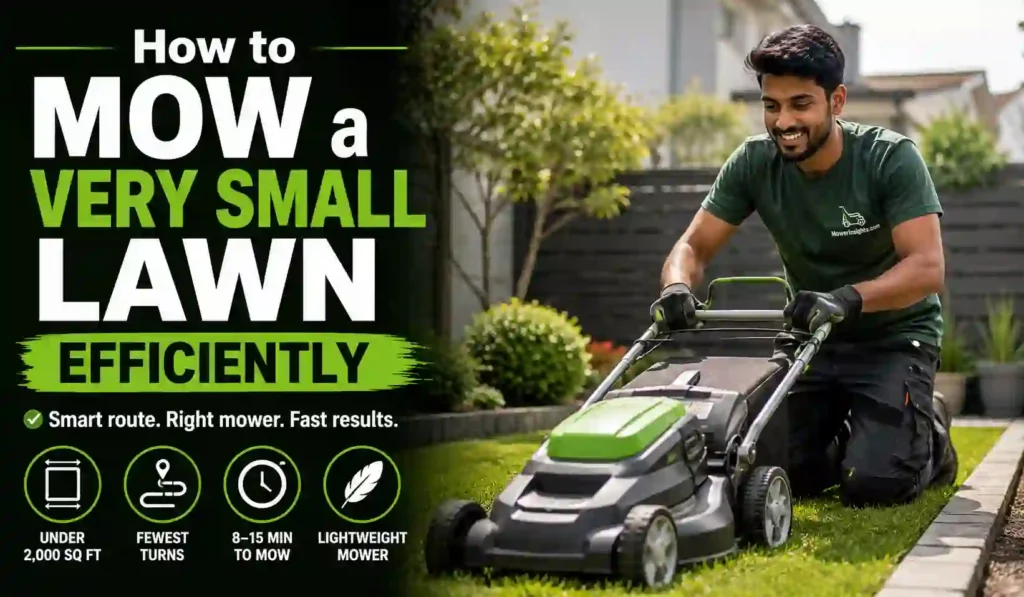
- A very small lawn is under about 2,000 square feet (WhatGrassIsThis, 2026) — that’s smaller than a tennis court.
- The fastest route is straight lines with the fewest turns, not a figure-eight or checkerboard pattern.
- Most very small lawns take 8 to 15 minutes to mow with the right mower and route.
- A lightweight push mower or battery mower beats a gas mower for lawns this size. Less weight means fewer wasted turns.
- The most common repair on small-lawn mowers is a bent blade from hitting curbs, sprinkler heads, or toy edges.
Mowing a very small lawn is not the same job as mowing a big one, just shorter. The turns matter more than the straight parts. A lawn under 2,000 square feet has so many edges and obstacles per square foot that most of your time goes into turning the mower around, not cutting grass. This guide gives you the exact route, the right tools, and the mistakes a repair shop sees most from small-lawn owners.
What You’ll Learn
To mow a very small lawn fast: measure it first. Pick a lightweight push or battery mower. Mow the edges first in one pass. Then mow the open middle in straight lines, turning at the ends only. Most lawns under 2,000 sq ft take 8 to 15 minutes this way.

What You’ll Need
- A push mower or battery mower with a 14 to 18 inch cutting width
- A string trimmer or long-handled shears for edges the mower can’t reach
- Safety glasses
- Closed-toe shoes
- A rake or stiff broom for clippings on hard surfaces
- A tape measure (only needed once, to size your lawn)
What Counts as a “Very Small Lawn”
A very small lawn is usually under 2,000 square feet. That’s about the size of four parking spaces side by side. The average American lawn is far bigger, sitting around 5,000 to 8,000 square feet once you remove the house and driveway from the lot (WhatGrassIsThis, 2026). A very small lawn is a quarter of that or less.
Picture a 40-by-50-foot rectangle. That’s 2,000 square feet. A postage-stamp city yard is often closer to 500 to 1,000 square feet, about the size of a two-car garage (LawnInsiders, 2025).
Size changes your whole approach. On a big lawn, engine power and fuel range matter most. On a very small lawn, turning radius and weight matter most. A heavy self-propelled gas mower built for a quarter acre will fight you on a 600-square-foot city lot. It’s the wrong tool, not a smaller version of the right one.
Step 1: Measure Your Lawn Once
Measure the length and width of your lawn in feet. Multiply them. That gives you the square footage. Write this number down. You’ll use it to size your mower and set your time expectations.
Time estimate: 3 minutes, one time only.
Step 2: Pick the Right Mower for the Space
For lawns under 2,000 square feet, choose a mower that’s light enough to lift with one hand at the handle. A 14 to 18 inch cutting deck is enough. Anything wider gets stuck between tight obstacles.
In our shop, the mowers that come in most often from small-yard owners are heavy self-propelled gas models bought for a bigger lawn than they have. The extra weight means more strain turning around trees, beds, and fences, and that strain is what cracks deck housings and bends axles over time.
A push reel mower or a battery mower under 40 lbs works well here. Corded electric mowers work too, if you don’t mind managing the cord around obstacles.
Time estimate: This is a one-time decision, not a per-mow step.
Step 3: Clear the Lawn Before You Start
Walk the lawn first. Pick up toys, sticks, and stones. A stone thrown by a spinning blade can crack a window or hurt someone nearby. This step also protects your blade. Hidden sprinkler heads and edging stakes are the top cause of bent blades we see on small-lawn mowers in the shop.
Time estimate: 2 minutes.
Step 4: Mow the Edges and Borders First
Start at the outside edge of the lawn. Mow one full pass around the entire border, close to fences, beds, and walkways. This gives you a clean boundary to work inside of and removes the need to stop and start at edges later.
Use a string trimmer afterward for any strip the mower deck can’t reach, usually within 2 to 3 inches of a wall or fence post.
Time estimate: 3 to 5 minutes for the border pass.
Step 5: Mow the Open Middle in Straight Lines
This is where most guides get it wrong. A figure-eight or circular pattern sounds efficient, but on a lawn this small, it actually adds turns. More turns means more time and more chances to miss a strip.
Instead, mow the open middle section in straight, parallel lines, turning only at the two ends of each pass. Overlap each pass by about 2 inches so you don’t leave a thin missed strip between rows.
If your lawn is wider than it is long, run your lines along the longer side. Fewer, longer passes beat many short ones.
Time estimate: 4 to 8 minutes for most lawns under 2,000 sq ft.
Step 6: Handle Obstacles Without Full Stops
For a single tree, garden bed, or patio in the middle of the lawn, mow around it as one small loop within your straight-line pass, then rejoin your line. Full stops and restarts waste more time than a quick loop around an obstacle.

Time estimate: Add 1 to 2 minutes per obstacle.
Step 7: Finish Clippings and Clean the Mower
If clippings are short, leave them on the lawn. They break down and return some nutrients to the soil. If clippings are long or clumped, rake or bag them so they don’t smother the grass underneath.
Brush or hose off the underside of the mower deck after each cut. Built-up wet clippings are one of the most common reasons a small mower won’t restart the next time, since dried grass jams the blade and strains the starter.
Time estimate: 3 minutes.
Common Mistakes That Slow Small-Lawn Mowing Down
- Using a mower sized for a bigger lawn. A wide deck can’t turn tightly, so you end up making extra passes to catch missed strips.
- Mowing in circles or figure-eights out of habit. This pattern works on open, obstacle-free lawns. On a tight lawn, it multiplies turns.
- Skipping the pre-mow walk-through. Hidden sprinkler heads and toys cause most of the bent blades we see in the shop.
- Mowing wet grass. Wet clippings clog the deck and can stall a small engine, especially in shaded corners that stay damp longer.
- Cutting too short. Scalping the grass stresses the roots and often shows up first at the edges of a small lawn, where soil is shallower near paths and beds.
Safety Notes
Wear closed-toe shoes and safety glasses. Keep pets and children away from the area while mowing. Never reach under the deck while the mower is running or the engine is warm. Turn off the mower before crossing gravel, mulch beds, or a driveway to avoid throwing debris.
When to DIY vs. When to Call a Professional
Mowing itself is almost always a DIY job on a lawn this size. Call a professional, or bring the mower into a shop, if the engine won’t start after cleaning, if the blade is visibly bent, or if the mower vibrates hard when running. A bent blade left in use can crack the crankshaft, which turns a small repair into a full engine replacement.
Troubleshooting Small-Lawn Mowing Problems
| Symptom | Likely Cause | Fix |
|---|---|---|
| Thin missed strips between passes | Not overlapping passes enough | Overlap each pass by 2 inches |
| Mower stalls in shaded corners | Wet or thick grass clogging the deck | Let that section dry, or raise cutting height |
| Scalped patches near edges | Mower height set too low for uneven ground | Raise the deck one notch near edges and paths |
| Mower won’t restart next use | Dried clippings jammed under the deck | Clean the deck underside after every mow |
| Vibration or pulling to one side | Bent blade from hitting an obstacle | Stop mowing and have the blade checked or replaced |
Total Cost of a Small-Lawn Mowing Setup
| Item | Typical Cost | Notes |
|---|---|---|
| Lightweight push or battery mower | $150–$400 | Amazon listing price range for 14–18 inch decks, current as of publish |
| String trimmer | $40–$90 | Corded models sit at the low end |
| Annual blade sharpening | $10–$20 | Do it yourself with a file, or have a shop do it |
| Occasional repair (bent blade, cable) | $20–$60 | Most common repair on small-lawn mowers in our shop |
Who This Method Is NOT For
If your “small lawn” is actually over 3,000 square feet, straight parallel lines still work, but you may want a self-propelled mower to save effort on the longer passes. If your lawn is under 300 square feet, a mower may be overkill. Long-handled grass shears or a manual reel mower can finish that size in under 10 minutes with no engine to maintain.
Frequently Asked Questions
How long does it take to mow a very small lawn?
Most lawns under 2,000 square feet take 8 to 15 minutes with a lightweight mower and a straight-line route. Add 1 to 2 minutes per obstacle like a tree or garden bed.
What is considered a very small lawn?
A very small lawn is generally under 2,000 square feet, or about the size of four parking spaces (WhatGrassIsThis, 2026). Some city lots run as small as 500 square feet.
Is a figure-eight or circular pattern faster for a small lawn?
No. These patterns add extra turns on a lawn with many edges. Straight, parallel lines with turns only at the ends are faster for most very small lawns.
What size mower is best for a very small lawn?
A push or battery mower with a 14 to 18 inch cutting deck works best. Wider decks are harder to turn in tight spaces and often leave missed strips near edges.
Do I need to bag the clippings on a small lawn?
Only if the clippings are long or clumped. Short clippings can stay on the lawn and break down into the soil. Bag or rake anything that clumps to avoid smothering the grass.
Why does my small mower keep stalling near the edges?
Edges near beds and fences often stay damp longer, and thick or wet grass clogs the deck. Raise the cutting height slightly in those spots or let the area dry before mowing.