Quick Overview
- Most zero-turn mowers are rated safe on slopes up to 15 degrees. Past that, tip-over risk climbs fast (Toro, 2026).
- Engineering tests allow more tilt than real mowing does. ANSI’s commercial mower standard requires no tip-over until 30 degrees end-to-end or 20 degrees side-to-side on a test rig — that is a lab number, not a mowing rule (ANSI/OPEI B71.4, cited in Seacoast Power, 2026).
- Steering-wheel zero-turns with 4-wheel control, like Cub Cadet’s Synchro-Steer line, are built for slopes up to 20 degrees and cost roughly $4,700–$5,900 (Cub Cadet, 2026).
- OSHA recorded 35 worker deaths from riding-mower rollovers between fall 2019 and late 2022 — most tied to slopes (OSHA, 2022).
- If a slope is steeper than your mower’s rated limit, the fix is not “be more careful.” The fix is a different tool or a different plan for that patch of grass.
Zero-turn mower stability on slopes means how well the machine keeps all four wheels on the ground while you mow a hill. It depends on the slope angle, the mower’s weight balance, your tire pressure, and how you drive. This guide breaks down the real numbers behind that stability, shows you how to check your own slope, and tells you exactly when a zero-turn is the wrong tool for the job.
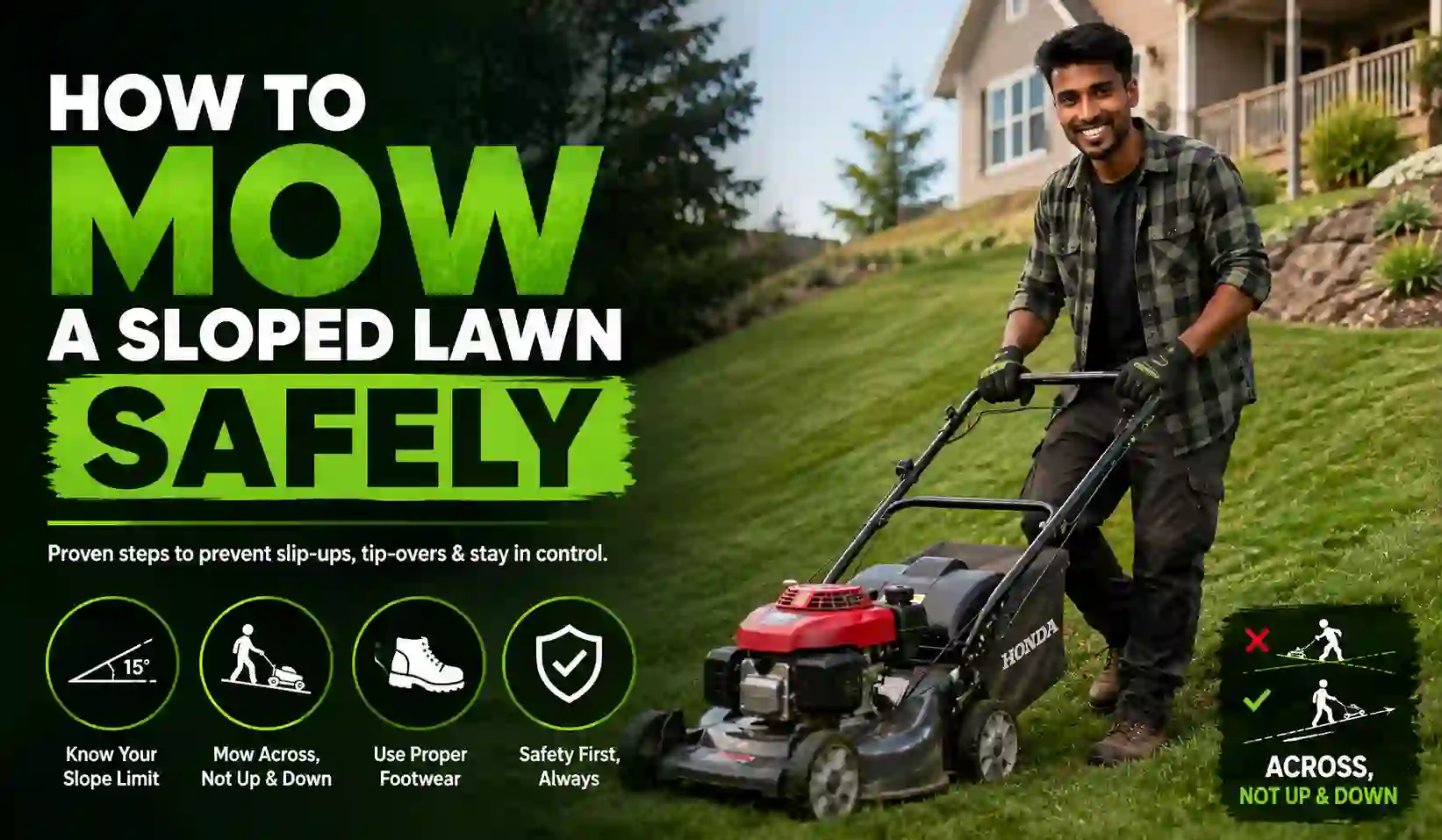
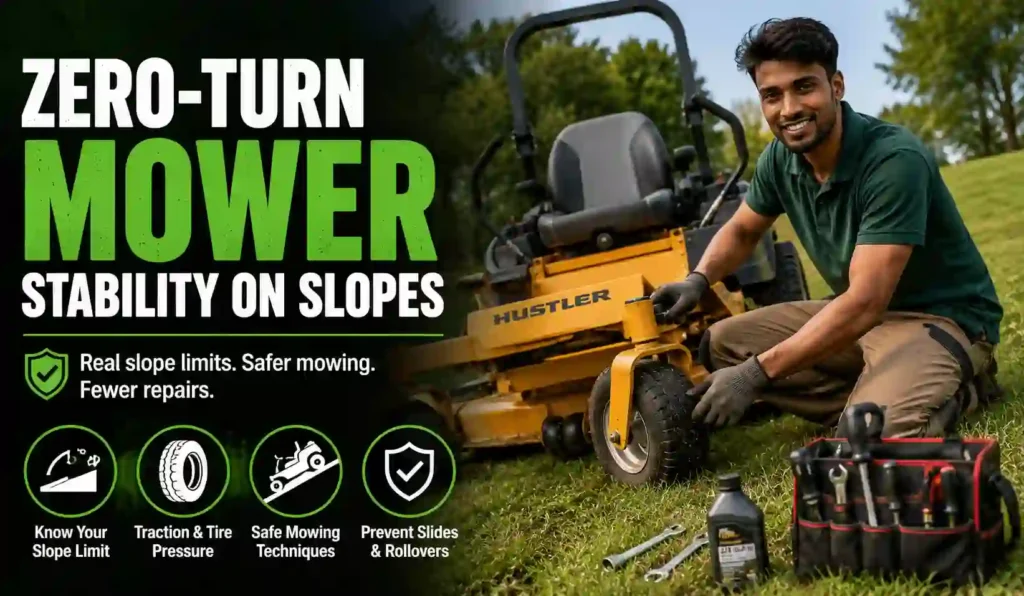
Fast Facts: How Stable Is a Zero-Turn Mower on a Slope?
A standard zero-turn mower stays stable on slopes up to about 15 degrees. That is roughly a hill that rises 27 feet over 100 feet of ground. Past 15 degrees, the risk of a slide or rollover rises fast, especially on wet grass or loose soil. Steering-wheel zero-turns with 4-wheel drive control can handle up to 20 degrees. Beyond that, you need a different machine — not a more careful driver.
What You Need Before You Mow a Slope
Check these four things before you drive onto any hill.
- A way to measure the slope. A phone level app works. So does a smartphone clinometer app.
- A tire pressure gauge. Slope traction depends on this more than people think.
- Your mower’s owner manual. It lists the exact rated slope angle for your model.
- A clear head start. Walk the slope first. Look for holes, wet patches, and drop-offs.
How Steep Is Too Steep? A Plain-Language Slope Guide
Slope angle numbers mean little until you can picture them. This table fixes that.
| Slope Angle | What It Looks Like | Zero-Turn Status |
|---|---|---|
| 0–5° | A gentle yard dip. Barely noticeable while walking. | Fully safe |
| 6–10° | A driveway apron or a soft roll in the lawn. | Safe with normal care |
| 11–15° | A noticeable hill. You’d lean forward walking up it. | Upper safe limit for most zero-turns (Toro, 2026) |
| 16–20° | A steep bank. Walking up it needs real effort. | Only steering-wheel/4-wheel models (Cub Cadet, 2026) |
| 21–30° | A hillside most people would call “too steep to mow.” | Standard zero-turns should not be used (OSHA, referenced in Seacoast Power, 2026) |
| 30°+ | Near the engineering tip-point tested on a lab rig. | Needs a slope mower, not a zero-turn (ANSI/OPEI B71.4) |
ere’s the split competitors blur together. ANSI’s B71.4 standard puts commercial mowers on a tilt table. The mower must not tip until 30 degrees end-to-end or 20 degrees side-to-side. That is a lab test. It proves the machine’s frame and weight balance are sound. It is not permission to mow at that angle.
Real mowing adds moving grass, soft dirt, wet blades, and a human driver. That is why every major brand’s operating limit sits far below the lab number, at 15 degrees for most models.
Step 1: Measure Your Slope Before You Mow It
Open a level app on your phone. Set the phone flat against a board, and lay the board on the slope. Read the degree number on the screen.
Do this at the steepest point of the hill, not the average. A slope often has one steep patch that matters more than the rest.
Write the number down. Compare it to your mower’s rated limit, printed in the owner’s manual and on a safety decal near the seat.
Step 2: Match the Mower to the Slope, Not the Other Way Around
If your slope reads under 15 degrees, a standard zero-turn is fine. Mow with normal care.
If it reads 15 to 20 degrees, only use a steering-wheel model built for that range. A lap-bar zero-turn rated to 15 degrees should not go on a 18-degree bank.
If it reads over 20 degrees, stop. No zero-turn is the right tool. Skip to the “When a Zero-Turn Isn’t the Right Tool” section below.
Step 3: Mow Up and Down the Slope, Never Across It
Point the mower straight up or straight down the hill. Never drive sideways across it.
Here’s why. A zero-turn is rear-heavy. Its engine and fuel tank sit over the back wheels. Driving sideways lets gravity pull that rear weight downhill. The front end can swing down and out of control.
Driving straight up or down keeps your weight centered between both drive wheels. That keeps the machine planted.
Step 4: Drop Your Tire Pressure Before Slope Work
Check your tires with a gauge before every slope mowing session. Over-inflated tires reduce the contact patch touching the ground.
A pressure around 10 to 12 psi on the rear tires increases that contact patch. More rubber on the ground means more grip (LawnGearLab, 2026).
Don’t go too low, though. Under-inflated tires can slip off the rim or wear unevenly. Check your tire’s sidewall for the minimum rated pressure first.
Step 5: Add Front Weights on Marginal Slopes
If your slope sits right at your mower’s limit, front wheel weights can help. Weights in the 25- to 200-pound range lower the front end’s center of gravity (LawnGearLab, 2026).
This keeps the front wheels planted longer during a turn or a sudden stop. It is a real fix, not a gimmick — but it only helps on slopes already near your mower’s rated range. It will not turn a 25-degree hill into a safe one.
Step 6: Never Mow a Slope When the Grass Is Wet
Wet grass is the single biggest hidden slope hazard. Grass blades hold moisture and a waxy coating. That coating cuts tire grip fast (Schmidt Implement, 2026).
A 12-degree slope that feels totally safe when dry can slide a mower when wet. Wait for the grass to dry. If you can’t wait, skip that section and trim it by hand later.
Step 7: Keep the Rollbar Up and the Seatbelt On
If your mower has a rollover protective structure (ROPS), keep the bar locked in the raised position on any slope. Wear the seatbelt every time.
A ROPS only protects you if it’s up and you’re strapped in when the mower tips. Folding it down for low branches, then forgetting to raise it again, is one of the most common mistakes we see (Toro, 2026).
Step 8: Know Your Bail-Out Plan
Before you start, know what you’ll do if the mower starts to slide. OSHA’s guidance is direct: stay off any slope edge within five feet of a drop-off, pond, or ditch (OSHA, 2026).
If the machine starts to lose traction, ease off the throttle. Don’t yank the controls. Sudden inputs on a sliding mower make a slide worse, not better.
What Actually Breaks: A Repair-Shop View of Slope Incidents
In our shop, slope-related repairs follow a pattern. It’s rarely a dramatic rollover. It’s usually a slow slide that ends with the deck clipping a rock, a fence post, or a curb.
The most common repair after that: a bent or snapped deck spindle. The blade stops suddenly on impact, and the shaft underneath takes the shock.
Second most common: a cracked or bent front caster fork. That happens when the front wheel drops into a hole mid-slide and the machine’s weight lands on it wrong.
Third: hydro-drive damage from an operator gunning the throttle to “power through” a slide. Zero-turn transmissions are not built for that kind of sustained side load.
Common Mistakes We See on Slopes
- Trusting the “feels fine” test. A slope can feel stable while walking and still be too steep for a mower’s weight and speed.
- Turning mid-slope. Every turn shifts weight sideways. Save turns for flat ground at the top or bottom.
- Speeding up to “get it over with.” Higher speed reduces reaction time and increases slide distance.
- Skipping the tire pressure check. This takes two minutes and gets skipped more than any other step.
- Mowing right after rain. Even a light morning dew changes traction more than most owners expect.
Troubleshooting: Slope Traction Problems
| Symptom | Likely Cause | Fix |
|---|---|---|
| Mower slides sideways while mowing straight | Grass is wet, or tire pressure is too high | Wait for dry grass; drop rear tire pressure to 10–12 psi |
| Front end dips or swings on a turn | Turning mid-slope instead of on flat ground | Only turn at the top or bottom of the hill |
| One rear wheel spins while the other doesn’t | Uneven weight distribution or a worn tire | Check tire tread depth; consider front weights |
| Mower struggles to climb straight up | Slope exceeds the machine’s rated limit | Stop; re-measure the slope and compare to your manual |
| Mower feels “twitchy” and hard to hold straight | Lap-bar sensitivity on an unfamiliar slope | Consider a steering-wheel model for regular slope work |
Steering-Wheel vs. Lap-Bar Zero-Turns on Slopes
Both types cut grass the same way. They differ in how they handle a hill.
A lap-bar zero-turn steers each rear wheel independently through two levers. It’s fast to learn and precise on flat ground. On a slope, small hand movements can translate into bigger direction changes than a new operator expects.
A steering-wheel zero-turn, like Cub Cadet’s Synchro-Steer models, drives all four wheels together through the steering column. That extra control is why these models carry a higher rated slope limit — up to 20 degrees instead of 15 (Cub Cadet, 2026).
| Feature | Standard Lap-Bar Zero-Turn | Steering-Wheel Zero-Turn (4-Wheel Control) |
|---|---|---|
| Typical rated slope limit | 15° | 20° |
| Learning curve | Short, but twitchy on hills | Longer, but steadier on hills |
| Typical price (mid-range model) | $3,300–$4,700 (Home Depot listing, 2026) | $4,700–$5,900 (Cub Cadet, 2026) |
| Best for | Flat to gently rolling yards | Yards with regular, moderate slopes |
When a Zero-Turn Isn’t the Right Tool
Some slopes are not a zero-turn job, no matter the model or the driver. If your measured slope is over 20 degrees, or it stays wet most of the season, consider these instead.
Stand-on mowers put your weight low and centered, close to the deck. Many operators report steadier footing on marginal slopes than a seated zero-turn offers.
Tracked or remote-control slope mowers are built specifically for steep terrain. Some models let the operator stand at a safe distance and guide the machine by remote. These machines run well above zero-turn prices, often $10,000 to $50,000 depending on size and features (TodaysMower, 2026).
Reseeding as a groundcover or wildflower bed is the honest answer for the steepest, smallest patches. A 30-degree strip along a drainage ditch usually isn’t worth the risk to mow at all.
Who Should Call a Professional Instead of Mowing It Themselves
If a slope sits above your mower’s rated limit, or you’re not confident measuring it yourself, a professional crew with slope-rated equipment is the safer call. This is especially true for slopes near water, retaining walls, or property lines you can’t clearly see.
If the issue is your mower underperforming on a slope it should handle — sliding, struggling, or feeling unstable at 12 degrees when it’s rated for 15 — that’s a service issue, not a slope issue. Worn tires, low tire pressure, or a misaligned deck can all mimic a stability problem. That’s worth a shop visit before you blame the hill.
Frequently Asked Questions
What is the maximum slope for a zero-turn mower?
Most zero-turn mowers are rated safe up to 15 degrees. Some steering-wheel models with 4-wheel control are rated to 20 degrees. Always check your specific owner’s manual, since ratings vary by model.
Can a zero-turn mower roll over on a slope?
Yes. OSHA recorded 35 worker deaths tied to riding-mower rollovers between fall 2019 and 2022, and slopes were a leading factor (OSHA, 2022). Staying within your mower’s rated slope limit is the single biggest way to prevent this.
Is it safer to mow up and down a slope or across it?
Up and down is safer. Mowing across a slope shifts a zero-turn’s rear-heavy weight downhill and can pull the front end out of control. Mowing straight up or down keeps weight centered between the drive wheels.
Does tire pressure really affect slope stability?
Yes, significantly. Lower rear tire pressure, typically around 10 to 12 psi, increases the tire’s contact area with the ground and improves grip on a slope (LawnGearLab, 2026). Check pressure before every slope mowing session.
Why do some zero-turns handle steeper slopes than others?
Steering-wheel models with 4-wheel control, like Cub Cadet’s Synchro-Steer line, distribute steering across all four wheels instead of two. That extra control point is why manufacturers rate them for steeper slopes than standard lap-bar models (Cub Cadet, 2026).
Should I mow a slope when the grass is wet?
No. Wet grass sharply reduces tire traction because of moisture and natural waxy coatings on the blades. A slope that’s safe dry can become unsafe wet, even at the same angle (Schmidt Implement, 2026).
Key Takeaways
- Measure your slope before you mow it. Don’t guess.
- Stay within your mower’s rated limit — 15 degrees for most standard zero-turns, 20 for steering-wheel models.
- Mow up and down, never across. Drop tire pressure to 10–12 psi before slope work. Skip wet grass entirely.
- Past 20 to 25 degrees, the right answer is a different machine, a professional crew, or leaving that patch unmowed — not a more careful driver.
Pingback: Best Lawn Mowers for Hills and Slopes in 2026