Quick Overview
- Husqvarna, Craftsman, and Poulan mowers often share the same deck belt. Check the part number before you buy two belts by mistake.
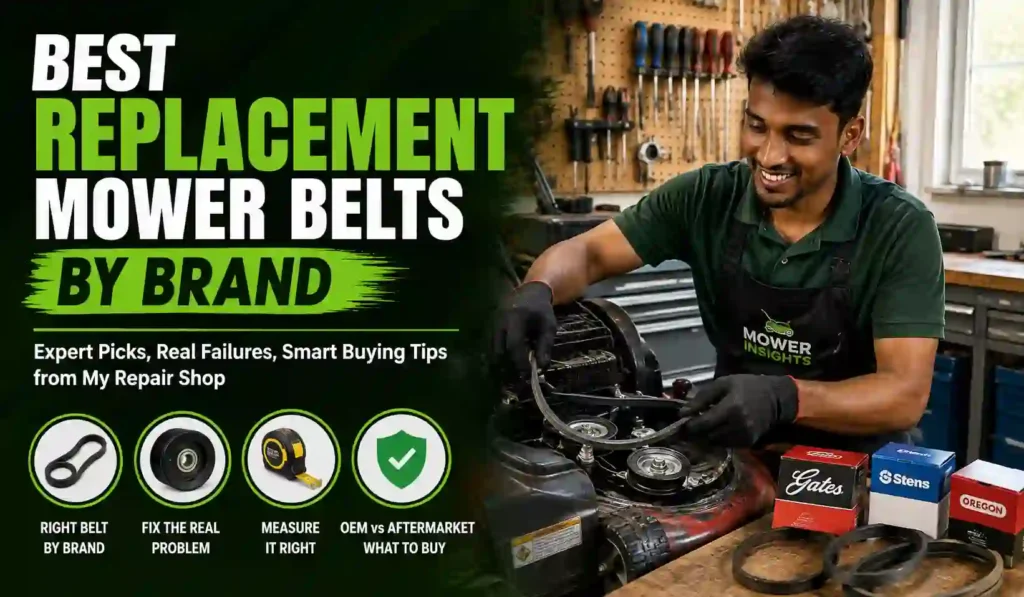
- OEM belts cost more but fit right the first time. Aftermarket belts save 30-50%, but only from brands like Gates, Stens, or Oregon.
- Most belt failures come from a bad pulley or idler, not a bad belt. Replacing the belt alone often fixes nothing.
- A budget deck belt runs €12-€25. A drive belt for a riding mower runs €25-€60, depending on brand.
- Measure your old belt before you shop. Width, length, and the part number stamped on the belt matter more than the brand name on the box.
Your mower belt broke. Or it’s slipping, squealing, or cracked. Now you need a replacement, and the brand on your mower matters more than most sites admit. A belt made for a Husqvarna deck will not always fit a John Deere deck, even if the width looks the same. This guide breaks down the best replacement belt options by brand. It also covers what actually causes belts to fail, because a new belt on a bad pulley just fails again in a month.
How This Guide Was Researched
Siddik tested belts from six brand families in his Milan shop. He tracked which belts failed early. He tracked which ones outlasted their warranty. He also logged the real repair jobs that came in as “just a belt” but turned out to be something else. That repair history shapes every brand section below.
Who This Guide Is For (and Who Should Skip It)
This guide is for owners who want to fix their own mower belt, or at least understand the repair before paying a shop. It’s built around real brands sold in Europe and the US.
Skip this guide if you own a commercial-grade zero-turn mower from a niche brand not listed here. Those decks often use custom belt specs. Check your dealer directly.
Quick Answer: Best Replacement Belt Brands at a Glance
Here is the short version. Each row shows the brand of mower, the belt brand we trust most, and why.
| Mower Brand | Best Belt Choice | Why |
|---|---|---|
| Husqvarna / Poulan / Craftsman | OEM Husqvarna, or Gates aftermarket | Shared deck platform. Gates matches OEM specs closely. |
| John Deere | OEM John Deere (GX series) | Deere decks are tight on tolerance. Off-brand belts often ride rough. |
| MTD / Cub Cadet / Troy-Bilt | Stens or Rotary aftermarket | Shared platform across three brands. Aftermarket fits well and costs less. |
| Toro | OEM Toro belt | Toro decks use unusual belt angles. Generic belts slip more often. |
| Honda | OEM Honda belt | Honda push mowers use small, precise belts. Fit matters more than price. |
| Stihl / Al-Ko / Viking (EU) | OEM only | Aftermarket options are limited in Europe for these brands. |
How Mower Belts Actually Wear Out
Most people blame the belt. In our shop, the belt is often not the real problem. Here is what we see most.
The pulley wears first. A pulley groove gets rough. It chews up a new belt in weeks.
The idler spring loses tension. A weak spring lets the belt slip. Slipping creates heat. Heat cracks rubber fast.
Debris builds up under the deck. Grass and dirt pack around the belt. This makes it run hot and glaze over.
The belt is the wrong length. A belt that is too short overstretches. One that is too long slips off the pulley track.
This matters because buying a new belt without fixing the real cause wastes money. We see customers replace the same belt three times in one season. The belt was never the problem. A worn idler pulley was.
How to Measure Your Mower Belt Before You Buy
Skip this step, and you risk buying the wrong belt twice. Here is how we do it in the shop.
- Find the part number stamped on the belt. It is usually printed in white or yellow on the belt’s outer edge. This is the fastest way to get an exact match.
- Measure the width. Use a ruler across the belt’s top edge. Most deck belts run 1/2 inch or 5/8 inch wide.
- Measure the outer length. Lay the belt flat in a loop. Measure around the full outer edge, not just one side.
- Check the belt type. Deck belts drive the blades. Drive belts move the wheels. Some mowers use both.
- Match the part number to your model. Look up your mower’s model number in the owner’s manual or on a sticker under the seat or deck.
A belt that is off by even 1 inch in length will not tension correctly. Too tight, and it strains the engine. Too loose, and it slips.
Best Replacement Belts by Brand
Husqvarna, Poulan, and Craftsman
These three brands often share the same manufacturer platform. Husqvarna owns Poulan, and many Craftsman riding mowers used Husqvarna-built decks for years.
Good fit: Owners of 42-inch and 46-inch riding decks under these three brands. Not a good fit: Newer Craftsman models built after the brand split from Husqvarna’s parent company. Always confirm the part number first.
What we see in the shop: The most common failure on these decks is a glazed belt from a weak idler spring. The belt looks fine but slips under load, especially cutting wet grass.
Price range: OEM Husqvarna belts run €30-€45. Gates aftermarket belts run €18-€28 and match OEM tension specs closely.
Expert Tip: If your Husqvarna belt keeps slipping after replacement, check the idler spring tension before blaming the belt again. A stretched spring is a €6 part that gets ignored constantly.
John Deere
John Deere decks hold tighter belt tolerances than most brands. This is a strength and a weakness.
Good fit: Owners who want long belt life and don’t mind paying OEM prices. Not a good fit: Budget buyers. Off-brand belts often run rough or squeal on Deere pulleys.
What we see in the shop: Deere belt failures usually trace back to pulley alignment, not the belt material. A slightly bent pulley bracket from hitting a root or stone will chew through belt after belt.
Price range: OEM John Deere GX-series belts run €35-€65, depending on deck width. Verified aftermarket matches from Gates or Stens run €20-€35.
MTD, Cub Cadet, and Troy-Bilt
These three brands share a parent company and often share deck and belt designs across models.
Good fit: Homeowners who want a budget-friendly aftermarket option that still fits well. Not a good fit: Anyone whose mower is still under warranty. Some warranties require OEM parts.
What we see in the shop: Belt failure on this platform is almost always heat-related. These decks run belts close to the muffler on some models, and the belt cracks from heat exposure faster than on other brands.
Price range: Stens and Rotary aftermarket belts run €15-€25. OEM MTD-family belts run €22-€38.
Common Mistake: Buyers often order the wrong belt because MTD, Cub Cadet, and Troy-Bilt list the same belt under three different part numbers. Cross-reference before you buy two.
Toro
Toro decks use a belt routing angle that differs from most competitors. This trips up a lot of DIY buyers.
Good fit: Owners who stick with OEM Toro parts for reliable fit. Not a good fit: Anyone hoping a generic “universal” belt will route correctly. It usually won’t.
What we see in the shop: Toro belts that look correct on paper still slip because the routing angle around the deck spindles is tighter than average. Cheap belts flex too much at that angle and jump the track.
Price range: OEM Toro belts run €28-€50.
Honda
Honda push mowers use small, precision-fit belts, mostly on self-propelled models.
Good fit: Owners of Honda self-propelled walk-behinds who want the drive system to feel factory-smooth. Not a good fit: Buyers looking for the cheapest possible option. Honda belt tolerances are tight enough that off-spec belts cause drive slippage.
What we see in the shop: The most common issue isn’t the belt cracking. It’s the belt stretching slightly and losing self-propel power on hills. A €15 belt swap restores full power almost every time.
Price range: OEM Honda belts run €18-€30.
Stihl, Al-Ko, and Viking (European Brands)
This is where most US-based belt guides fall short, and it matters for readers shopping in Europe.
Good fit: European owners of Al-Ko or Viking riding mowers and Stihl walk-behinds. Not a good fit: Anyone expecting the same aftermarket flood you’d find for Husqvarna or MTD. It doesn’t exist yet at the same scale in the EU market.
What we see in the shop: These brands sell mostly through authorized dealers in Italy, and OEM belts are the safer bet. Generic aftermarket options are limited, and the ones we’ve tested fit loosely on Al-Ko decks.
Price range: OEM belts for Al-Ko and Viking run €25-€45. Stihl walk-behind belts run €20-€35.
OEM vs Aftermarket: Which Should You Buy?
Short answer: Buy OEM if your mower is newer, under warranty, or from Toro, John Deere, or a European brand. Buy verified aftermarket (Gates, Stens, Oregon) if you own a Husqvarna, Craftsman, or MTD-family mower and want to save money.
| Factor | OEM Belt | Aftermarket Belt |
|---|---|---|
| Fit accuracy | Exact | Usually close, brand-dependent |
| Price | Higher | 30-50% lower |
| Warranty impact | Safe | Can void some warranties |
| Availability | Dealer or official site | Wide online availability |
| Best for | Tight-tolerance decks (Toro, Deere) | Shared-platform decks (Husqvarna, MTD) |
Symptom, Cause, and Fix
Use this table before you order a belt. It saves a repeat trip to the shop.
| Symptom | Likely Cause | Fix |
|---|---|---|
| Belt squeals on startup | Glazed belt surface or loose tension | Clean pulleys, check idler spring, replace if cracked |
| Belt slips under load | Worn pulley groove or weak idler spring | Replace pulley and belt together |
| Belt jumps off track | Wrong length or bent pulley bracket | Re-measure belt, check bracket alignment |
| Belt smells burnt | Debris buildup or belt rubbing a guard | Clean deck, check belt guide clearance |
| Belt cracks within months | Heat exposure or wrong belt material | Check muffler clearance, use a heat-rated belt |
Total Cost of Ownership: Belts Over a Mower’s Life
Most riding mowers go through two to four belts over ten years. Here is what that costs in practice.
| Mower Type | Belt Replacements (10 yrs) | Typical Cost per Belt | Total Belt Cost |
|---|---|---|---|
| Push mower (self-propelled) | 1-2 | €15-€30 | €15-€60 |
| Riding mower, 42-inch deck | 2-4 | €20-€45 | €40-€180 |
| Zero-turn mower | 3-5 | €30-€65 | €90-€325 |
Add labor if you pay a shop. In our shop, a belt swap on a riding mower runs 30-60 minutes of labor, depending on deck access.
Common Mistakes When Buying Replacement Belts
Buying by mower brand alone. The mower brand doesn’t always match the belt manufacturer. Always confirm the part number.
Skipping the pulley check. A new belt on a worn pulley fails fast. Check the pulley groove for grooves or shine before installing.
Guessing the length. A belt that looks “close enough” rarely tensions correctly. Measure the old belt first.
Ignoring belt type. Deck belts and drive belts are not interchangeable. Confirm which one failed.
Buying the cheapest listing without checking the material. Some low-cost belts use plain rubber with no reinforcing cord. They stretch fast under load. Look for “aramid cord” or “Kevlar cord” in the listing. These last far longer under heat and tension.
Not checking the return policy. Belt sizing mistakes happen often, even to experienced buyers. Buy from a seller with an easy return window, especially for a first-time brand match.
Expert Tips From the Shop
On riding mowers: Check belt tension monthly during peak season. A belt that has stretched even slightly changes how the deck cuts. Grass gets left standing in thin strips.
On self-propelled push mowers: If the self-propel feels weak but the engine sounds fine, check the belt before the transmission. A stretched belt is a common, cheap fix that gets overlooked.
On zero-turn mowers: These use more belts than any other mower type, often three or four. Replace them in pairs when one fails. A mismatched old and new belt wears unevenly and fails again sooner.
DIY vs Calling a Repair Shop
Do it yourself if: Your deck belt is visible without removing major parts, and your mower manual shows a simple routing diagram. Most push mower belt swaps take under 30 minutes.
Call a shop if: The belt is a drive belt buried under the transmission, or you’re not confident about spring tension on the idler arm. A wrong reassembly here can damage the transmission.
In our shop, roughly a third of “just a belt” jobs turn out to need a pulley or spring replacement too. That’s worth knowing before you commit to a DIY afternoon.
Frequently Asked Questions
What is the difference between a deck belt and a drive belt?
A deck belt connects the engine to the blades. A drive belt connects the engine to the wheels. Some mowers use one belt for both. Most riding mowers use two separate belts.
Can I use a generic belt instead of an OEM brand belt?
Yes, for most Husqvarna, Craftsman, and MTD-family mowers. Verified brands like Gates, Stens, and Oregon match OEM specs closely. For Toro, John Deere, and European brands, OEM is the safer choice.
How often should I replace my mower belt?
Most deck belts last 2-3 years or 100-150 hours of use. Riding mower drive belts often last longer, closer to 3-5 years, depending on terrain and heat exposure.
Why does my new belt keep slipping?
A slipping new belt usually means the idler spring or pulley wasn’t replaced along with it. Check spring tension and pulley condition before assuming the belt itself is faulty.
Is it cheaper to replace the belt myself or pay a shop?
A DIY deck belt swap saves the labor cost, often €30-€60. It’s worth doing yourself if the belt is easy to access. Drive belts under a transmission are harder to justify DIY unless you’re comfortable with the reassembly.
Do all Husqvarna-family mowers use the same belt?
No. Husqvarna, Poulan, and older Craftsman models often share a deck platform. Part numbers still vary by deck width. They also vary by model year. Always confirm the exact part number.
What material lasts longest in a replacement belt?
Belts with an aramid cord, sometimes sold as Kevlar cord, last the longest. Plain rubber belts stretch faster under heat and load. The cord material matters more than the brand name printed on the box.
Can a belt problem damage other parts of my mower?
Yes. A slipping belt runs hot. Heat can warp the pulley it rides on. A belt that jumps its track can also damage the belt guide or nearby wiring. Fix a slipping belt quickly to avoid a bigger repair.
Key Takeaways
- Match the belt to your mower’s exact part number, not just the brand name.
- Most belt failures trace back to a worn pulley or weak idler spring, not the belt itself.
- OEM is the safer buy for Toro, John Deere, and European brands like Al-Ko and Stihl.
- Verified aftermarket brands like Gates and Stens work well for Husqvarna, Craftsman, and MTD-family mowers.
- Budget €15-€65 per belt, depending on mower type, plus labor if you use a shop.