Quick Overview
- Most robot mowers work well on slopes up to 20-25 degrees (about a 35-45% grade).
- A few premium models handle steeper slopes, up to 45-50 degrees.
- Wet grass on a slope is more dangerous than a dry, steep slope.
- Wheel slip, not tipping, is the most common robot mower problem on hills.
- Check your yard’s slope with a phone app before you buy.
Robot mowers can handle many slopes. But not all slopes. The key number is degrees, not just “steep” or “flat.” A 20-degree slope feels steep to walk on. Most robot mowers handle that just fine. Above 25 degrees, many models start to slip or lose grip. This guide gives you real numbers. It also covers wet grass, boundary wires, and what breaks first on hilly lawns.
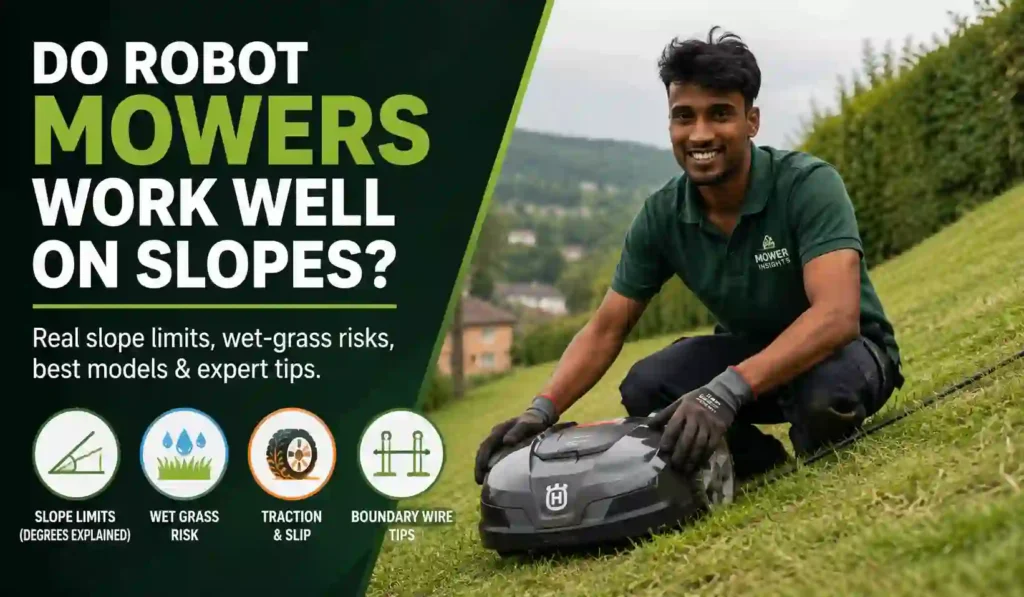
What Slope Angle Can Robot Mowers Handle?
Most robot mowers handle slopes up to 20 degrees. Some go up to 25 degrees. That is about a 35-45% grade.
A 20-degree slope is steeper than it sounds. Stand on a 20-degree hill. It feels like a real climb. Most yards are much flatter than that.
Degree numbers matter more than words like “steep.” Brands use different words for the same slope. One brand’s “moderate slope” might be another’s “steep slope.” Always check the exact degree number.
Here is a simple table to compare typical slope ratings.
| Slope Rating | Degrees | What It Feels Like |
|---|---|---|
| Flat to gentle | 0-10° | Easy walk, barely notice a slope |
| Moderate | 10-20° | Clear incline, most robot mowers handle this |
| Steep | 20-35° | Hard to walk on, only some models handle this |
| Very steep | 35-50° | Needs a specialist robot mower |
In our shop, we see many owners guess their slope wrong. They call a hill “steep.” The hill is often only 12 degrees. A tape measure and a phone app fix this guess fast.
How to Measure Your Yard’s Slope
You do not need special tools. A phone app can measure your slope in seconds. Most phones have a built-in level app with an angle reader.
Follow these steps:
- Open your phone’s level or compass app.
- Find the angle or degree reading tool inside it.
- Lay the phone flat on the steepest part of your lawn.
- Read the degree number on the screen.
- Repeat this at three or four spots on the slope.
- Use the highest number you find. That is your real slope.
Do this test after it rains once. Wet ground can shift your footing. Test in a few different spots, not just one. Lawns often have one steep patch and the rest flat.
If your highest reading is under 20 degrees, most robot mowers will work. If it is over 25 degrees, you need a slope-specific model. We cover those models next.
Why Wet Grass Is the Real Danger on Slopes
Wet grass is more dangerous than a steep dry slope. This is the biggest gap in most buying guides. A dry 20-degree slope is often safer than a wet 12-degree slope.
Water makes grass slick. Robot mower wheels lose grip on wet grass fast. The mower can slide sideways. It may also slide down the slope instead of turning.
Most robot mowers use rain sensors. These sensors send the mower home when rain starts. But morning dew is not rain. Dew makes grass just as slippery. Many mowers do not detect dew at all.
Expert Tip: In our shop, we see more slope-related mower faults from dew than from actual rain. Set your mower’s schedule to start after 10 a.m. This gives dew time to dry first.
A mower that slides on wet grass can:
- Damage its own wheels from spinning in place.
- Scalp the lawn by digging into one soft, wet spot.
- Drift outside the boundary wire on a slope.
Robot Mowers Built for Steep Yards
A small group of robot mowers are built just for steep yards. These models use extra wide wheels, sharper wheel spikes, or all-wheel traction systems.
These slope-specific models often handle 35 to 50 degrees. That is a real steep hill. Regular robot mowers stop working well long before that point.
Here is what to look for in a slope-rated model:
| Feature | Why It Helps on Slopes |
|---|---|
| Wide rear wheels | Spreads weight, grips more grass |
| Metal wheel spikes | Bites into soil for extra grip |
| All-wheel drive | Both wheel sides push, less slipping |
| Low center of gravity | Harder for the mower to tip or slide |
| Higher-degree rating on spec sheet | Direct proof it was built for hills |
These slope-rated mowers usually cost more. Expect to pay a real premium over a flat-yard model.
What Happens When a Robot Mower Struggles on a Hill
A struggling mower does not usually flip over. That is a common fear, but it is rare. The real problem is wheel slip.
Wheel slip happens when the wheels spin but the mower does not move forward. The wheels dig a small rut into the wet or soft soil. This rut gets deeper with each pass.
Siddik has opened up several mowers with this exact issue. Here is what he found: “The motor was fine. The wheels were fine. The problem was one worn drive belt. It could not handle the extra strain from constant hill slipping.”
Wheel slip causes a chain of small problems:
- The battery drains faster from the extra motor strain.
- The drive belt or gear wears out sooner than normal.
- The mower may get stuck and shut down mid-job.
- Grass gets torn instead of cut cleanly in that one spot.
Boundary Wire Placement on Sloped Lawns
Boundary wire needs a different placement plan on a slope than on flat ground. Most buying guides skip this step entirely.
On flat ground, you bury the wire in a simple straight line. On a slope, water runoff can wash soil away from the wire. This exposes the wire and can damage it over time.
Follow these placement tips for sloped sections:
- Bury the wire slightly deeper on slopes, not just at the standard flat-ground depth.
- Avoid placing the wire at the very bottom of a slope, where water pools.
- Check the wire after heavy rain for any exposed sections.
- Keep the wire path wider than usual on a slope corner, since mowers drift more there.
Common Mistake: Many owners place the wire in a tight loop at the top of a slope. The mower then turns sharply on the steepest part. This is exactly where wheel slip happens most. Keep turns on the flattest part of the slope instead.
Common Repairs From Slope Use
Slope use adds wear to specific parts. This is where a repair-shop view helps more than a spec sheet.
| Part | Slope-Related Problem | Typical Repair Cost |
|---|---|---|
| Drive belt | Extra strain from wheel slip wears it faster | [VERIFY: current typical repair cost range] |
| Wheel motor | Constant slip overheats the small motor | [VERIFY: current typical repair cost range] |
| Battery | Faster drain and more charge cycles shorten life | [VERIFY: current typical battery replacement cost] |
| Boundary wire | Washout or exposure on slope sections | [VERIFY: current typical wire repair cost] |
In our shop, most slope-related repairs are the drive belt. Owners often do not know the belt is the cause. They usually think the whole motor has failed.
Good Fit vs. Not a Good Fit
A robot mower is a good fit for your slope if:
- Your yard’s steepest measured point is under 20 degrees.
- Your slopes stay mostly dry through the day.
- You can set a mowing schedule for after 10 a.m.
- You are willing to check the boundary wire after storms.
A robot mower is not a good fit for your slope if:
- Your yard has a section over 35 degrees, and you cannot buy a slope-rated model.
- Your slope stays shaded and wet most of the morning.
- You want a “buy it and forget it” setup with zero wire checks.
- Your budget does not allow for a true slope-rated model on a steep yard.
Frequently Asked Questions
Do robot mowers work well on slopes?
Yes, on slopes up to about 20-25 degrees. Above that, you need a slope-rated model built for steeper ground.
What degree slope can a robot mower handle?
Most standard models handle up to 20 degrees. Slope-rated models can handle 35 to 50 degrees.
Can a robot mower flip over on a hill?
This is rare. The more common problem is wheel slip, not tipping.
Is wet grass worse than a steep slope for robot mowers?
Yes. Wet grass reduces wheel grip more than a dry steep slope does.
How do I know my yard’s exact slope?
Use your phone’s level app. Lay it flat on the steepest spot and read the degree number.
Do slope-rated robot mowers cost more?
Yes, they usually cost more than standard flat-yard models.
Pingback: Best Lawn Mowers for Hills and Slopes in 2026