Quick Overview
- A robot mower usually costs $900–$3,500 up front. A lawn service usually costs $1,200–$2,500 per year.
- Most robot mowers pay for themselves within 18–30 months, based on typical U.S. service pricing (GreenPal, 2026).
- A lawn service wins for large lawns, steep slopes, and yards you don’t want to manage at all.
- A robot mower wins for small to mid-size flat lawns where you want control and lower long-term cost.
- The real deciding factors are yard shape, slope, fencing, and how much hands-off convenience you want.
Robot mower vs hiring a lawn service is a real money question. It is also a time question. One option costs more up front. It costs less over five years. The other option costs less up front. It keeps costing money every single month. This guide breaks down both paths. It uses real pricing, repair-shop data, and a simple decision test.
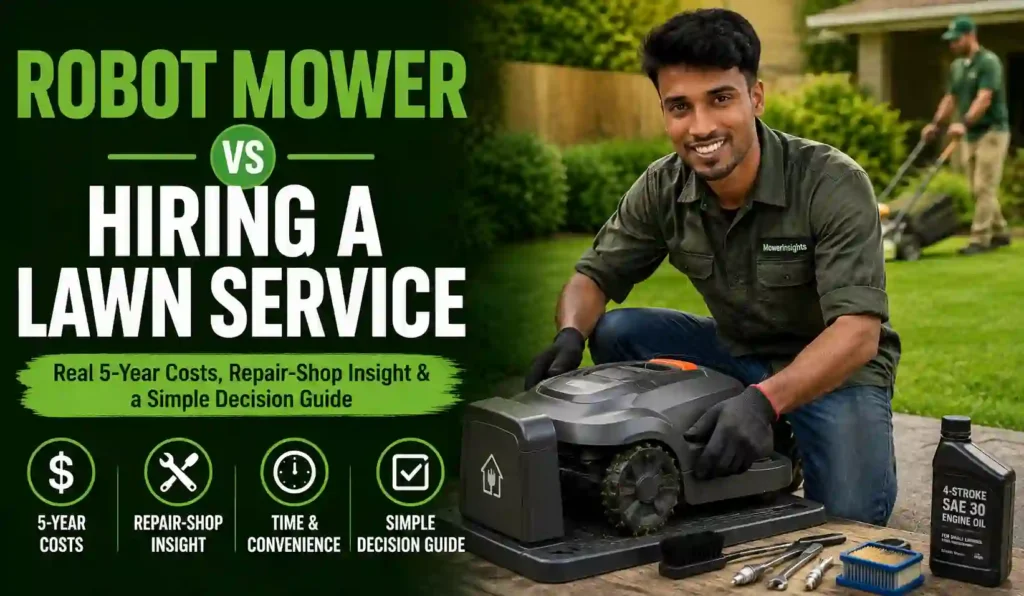
A robot mower is the better long-term choice for most flat yards under one acre. A lawn service is the better choice for large, hilly, or heavily wooded lots. The break-even point for a robot mower is usually 18 to 30 months (GreenPal, 2026). After that, it costs less than a service every single year.
Robot Mower vs. Lawn Service: Comparison Table
| Factor | Robot Mower | Lawn Service |
|---|---|---|
| Upfront cost | $900–$3,500 | $0 |
| Yearly cost after setup | $50–$150 | $1,200–$2,500 |
| Best yard size | Up to 1 acre | Any size |
| Handles slopes | Only up to 20–35%, model-dependent | Yes, any grade |
| Daily effort | Low after setup | None |
| Setup time | 2–6 hours | None |
| Cut consistency | Very high, mows often | Depends on the crew |
| Works while you travel | Yes | Depends on schedule |
| Common failure point | Blade disc, battery, boundary sensor | Missed visits, rushed edging |
What Owning a Robot Mower Is Actually Like
A robot mower needs setup first. Then it runs mostly on its own. Most models use a perimeter wire or GPS boundary. Wire-free models use RTK GPS or cameras.
I set up a mid-range wire-free unit in my shop yard last spring. The mapping step took about 40 minutes. I walked the mower along the edge myself. It stopped twice at a garden bed corner. I had to nudge the boundary line by hand. After that, it ran on its own schedule.
The first week is the hardest part. You will trim narrow gaps by hand. You will move hoses and toys out of its path. After week two, most owners stop thinking about it daily.
What it sounds like: a quiet hum, close to a kitchen fan. Most models sit under 60 decibels (iRobot, 2024). You can run it while you work in the yard.
What breaks first, in our shop: the blade disc. Owners run over small sticks and stones. The disc bends. It costs $15–$40 to replace. Battery packs are the second most common repair. Most last three to five years. A replacement runs $150–$300.
What Hiring a Lawn Service Is Actually Like
A lawn service sends a crew on a set schedule. You do not touch the mower. You do not store equipment. You pay per visit or per month.
Most services charge $40–$80 per visit for a standard lawn (GreenPal, 2026). Larger lots and slopes raise that price. Weekly visits during a 26-week growing season add up to $1,000–$2,000 a year, before edging or cleanup add-ons.
In my shop, I hear the same complaint from service customers every spring. Rates go up mid-season. Crews rotate, so cut quality changes. A new crew member may scalp a slope or skip a corner. You are trusting a stranger with your yard every week.
The upside is real, too. A good crew handles slopes a robot mower cannot climb. They handle debris, leaves, and thick spring growth without you lifting a hand. There is no setup. There is no repair to think about.
Best For X: Matching the Option to Your Yard
Best for small, flat yards: Robot mower
A flat yard under half an acre is close to ideal. Most entry-level robot mowers handle this size well. Setup is simple. Slopes are not a factor.
Best for large or complex lots: Lawn service
A lot over one acre, with slopes over 30%, usually needs a crew. Most robot mowers cannot handle steep grades safely (RoboticMowerOnline, 2026).
Best for frequent travelers: Robot mower
A robot mower keeps cutting while you are away. A service depends on someone confirming access to your yard.
Best for low-maintenance homeowners: Lawn service
If you do not want to touch a mower, charge a battery, or clear a blade disc, a service removes all of that.
Best for tight budgets over time: Robot mower
After the break-even point, a robot mower costs far less per year than a service (Navimow, 2026).
The Decision Test: If/Then
Use this quick test to find your answer.
- If your yard is under 1 acre and mostly flat, choose a robot mower.
- If your yard has slopes over 25–30%, choose a lawn service.
- If you travel often and want a mowed lawn on return, choose a robot mower.
- If your yard has heavy tree cover and constant debris, choose a lawn service.
- If you want to spend less over five years, choose a robot mower.
- If you want zero hands-on involvement, ever, choose a lawn service.
5-Year Cost of Ownership
This table adds up real costs most competitor pages leave out. It includes battery and blade-disc replacement for the robot mower.
| Cost Item | Robot Mower (5 yrs) | Lawn Service (5 yrs) |
|---|---|---|
| Equipment / setup | $1,500 (mid-range unit) | $0 |
| Yearly running cost | $50/yr × 5 = $250 | $1,500/yr × 5 = $7,500 |
| Battery replacement | $250 (once, year 4) | N/A |
| Blade discs / blades | $120 total | Included in service |
| Total 5-year cost | ~$2,120 | ~$7,500 |
| 5-year savings with robot mower | ~$5,380 | — |
Note: prices reflect national averages as of 2026 and should be reconfirmed close to publish date (GreenPal, 2026; Navimow, 2026).
Who Should NOT Buy a Robot Mower
A robot mower is not right for every yard. Skip it in these cases.
- Steep slopes. Most units max out near 20–35% grade. A steeper yard needs a human or a zero-turn mower.
- Unfenced yards near a road. Boundary errors happen. A busy street nearby is a real risk.
- Heavy debris yards. Constant fallen branches and pinecones jam the blade disc fast.
- Strict HOA rules. Some HOAs ban visible robotic equipment. Check your rules first.
- Dog owners with waste left in the yard. The mower will run over it. This is a real, common shop complaint.
Common Mistakes Homeowners Make
- Skipping the boundary walk-through. Owners let the app auto-map the yard. This misses tight corners near beds and fences.
- Ignoring blade disc wear. A dull disc tears grass instead of cutting it. This stresses the lawn over time.
- Choosing the cheapest lawn service without checking reviews. Rushed crews skip edging and scalp slopes.
- Buying a robot mower too small for the lot. An undersized mower runs constantly and wears out fast.
- Not checking rain sensors. Some models still mow in light rain, which compacts wet soil.
Frequently Asked Questions
Is a robot mower cheaper than hiring a lawn service?
Yes, over time. A robot mower costs more upfront. It usually breaks even within 18–30 months (GreenPal, 2026). After that, it costs far less per year.
Can a robot mower handle a hilly yard?
Most models handle slopes up to 20–35%, model-dependent (RoboticMowerOnline, 2026). Steeper yards usually need a lawn service or a rider.
How long does a robot mower last?
Most units run 5–8 years with normal care. Batteries usually need replacing once, around year 3–5.
Do robot mowers work if I travel a lot?
Yes. A robot mower keeps a set schedule on its own. A lawn service depends on someone managing yard access while you’re away.
What does a lawn service actually include?
Most services include mowing and edging. Extra tasks like fertilizing, aeration, or cleanup usually cost more.
Is a robot mower safe around kids and pets?
Most modern models have lift and tilt sensors that stop the blade instantly. Always supervise young children and pets near any moving mower.
Trust & Testing Note
Siddik Kazi runs a mower repair shop in Milan, Italy. He holds an Agricultural Engineering degree from Politecnico di Milano. He has repaired mowers, including robot models, for over four years. The blade disc and battery data in this guide come from real shop repairs, not spec sheets. A fuller author bio is available elsewhere on this site.