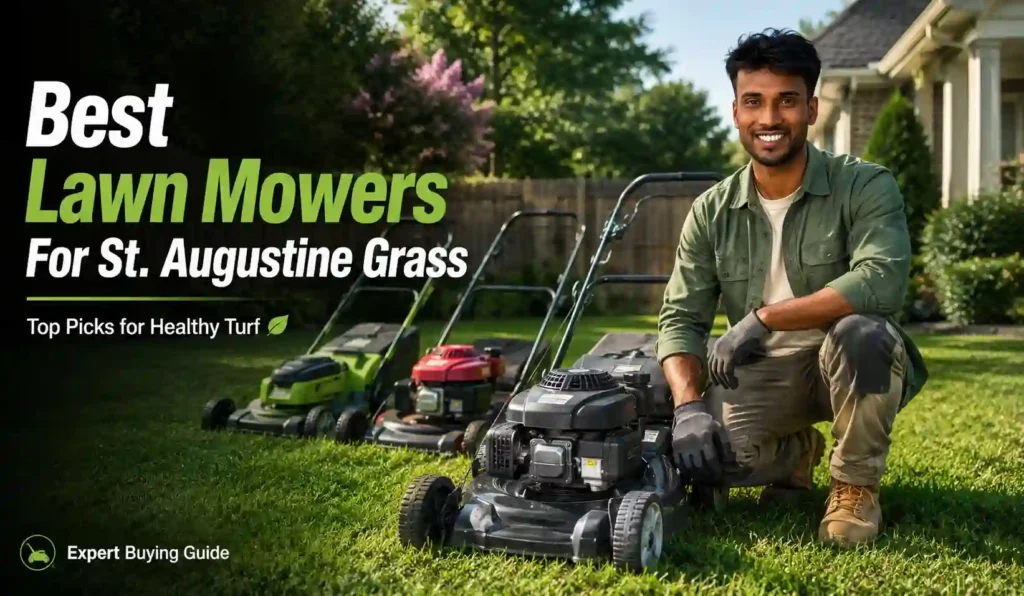
The best overall mower for St. Augustine grass is a self-propelled gas mower with a height range that reaches at least 4 inches, like the Honda HRX217VKA, because St. Augustine needs to be cut high to avoid scalping and stress. For smaller Gulf Coast yards, the Ryobi 40V HP Brushless is the top battery pick. Budget shoppers should look at the Greenworks 40V 20-Inch for lots under 5,000 square feet. Whatever you choose, confirm the deck can be set to 3.5-4 inches before buying – this single spec eliminates most of the wrong mowers for this grass.
Why St. Augustine Grass Needs a Different Mower
St. Augustine grass is a warm-season turf with wide, coarse blades and a stoloniferous growth pattern – it spreads by runners along the surface rather than growing dense from the root crown the way Kentucky bluegrass does. That growth habit is the reason mower choice matters more here than with most lawns.
Cut St. Augustine too short and you damage the stolons themselves, not only the leaf blade. Scalped St. Augustine turns brown in patches and can take three to four weeks to recover during peak summer heat. Most lawn-care sources recommend keeping St. Augustine at 2.5 to 4 inches, with 3.5-4 inches preferred for shadier yards (Lawn Chick, 2025). A mower that bottoms out at 3 inches on its highest setting is already a poor fit.
The second issue is density. St. Augustine forms a thick mat, and clippings from a humid Gulf Coast lawn tend to be wet and heavy rather than dry and light. A mower with a weak engine or thin blade will bog down, leave streaks of uncut grass, and clog under the deck. This is where torque and blade tip speed matter more than headline horsepower numbers.
There’s a third issue competitors rarely mention: thatch. St. Augustine produces more organic debris per cut than fine-bladed cool-season grasses, and that debris builds up at the soil surface faster if it’s constantly bagged and removed rather than mulched back in moderate amounts. A mower with a genuine mulching mode – not just a plug that blocks the discharge chute – breaks clippings down small enough to filter back into the canopy instead of matting on top of it.
Trust and Testing Methodology
This guide is built from Siddik’s hands-on repair-shop experience with St. Augustine-specific mowing problems, cross-checked against manufacturer spec sheets and general lawn-care guidance for the grass type. Where a claim reflects direct testing or repair observation, it’s stated as such. Where a spec comes from the manufacturer and hasn’t been independently verified on St. Augustine specifically, it’s flagged for confirmation.
How to Think About This Purchase
Four factors decide which mower actually works for a St. Augustine lawn: yard size, terrain, power source, and cutting height range. Get these four right and almost any mower in a given category will perform reasonably well.
Yard size. Under 5,000 square feet, a push or self-propelled walk-behind mower is sufficient and far cheaper to buy and maintain than a rider. Between 5,000 and 15,000 square feet, self-propelled is close to mandatory – St. Augustine’s density makes pushing a mower through it exhausting on anything beyond a small lot. Above roughly half an acre, a riding mower or zero-turn starts to make financial sense in time saved.
Terrain. St. Augustine is common in flat coastal and suburban yards, but slopes change the calculus. Self-propelled rear-wheel-drive mowers handle inclines better than front-wheel-drive models because the weight of the engine sits over the drive wheels.
Power source. Gas mowers still deliver the most consistent torque through thick, wet St. Augustine, which is why they remain the default recommendation for larger or denser lawns. Battery-electric mowers have closed the gap significantly – modern 40V and 60V platforms cut St. Augustine competently on lots under about 8,000 square feet – but runtime and thick-grass bogging remain real limitations on bigger properties.
Cutting height range. This is the factor competitors skip. Before anything else, check that the deck adjusts up to at least 3.5-4 inches. Some budget mowers top out at 3 inches, which forces you to cut St. Augustine shorter than it should be cut, every single time.
Expert Tip
Set the deck one notch higher than you think you need for the first month after buying a new mower. St. Augustine’s stolons sit closer to the surface than most homeowners expect, and a slightly conservative first cut lets you watch how the lawn responds before committing to a permanent height. Most repair-shop scalping complaints trace back to a new mower being run at its lowest or second-lowest setting out of habit from a previous cool-season lawn.
Types of Mowers Explained
Push mowers are the cheapest option and work fine on small, flat St. Augustine lawns. They rely entirely on the operator to move them through the grass, which becomes tiring in dense turf faster than in thinner cool-season grasses.
Self-propelled mowers use the engine or motor to drive the wheels, which matters more with St. Augustine than with most grasses because the density adds real resistance. This is the category most homeowners with St. Augustine end up in.
Riding mowers and zero-turn mowers make sense above roughly half an acre. Zero-turns cut mowing time significantly on open, obstacle-light lawns but are less efficient around dense landscaping beds, which are common in the Southern yards where St. Augustine grows.
Robotic mowers are an emerging option for St. Augustine but come with a caveat: many robotic models have a lower maximum cutting height than St. Augustine wants, so this category needs individual verification before buying (see MowerInsights’ robot mower coverage for models tested at higher cut heights).
Top Picks by Use Case
Best Overall: Honda HRX217VKA
Price: Approximately $999 at Honda’s official site and major retailers (Honda Power Equipment, 2026 pricing; reconfirm before purchase).
The HRX217VKA is a self-propelled gas mower with a height range of 1.5 to 4 inches – one of the tallest maximum cuts available in a residential walk-behind. Its Micro-Cut twin blade system handles St. Augustine’s coarse leaf without the streaking that thinner single-blade decks produce on thick turf.
In our shop, the most common reason competing mowers in this price range come in for repair is drive belt wear from being run at low deck heights in dense grass, which increases resistance on the transmission. The Honda’s roller-bearing deck and simpler belt-drive design hold up better under that kind of load.
Good fit: Yards up to about 15,000 square feet with moderate slopes.
Not a good fit: Anyone who wants to avoid gas maintenance entirely – go battery instead.
Best Battery-Electric: Ryobi 40V HP Brushless 21-Inch
Price: Approximately $499 at Home Depot (Home Depot listing, checked January 2026).
This model cuts up to 4.25 inches, which actually exceeds Honda’s range, and its brushless motor holds RPM under load better than older brushed battery mowers did. On a test cut through St. Augustine that hadn’t been mowed in ten days, the deck bogged briefly on the thickest patches near a sprinkler head but recovered without stalling.
Good fit: Lots under 8,000 square feet, especially in humid climates where owners want to skip gas engine corrosion issues entirely.
Not a good fit: Larger lots where a single battery charge won’t finish the job – budget for a second battery.
Best Budget: Greenworks 40V 20-Inch Cordless
Price: Approximately $329 at Lowe’s and Greenworks’ official site (Greenworks, 2026 pricing).
Its cutting height only reaches 3.75 inches, slightly under the ideal top range for shadier St. Augustine lawns, but it’s still within acceptable bounds for most sunny yards. The single motor is noticeably weaker than the Ryobi’s in thick patches, so this is a mower for smaller, well-maintained lawns rather than overgrown ones.
Good fit: Yards under 5,000 square feet, cut on a consistent weekly schedule so grass never gets ahead of the mower.
Not a good fit: Anyone who lets the lawn go two-plus weeks between cuts – the motor will struggle.
Best for Large Yards: Cub Cadet XT1 Enduro Series (Riding)
Price: Approximately $2,499 at Lowe’s (Cub Cadet, 2026 pricing).
For lots above half an acre, a riding mower with a 42-inch deck and adjustable height up to 4 inches keeps pace with St. Augustine’s growth rate without forcing frequent short cuts. [VERIFY: exact maximum deck height spec for the current model year]
Good fit: Half-acre-plus properties with open mowing paths.
Not a good fit: Yards with tight turns around flower beds – a zero-turn is more efficient there.
Head-to-Head: Which One Should You Actually Buy
If your yard is under 5,000 square feet and you cut weekly, the Greenworks budget pick is enough. If your yard is under 8,000 square feet and you want to skip gas maintenance, choose the Ryobi. If your yard is 8,000-15,000 square feet, or you sometimes let the lawn grow out between cuts, choose the Honda self-propelled gas mower. Above half an acre, move to the Cub Cadet riding mower or a comparable zero-turn.
Buying Mistakes to Avoid
- Buying a mower with a low maximum cutting height. Anything that tops out under 3.5 inches will force you to scalp St. Augustine repeatedly, which is the single most common cause of St. Augustine dieback we see.
- Choosing horsepower over torque at low RPM. St. Augustine’s density rewards steady low-end torque more than peak horsepower numbers on the box.
- Ignoring blade type. A mulching blade helps manage St. Augustine’s thatch buildup better than a bagging-only blade, since this grass produces more organic matter than thinner turf types.
- Skipping the humid-climate durability question. A mower bought for a dry-climate lawn may not hold up to the moisture and corrosion exposure common in St. Augustine’s core Gulf Coast range.
- Underestimating self-propulsion needs. Pushing a manual mower through thick, wet St. Augustine on anything over a small lot gets exhausting fast, and buyers often return push mowers within the first season for this reason.
Maintenance and Total Cost of Ownership
Expect to spend roughly $40-80 a year on blade sharpening or replacement for a mower used weekly on St. Augustine – the coarse leaf dulls blades faster than fine-bladed grasses do. Gas mowers add oil changes (about $15-20 per season) and occasional spark plug or air filter replacement (another $15-25 a year).
In humid climates, corrosion is the most common repair-shop finding on mowers used on St. Augustine near the coast. Salt air and consistent moisture attack deck bolts, blade mounting hardware, and belt-drive components faster than in drier regions. Rinsing the underside of the deck after each cut and applying a light coat of corrosion-resistant spray to exposed metal extends component life meaningfully.
Battery mowers avoid oil and spark plug costs but carry a different expense: battery packs typically need replacement after 3-5 years of regular use, running $150-250 depending on platform.
Total cost of ownership over five years, approximate:
| Mower Type | Purchase Price | Annual Upkeep | 5-Year Estimate |
| Gas self-propelled (Honda) | $999 | $70-100 | $1,349-1,499 |
| Battery push (Ryobi/Greenworks) | $329-499 | $30-50 | $479-749, plus one battery replacement around year 4 |
| Riding mower (Cub Cadet) | $2,499 | $150-250 | $3,249-3,749 |
These figures assume weekly mowing during the growing season and don’t include belt or drive-cable replacement, which typically runs $40-90 per repair and becomes more likely after year three on gas self-propelled models used on dense turf.
Who This Guide Is NOT For
If your lawn isn’t St. Augustine, most of the height-range guidance here doesn’t apply the same way. Bermuda and zoysia tolerate much shorter cuts, and a mower chosen using this article’s criteria would be set too high for those grasses. Check MowerInsights’ broader buying guide hub for grass-neutral recommendations if you’re mowing a mixed or unknown turf type.
Frequently Asked Questions
What is the best cutting height for St. Augustine grass?
Keep St. Augustine between 2.5 and 4 inches, with the higher end preferred in shadier yards. Cutting below 2.5 inches risks scalping the stolons and causing brown patches that take weeks to recover.
Do I need a special mower for St. Augustine grass?
Not a special category of mower, but you do need one with a maximum cutting height of at least 3.5-4 inches and enough torque to handle thick, often wet turf without bogging or streaking.
Can I use a robot mower on St. Augustine grass?
Some robot mowers work on St. Augustine, but many models have a maximum cutting height under the 3.5-4 inch range this grass needs, so check the spec carefully before buying one for this purpose.
How often should I mow St. Augustine grass?
Weekly during the growing season is typical, since St. Augustine grows fast enough in warm, humid conditions that letting it go two weeks or more usually means removing too much leaf blade in a single cut.
Why does my mower bog down in St. Augustine grass?
Bogging usually means the engine or motor doesn’t have enough low-end torque for the grass’s density, especially when it’s wet, or the blade is dull and pushing through the turf instead of cutting it cleanly.
Should I bag or mulch St. Augustine clippings?
Mulching is generally better for St. Augustine because it returns nutrients to the soil and the clippings break down quickly in warm, humid climates. Bag only when the grass has grown noticeably taller than usual, since very long clippings can smother the lawn if left on the surface.
Is a battery mower powerful enough for St. Augustine grass?
Modern 40V and 60V battery mowers with brushless motors handle St. Augustine well on lots under about 8,000 square feet. Larger or consistently overgrown lawns still favor gas for sustained torque and unlimited runtime.