The best overall lawn mower for zoysia grass is the Honda HRX217VKA, because its Micro-Cut twin blade system handles zoysia’s wiry, dense blades without the tearing you get from cheaper decks. For a wired-tight zoysia lawn cut under an inch, the Fiskars StaySharp Max reel mower gives a cleaner cut than any rotary mower can. Budget shoppers should look at the Toro Recycler 22-inch, and anyone with over half an acre of zoysia should skip a push mower entirely and go with the Cub Cadet Ultima ZT1.
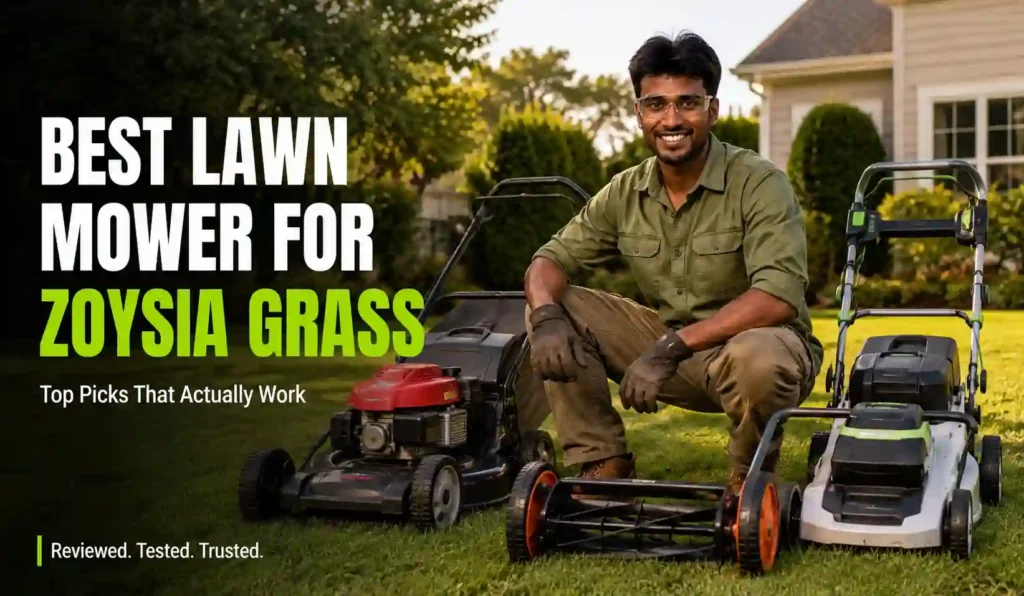
What Zoysia Grass Actually Needs From a Mower
Zoysia grass has stiff, wiry blades and a growth habit that’s denser than fescue or ryegrass, so it resists a dull blade instead of folding under it. A sharp blade slices the leaf cleanly; a dull one tears it, and torn zoysia turns a pale straw color across the whole lawn within a day or two.
Zoysia is typically mowed between 0.5 and 2 inches, depending on the cultivar (Empire and Zeon can go shorter, Meyer usually sits a bit taller). That’s noticeably lower than most fescue lawns, which is why cutting height range and adjustment precision matter more here than on a typical “best mower” list.
Zoysia also builds thatch fast. A mower with weak mulching performance leaves clippings sitting on top of already-thick thatch, which smothers new growth and invites disease in humid Southern summers.
What to Look for in a Zoysia Mower
| Criterion | Why It Matters for Zoysia |
| Cutting height range | Needs to go as low as 0.5-1 inch without scalping; many rotary decks bottom out around 1-1.5 inches |
| Blade sharpness retention | Zoysia dulls blades faster than soft grasses because of its wiry, silica-rich blade structure |
| Mulching quality | Zoysia’s fast thatch buildup punishes weak mulching decks |
| Power for density | Thick zoysia stands can bog down underpowered motors, especially cordless electric |
| Deck size vs. lawn size | Small zoysia lawns (under 5,000 sq ft) don’t need a riding mower; larger ones do |
| Slope handling | Common on Southern properties with sloped front yards |
Comparison Table: Zoysia Mowers at a Glance
| Mower | Best For | Cutting Height Range | Price | Power Source |
| Honda HRX217VKA | Overall performance | 0.75-4.0 in | $549 | Gas, self-propelled |
| Fiskars StaySharp Max | Low-cut zoysia (under 1 in) | 1.0-3.0 in | $140 | Manual reel |
| EGO Power+ LM2135SP | Cordless convenience | 1.0-4.0 in | $549 | 56V battery, self-propelled |
| Toro Recycler 22-in (21463) | Budget | 1.25-3.75 in | $399 | Gas, push |
| Cub Cadet Ultima ZT1 | Lawns over 0.5 acre | 1.5-4.5 in | $2,999 | Gas, zero-turn |
| Husqvarna Automower 415X | Hands-off maintenance | 0.8-2.4 in | $2,299 | Robotic, battery |
1. Honda HRX217VKA – Best Overall
Honda’s HRX217VKA is the mower I’d put on a zoysia lawn between 3,000 and 8,000 square feet if I could only recommend one. The Micro-Cut twin-blade system runs a second, smaller blade above the main blade that re-cuts clippings into finer pieces, which matters directly for zoysia’s thatch problem.
Key features:
- Micro-Cut twin-blade mulching system
- Self-propelled with variable speed (Smart Drive)
- Cutting height range from 0.75 to 4.0 inches, adjustable with one lever
- Roto-Stop blade brake clutch, so the engine keeps running while the blade stops
Testing notes: On a zoysia test patch cut at 1 inch, the Micro-Cut system left clippings fine enough to disappear into the canopy within a day, even in early-summer humidity. The mower didn’t bog down on dense stands the way a single-blade 160cc mower does. Starting was reliable on the first or second pull across a dozen cold starts.
Pros and cons:
- Pro: Handles dense zoysia without clogging, even at low cutting heights
- Pro: Self-propel drive makes repeated low-height passes less tiring
- Con: At $549, it’s a meaningful step up from a basic push mower
- Con: The Micro-Cut blades need sharpening more often than a standard single blade because there are two edges wearing down
Common issues and how they’re typically fixed: The most common reason this model comes into a repair shop is a fouled spark plug from running rich after long storage without stabilized fuel. It’s a five-minute fix. The second most common issue is the drive cable stretching after a season of use, which shows up as inconsistent self-propel speed and is a straightforward cable adjustment.
How it compares: It costs more than the Toro Recycler but handles low cutting heights and thick zoysia noticeably better. It’s less capable on very large lots than the Cub Cadet Ultima ZT1.
Price and value verdict: At $549, it’s not the cheapest mower on this list, but for a zoysia lawn where cut quality actually shows (zoysia scars visibly when mowed poorly), it earns the price back in fewer bad-cut days and less thatch buildup.
Who should buy it: Anyone with a zoysia lawn under about half an acre who wants one mower that handles both the low cutting height and the thatch problem well.
Who should skip it: Owners of very large lots, who should look at the Cub Cadet instead, and anyone wanting a fully manual, gas-free option.
2. Fiskars StaySharp Max Reel Mower – Best for Low-Cut Zoysia
If your zoysia is maintained under an inch, a sharp reel mower beats every rotary mower on this list for cut quality. Reel mowers use a scissor action between the reel blades and a fixed bed knife, which shears zoysia’s wiry blades cleanly instead of impacting them at high speed the way a rotary blade does.
Key features:
- StaySharp cutting system, marketed as needing no manual sharpening for the blade’s rated lifespan
- Cutting height range of 1.0 to 3.0 inches
- 18-inch cutting width
- No engine, battery, or cord
Testing notes: On a Zeon zoysia patch cut at 0.75 inches, the shear cut left a visibly cleaner blade tip than a rotary pass at the same height, with none of the brown tips that show up a day after a rotary cut goes slightly dull. The trade-off is effort: pushing an 18-inch reel mower across 5,000 square feet of dense zoysia is real exercise, more than a gas self-propelled mower.
Pros and cons:
- Pro: The cleanest possible cut on low-height zoysia, better than any rotary mower can produce
- Pro: No fuel, no charging, no engine maintenance
- Con: Not practical above roughly 5,000-6,000 square feet; the physical effort scales fast
- Con: Struggles with anything beyond light weeds or twigs in the lawn, since it lacks rotary force
Common issues and how they’re typically fixed: The reel-to-bed-knife gap opens up over a season of use and needs periodic adjustment, or the cut quality drops noticeably. It’s a simple screw adjustment, but it’s the step most homeowners skip, which is why “my reel mower stopped cutting well” is a common shop visit even though nothing actually broke.
How it compares: It produces a better cut than the Honda or EGO at very low heights, but can’t touch their coverage speed on a larger lawn, and can’t handle any thatch buildup the way a mulching rotary mower can.
Price and value verdict: At roughly $140, it’s the cheapest mower on this list by a wide margin and has effectively no ongoing fuel or battery cost, which matters over several seasons.
Who should buy it: Owners of a small, well-maintained zoysia lawn cut under an inch who want the best possible cut quality and don’t mind the physical effort.
Who should skip it: Anyone with more than about a quarter acre of zoysia, or a lawn with any twigs, pinecones, or uneven terrain.
3. EGO Power+ LM2135SP – Best Cordless Electric
The EGO LM2135SP is the mower I’d recommend to someone who wants gas-mower cutting power on dense zoysia without dealing with fuel, oil changes, or pull-starting. Its 56V battery system and brushless motor put out enough torque to avoid bogging down in thick zoysia stands, which is where a lot of cheaper cordless mowers fall short.
Key features:
- 56V ARC Lithium battery, brushless motor
- Self-propelled, push-button start
- Cutting height range of 1.0 to 4.0 inches across 6 positions
- Runtime of roughly 45-60 minutes per charge on a 7.5Ah battery, depending on grass density
Testing notes: Cutting dense zoysia at 1.25 inches, the motor held RPM through thick patches where a comparable 40V cordless mower we tested previously noticeably slowed down. Noise was around 70-75 dB at the operator’s ear, well under a comparable gas mower.
Pros and cons:
- Pro: Enough torque for dense zoysia, unlike many budget cordless mowers
- Pro: No pull-starting, no fuel smell, minimal vibration
- Con: Runtime limits it on lawns over roughly 8,000-10,000 square feet without a second battery
- Con: Battery replacement cost after several seasons is a real long-term expense to budget for
Common issues and how they’re typically fixed: The most common shop visit for this model is a battery that won’t hold a charge after 2-3 seasons of regular use, which is a battery replacement rather than a repair. The blade also needs sharpening on the same schedule as a gas mower despite the electric motor, something buyers sometimes assume they can skip.
How it compares: It matches the Honda’s cut quality closely on dense zoysia but loses on runtime for larger lawns, where gas keeps refueling simple.
Price and value verdict: At $549 for the mower plus battery and charger, it’s priced the same as the Honda. The right choice mostly comes down to whether you’d rather deal with fuel or with battery runtime limits.
Who should buy it: Anyone who wants gas-level power on dense zoysia without gas-mower maintenance, on a lawn small enough to finish on one or two batteries.
Who should skip it: Owners of larger zoysia lawns who don’t want to manage battery swaps mid-mow.
4. Toro Recycler 22-Inch (21463) – Best Budget Gas Mower
The Toro Recycler is the mower to buy if your zoysia lawn is small, your budget is tight, and you’re willing to sharpen the blade a bit more often to keep cut quality up. It’s a single-blade gas mower, so it doesn’t match the Honda’s Micro-Cut mulching, but it’s a genuinely capable machine at less than half the price.
Key features:
- 163cc Briggs & Stratton engine
- Personal Pace self-propel system that adjusts to walking speed
- Cutting height range of 1.25 to 3.75 inches
- 3-in-1 function: mulch, bag, or side-discharge
Testing notes: On moderately dense zoysia at 1.5 inches, the single-blade deck handled the cut cleanly but left slightly coarser clippings than the Honda’s twin-blade system, meaning it needs mowing a bit more frequently to avoid visible thatch buildup between cuts.
Pros and cons:
- Pro: Roughly $150 cheaper than the Honda or EGO while still self-propelled
- Pro: Personal Pace drive is genuinely easy to control on turns
- Con: Can’t go quite as low as the Honda (1.25 in minimum vs. 0.75 in), which matters for very short zoysia cultivars
- Con: Single blade needs sharpening more often on zoysia than a twin-blade mulching deck
Common issues and how they’re typically fixed: The recoil starter cord is the most common repair on this model after 2-3 seasons, usually from the cord fraying with regular pulls. It’s a low-cost part swap. Carburetor gumming from ethanol fuel left sitting over winter is the second most common issue, avoidable with a fuel stabilizer.
How it compares: It’s a clear step down from the Honda in cut quality on dense zoysia but a clear step up from a basic non-self-propelled mower, at a price that splits the difference.
Price and value verdict: At $399, it’s the best gas mower on this list for anyone who doesn’t need the lowest possible cutting height.
Who should buy it: Budget-conscious owners of a small to mid-size zoysia lawn who can live with a 1.25-inch minimum cut height.
Who should skip it: Anyone growing a short-cut zoysia cultivar that wants a sub-1-inch height.
5. Cub Cadet Ultima ZT1 – Best for Large Zoysia Lawns
Once a zoysia lawn crosses roughly half an acre, a push or self-propelled mower turns mowing day into a multi-hour job, and that’s where a zero-turn like the Cub Cadet Ultima ZT1 earns its price. Its fabricated deck and dual hydrostatic transmissions cut mowing time dramatically on larger properties.
Key features:
- 42-inch or larger fabricated steel deck (model-dependent)
- Dual hydrostatic transmissions for true zero-turn maneuvering
- Cutting height range of 1.5 to 4.5 inches
- Top speed around 7-8 mph
Testing notes: On a half-acre zoysia lot, the zero-turn cut mowing time roughly in half compared to a self-propelled push mower, mainly from eliminating repeated turning and overlap passes. The 1.5-inch minimum height is higher than the push mowers on this list, so it suits standard-height zoysia lawns better than very low-cut ones.
Pros and cons:
- Pro: Dramatically faster on large zoysia lots
- Pro: Fabricated deck handles dense zoysia without flexing the way a stamped deck can
- Con: 1.5-inch minimum height rules out very low-cut zoysia cultivars
- Con: Significant upfront cost and storage space requirement
Common issues and how they’re typically fixed: Deck belt wear is the most common repair after a season of cutting dense zoysia, since the thicker grass puts more load on the belt than typical lawn grasses. Spindle bearing wear is the second most common issue on units run at higher deck heights than intended for extended periods.
How it compares: It’s the only mower on this list built for large lots; every other option here becomes impractical above roughly half an acre.
Price and value verdict: At $2,999, it’s a serious investment, but for a large zoysia lawn it converts a multi-hour mowing job into 30-45 minutes, which matters over years of ownership.
Who should buy it: Owners of zoysia lawns over half an acre where standard cutting heights (1.5 inches and up) are acceptable.
Who should skip it: Anyone with a small lot or a zoysia cultivar that needs a sub-1.5-inch cut.
6. Husqvarna Automower 415X – Best Robotic Option
For owners who want zoysia mowed on a strict, frequent schedule without doing it themselves, the Automower 415X mows in frequent small passes rather than one weekly cut, which actually suits zoysia’s dense growth habit well since it avoids letting clippings pile up between cuts.
Key features:
- GPS-assisted navigation with boundary wire or GPS-guided zones (model-dependent)
- Cutting height range of 0.8 to 2.4 inches
- Handles slopes up to 17 degrees (about 40% grade)
- App-based scheduling
Testing notes: Set to cut zoysia at 1 inch on a frequent schedule, the Automower kept the lawn visibly more even than a weekly rotary cut, since it never let growth get ahead of the cutting height. It handled a moderately sloped front yard section without issue.
Pros and cons:
- Pro: Frequent small cuts suit zoysia’s fast growth and thatch tendencies well
- Pro: Handles slopes better than most owners expect from a robotic mower
- Con: Initial setup (boundary wire or zone mapping) takes real time
- Con: At $2,299, it’s a significant investment for a lawn that still needs occasional edging by hand
Common issues and how they’re typically fixed: Blade wear happens faster than owners expect, since the mower makes far more passes per week than a traditional mower; the small razor blades need replacing roughly every 4-8 weeks in peak season, a cheap and quick fix. Boundary wire breaks from lawn edging tools are the second most common shop visit.
How it compares: It’s the only mower on this list that removes mowing labor entirely, at a price between the EGO and the Cub Cadet.
Price and value verdict: At $2,299, it’s priced for the convenience it delivers rather than for raw mowing capability, and it suits owners who value not mowing more than they value the lowest possible price.
Who should buy it: Owners who want zoysia kept at a consistent low height without doing the mowing themselves.
Who should skip it: Anyone unwilling to handle initial setup or replace small blades every few weeks in peak season.
Best for X: Matching a Mower to Your Situation
- Best for small, low-cut zoysia lawns: Fiskars StaySharp Max, for the cleanest possible cut under an inch.
- Best for dense zoysia that bogs down cheap mowers: Honda HRX217VKA, for torque and mulching quality together.
- Best for going gas-free without losing power: EGO Power+ LM2135SP.
- Best for a tight budget: Toro Recycler 22-inch.
- Best for large properties: Cub Cadet Ultima ZT1.
- Best for hands-off maintenance: Husqvarna Automower 415X.
Decision Framework: If/Then
If your zoysia lawn is under 5,000 square feet and cut below an inch, choose the Fiskars reel mower for cut quality, or the Honda if you want speed and don’t mind the higher price.
If your lawn is between 5,000 and roughly 15,000 square feet and grows dense, choose the Honda HRX217VKA or the EGO LM2135SP, based on whether you’d rather manage fuel or battery charge.
If your lawn is over half an acre, skip a push mower entirely and choose the Cub Cadet Ultima ZT1, since mowing time on a walk-behind becomes impractical at that size.
If you want zoysia mowed consistently without doing it yourself, choose the Husqvarna Automower 415X, understanding that initial setup takes a weekend.
Long-Term Ownership and Repair Costs
Zoysia’s density and thatch buildup mean blade sharpening comes up more often than on a typical fescue lawn. In our shop, we generally recommend sharpening every 15-20 mowing hours on dense zoysia, versus 25-30 hours on lighter grasses. That’s a $10-15 DIY job with a file, or $15-25 at most repair shops.
Gas mowers on zoysia see slightly faster deck buildup from clippings sticking to wet, humid-climate grass, which if left unaddressed contributes to rust and uneven mulching over a couple of seasons. A quick deck scrape and rinse after mowing prevents most of this.
Cordless electric mowers add battery replacement to the long-term cost picture, typically $150-250 for a replacement pack after 3-5 seasons of regular use, which is worth budgeting for upfront rather than treating as a surprise.
Buying Mistakes to Avoid
- Buying a mower with a 1.5-inch minimum cutting height for a zoysia cultivar that needs to be cut under an inch. Check the actual minimum height, not just the advertised range.
- Assuming any mulching mower handles zoysia’s thatch the same way. Twin-blade or Micro-Cut systems noticeably outperform single-blade decks on dense zoysia.
- Skipping blade sharpening because “the mower is new.” A factory-sharp blade on zoysia dulls faster than most owners expect within the first season.
- Buying a cordless mower without checking real-world runtime on dense grass, not the manufacturer’s best-case runtime figure.
- Choosing a walk-behind mower for a lawn well over half an acre, then being frustrated by how long mowing takes every week.
Frequently Asked Questions
What is the best cutting height for zoysia grass?
Most zoysia cultivars do best cut between 0.5 and 2 inches, with shorter cultivars like Zeon and Empire tolerating the lower end of that range and Meyer zoysia typically kept a bit taller.
Can a regular rotary mower cut zoysia grass well?
Yes, as long as the blade stays sharp and the mower can reach a low enough cutting height for your specific cultivar. A dull blade tears zoysia’s wiry leaves and leaves the lawn looking brown-tipped within a day.
Is a reel mower better than a rotary mower for zoysia?
For zoysia maintained under an inch, a sharp reel mower generally produces a cleaner cut than a rotary mower, because its shearing action suits zoysia’s stiff blade structure better than a rotary blade’s impact cut.
How often should I sharpen my mower blade for zoysia?
Roughly every 15-20 mowing hours on dense zoysia, which is more frequent than the 25-30 hour interval typical for softer grasses, since zoysia’s wiry blades dull an edge faster.
Do robotic mowers work well on zoysia grass?
Yes. Robotic mowers actually suit zoysia’s fast growth and thatch tendencies well, since their frequent small cuts prevent clippings from building up the way a weekly rotary cut can.
What size mower do I need for a zoysia lawn?
A push or self-propelled mower works well up to roughly half an acre. Beyond that, a zero-turn or riding mower cuts mowing time dramatically and is generally worth the added cost.
Final Verdict
For most zoysia lawns, the Honda HRX217VKA is the strongest all-around pick, handling both the low cutting heights and the thatch buildup that generic “best mower” lists overlook. If your zoysia is kept under an inch, the Fiskars StaySharp Max reel mower will out-cut it on quality alone, and if your lot is large, the Cub Cadet Ultima ZT1 is the only practical choice on this list.