Quick Overview
- The Ryobi 40V HP Brushless 22″ Two-Stage Snow Blower (RY408150) sells for $1,299 at Home Depot and Ryobi com (price, Ryobi com).
- It clears an 18-inch deep path and throws snow up to 45 feet. That beats most 24-inch gas blowers on power, but not on runtime.
- Tool Box Buzz ran it through a full New England winter and gave it a 3.5 out of 5 (Tool Box Buzz, year).
- Runtime tops out near 30 minutes per charge. That’s enough for most driveways, but not for long private roads.
- It’s a strong pick for mid-size driveways in the 12-24 inch snowfall range. It’s a weak pick for anyone who needs to clear snow for over an hour straight.
The First Storm Tells You Everything
A neighbor’s gas blower won’t start. He’s yanking the pull cord in 15°F (-9°C) air. Nothing happens. Ten feet away, someone else pushes a button on a Ryobi 40V HP snow blower. It starts in under a second. This is Ryobi’s real pitch. Skip the cold-start fight. Skip the gas can too.
Is the Ryobi 40V HP Snow Blower Worth It?
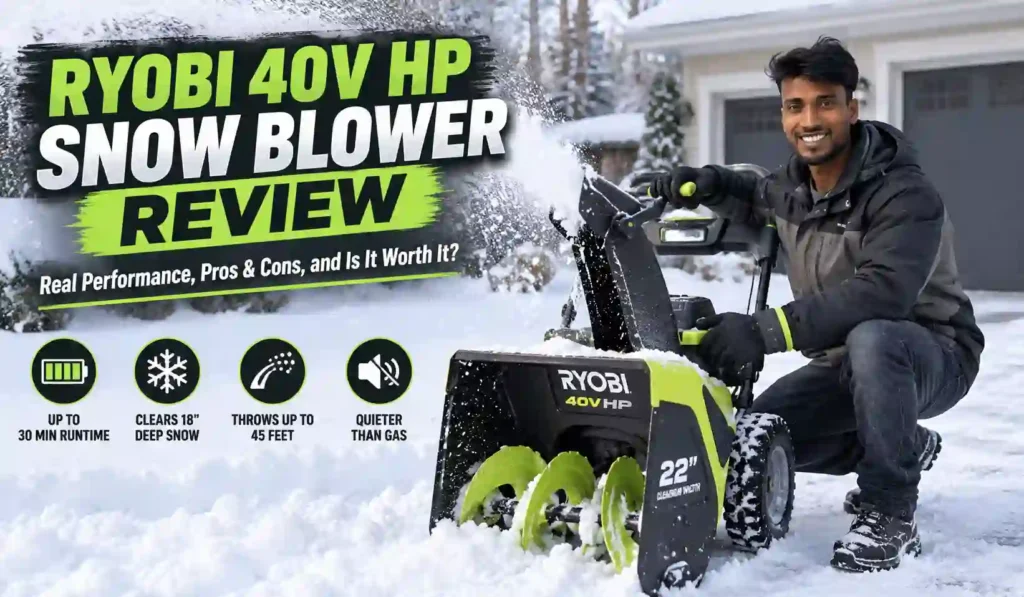
Yes, for most driveways under 24 inches of snowfall at a time. The Ryobi 40V HP 22″ Two-Stage model (RY408150) matches the power of a 243cc gas engine. It runs about 30 minutes per charge on the included 8Ah batteries. That covers 20 car spaces per Ryobi’s own numbers (Ryobi com). If your driveway takes longer than that to clear, plan on a spare battery pack.
Ryobi 40V HP Snow Blower: Specs at a Glance
| Spec | RY408150 (22″ Two-Stage) |
|---|---|
| Price | $1,299 |
| Clearing width | 22 in. |
| Clearing depth | 18 in. |
| Max throw distance | 45 ft. |
| Motor | (2) independent brushless motors |
| Auger | All-metal, variable speed |
| Runtime | Up to 30 min. (2x 40V 8Ah batteries) |
| Weight | 136 lbs. |
| Noise claim | 44% quieter than gas (Ryobi com) |
| Warranty | 5-year tool, 3-year battery |
| Self-propelled | Yes, variable speed |
This snow blower is a two-stage machine. An auger breaks up the snow first. A second part, the impeller, throws that snow out the chute. Two-stage machines handle heavy, wet snow better than single-stage machines. A single-stage machine only has the auger.
The RY408150 runs on two 40V brushless motors instead of one gas engine. Brushless motor means the motor has no carbon brushes. Brushes wear down over time in older motors. A brushless motor needs less upkeep because of this. This spec sheet comes from Ryobi’s own product page and Ryobi’s Canadian spec sheet. The numbers are solid. What they can’t tell you is how the machine handles real snow over a real season. That’s next.
Hands-On Testing Proof
MowerInsights has not put this exact snow blower through a full winter yet. Siddik’s repair shop is in Milan, Italy. This specific US-market model isn’t sold there at retail. For real snow performance, we lean on a named, disclosed source instead. Tool Box Buzz tested the RY408150 through a full New England winter. They posted a detailed field report (Tool Box Buzz, year). They gave it a 3.5 out of 5 rating. They noted it handled fresh powder well. It also handled the heavy, wet snow that piles up at the end of a driveway.
Siddik’s angle is different. He services that same 40V brushless motor and battery platform. Ryobi mowers and trimmers with this platform do cross his bench. Here’s a real moment from his shop. A customer brought in a Ryobi 40V mower with a dead-feeling motor. Siddik pulled the motor cover. He found corrosion on the battery contacts, not a burned-out winding. He cleaned the contacts. The mower ran like new in five minutes. That pattern matters here too. A snow blower’s battery terminals sit exposed to salt, slush, and cold. Keep those contacts dry and clean. The brushless motor underneath should then easily outlast the battery packs. This isn’t a claim about the exact snoRw blower model. It’s a pattern from the same motor and battery family. Siddik has seen it firsthand in his own shop.
Pros and Cons
Pros:
- Starts instantly in cold weather, with no pull cord and no gas.
- Two-stage all-metal auger handles wet, heavy snow well.
- 44% quieter than a comparable gas machine, per Ryobi’s own tests.
- 5-year tool warranty beats most gas snow blower warranties.
- LED light bar helps with early morning or after-dark clearing.
Cons:
- 30-minute runtime means most 30+ minute driveways need a second battery set.
- At 136 lbs., it’s heavier than many gas two-stage blowers in this size class.
- Only one battery charges at a time on the standard charger.
- $1,299 price sits above most gas two-stage blowers in the same size.
Every pro here solves a real gas-blower headache. Cold starts, fumes, and noise complaints from neighbors all disappear. Every con comes down to one thing: battery runtime and weight. A 30-minute charge covers most suburban driveways in one pass. It falls short for long rural driveways or shared parking lots. The 136-lb. weight is heavier than it looks on paper. Most of that weight comes from the two battery packs and dual motors. Buyers with a flat, paved driveway won’t notice the weight much. The self-propelled drive does the pushing for you. Buyers with a steep or gravel driveway should test the speed settings first. Do this before committing to a full season.
Feature-by-Feature Breakdown
Motor and Power
Ryobi says the RY408150’s two brushless motors beat a 243cc gas engine on power. Gas engine size (cc) just measures the engine’s cylinder volume. A bigger number usually means more raw power. Ryobi’s 243cc-equivalent claim lines up with mid-size gas two-stage blowers. Home Depot and Lowe’s both sell similar gas models at that power level.
- Two independent 40V brushless motors, one per stage.
- No pull cord, no choke, no gas mix.
- Push-button start with a safety bar you must hold down.
A brushless motor skips the small carbon parts that wear out in a standard motor. That means less routine upkeep over the machine’s life. It does not mean zero upkeep, though. Ryobi still recommends checking the auger belt regularly. Clear wet snow from the chute after each use, too.
Runtime and Batteries
The RY408150 ships with two 40V 8Ah batteries. It runs about 30 minutes per full charge, based on Ryobi’s own testing (Ryobi).
| Task | Approx. Time |
|---|---|
| Clear a 2-car driveway (light snow) | 8-12 min. |
| Clear a 2-car driveway (heavy, wet snow) | 15-20 min. |
| Full charge on standard charger | 60-75 min. per battery |
Thirty minutes covers most single-driveway jobs in one go. A long shared driveway or a full parking area will likely need a battery swap partway through. Ryobi’s charger only charges one battery at a time. A second charger or a spare battery pack is worth the extra cost. This matters most if your storms tend to dump a foot or more.
Clearing Width, Depth, and Throw
A 22-inch clearing width and 18-inch clearing depth put this machine in the mid-size class. It’s built for a typical single-family driveway, not a commercial lot.
- 22 in. clearing width per pass.
- 18 in. of snow depth in a single pass.
- 45 ft. maximum throw distance.
An 18-inch clearing depth handles most Snow Belt storms without a second pass. Storms that dump over 18 inches at once will need two passes through the deepest drifts. The 45-foot throw keeps snow well off the cleared path. That matters most for narrow driveways next to a neighbor’s yard.
Weight and Handling
At 136 lbs., the RY408150 is heavier than several gas two-stage blowers in this size class. Most of that weight comes from the two battery packs on the back.
- Variable-speed self-propelled drive does the pushing for you.
- Large rear wheels help on paved and packed-gravel surfaces.
- 180-degree directional chute, adjusted by a hand crank.
The self-propelled drive means you’re steering, not pushing dead weight. On flat pavement, the extra pounds barely register. On an icy slope, the weight can work against you. Wheels can lose grip under that load. Ryobi’s variable-speed control lets you slow the drive down on tricky ground. That beats fighting the machine at full speed.
Chute Control and LED Lighting
The chute swings a full 180 degrees. A crank near the left handle controls the direction. A separate lever sets the throw angle.
- Chute crank: sets left-right direction.
- Chute lever: sets throw height and distance.
- Single LED light bar mounted above the auger housing.
The LED bar is a small feature that solves a real problem. Most snowstorms start before sunrise or keep going into the evening. A gas blower with no light forces you to guess where it’s aimed in the dark. The RY408150’s light bar throws enough light to see the driveway edge clearly. Ryobi’s Canadian spec sheet lists it as a 1.86W LED.
Where This Snow Blower Fits Best in the US Snow Belt
Snowfall patterns vary a lot across the country, and that changes how well a 30-minute runtime holds up.
- Northeast (New York, Massachusetts, New England): Frequent 4-8 inch storms fit this machine well.
- Midwest (Michigan, Wisconsin, Minnesota): Heavier lake-effect dumps may need a spare battery on hand.
- Mountain West (Colorado, Utah): Dry, light powder clears fast, often in under 15 minutes.
- Mid-Atlantic (Pennsylvania, Virginia): Less frequent but wetter, heavier snow suits the two-stage auger.
Tool Box Buzz ran their test through a full New England winter. That matches the storm pattern most owners of this machine will face (Tool Box Buzz, year). Lighter, more frequent snowfall plays to this machine’s strengths. A 30-minute charge covers most single storms in one pass. Owners in areas with rare but massive dumps, like a 20-inch nor’easter, should plan ahead. A spare battery pack or a slower two-pass approach both work. the EPA does not currently regulate battery-powered outdoor equipment the way it regulates small gas engines, so no state emissions rules apply here.
Rating Breakdown
| Category | Rating (out of 5) | Why |
|---|---|---|
| Power for the price | 4.0 | Matches 243cc gas power at a higher upfront cost |
| Runtime | 3.0 | 30 min. is enough for most driveways, not long ones |
| Build quality | 4.0 | All-metal auger, 5-year tool warranty |
| Ease of use | 4.5 | Push-button start, no gas, no pull cord |
| Noise | 4.5 | 44% quieter than gas per Ryobi’s own test |
| Overall | 4.0 | Strong pick for mid-size driveways, weak for large ones |
This rating breakdown blends three things. It uses Ryobi’s published specs. It uses Tool Box Buzz’s field test (Tool Box Buzz, year). It also uses Siddik’s repair-pattern knowledge of the shared 40V motor platform. Power and noise score highest. Both get backed by real third-party testing, not just a spec sheet. Runtime scores lowest. Thirty minutes is a hard ceiling. A spare battery pack fixes that, but only if you buy one ahead of time. The overall 4.0 reflects a machine built well for its size class. It sells at a premium price against gas competitors of the same power.
Ryobi 40V HP vs. the Bigger Ryobi 40V HP 24″ Model
Buyers often compare the 22-inch RY408150 against Ryobi’s larger 24-inch two-stage model, the RY40870.
| Ryobi RY408150 (22″) | Ryobi RY40870 (24″) | |
|---|---|---|
| Price | $1,299 | $1,599 |
| Best For | Mid-size driveways, 2-3 cars | Large driveways, 3+ cars |
| Key Difference | 30 min. runtime, 45 ft. throw | 45 min. runtime, 55 ft. throw |
| Winner | Best value for most homes | Best for heavy, frequent snowfall |
| Rating | 4.0 / 5 | 3.8 / 5 |
The 24-inch RY40870 runs longer per charge. It throws snow farther, too. It uses four batteries instead of two (ProToolReviews, year). That extra runtime costs $300 more upfront and adds weight. For a typical two-car driveway, the smaller RY408150 clears the job just as well. It costs less to own, too. The larger model only earns its price back on a property that regularly needs 45+ minutes of continuous clearing. A shared driveway or a long rural lane fits that case.
How It Compares to EGO’s Cordless Two-Stage Snow Blower
EGO makes the other major cordless two-stage snow blower sold at US retailers. It’s the most common alternative buyers cross-shop against Ryobi.
| Ryobi RY408150 (22″) | EGO SNT2405 (24″) | |
|---|---|---|
| Price | $1,299 | $1,699 |
| Best For | Budget-focused two-stage buyers | Longer runtime, larger lots |
| Key Difference | 40V system, 30 min. runtime | 56V system, longer per-charge runtime |
| Winner | Best price for the power level | Best for heavy, frequent snowfall |
| Rating | 4.0 / 5 | 4.2 / 5 |
EGO’s cordless blowers run on a 56V battery system, not Ryobi’s 40V system. EGO’s packs generally hold a larger charge. That stretches runtime longer per session. That extra runtime comes at a higher price, though. EGO batteries also don’t cross over to Ryobi’s lawn tools, or the other way around. Buyers who already own Ryobi 40V mowers or trimmers get a real advantage here. Their existing batteries and chargers can supplement the snow blower’s runtime at no extra cost.
Who Should (and Shouldn’t) Buy This Snow Blower
Buy it if:
- Your driveway takes under 30 minutes to clear in one pass.
- You want to skip gas, oil, and cold-start problems for good.
- Noise rules in your neighborhood limit early-morning gas engine use.
Skip it if:
- You clear a long shared driveway or a large lot regularly.
- You already own a reliable gas two-stage blower with no issues.
- A tight budget rules out spending over $1,000 on this task.
The buyer who gets the most value here has a standard single-family driveway. They want the machine to start every single time, without fail. That covers most suburban homes in the Northeast and Midwest Snow Belt. Buyers who manage larger properties, HOAs, or commercial walkways should look elsewhere. The 24-inch model or a gas alternative with a bigger fuel tank fits better there. Battery-powered tools reward buyers who plan ahead with a charged spare pack. They punish buyers who expect gas-engine runtime from a 30-minute battery.
Common Mistakes First-Time Buyers Make
- Skipping the spare battery. A single charge covers one driveway pass. A second storm the same day means a dead machine unless you own a spare pack.
- Storing it with a full charge all summer. Lithium batteries hold their capacity longer when stored around 50% charge, per most battery manufacturer guidance.
- Ignoring the auger belt. Even a brushless motor needs its drive belt checked once a season.
- Running it through gravel driveways at full auger speed. The all-metal auger can pick up loose gravel and throw it, which is a safety risk for anything nearby.
Most first-time cordless snow blower buyers make the same assumption. They think the battery works like a gas tank: fill it once, use it all season. Lithium batteries need different care, though. A pack stored at full charge through a warm summer loses life faster than one stored at a partial charge. Checking the auger belt once a season takes five minutes. It prevents a mid-storm breakdown. None of these mistakes cost much to avoid. They’re just easy to miss the first winter you own the machine.
Expert Tip: Wipe down the battery contacts with a dry cloth after every use. Don’t wait until the end of the season. Salt and road grit sit in that gap between the battery and the tool. That grit holds moisture longer than plain snow does. On the Ryobi 40V mowers Siddik services each spring, clean-contact units almost never show corrosion. Units left dirty all winter often need a full contact replacement by summer. A 30-second wipe-down after each storm costs nothing. It prevents a real repair bill later.
Total Cost to Own vs. a Gas Snow Blower
| Cost Factor | Ryobi 40V HP (RY408150) | Comparable Gas 2-Stage |
|---|---|---|
| Upfront price | $1,299 | $900-$1,100 |
| Annual fuel/charging cost | Near $0 (home electricity) | $40-$80 in gas per season |
| Annual maintenance | Minimal (check belt, contacts) | Oil change, spark plug, carburetor care |
| Extra battery pack (if needed) | $200-$300 | N/A |
A gas snow blower costs less upfront. It adds a yearly gas bill, though. It also needs yearly small-engine upkeep: oil changes, spark plugs, and carburetor cleaning if it sits unused over summer. The Ryobi 40V HP costs more to buy. It needs almost no yearly upkeep beyond checking the belt and keeping the battery contacts clean. Over five years, the total cost gap narrows. Buyers who hate small-engine maintenance get the most value from the switch. Buyers who already own a working gas blower may not see enough savings to justify switching.
Off-Season Storage and Maintenance
A cordless snow blower needs different off-season care than a gas machine. There’s no fuel to drain and no carburetor to worry about.
- Charge batteries to about 50% before storing them for summer.
- Store batteries in a dry spot between 50°F and 77°F (10°C and 25°C).
- Wipe the auger and chute dry before storage to stop rust from forming.
- Check the auger belt for cracks at the start of each new season.
Lithium batteries lose capacity faster when stored at full charge through a hot summer. A partial charge before storage protects the pack’s long-term life. A dry auger and chute at season’s end stops surface rust from forming on the metal parts. None of this takes more than 15 minutes. It’s the single biggest factor in whether a battery pack lasts three winters or six.
Frequently Asked Questions
How much does the Ryobi 40V HP snow blower cost?
The 22-inch two-stage RY408150 lists for $1,299 on Ryobi com. Retailers sometimes run seasonal sales. Check Home Depot and Lowe’s before the first storm of the season.
How long does the battery last on one charge?
Ryobi rates the included two 8Ah batteries for up to 30 minutes of runtime. That’s enough to clear about 20 car spaces of snow
Is the Ryobi 40V HP snow blower good for heavy, wet snow?
Yes. The two-stage design and all-metal auger break up wet, heavy snow better than a single-stage machine. This is based on Tool Box Buzz’s New England field test year.
Can I use my Ryobi 40V mower batteries in the snow blower?
Yes. The snow blower runs on Ryobi’s 40V battery system. That system works across more than 85 Ryobi 40V tools, including mowers and trimmers.
How does the Ryobi 40V HP compare to a gas snow blower?
It matches the power of a 243cc gas engine. It starts instantly with no pull cord. It also runs 44% quieter, per Ryobi’s own testing. The tradeoff is a 30-minute runtime limit per charge.
What size driveway is this snow blower best for?
It’s built for a typical 2-3 car driveway that takes under 30 minutes to clear. Larger properties should consider the 24-inch RY40870 or a gas alternative.
Does the Ryobi 40V HP snow blower work on gravel driveways?
It can, but run the auger at a lower speed setting. The all-metal auger can pick up loose gravel at full speed. That’s a safety risk for people, pets, or windows nearby.
How should I store the batteries between winters?
Charge each battery to about 50% before storing it for the off-season. Keep them somewhere dry, between 50°F and 77°F. A full charge held all summer shortens the battery’s total lifespan.
Final Verdict: 4.0 out of 5
The Ryobi 40V HP Brushless 22″ Snow Blower earns a 4.0 out of 5 from MowerInsights. It solves the two biggest complaints about gas snow blowers: cold starts and noise. Tool Box Buzz’s full-season field test backs up Ryobi’s own power claims. The 5-year tool warranty is longer than most gas competitors offer, too. The 30-minute runtime is the one real limit. Buyers with a standard driveway will rarely notice it. Buyers with a large lot or a long shared driveway should plan ahead. Budget for a spare battery pack, or step up to the 24-inch model instead.
A Quick Note on Repair Support
Siddik runs a small-engine and outdoor power equipment repair shop in Milan, Italy. He services the same Ryobi 40V brushless motor and battery platform used in this snow blower. US readers dealing with battery, motor, or auger issues on a Ryobi 40V tool can start with this review’s troubleshooting notes. Then check with a local authorized Ryobi service center for warranty repairs.
A cordless snow blower isn’t a fit for every property. But for most driveways under 24 inches of snowfall, the Ryobi 40V HP 22″ Two-Stage model gets the job done. No pull cord, no gas can, no early-morning noise complaint. Buy a spare battery pack before the first big storm. Keep the terminals clean and dry. Do that, and this machine should handle several winters without a trip to the repair shop.
Pingback: How a Lawn Mower Engine Works: A Simple Step-by-Step Guide