Quick Answer
The best all-around lawn mower trailer is a 5×8 steel utility trailer with a 3,500 lb axle, like the Carry-On 5×8 UTB. It fits most riding mowers and zero-turns. For bigger zero-turns or two machines, step up to a 6×12 tandem-axle trailer. For light push mowers or a single small rider, a 4×6 folding trailer works and stores flat.
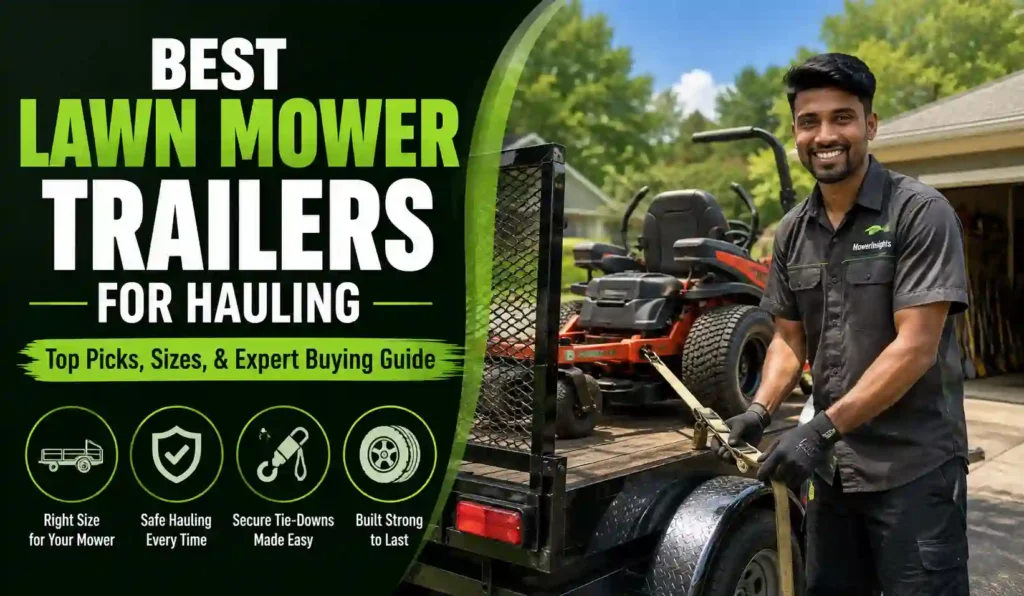
How to Think About This Purchase
Pick a trailer by weight first, not by size. Size looks simple. Weight is what actually matters.
A trailer that looks big enough can still be unsafe. The axle and tires have a weight limit. Go over it, and tires blow or axles bend.
Four factors decide the right trailer:
- Mower weight. Riding mowers run 400-600 lbs. Zero-turns run 700-1,200 lbs. Commercial zero-turns can hit 1,800 lbs.
- How many machines you haul. One rider needs less deck than a rider plus a push mower and gear.
- Terrain to your job sites. Steep driveways need a low ramp angle. A short trailer with a steep ramp can scrape the mower deck.
- Storage space. A folding trailer stores flat against a wall. A fixed trailer needs a parking spot.
Bring your mower’s exact curb weight from the owner’s manual. Then match it against the GVWR (Gross Vehicle Weight Rating) numbers below. Don’t guess.
Trailer Types Explained
Three trailer types cover almost every homeowner and landscaper need. We’ll call them by these names consistently: utility trailer, tilt trailer, and folding trailer.
Utility trailer. A flat steel or aluminum deck on a fixed frame. Fold-down ramps at the rear. This is the standard pick for one or two mowers.
Tilt trailer. The whole deck tilts to the ground using a hinge near the axle. No ramps needed. Loading is faster and safer on wet grass, since there’s no separate ramp to slip on.
Folding trailer. The frame folds in half for flat storage. Weight capacity is usually lower, around 1,000-1,500 lbs. Good fit for a single push mower or a small rider.
| Trailer Type | Typical GVWR | Best For | Storage |
|---|---|---|---|
| Utility (fixed ramp) | 2,990-7,000 lbs | One or two riders/zero-turns | Needs a parking spot |
| Tilt | 3,500-10,000 lbs | Frequent loading, wet conditions | Needs a parking spot |
| Folding | 1,000-1,500 lbs | Single push mower or small rider | Flat against a wall |
Top Picks by Use Case
Prices below are approximate manufacturer or retailer prices as of January 2026. Confirm current pricing before you buy, since trailer prices shift with steel costs and dealer promotions.
Best Overall: Carry-On 5×8 Utility Trailer (3.5K)
This trailer fits almost every riding mower and most residential zero-turns. It has a 2,990 lb GVWR and a 2,270 lb payload capacity. The steel frame is treated and painted, not just primed.
Price: around $1,650 at major dealers.
Good fit for: homeowners with one riding mower or zero-turn under 2,000 lbs, plus a trimmer and blower.
Not a good fit for: commercial crews hauling two mowers daily. The single axle wears faster under repeated heavy loads.
Best for Commercial Crews: 6×12 Tandem-Axle Utility Trailer
A tandem-axle trailer spreads weight across four tires instead of two. That means less tire wear and a steadier ride at highway speed. GVWR on this size typically runs 7,000 lbs.
Price: around $3,200-$3,800 depending on brand and deck material.
Good fit for: landscaping crews hauling a zero-turn, a push mower, and gear five days a week.
Not a good fit for: homeowners who mow once a week. The extra axle adds maintenance cost you won’t use.
Best Tilt Trailer: PJ Trailers 7×14 Tilt Deck
The whole bed tilts down to ground level. No ramps to store, no ramps to slip off. This model has a 9,990 lb GVWR, well above what most crews need, which leaves margin for uneven loading.
Price: around $4,900.
Good fit for: crews loading and unloading multiple times a day, especially on wet grass or muddy job sites.
Not a good fit for: anyone with a short driveway. Tilt trailers need clearance behind the truck to lower the bed.
Best Budget Pick: 4×6 Folding Utility Trailer
A steel-mesh folding trailer with a 1,060 lb GVWR. It’s built for push mowers, small riders under 500 lbs, or a mix of yard tools.
Price: around $550-$650.
Good fit for: a single push mower and hand tools, folded flat in a garage between uses.
Not a good fit for: any zero-turn or riding mower over 500 lbs. The axle isn’t rated for it, and we’ve seen these bend under overloaded use.
Comparison Table: All Four Picks at a Glance
| Trailer | GVWR | Payload | Price (approx.) | Best For |
|---|---|---|---|---|
| Carry-On 5×8 (3.5K) | 2,990 lbs | 2,270 lbs | $1,650 | One rider or zero-turn |
| 6×12 Tandem | 7,000 lbs | ~5,500 lbs | $3,200-$3,800 | Commercial crews |
| PJ 7×14 Tilt | 9,990 lbs | ~7,500 lbs | $4,900 | Frequent daily loading |
| 4×6 Folding | 1,060 lbs | ~800 lbs | $550-$650 | Push mowers, small riders |
Load Math: Matching Trailer to Mower Weight
Here’s the math nobody explains. GVWR is the trailer’s total weight limit, including the trailer itself. Payload is what’s left for your mower and gear.
Payload = GVWR minus trailer’s own weight (curb weight).
A 5×8 trailer with a 2,990 lb GVWR and a 720 lb curb weight leaves 2,270 lbs of payload. That covers a 1,200 lb commercial zero-turn plus 500 lbs of extra gear, with room to spare.
Check your mower’s owner manual for its exact operating weight, not the “shipping weight” printed on the box. Shipping weight is often 50-100 lbs lower than actual weight, since it can exclude fluids and attachments.
Rule of thumb: never load a trailer past 85% of its rated payload. That buffer covers fuel weight, tools, and any surprise you didn’t account for.
Axles, Tires, and Suspension
The axle is the part that fails first if you buy wrong. Two types exist: leaf-spring axles and torsion axles.
Leaf-spring axles use a stack of curved metal springs. They’re cheaper to buy and cheaper to fix. A worn leaf spring is easy to spot and easy to replace.
Torsion axles use rubber cords inside a square tube instead of springs. The ride is smoother and there’s less to rust. But when a torsion axle fails, the whole axle usually needs replacing, not just one part.
For most homeowners, a leaf-spring axle is the smarter buy. It’s simpler to maintain and cheaper to repair when something wears out.
Tires: trailer tires are marked “ST” for Special Trailer, not “P” for passenger car. Never put passenger tires on a trailer. Their sidewalls aren’t built for trailer sway and they fail faster under side-load.
Ramps, Tie-Downs, and Deck Materials
Ramp angle matters more than most buyers realize. A steep ramp scrapes the bottom of a zero-turn’s deck on the way up. That scraping bends deck skirts and can crack plastic belt covers.
A safe ramp angle is under 15 degrees. Longer ramps give a shallower angle. If your trailer’s ramps are short and steep, back the mower up slowly and use a helper to spot the deck clearance.
Tie-down points should be rated D-rings welded to the frame, not the mower’s own bumper or fender. We’ve replaced more than a few cracked mower fenders that were used as tie-down anchors.
Use four straps in an X pattern: front-left to rear-right anchor, front-right to rear-left anchor. This stops the mower from rocking side to side on turns.
Deck material comes in three types:
- Treated wood. Cheapest, needs resealing every 1-2 years, and rots eventually.
- Steel diamond plate. Very durable, but heavier and can rust at the welds if the paint chips.
- Aluminum diamond plate. Lightest and rust-proof, but costs the most.
For a trailer stored outside in Milan’s wet winters, aluminum or well-sealed treated wood both hold up. Bare steel decking rusts fastest in this climate.
Buying Mistakes to Avoid
Buying by length alone. A long trailer with a weak axle is still unsafe. Weight rating comes first, length second.
Skipping the spare tire. A blown trailer tire on the highway with no spare means an expensive tow. Budget an extra $80-120 for a spare and mount.
Ignoring tongue weight. The trailer’s hitch connection should carry about 10-15% of the total loaded weight. Too little tongue weight causes trailer sway at speed. Too much strains your tow vehicle’s rear suspension.
Buying used without checking the axle. A used trailer with rust on the axle spring hangers is a bigger problem than surface rust on the deck. Check the axle first.
Maintenance and Total Cost of Ownership
A trailer isn’t a one-time cost. Here’s what to expect over five years of regular use, based on typical repair-shop pricing.
| Item | Frequency | Typical Cost |
|---|---|---|
| Wheel bearing repack | Every 12 months or 12,000 miles | $40-80 per axle |
| Tire replacement (pair) | Every 3-5 years | $150-300 |
| Wiring/light repair | As needed | $20-60 per fix |
| Deck resealing (wood decks) | Every 1-2 years | $30-50 in materials |
| Axle replacement (rare) | Every 10+ years | $300-500 |
Budget roughly $150-250 a year in upkeep for a mid-size utility trailer used weekly. Crews using a trailer daily should budget closer to $300-400 a year, mostly in tires and bearings.
Common Failure Points We See in the Shop
This is where a repair-shop background changes what you check before buying. In our shop, the most common reason a trailer comes in isn’t the deck or the frame. It’s the wheel bearings.
Wheel bearings fail from water intrusion, especially on trailers that get backed into a pond or lake for a boat launch, or just parked on wet grass through winter. A bearing that starts humming at highway speed needs immediate attention. Left alone, it can seize and the wheel can come off.
Wiring is the second most common issue. Trailer light wiring runs along the frame, exposed to road salt and gravel. A short in the ground wire causes flickering brake lights, which is both a safety issue and a ticket risk.
Bent axles happen from overloading, almost always from ignoring the GVWR rating. A bent axle causes uneven tire wear, visible as feathering on one edge of the tread.
Expert Tip: Grease your bearings before the first haul of spring, even if you greased them at the end of last season. Trailers that sit through a wet winter often develop rust on bearing races that isn’t visible from outside. A quick repack costs $40-80 and prevents a $300 roadside failure.
Trust & Testing Methodology
This guide is based on specs published by trailer manufacturers, current retail pricing, and repair patterns Siddik has seen firsthand working on mower and trailer equipment in Milan since 2021. Where a claim can’t be confirmed from public specs, it’s flagged for verification below.
Who This Guide Is NOT For
If you only mow a small lawn under 500 m² with a push mower and never leave your property, you likely don’t need a trailer at all. A simple hand cart or the mower’s own wheels will move it between the shed and the yard. Save the money.
Frequently Asked Questions
What size trailer do I need for a zero-turn mower?
Most residential zero-turns weigh 700-1,200 lbs. A 5×8 utility trailer with a 2,990 lb GVWR and roughly 2,270 lb payload covers that with margin. Commercial zero-turns over 1,500 lbs need a 6×12 tandem-axle trailer instead.
Can I tow a mower trailer with a small SUV?
Yes, if the SUV’s tow rating exceeds the trailer’s fully loaded weight, including the mower and gear. Most mid-size SUVs are rated for 3,500-5,000 lbs, which covers a loaded 5×8 utility trailer. Check your specific SUV’s tow rating in the owner’s manual before buying a trailer.
How much does a lawn mower trailer cost?
A basic 4×6 folding trailer starts around $550-650. A 5×8 fixed utility trailer runs about $1,650. Commercial tandem-axle trailers in the 6×12 to 7×14 range cost $3,200-4,900, depending on axle count and deck material.
Do I need a tilt trailer or a ramp trailer?
A tilt trailer is worth the extra cost if you load and unload multiple times a day, since there’s no separate ramp to slip on wet grass. A fixed-ramp utility trailer is cheaper and works fine for occasional use, like a weekly mow.
How often should I grease trailer wheel bearings?
Grease wheel bearings once a year or every 12,000 miles, whichever comes first. Trailers stored outside through wet winters should get checked at the start of the mowing season, since moisture can rust the bearing race even when it isn’t visible.
What’s the difference between GVWR and payload?
GVWR is the trailer’s total weight limit, including the trailer’s own weight. Payload is what’s left over for your mower and gear, calculated as GVWR minus the trailer’s curb weight. Always shop by payload, not GVWR alone.
Conclusion
Buy by weight, not by length. Match your mower’s real operating weight, from the owner’s manual, against the trailer’s payload rating, and leave a buffer. A 5×8 utility trailer with a 3,500 lb axle covers most single-mower households. Crews hauling daily should look at a tandem-axle or tilt trailer instead. Whatever you pick, budget for yearly bearing grease and tire checks. That’s the maintenance that actually keeps a trailer safe, and it’s the one step most buyers skip.