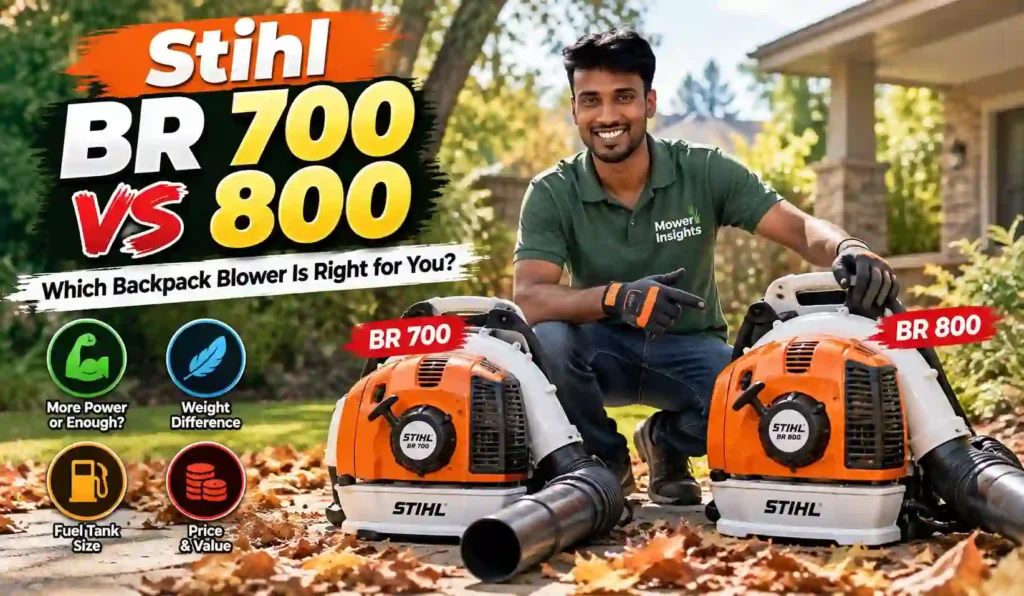
Stihl BR 700 vs 800 comes down to one question: is 20% more power worth about $20 to $130 more money, two extra pounds on your back, and a bigger fuel tank? For most homeowners with under five acres, the BR 700 is enough. For wet leaves, heavy debris, and all-day work, the BR 800 earns its price. This guide compares them side by side so you can pick one with confidence.
Quick Answer
The BR 800 C-E is stronger. It makes 41 Newtons of blowing force against 35 for the BR 700, and it has a side-start handle. The BR 700 is lighter by 2.4 pounds and usually costs less. Both move the same 912 cubic feet of air per minute (cfm), so the real gap is air speed, not volume.
Pick the BR 700 for yards up to about five acres. Pick the BR 800 for bigger properties, wet leaves, or paid work.
What to Look for Before Buying a Backpack Blower
Five things decide which blower fits you: blowing force, weight, starting method, tube design, and price. Everything else is minor. Blowing force tells you how hard the air pushes debris. Weight tells you how tired your back will be after an hour.
Here are the five checks, in order of importance:
- Blowing force in Newtons (N). One Newton is the push needed to move 1 kilogram at a steady rate. Higher means it moves wetter, heavier piles.
- Weight with fuel. The listed weight leaves out gas, so add about 2 to 3 pounds.
- Starting method. A side-start handle lets you restart without taking the blower off.
- Tube type. A telescopic tube adjusts to your height. A fixed tube is lighter and cheaper.
- Total cost. Price today, plus filters, spark plugs, and fuel over the years.
Stihl BR 700 vs 800 Models and Types
Each line comes in two versions. The BR 700 and BR 800 C-E have telescopic tubes. The BR 700 X and BR 800 X have fixed tubes and cost less. The table below sets the main models next to each other so you can see where each one sits.
| Model | Engine | Blowing Force | Weight (no fuel) | Tube | Price |
|---|---|---|---|---|---|
| BR 700 X | 64.8 cc | 34 N | 23.0 lb | Fixed | $619.99 |
| BR 700 | 64.8 cc | 35 N | 23.4 lb | Telescopic | $729.99 |
| BR 800 X | 79.9 cc | 41 N | About 25.8 lb | Fixed | Ask a dealer |
| BR 800 C-E | 79.9 cc | 41 N | 25.8 lb | Telescopic, side start | $749.99 |
Prices may vary by retailer and change over time. The BR 800 X is the lower-cost 800 with a fixed tube and no side-start handle, based on how dealers describe the two versions. When people say Stihl BR 700 vs 800, they usually mean the telescopic BR 700 against the BR 800 C-E, and that is the match-up this guide focuses on.
What the “X” and “C-E” Letters Mean
The X models are the stripped-down versions. They use a one-piece fixed tube and a flexible pleated hose. The C-E models add the telescopic tube and, on the BR 800, the side-start handle. Stihl’s own wording says the fixed-tube BR 700 X weighs half a pound less than the telescopic BR 700.
Buying Factors That Matter in the Stihl BR 700 vs 800 Choice
Seven factors separate these two blowers: power, air speed, engine and fuel tank, weight, starting, noise, and build. The BR 800 wins on power, speed, and tank size. The BR 700 wins on weight and price. Each factor below lists the trade-off on both sides.
Blowing Force: 41 Newtons vs 35 Newtons
The BR 800 C-E produces 41 N of blowing force, and the BR 700 produces 35 N. That is about 17% more push. Stihl says the BR 800 delivers 20% more power than the BR 700, and the two numbers line up.
- BR 800 advantage: it shifts wet, packed leaves and heavy debris that make a BR 700 work harder.
- BR 800 drawback: you pay for power you may never use on a light-duty yard.
- BR 700 advantage: 35 N is enough for dry leaves, grass clippings, and normal fall cleanup.
- BR 700 drawback: wet oak or maple leaves in a thick layer slow it down.
Owner discussions are split on how big the gap feels. Some owners say the BR 700 was only a small step up from the older BR 600. Others say the BR 800 is far stronger than either. That fits the numbers: the jump from 700 to 800 is bigger than the jump from 600 to 700.
Air Speed and Air Volume: Same Cfm, Different Speed
Both blowers list 912 cfm of air volume at the nozzle. Air speed is where they differ. The BR 700 averages about 165 mph and peaks near 197 mph through the round nozzle. The BR 800 C-E averages 199 mph and peaks at 239 mph.
That is roughly 20% faster air. Think of a garden hose. Same water volume, but a tighter spray hits harder. Faster air lifts stuck, damp debris. More volume moves dry piles in bulk.
- BR 800 advantage: higher speed breaks wet leaves loose from grass and mulch beds.
- BR 800 drawback: the extra speed can scatter mulch and gravel if you are careless.
- BR 700 advantage: 912 cfm still moves a lot of dry material fast.
- BR 700 drawback: it needs more passes on stubborn spots.
Engine Size and Fuel Tank
The BR 800 has a 79.9 cc engine that makes 4.4 horsepower (bhp). The BR 700 has a 64.8 cc engine that makes 3.8 bhp. Both use Stihl’s 4-MIX engine, a design that burns less fuel and makes less noise than a standard two-stroke.
The fuel tank gap is large. The BR 800 holds 67.6 fluid ounces. The BR 700 holds 47.3 fluid ounces, about 30% less. That means fewer refuel stops on the BR 800.
- BR 800 advantage: a bigger tank means longer work between fill-ups.
- BR 800 drawback: a larger engine burns more gas per hour at full throttle.
- BR 700 advantage: smaller engine, lower fuel cost over a season.
- BR 700 drawback: more refuel breaks on a large property.
Weight and Comfort on Your Back
The BR 800 C-E weighs 25.8 pounds empty. The BR 700 weighs 23.4 pounds empty. That is a 2.4-pound gap. With a full tank, a MowerInsights estimate puts the BR 700 near 26 pounds and the BR 800 near 29 pounds.
Both blowers use the same comfort setup: S-shaped shoulder straps, a hip belt, a chest strap, a back pad, and Stihl’s anti-vibration system. The harness spreads the load the same way on both.
- BR 700 advantage: lighter, so it is easier to wear for a full afternoon.
- BR 700 drawback: you give up some power for that weight savings.
- BR 800 advantage: Stihl calls the power-to-weight ratio excellent, and the extra push per pound is real.
- BR 800 drawback: 29 pounds with fuel is a lot for a smaller person or a first-time user.
Starting: Side-Start Handle vs Top Pull
The BR 800 C-E has a starting handle on the side. You can pull-start it while still wearing the blower. The BR 700 has a standard starter handle, so you set it down or take it off to restart.
This matters more than it sounds. If you stop to move a ladder, talk to a neighbor, or empty a trash bag, you restart often. One owner on a tractor forum said the side-start is nice, but a lot of money for that one feature. That is a fair view if you rarely stop.
- BR 800 advantage: restart in seconds without taking the blower off.
- BR 800 drawback: more parts on the engine, so one more thing to wear out over time.
- BR 700 advantage: simple, proven starting with a semi-automatic choke.
- BR 700 drawback: every restart means shrugging off the straps or setting it on a flat spot.
Noise Levels
Stihl rates the BR 700 X at 75 dB(A) and the BR 800 C-E at 78 dB(A). Both numbers come from ANSI testing, the US standard for blowers. A 3 dB gap is small, but both are loud. Wear ear protection on either one.
- BR 700 advantage: slightly quieter, which helps in tight neighborhoods.
- BR 700 drawback: still loud enough to need ear muffs.
- BR 800 advantage: its 4-MIX engine runs quieter than most two-stroke blowers in this power class.
- BR 800 drawback: the extra 3 dB is audible, especially at full throttle.
Many US cities and HOAs limit gas blower use by hour or by decibel level. Check your local rules before you buy either one.
Build and Durability
Stihl builds both blowers in the United States from domestic and global parts. Both are sold as professional machines. Neither is a light homeowner product.
- BR 700 advantage: fewer moving parts and a long track record in the field.
- BR 700 drawback: the telescopic tube joint is a wear point after years of daily use.
- BR 800 advantage: the engine and housing were redesigned for the bigger power, not just a larger engine dropped into the old body.
- BR 800 drawback: the side-start assembly adds one more part to inspect.
Choose Based on Your Needs
The right blower depends on your yard size, leaf type, and how often you stop to restart. Most homeowners should buy the BR 700. Buyers with large, wooded lots or paid mowing work should buy the BR 800. The scenarios below match each situation to a pick.
| Your Situation | Best Pick | Why |
|---|---|---|
| Under 1 acre, light leaves | Neither – consider a handheld | Both are pro machines and heavier than you need |
| 1 to 5 acres, mixed trees | BR 700 | Enough force, lower weight, lower price |
| 5+ acres or wooded lot | BR 800 C-E | Bigger tank and more force save time |
| Wet fall leaves (Zones 5 to 8) | BR 800 C-E | Faster air breaks wet leaves loose |
| Dry climate, needles and dust (Southwest, Texas) | BR 700 | Dry debris needs volume, not extra speed |
| Paid landscaping work | BR 800 C-E | Side start and tank size cut downtime |
| Smaller or newer user | BR 700 | Lower carry weight |
| Tight budget | BR 700 X | Lowest price of the four models |
Small Yards: Under One Acre
A backpack blower of this size is more than most small yards need. A handheld gas blower or a strong cordless model weighs less and costs less. If you still want a Stihl backpack for a large suburban lot, the BR 700 is the sensible one.
Large Yards and Wooded Lots
On five or more acres, the BR 800 pays back its price in time saved. The bigger tank means fewer refuel stops. The extra force clears fall leaf layers in fewer passes. Think of it as a bigger bucket: you make fewer trips.
Features You Actually Need
Three features matter on a backpack blower: an adjustable tube, a comfortable harness, and easy starting. Both Stihl models include the first two. Only the BR 800 C-E adds the side-start handle.
Must-have features:
- A telescopic tube if more than one person will use it
- A tool-free handle adjustment to fit your arm length
- A throttle lock so you do not squeeze the trigger all day
- A one-touch stop switch for quick shutoffs
- A hip belt that moves weight off your shoulders
Nice-to-have features:
- Side-start handle for frequent stops
- A curved flat nozzle for wide, open ground
- A tube holder hook for easy transport
- A bigger fuel tank for long jobs
Features You Can Skip
You can skip the BR 800’s side-start handle if you work in long, steady runs. You can skip the telescopic tube if you are the only user and you know your fit. The X models drop both and save money.
- Side-start handle: worth it only if you stop and restart often.
- Telescopic tube: skip it if one person always uses the blower. The fixed-tube X models are lighter.
- The BR 800 itself: skip it for small yards. You pay for force you will not use.
- Extra nozzles: buy the flat nozzle only if you clear large paved or flat areas.
Stihl BR 700 vs 800 Price and Value
The BR 700 X runs about $619.99, the BR 700 about $729.99, and the BR 800 C-E about $749.99. The BR 800 C-E launched at $699.99, and the BR 700 launched at $549.95. Prices have climbed since. Prices may vary by retailer and change over time.
| Tier | Model | Typical Price | What You Get |
|---|---|---|---|
| Budget | BR 700 X | $619.99 | Fixed tube, 34 N, lightest of the four |
| Mid-range | BR 700 | $729.99 | Telescopic tube, 35 N, 23.4 lb |
| Premium | BR 800 C-E | $749.99 | 41 N, side start, 67.6 oz tank |
The price gap between the BR 700 and BR 800 C-E is small in some stores. If the BR 700 and BR 800 C-E sit within $20 of each other at your dealer, the BR 800 is the better value. If you can get the BR 700 X near $620, the gap to the BR 800 grows to about $130, and the BR 700 X wins on price alone.
Ask your local dealer about service support too. Stihl sells through dealers rather than big-box online shops for most professional models, and a nearby shop can matter more than a $30 price gap.
Common Buying Mistakes
The biggest mistake is buying more blower than the yard needs. The second is ignoring weight. The third is not checking which air filter and parts each model uses before stocking spares.
- Buying the BR 800 for a half-acre lot. You carry 3 extra pounds and pay more for force you never use.
- Judging by the listed weight alone. The 25.8 pounds and 23.4 pounds figures are empty. Add fuel.
- Assuming the parts are the same. The BR 700 and BR 800 use different air filters, so a spare for one will not fit the other. Check part numbers before you order.
- Skipping the fit test. Wear it, loaded with fuel, for ten minutes at the dealer before you buy.
- Ignoring local noise rules. Some towns restrict gas blowers by hour or season.
- Paying extra for side start you will not use. If you work in long runs, you gain little.
Maintenance and Long-Term Cost
Both blowers need the same basic care: clean the air filter, replace the spark plug, use fresh mixed fuel, and store them dry. Over five years, upkeep costs are close. The BR 800 uses slightly more fuel and a larger air filter. Neither is expensive to maintain.
Based on Siddik’s hands-on repair experience, most blower problems come from old fuel and clogged filters, not from engine wear. A few habits prevent most repair visits:
- Use fresh gas and the mix ratio listed in the manual for 4-MIX engines.
- Tap out or replace the air filter every season. The BR 800 takes a different filter than the BR 700.
- Check the spark plug each spring.
- Empty the tank before long storage, or add fuel stabilizer.
- Inspect the pleated hose and tube joint for cracks.
| Cost Item | BR 700 | BR 800 C-E |
|---|---|---|
| Fuel tank size | 47.3 oz | 67.6 oz |
| Air filter | Shared with BR 500 and BR 600 | BR 800-specific |
| Fuel use at full throttle | Lower | Higher |
| Moving parts to inspect | Fewer | One more (side-start) |
| Service availability | Wide, older design | Wide, current flagship |
The BR 700 has been sold longer, so used parts and aftermarket support are easy to find. The BR 800 is newer and still the top Stihl backpack blower, so dealer parts support stays strong.
Recommended Specifications by Yard Size
Match blowing force and tank size to your property. A 35 N blower handles most residential work. A 41 N blower suits large lots and wet debris. The table below gives a simple starting point.
| Yard Type | Suggested Blowing Force | Suggested Tank | Best Stihl Pick |
|---|---|---|---|
| Up to 1 acre | 25 to 30 N | Under 40 oz | Handheld, not backpack |
| 1 to 3 acres | 34 to 35 N | 45 oz or more | BR 700 X or BR 700 |
| 3 to 5 acres | 35 N | 45 oz or more | BR 700 |
| 5+ acres or woods | 41 N | 65 oz or more | BR 800 C-E |
| Paid daily work | 41 N | 65 oz or more | BR 800 C-E |
FAQs
Is the Stihl BR 800 better than the BR 700?
The BR 800 C-E is stronger, with 41 N of blowing force against 35 N for the BR 700. It also has a side-start handle and a larger fuel tank. The BR 700 is lighter and usually cheaper. “Better” depends on your yard size and how much weight you want to carry.
What is the main difference in Stihl BR 700 vs 800?
The main difference in Stihl BR 700 vs 800 is power. The BR 800 has a 79.9 cc engine, 4.4 bhp, and 41 N of force. The BR 700 has a 64.8 cc engine, 3.8 bhp, and 35 N. Stihl says the BR 800 gives 20% more power than the BR 700.
Do the BR 700 and BR 800 move the same amount of air?
Yes. Both list 912 cfm at the nozzle. The BR 800 pushes that air faster, with an average of 199 mph against about 165 mph for the BR 700. Faster air hits harder, which helps on wet, stuck debris.
How much heavier is the BR 800 than the BR 700?
The BR 800 C-E weighs 25.8 pounds without fuel, and the BR 700 weighs 23.4 pounds. The gap is 2.4 pounds. With a full tank, a MowerInsights estimate puts the BR 700 near 26 pounds and the BR 800 near 29 pounds.
Is the BR 800 worth the extra money?
It is worth it for large properties, wet leaves, or daily use. For a typical suburban yard under five acres, the BR 700 does the job for less money and weight. If a dealer prices the two within $20 of each other, the BR 800 becomes the easier choice.
Can I use a BR 700 for firebreaks or heavy clearing?
Yes. A fire-management trade article describes both Stihl blowers as useful for clearing firebreaks of dry leaves and twigs. The BR 800 clears faster. Both are tools for trained users, not a replacement for water on active fires.
Do the BR 700 and BR 800 use the same parts?
Some parts overlap, but not all. They use different air filters, so check the part number for your model before ordering spares. A dealer can confirm fit by model number.
What is the difference between the BR 700 and the BR 700 X?
The BR 700 X has a fixed-length tube and a flexible pleated hose. It weighs 23.0 pounds, half a pound less than the BR 700, and it costs less. You lose the telescopic tube, so it fits best when one person always uses it.
Final Buying Advice
Buy the BR 700 if your yard is under five acres and you value lower weight and price. Buy the BR 800 C-E if you clear large or wooded property, deal with wet leaves, or restart your blower often. Buy the BR 700 X if budget comes first. Whichever you pick, try it on with a full tank before you pay.
Why Trust This Guide
The Stihl BR 700 vs 800 comparison here comes from workshop experience with backpack blowers, not only spec sheets. Siddik repairs and services lawn equipment at his shop in Milan, Italy, and sees how these engines age.
Sources and methodology: specs come from manufacturer figures tested to the ANSI standard, checked against dealer listings. Pricing reflects current US dealer listings. Owner comments come from public forum discussions, read for patterns rather than quoted. Full-tank weights are MowerInsights estimates.