Quick Overview
- The RedMax EBZ8500 pushes harder than the Stihl BR 700, with 40 N of blowing force against 35 N.
- Both blowers move about 910 CFM at the nozzle, so the difference is push, not volume.
- The Stihl is about 1.3 lbs lighter, starts easier, and carries a much lower noise rating.
- The RedMax holds 77.8 fl oz of fuel. The Stihl holds 47.3 fl oz.
- Pick the RedMax for heavy, wet leaf piles. Pick the Stihl for mixed yard cleanup and long, comfortable days.
The RedMax EBZ8500 is the better blower for big leaf jobs. The Stihl BR 700 is the better blower for people who want comfort, easy starts, and less noise. The RedMax wins on raw push and fuel capacity. The Stihl wins on weight, starting, and sound. If you clear heavy, wet leaves every fall, buy the RedMax.
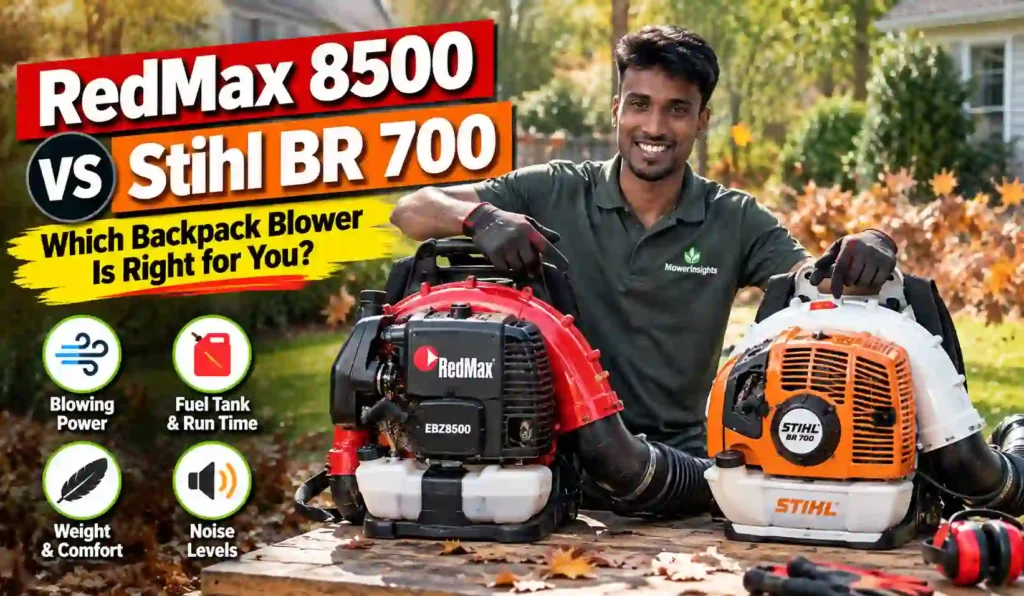
RedMax 8500 vs Stihl BR 700: Why This Matchup Matters
RedMax 8500 vs Stihl BR 700 is the backpack blower debate that landscaping crews and serious homeowners keep returning to. Both machines sit in the same size class. Both cost several hundred dollars. Both are built for people who blow leaves for hours, not minutes.
On paper they look close. The airflow numbers are almost the same. The real gap shows up in how the two engines work and how each blower feels on your back after an hour.
This guide compares the two blowers on power, engine, weight, noise, fuel tank, upkeep, and price. It ends with a clear pick for each type of yard.
Is the RedMax 8500 Still Sold?
No, RedMax no longer lists the EBZ8500 as a current model. The EBZ8550 replaced it, and the EBZ8560 replaced that. You can still find leftover new stock and used EBZ8500 units, so the comparison still matters for many buyers.
The current model, the EBZ8560, is close to the old 8500 in size and layout. It pushes more air, at 1,000 CFM and 220 mph. It also weighs 25.5 lbs and costs $649.99.
If you buy an EBZ8500 used, check the engine compression and the fuel lines first. If you buy new today, you will most likely buy the EBZ8560. Everything in this guide about handling, fuel tank size, and engine type applies to both.
RedMax 8500 vs Stihl BR 700 Specs Side by Side
The two blowers match closely on airflow and differ most on engine size, blowing force, fuel tank, and noise. The table below uses each maker’s published numbers. The BR 700 is Stihl’s high-output pro backpack blower. The EBZ8500 was RedMax’s top blower before the 8550 and 8560.
| Spec | RedMax EBZ8500 | Stihl BR 700 |
|---|---|---|
| Engine type | Strato-charged 2-stroke | STIHL 4-MIX |
| Displacement | 75.6 cc | 64.8 cc |
| Engine power | 4.4 hp | 3.8 hp |
| Airflow at tube or nozzle | 908 CFM | 912 CFM |
| Max air speed | 206 mph (round nozzle) | 197 mph |
| Blowing force | 40 N | 35 N |
| Fuel tank | 77.8 fl oz | 47.3 fl oz |
| Weight (dry) | 24.7 lbs | 23.4 lbs |
| Noise rating | Similar to EBZ8560 (106 dB(A) at operator’s ear) | 75 dB(A) sound pressure rating |
| Throttle | Hip or right-hand versions | Tube throttle |
| Current price | About $650 (EBZ8560 replacement) | $729.99 |
Two notes on these numbers. First, an independent test of the EBZ8500 measured 916 CFM and 181 mph, which is more air and less speed than the maker claims. Second, the noise figures come from different test methods, so do not read them as an exact gap.
Power: Which Blower Moves More Leaves?
The RedMax moves more leaves, mostly because of blowing force. Both blowers push about 910 CFM at the nozzle, but the EBZ8500 makes 40 N of force and the BR 700 makes 35 N. That is about 14% more push. In a deep, wet pile, that extra push is what keeps the pile rolling.
CFM (cubic feet per minute) measures how much air leaves the nozzle. Blowing force, in newtons (N), measures how hard that air hits. Think of CFM as the size of a river and force as how fast it hits the rocks. Wet leaves need force.
Here is how the two compare in the field:
- The RedMax has a bigger engine, 75.6 cc against 64.8 cc, so it holds full power under heavy load.
- Owners who run both say the RedMax keeps moving a pile that the Stihl stalls on.
- One owner described the Stihl BR 700 as a compromise that has more power than the older BR 600 but keeps its comfort.
- The Stihl handles bed edges and shrub detail better because it is lighter and easier to aim.
- Both blowers clear dry leaves and grass clippings with no trouble.
The RedMax can be too strong for light jobs. It can scatter mulch and loose soil when you only want to clear a patio. Variable throttle helps, and both blowers have it.
For a yard with mature hardwoods, such as oak or maple, the RedMax saves real time. For a yard with a few small trees, you will not use that extra power.
Power: RedMax 9.5/10, Stihl 8.5/10.
Best for: The RedMax suits anyone who moves deep leaf piles. The Stihl suits anyone who blows a mix of leaves, clippings, and light debris.
Engine and Starting: 2-Stroke vs 4-MIX
The RedMax uses a 2-stroke engine and the Stihl uses a 4-MIX engine, and this is the biggest design difference between them. A 2-stroke fires on every turn of the crankshaft, which gives high power in a light package. Stihl’s 4-MIX is a four-stroke design that still runs on a fuel and oil mix, so you do not need a separate oil fill.
Stihl says its 4-MIX engine cuts fuel use and exhaust compared with older 2-stroke designs. That claim matches what owners report. The RedMax burns more fuel, and an independent test flagged fuel use as one of its two weak points.
Starting is where the Stihl pulls ahead. The BR 700 has a purge primer and a semi-automatic choke. One owner who ran both reported that the Stihl started in two pulls after winter, while the RedMax took seven. That is one person’s report, not a lab result, but it matches the general reputation of each engine.
- The RedMax is simple, loud, and strong. It runs rough for a minute when cold, then settles.
- The Stihl starts easier and runs smoother from the first second.
- A RedMax that has sat all winter with old fuel is the one most likely to fight you.
Both engines start easily when you use fresh fuel and a stabilizer. Old gas is the main reason either one refuses to start.
Engine and Starting: RedMax 7.5/10, Stihl 8.5/10.
Best for: The Stihl suits anyone who starts the blower many times a day. The RedMax suits anyone who runs it for long stretches.
Weight and Comfort
The Stihl BR 700 is lighter and more comfortable. It weighs 23.4 lbs dry. The RedMax EBZ8500 weighs 24.7 lbs by the maker’s number, and an independent test measured 25.1 lbs. That is a gap of 1.3 to 1.7 lbs before you add any fuel.
The gap grows once you fill the tanks. A full RedMax tank holds 77.8 fl oz, and a full Stihl tank holds 47.3 fl oz. Fuel weighs about 6 lbs per gallon. The extra 30 fl oz in the RedMax tank adds roughly 1.4 lbs on your back.
So a full RedMax carries around 3 lbs more than a full Stihl. Over a four-hour shift, you feel that.
Comfort features differ too:
- The RedMax has wide straps, a contoured back pad, and a Max Cooled pad that pulls air across your back on hot days.
- The Stihl has an adjustable harness, anti-vibration mounts, and a telescopic tube that fits tall and short users.
- The Stihl control handle adjusts with a lever and no tools.
- Owners describe the RedMax as heavier and clunkier at close, detail work.
- Owners describe the RedMax harness as comfortable for its weight.
Hip throttle versus tube throttle also matters. The Stihl BR 700 has the throttle on the tube, so your hand controls speed right where you aim. Many RedMax units use a hip throttle, and RedMax also sells right-hand versions. Try both styles before you buy if you can.
Weight and Comfort: RedMax 7.5/10, Stihl 8.5/10.
Best for: The Stihl suits anyone who works long days or does detailed cleanup. The RedMax suits anyone who wears the blower in short, heavy bursts.
Noise Levels
The Stihl BR 700 is quieter, though the exact gap is hard to pin down. Stihl lists a 75 dB(A) sound pressure rating for the BR 700. RedMax lists about 106 dB(A) at the operator’s ear on the current EBZ8560. The two numbers use different test methods, so the real difference is smaller than 31 dB.
Even so, owners agree the RedMax is the louder machine. One owner who ran both called it “way louder” than the Stihl. Both blowers are loud enough to need hearing protection.
Noise rules matter for US homeowners and crews. Many towns and HOAs set quiet hours or limit gas blower use. Some cities restrict gas blowers in summer or ban them in set zones. Check your local rules before you buy.
A quieter blower also reduces complaints from neighbors. If you work in dense suburbs, that counts for something.
- Wear ear protection rated for the noise, whichever blower you pick.
- Start work after the local quiet-hours window ends.
- The Stihl is the easier blower to live with in tight neighborhoods.
Noise: RedMax 6.5/10, Stihl 8.0/10.
Best for: The Stihl suits dense neighborhoods and early starts. The RedMax suits open lots and rural jobs.
Fuel Tank and Run Time
The RedMax runs much longer between fills. Its 77.8 fl oz tank is about 64% bigger than the Stihl’s 47.3 fl oz tank. RedMax also describes this as the largest fuel tank in the industry. On a big property, that means fewer trips back to the truck.
Bigger tank does not always mean longer run time, though. The RedMax burns fuel faster, and an independent test flagged fuel use as a weak spot. Stihl’s 4-MIX engine sips fuel by comparison. So the real run-time gap is smaller than the tank gap.
Here is the trade-off in plain terms:
- The RedMax gives you more minutes per fill, but costs more fuel per hour.
- The Stihl gives you fewer minutes per fill, but costs less fuel per hour.
- On a full-day job with a truck nearby, the RedMax tank saves refuel stops.
- On a short job, the Stihl tank is plenty.
The weight penalty matters here. You can also fill the RedMax tank halfway and cut about 0.7 lbs of weight when you want a lighter load.
Fuel Tank and Run Time: RedMax 9.0/10, Stihl 7.0/10.
Best for: The RedMax suits large properties with long clearing sessions. The Stihl suits smaller lots where a single tank covers the job.
Maintenance and Long-Term Cost
Both blowers need the same basic care, but the Stihl costs less to fuel and the RedMax is simpler to repair. Over several seasons, fuel savings add up for the Stihl. Easy service and a strong dealer base help the RedMax. Neither engine forgives old fuel.
Routine upkeep is the same for both:
- Clean the air filter every 10 to 25 hours of use, more often in dusty yards.
- Replace the spark plug once a season. The RedMax uses an NGK CMR7H.
- Use fresh fuel mixed to the maker’s ratio, and add stabilizer for winter storage.
- Check the fuel lines and the primer bulb each spring for cracks.
- Inspect the harness and tube clamps for wear.
Based on Siddik’s hands-on repair experience, a 4-MIX engine is less forgiving of a dirty carburetor or bad fuel. When something goes wrong, the fix takes more careful work than on a simple 2-stroke. That is a repair cost to weigh, not a flaw in the design.
Dealer access matters for both brands. Stihl sells its products through its own dealer network, and the BR 700 is a dealer pickup item. RedMax also sells through authorized dealers, and Husqvarna owns the RedMax brand. One owner skipped the RedMax because no dealer served his area, so check your local options before you commit.
A blower with a nearby service shop is worth more than one with slightly better numbers. Ask the dealer about parts, tune-ups, and typical repair wait times.
Price and Value
The RedMax costs less. The Stihl BR 700 sells for $729.99. The current RedMax replacement, the EBZ8560, sells for $649.99. That is about $80 less for more power and a bigger tank. Prices may vary by retailer and change over time.
The EBZ8500 itself is no longer in the current lineup, so new-in-box pricing varies. Leftover stock and used units can cost less than the EBZ8560, but they also carry more risk. A used blower with weak compression is not a bargain.
Here is how value breaks down:
| Factor | RedMax | Stihl BR 700 |
|---|---|---|
| Upfront cost | About $650 (EBZ8560) | $729.99 |
| Fuel cost over time | Higher | Lower |
| Extra tank capacity | Yes, 77.8 fl oz | No, 47.3 fl oz |
| Comfort per dollar | Lower | Higher |
If you run the blower 100 hours or more each year, fuel savings on the Stihl start to narrow the price gap. If you use it a few weekends each fall, the cheaper RedMax is the better buy.
Scorecard
The scores below are MowerInsights ratings based on spec comparison, independent test data, and owner feedback. They show a close race, with the RedMax ahead by a small margin because of power and tank size.
| Category | RedMax EBZ8500 | Stihl BR 700 |
|---|---|---|
| Power | 9.5 | 8.5 |
| Engine and starting | 7.5 | 8.5 |
| Weight and comfort | 7.5 | 8.5 |
| Noise | 6.5 | 8.0 |
| Fuel tank and run time | 9.0 | 7.0 |
| Price and value | 9.0 | 7.5 |
| Average | 8.2 | 8.0 |
The average hides the real story. The RedMax scores higher on the things that clear big piles. The Stihl scores higher on the things you notice every minute you wear it.
Pros and Cons
Each blower has clear strengths and one or two problems that could change your buying decision.
| RedMax EBZ8500 | Stihl BR 700 | |
|---|---|---|
| Pros | 40 N blowing force for deep, wet piles | Lighter at 23.4 lbs |
| 77.8 fl oz tank for long runs | Easier starts with purge primer and semi-automatic choke | |
| Lower price for the current replacement | Lower noise rating | |
| Cooled back pad for hot days | Adjustable tube and lever-adjust handle | |
| Cons | Heavier, and heavier still with a full tank | Lower blowing force, 35 N |
| Louder | Smaller 47.3 fl oz tank | |
| Higher fuel use | Higher price at $729.99 | |
| Discontinued, so you buy used or the 8560 | Harder to work on if the carburetor goes bad |
The biggest decision-changing con for the RedMax is weight with a full tank. The biggest one for the Stihl is that it stalls out on the deepest, wettest piles where the RedMax keeps going.
Which One Should You Choose?
Choose by your yard and your hours, not by the spec sheet. Each situation below points to one clear pick.
Large yard with mature hardwood trees
Buy the RedMax. Deep oak and maple leaf drops are exactly where the extra blowing force pays off. The big tank also keeps you working without stops.
Small or medium suburban yard
Buy the Stihl BR 700. You will not use the RedMax’s extra power, and the lighter weight, easier start, and lower noise make every job smoother.
Full-time landscaping crew
Buy the RedMax if your crew mainly clears heavy fall leaves. Buy the Stihl if your crew mixes mowing cleanup, bed work, and light debris all year. Many crews run one of each, and the owner reports in this comparison say that mix works well.
Beginner or first-time backpack blower buyer
Buy the Stihl BR 700. It is easier to start and easier to aim. You will make fewer mistakes while you learn.
HOA or tight neighborhood
Buy the Stihl. The lower noise rating helps with quiet-hours rules and neighbor complaints.
Tight budget
Buy the RedMax EBZ8560 new, or a well-checked used EBZ8500. You get more power for about $80 less.
FAQs
Is the RedMax 8500 better than the Stihl BR 700?
The RedMax 8500 is better for raw power and fuel capacity. The Stihl BR 700 is better for weight, noise, and ease of starting. Neither wins every category. Your yard and your work hours decide which one fits.
Which blower is more powerful, the RedMax 8500 or the Stihl BR 700?
The RedMax is more powerful. It has a 75.6 cc engine and 40 N of blowing force. The Stihl has a 64.8 cc engine and 35 N of blowing force. Both move about 910 CFM at the nozzle, so the RedMax advantage shows up in push, not air volume.
Which blower is quieter?
The Stihl BR 700 is quieter. Stihl lists a 75 dB(A) sound pressure rating, and RedMax lists about 106 dB(A) at the operator’s ear for its current model. The two figures use different test methods, but owners confirm the RedMax is louder. Wear hearing protection with either one.
Is the Stihl BR 700 worth the extra money?
The Stihl BR 700 is worth it if you value comfort, quiet, and easy starts. It costs $729.99, about $80 more than the current RedMax replacement. If you only need maximum power on a budget, the RedMax is the better value.
What replaced the RedMax EBZ8500?
RedMax replaced the EBZ8500 with the EBZ8550, then with the EBZ8560. The EBZ8560 makes 1,000 CFM and 220 mph, and it weighs 25.5 lbs. It looks and handles like the EBZ8500, with a bit more power.
What is the difference between the Stihl BR 700 and the BR 700 X?
The BR 700 X has a fixed-length tube and a flexible hose, and it weighs 23.0 lbs, about half a pound less than the BR 700. Its top air speed is 193 mph against 197 mph. Both use the same 64.8 cc engine and the same 912 CFM airflow.
Can I use either blower for wet leaves?
Yes, but the RedMax handles heavy, wet leaves better. Its extra blowing force keeps wet piles moving. The Stihl can clear wet leaves too, but you will need more passes on deep piles.
How often should I service a backpack blower?
Clean the air filter every 10 to 25 hours, change the spark plug once a season, and use fresh fuel with stabilizer. Check the fuel lines each spring. Both blowers need the same basic care.
Final Verdict
The RedMax EBZ8500 takes the win on power, tank size, and price, with an overall score of 8.2 out of 10. The Stihl BR 700 scores 8.0 and takes the win on comfort, noise, and starting. For a yard full of mature hardwoods, buy the RedMax, or the EBZ8560 if you want a new unit. For a typical suburban yard, long work days, or a first backpack blower, buy the Stihl BR 700. Anyone who works in a quiet-hours neighborhood should lean Stihl.
Why Trust This Guide
Siddik Kazi runs a lawn mower and outdoor power equipment repair shop in Italy, and the repair and maintenance notes in this guide come from that workshop experience. This guide was built from manufacturer spec sheets, independent test measurements, and owner reports from professional landscaping communities. Where a number comes from one owner or a different test method, the guide says so.