A lawn mower engine knocking noise is a metallic tap, clack, or thud that repeats as the engine turns, and it can come from something as simple as a loose blade or something as serious as a worn connecting rod. The sound feels alarming, but many knocks turn out to be cheap fixes. The trick is to check the easy causes first and to know which knocks mean “stop running it now.”
This guide explains what makes the sound, how to tell the types apart, and what to do about each one. You will also learn when a repair is worth it and when a new mower makes more sense. No special training is needed to follow along, but you will need basic hand tools and a little patience.
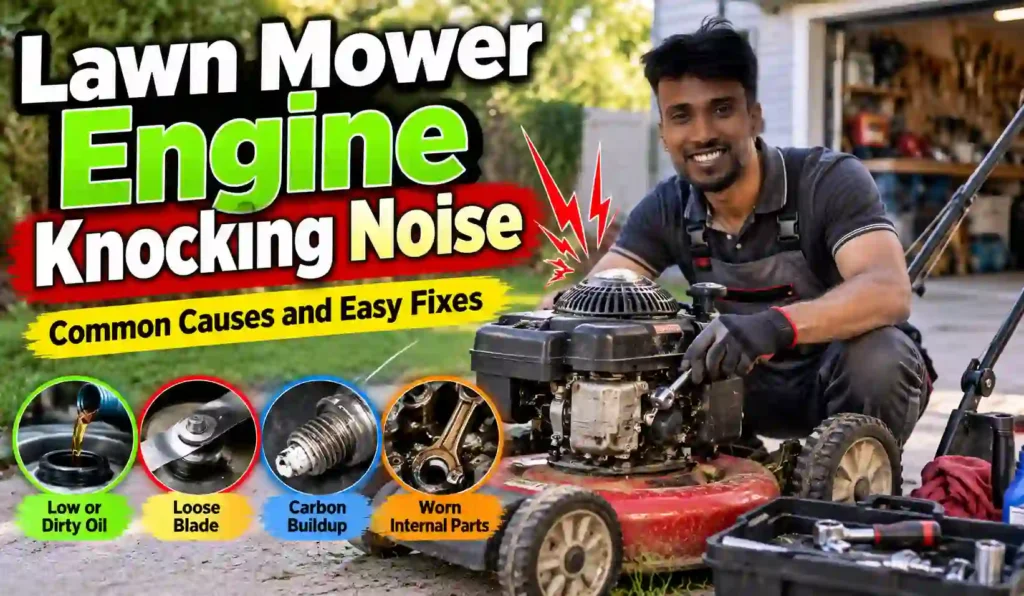
Quick Answer: What Causes a Lawn Mower Engine Knocking Noise?
The most common causes of a lawn mower engine knocking noise are low or dirty oil, a loose or mismatched blade, loose bolts or covers, a worn blade adapter, a sheared flywheel key, carbon buildup, and worn internal parts. Start with the oil, the blade, and the bolts. A deep thud that gets louder under load usually points to a worn connecting rod, and you should stop using the mower.
Here is the fast version:
- Shut the engine off and pull the spark plug wire before you touch anything.
- Check the oil level and color on the dipstick.
- Check the blade, blade bolt, and blade adapter for movement.
- Check every external bolt, the muffler, and the flywheel screen.
- If the knock is deep and rhythmic, stop and test for internal wear.
What Is a Lawn Mower Engine Knocking Noise?
A lawn mower engine knocking noise is any repeating metallic impact sound from the engine or the parts attached to it. It can be a light tick, a sharp clack, a pinging sound, or a heavy thud. The noise either comes from a part that is loose, a part that is worn, or fuel that burns at the wrong moment.
Not every knock comes from inside the engine. The blade is bolted straight to the crankshaft, so a loose blade or a worn blade adapter sends its rattle up the shaft and into the crankcase. That is why an outside problem can sound exactly like a rod knock.
Think of it like a car wheel with a loose lug nut. The wheel is the part that is loose, but you hear the thump through the whole car. A mower works the same way, and the crankshaft carries the sound.
There are three broad sources of a knock:
- Loose or worn parts outside the engine block, such as the blade, adapter, muffler, or shroud.
- Combustion problems, such as fuel igniting too early from carbon, heat, or poor fuel.
- Worn parts inside the engine, such as the connecting rod, crankshaft journal, or piston.
Knowing which group you are in is the whole job. Once you know that, the fix is usually clear.
How Does a Lawn Mower Engine Make a Knocking Sound?
A knocking sound happens when metal hits metal at the wrong moment, or when fuel burns before the piston is ready for it. Either one sends a hard pulse through the engine that you hear as a tap or thud. The sound repeats once for each turn or each combustion cycle, so it speeds up as the engine speeds up.
Here is the basic path from cause to sound:
- The piston moves up and down inside the cylinder, and the connecting rod links it to the crankshaft.
- A thin film of oil keeps the rod and the crankshaft from touching each other. Many small engines have no separate bearing insert at this joint, so the rod rides directly on the shaft with only oil between them.
- When oil runs low or gets old and thin, the film breaks. The rod then slaps against the crankshaft on every stroke.
- Wear makes the gap between the parts larger over time, so the slap gets louder.
That covers an internal knock. Combustion knock follows a different path. Carbon deposits on the piston or in the combustion chamber can glow hot enough to light the fuel before the spark plug fires. The fuel then burns against the rising piston, and you hear a sharp ping or knock, usually under load.
Lubrication matters in another way. Many push mower engines use splash lubrication, which means a small dipper on the rod flings oil around inside the crankcase. If the oil level is low, or if you run the mower on a steep slope, the dipper may miss the oil. The rod then runs dry for a few seconds on every pass, and damage builds fast.
Heat adds to every one of these problems. Grass clippings packed between the cooling fins hold heat in the cylinder. A hotter engine thins the oil, expands the parts, and makes pre-ignition more likely.
Main Types of Lawn Mower Engine Knocking Noise
There are about eight common types of lawn mower engine knocking noise, and each one has its own cause, sound, and fix. They run from cheap and outside the engine to costly and inside it. Work through them in this order, because it saves the most time and money.
1. Low or Dirty Oil
Low or dirty oil is the first thing to check, and it is the most common cause of internal knocking. Without enough oil, the rod and crankshaft lose their protective film and start to hit each other. Dark, gritty, or thin oil protects poorly even when the level looks fine.
What to do:
- Let the engine cool, set the mower on level ground, and pull the dipstick.
- Add the oil type and amount listed in your owner’s manual if the level is low. Do not overfill, since too much oil can foam and cause its own problems.
- Change the oil if it looks black, smells like gas, or feels gritty between your fingers.
- Start the engine and listen. If the knock is gone or much quieter, oil was the cause.
If the knock stays after a fresh oil change, do not keep running the mower. The damage may already be done.
2. Loose Blade, Worn Adapter, or Bent Blade
A loose blade or a worn blade adapter makes a clanging knock that sounds a lot like a rod knock. This is one of the most common false alarms in lawn mower engine knocking noise cases. It is also one of the cheapest to fix.
Slack in the blade adapter (also called the blade hub) is easy to miss. The adapter slides onto the crankshaft and locks in place with a small key. If the key or adapter wears, the adapter can shift a tiny amount. You may hear the knock only at startup and shutdown, when the engine turns slowly and the blade is not yet spinning fast enough to settle.
Here is what to check:
- Disconnect the spark plug wire and tip the mower with the air filter and carburetor facing up.
- Grip the blade and try to move it. It should not rock, twist, or slide.
- Check that the blade bolt is tight to the torque listed in your manual.
- Look at the blade for bends, cracks, or an uneven shape.
- Remove the blade and wiggle the adapter. It should sit snug on the crankshaft with no play.
One more cause is easy to overlook. A replacement blade that is a little thinner than the original can let the hardware loosen even with a tight bolt. The blade then shifts back and forth in its plane of rotation and hammers the shaft. Match the blade part number to your mower model.
3. Loose External Parts
Loose bolts and covers cause a light rattle or tick that is easy to confuse with an internal knock. A rattle tends to be irregular and metallic, while a true internal knock repeats in a steady rhythm. Heat and vibration work bolts loose over a season, so check these every spring.
Check these parts with the engine off and cool:
- Muffler and muffler heat shield
- Carburetor and air filter housing
- Flywheel screen and shroud
- Engine mounting bolts
- Spark plug and plug wire
- Crankshaft pulleys on riding mowers
Tighten anything that moves. A cracked or worn engine mount can also let the engine shift enough to touch the deck, so inspect the mounts for splits.
4. Sheared or Worn Flywheel Key
A sheared flywheel key causes a knock because it changes the timing of the spark. The flywheel carries magnets that trigger the ignition coil. A small metal key locks the flywheel to the crankshaft in the right position. When that key shears or wears, the flywheel sits slightly out of place, and the spark fires too early or too late.
You may see these signs together:
- A knock, ping, or backfire
- Hard starting, especially when the engine is warm
- Weak power and rough running
A key can shear when the blade hits a stump or rock and the engine stops suddenly. It can also shear when the flywheel nut is under-tightened, or when oil or grease gets on the shaft taper. Even a partly sheared key can throw timing off enough to cause trouble. Replacing the key is cheap, but be sure to tighten the flywheel nut to the torque in the service manual. Specs differ by engine, so look yours up by model number.
5. Carbon Buildup and Pre-Ignition
Carbon buildup causes a sharp ping or knock, usually under load, because hot carbon deposits can light the fuel too early. Carbon builds up on the piston crown and in the combustion chamber over many hours. It raises compression a little and can glow like a tiny ember. That ember fires the mixture before the spark plug does.
Signs of carbon knock include:
- A pinging sound when you push the mower through thick grass
- A knock that gets worse as the engine heats up
- Better behavior at idle than at full throttle
A fuel system cleaner added to fresh fuel can help with light deposits. For heavy buildup, a technician can remove the cylinder head and clean the piston and chamber by hand. That job takes more time, so weigh it against the age and value of the mower.
6. Poor or Stale Fuel
Stale or incorrect fuel can cause a combustion knock because it does not burn at the right moment. Gasoline that sits in a tank or can for about a month without a stabilizer starts to break down. It then burns unevenly, and a light ping may follow.
Use fresh regular unleaded gasoline with an octane rating that matches your manual, which is 87 for most small engines. Use fuel with no more than 10 percent ethanol (E10). The U.S. Environmental Protection Agency has not approved E15 for use in small engines like lawn mowers, so check the pump label before you fill your can.
If you suspect the fuel, drain the tank, refill with fresh gas, and run the mower for a few minutes. If the knock fades, the old fuel was part of the problem.
7. Overheating
An overheating engine can knock because heat changes how fuel burns and how metal parts fit together. Hot oil thins out, parts expand, and fuel is more likely to ignite early.
The most common cause is blocked airflow. Grass clippings and dust pack into the cooling fins around the cylinder and hide under the shroud. Clean the fins with a stiff brush or compressed air, and make sure the cooling shroud is in place and not cracked. Then check the oil, since low oil also adds heat.
8. Valve Tick
A light, fast ticking sound from the top of the engine can mean the valves have too much clearance. Valve clearance (the small gap between the valve stem and the lifter) is set at the factory and can open up with wear. The sound is a lighter tap than a rod knock, and it stays about the same under load.
Some engines have adjustable valves, and some do not. Check your service manual for the valve clearance spec and the adjustment steps for your model. If you are not comfortable adjusting valves, a repair shop can do it quickly.
9. Worn Connecting Rod, Crankshaft, or Piston
A worn connecting rod bearing surface causes a deep, heavy thud that tracks engine speed and gets worse under load. This is the serious one. It usually follows long stretches of low oil, old oil, or hard use. It can also follow a hydrolock event, where water or fuel fills the cylinder and bends the rod.
When a rod wears, the gap between the rod and the crankshaft grows. The rod then hits the shaft on each stroke. If the wear keeps going, the rod can break and throw pieces through the engine block. At that point the engine is scrap.
Signs of rod trouble:
- A deep knock that does not go away after an oil change
- A thud that gets louder with throttle and load
- Metal flakes or a gray, glittery look in the drained oil
- Loss of power, smoke, or sudden shutdown
If you suspect this, stop running the mower. The next sections explain how to confirm it.
How to Tell Which Knock You Have
You can narrow down a lawn mower engine knocking noise by listening for when it happens, how it changes with speed, and where it seems to come from. These three clues sort most knocks into the right group in a few minutes. Use the table as a starting point, not a final answer.
| Sound and timing | Most likely cause | How urgent |
|---|---|---|
| Clank at startup and shutdown, smooth at speed | Loose blade adapter or worn hub | Low, but fix soon |
| Irregular rattle that changes with throttle | Loose muffler, shield, shroud, or bolts | Low |
| Clang that is steady and tied to blade rotation | Loose, bent, or wrong blade | Medium, since a loose blade is a safety risk |
| Ping or knock under load, quiet at idle | Carbon, poor fuel, or overheating | Medium |
| Knock with hard starting or backfire | Sheared or worn flywheel key | Medium |
| Light fast tick from the top of the engine | Valve clearance too large | Low to medium |
| Deep thud that rises with speed and load | Worn connecting rod or crankshaft | High, stop using it |
Two quick tests help a lot. First, listen at idle and then at full throttle. A knock that shows up only under load points to fuel, carbon, or heat. A knock that is there all the time points to a loose part or internal wear.
Second, check the knock with the blade removed, if you are able to run the engine safely that way. If the noise disappears, the blade, adapter, or key was the source. If it stays, the problem is in the engine itself. Only run the engine with the blade off if your manual allows it and the mower is secure, and keep your hands and clothing clear.
Why Fixing a Knock Early Saves Money
Fixing a knock early costs less because most causes get worse the longer you run the engine. A loose blade only needs a bolt and a key. A rod that runs dry for another month can end up needing a whole new engine.
Here are the main payoffs of acting fast:
- You catch cheap problems, like a loose bolt or low oil, before they damage the engine.
- You avoid a thrown blade, which is a real safety hazard for you and anyone nearby.
- You keep the mower’s value, since an engine with internal damage is worth very little.
- You avoid being stuck mid-season with a dead mower when your lawn grows fastest.
A quick check also tells you whether the repair is worth doing at all. If a 10-minute inspection finds a loose blade, you are done. If it finds metal in the oil, you can decide on a replacement without wasting a weekend.
What You Can and Cannot Diagnose at Home
You can rule out most outside causes at home with basic tools, but you usually cannot confirm an internal knock without opening the engine. A home check can find a loose blade, a loose bolt, low oil, or a sheared key. It cannot measure bearing wear precisely.
What you can do with a wrench, a flashlight, and a little time:
- Check oil level, color, and feel.
- Drain the oil over a clean white paper towel or a magnet to look for metal bits.
- Test blade, adapter, and bolt tightness.
- Inspect the flywheel key by removing the flywheel (if your manual explains how).
- Run a compression test with a gauge in the spark plug hole.
What needs more than a quick home check:
- Measuring rod bearing clearance and crankshaft journal wear.
- Measuring cylinder bore and piston wear.
- Setting valve clearance with a feeler gauge on some engines.
Service manuals list wear limits for these parts, usually in thousandths of an inch. If you can feel clear side-to-side play in the crankshaft or hear a thud inside the crankcase, assume the wear is past the limit. Low compression plus a knock adds to that case.
A compression test is the easiest at-home check. Warm the engine slightly, remove the spark plug, thread in a compression gauge, and pull the starter cord several times. A very low reading suggests worn rings, a worn cylinder, or a valve problem. Your manual or a shop can tell you the healthy range for your engine.
Factors to Consider Before You Repair the Engine
Before you pay for or attempt an engine repair, weigh the age of the mower, the price of parts, your skill level, and the cost of a new mower or replacement engine. A cheap fix on a good mower is worth doing. An expensive internal repair on an old, low-end mower usually is not.
Think through these points:
- Age and condition. An older push mower with a worn deck, bad wheels, and a tired engine has less value to protect.
- Engine type. Commercial-grade engines and engines with cast iron sleeves are often worth rebuilding. Basic aluminum-bore engines on budget mowers often are not.
- Parts cost. A connecting rod, gasket set, and oil add up fast. If parts alone approach half the price of a new mower, replacement usually wins. This is a MowerInsights rule of thumb, not a fixed rule.
- Your tools and time. Opening a crankcase takes a torque wrench, a clean workspace, and the service manual. A mistake can ruin a good engine.
- How you use it. A mower used daily on a big property needs a sound engine. One used twice a month on a small yard has more room for a cheap fix.
Match the decision to the finding. A loose blade, a bad key, or dirty oil is a repair. A thrown rod or a scored cylinder is usually a replacement.
Practical Tips: A 10-Minute Knock Check
A 10-minute check covers the most likely causes of a lawn mower engine knocking noise in the right order. Do it with the engine off and cool, the spark plug wire disconnected, and the mower on a flat surface. Follow the steps in order, because each one rules out a cheaper problem before the next.
- Disconnect the spark plug wire. This stops the engine from starting by accident while your hands are near the blade.
- Check the oil. Pull the dipstick, wipe it, reinsert it, and pull it again. Look at both the level and the color. Fix the level or change the oil if needed.
- Tip the mower safely. Tilt it so the air filter and carburetor face up. This keeps oil and fuel from flowing where they should not.
- Test the blade. Try to rock, twist, and slide it. Look for bends and cracks. Check that the bolt is tight.
- Check the blade adapter. Remove the blade if you need to, and see whether the adapter moves on the shaft.
- Check outside bolts and covers. Tighten the muffler, shield, shroud, and mounting bolts.
- Clean the cooling fins. Brush out clippings and dust, and check that the shroud is intact.
- Inspect the oil for metal. If you are changing the oil, drain it over a paper towel and look for flakes.
- Refuel if the gas is old. Drain and replace gas that is more than about a month old.
- Restart and listen. Run the engine at idle, then at full throttle. Write down what changed.
Some tips make the job go better:
- Take a phone video of the knock before and after each fix so you can compare.
- Change one thing at a time. If you change three things at once, you will not know which one worked.
- Use a torque wrench on the blade bolt and the flywheel nut. Guessing leads to loose parts or stripped threads.
- Keep a spare flywheel key and a few blade bolts on the shelf. They cost very little.
Stop right away if the knock gets louder, if the engine loses power, or if you see smoke. Those signs mean the engine may be failing.
Common Problems and Misconceptions
Several wrong ideas about knocking keep people from fixing it right. The biggest one is that a mower that still cuts is fine. A knocking engine that still runs is often a few mowings away from a bigger failure.
Here are the most common mistakes and myths, corrected:
- “A thicker oil will quiet the knock.” Thicker oil can hide a light noise for a short time, but it does not repair worn parts. Use the grade in your manual.
- “It only knocks at startup, so it’s nothing.” A knock only at startup and shutdown is often a loose blade adapter or a worn hub. It is not harmless, because the slack gets worse.
- “Premium gas will fix a pinging engine.” Most small engines are built for regular unleaded. Premium will not help, and the real cause is usually carbon, heat, or old fuel.
- “If the oil level is full, the oil is fine.” Oil that is old, thin, or full of fuel protects poorly even when the dipstick reads full.
- “A knock always means the engine is dead.” Many knocks come from loose or cheap-to-fix parts. Check those first.
- “I can top off the oil and keep mowing.” If the rod has already worn, more oil will not undo the damage. The knock will return.
- “Any blade that fits will do.” A blade with the wrong thickness or mounting pattern can loosen and knock even with a tight bolt.
Another common slip is running the mower on a steep slope with the oil level low. Splash lubrication works best on level ground with a full crankcase. Tilting the engine can pull oil away from the dipper, and the rod suffers for it.
Repair or Replace: A Quick Comparison
Whether to repair or replace depends on what the knock turns out to be. Cheap external causes are always worth fixing, while a thrown rod or a scored cylinder usually is not. This table shows how the decision tends to go.
| Finding | Typical repair | Worth fixing? |
|---|---|---|
| Low or dirty oil, knock gone after change | Oil change | Yes |
| Loose blade or bolts | Tighten or replace blade | Yes |
| Worn blade adapter or key | New adapter or key | Yes |
| Sheared flywheel key | New key, correct nut torque | Yes |
| Light carbon ping | Fuel cleaner, fresh fuel | Yes |
| Heavy carbon buildup | Head removal and cleaning | Depends on mower value |
| Valve tick | Valve adjustment | Yes on a good mower |
| Worn rod or crankshaft | Rod, crank, gaskets, or new engine | Often no on budget mowers |
| Thrown rod or holed block | New engine or new mower | No |
If you land in the last two rows, price a replacement engine and a new mower side by side. Some owners fit a new engine on a good deck, and others buy a new machine. The better choice depends on the shape of the deck, wheels, and handle.
FAQs
Why is my lawn mower engine making a knocking noise?
A lawn mower engine knocking noise usually comes from low or dirty oil, a loose blade or adapter, loose bolts, a sheared flywheel key, carbon buildup, or worn internal parts. Check the oil, blade, and bolts first, because those are the cheapest and most common causes. A deep thud that rises with load points to a worn rod.
Is it safe to keep mowing with a knocking engine?
No, not until you know the cause. A loose blade is a safety hazard, and a worn rod can fail without warning and throw metal out of the engine. Stop, disconnect the spark plug wire, and run through the 10-minute check before you use the mower again.
Why does my mower knock only when I start it or shut it off?
A knock at startup and shutdown usually means slack in the blade adapter, a worn key, or a slightly loose blade. At low speed the parts can move against each other, and at full speed they settle and run smoothly. Remove the blade and check for play in the adapter on the crankshaft.
Can low oil cause a lawn mower engine to knock?
Yes. Low oil breaks the thin film that keeps the connecting rod off the crankshaft, so the parts hit each other. Old or fuel-thinned oil does the same thing. Check the level and color on a flat surface, and change the oil if it is dark or smells like gas.
Can a loose blade sound like rod knock?
Yes. The blade bolts straight to the crankshaft, so a loose blade, bent blade, or worn adapter sends its clatter into the engine and sounds just like an internal knock. Check the blade, bolt, and adapter before you assume the engine is damaged.
Will a fuel additive stop engine knock?
Only if the cause is carbon or stale fuel. A fuel system cleaner can reduce light carbon deposits that cause pinging under load. An additive cannot fix a worn rod, a loose blade, or a sheared key, so confirm the cause first.
How much does it cost to fix a knocking lawn mower engine?
The cost ranges from a few dollars for a flywheel key, blade bolt, or oil change to more than the mower is worth for a rod, crankshaft, and gasket repair. Parts prices vary by engine and retailer, and they change over time. Compare the repair quote to the price of a new mower before you commit.
How do I know if the knock is a connecting rod?
A rod knock is a deep, heavy thud that stays after you change the oil and gets louder with speed and load. You may also see metal flakes in the drained oil and feel side-to-side play in the crankshaft. Confirming it usually means opening the engine, so have a shop check it if you are not sure.
Final Takeaway
A lawn mower engine knocking noise has a short list of likely causes, and most of them are outside the engine block or easy to correct. Check the oil, the blade, the adapter, and the bolts first. Move on to the flywheel key, the fuel, and the cooling fins next.

A deep thud that rises with load, metal in the oil, or a knock that stays after an oil change points to internal wear. In that case, stop using the mower and decide between a shop repair and a replacement. Acting early keeps the repair small.
Why Trust This Guide
This guide comes from MowerInsights.com, a site run by Siddik Kazi, who also operates a lawn mower repair and maintenance service in Italy. That shop work is where the focus on loose blades, worn adapters, and oil-starved engines comes from.
Sources and methodology: the advice in this guide draws on manufacturer service guidance for small engines, general small-engine repair practice, and an analysis of common owner-reported problems. The fuel guidance follows U.S. federal rules on ethanol blends in small engines. Always follow your own engine’s owner’s manual for oil type, capacity, and torque values.