Bad gas in lawn mower symptoms usually show up on the first mow of spring, when a mower that ran fine last fall cranks and cranks but never catches. You pull the cord ten times, swap the spark plug, and still get nothing. In many cases the engine is fine, and the gas that sat in the tank all winter is the cause.
Fuel goes stale faster than most people expect. A tiny gummed-up carburetor can also copy a dozen other mower problems. This guide explains what bad gas is, how it forms, and the exact signs to look for. You will also learn a two-minute jar test, the fix, and how to stop it from coming back.
Quick Answer
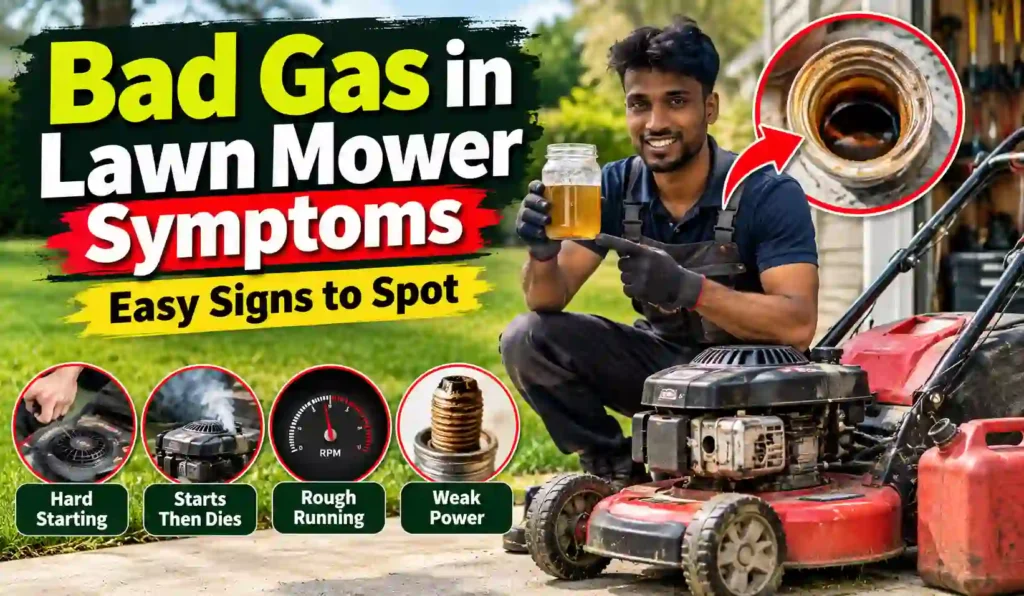
The most common bad gas in lawn mower symptoms are hard starting, an engine that starts and then dies, surging speed, rough running, and weak power under load. The fuel often smells sour and looks darker than fresh gas. Gas starts to go stale after about 30 days. Drain the old fuel, refill with fresh gas, and add a fuel stabilizer.
What Is Bad Gas in a Lawn Mower?
Bad gas is gasoline that can no longer burn cleanly in a small engine. It may be old, mixed with water, dirty, or the wrong blend for your mower. Fresh gas ignites easily and leaves very little residue. Bad gas ignites poorly and leaves sticky deposits that clog the fuel system.
Most mowers use a carburetor, a small part that mixes fuel and air before the mix enters the engine. The carburetor measures fuel through very small openings called jets. Even a thin film of residue can block a jet. That is why bad gas in lawn mower symptoms look like ordinary engine trouble instead of an obvious fuel warning.
Most pump gas in the United States is E10. That means 90 percent gasoline and 10 percent ethanol, a grain-based alcohol. Ethanol matters here because it pulls moisture out of the air, which speeds up fuel problems in a mower that sits for weeks.
How Gas Goes Bad Inside a Lawn Mower
Gas goes bad in three steps: the light parts evaporate, the remaining fuel oxidizes into gum, and ethanol pulls in water. Each step begins within weeks of the fill-up. Think of an open soda going flat. The fizz leaves first, and what remains is sticky and weak.
Step 1: The Light Parts Evaporate
Gasoline contains light compounds that make an engine easy to start. These evaporate first, even in a closed tank. What stays behind is heavier fuel that is harder to ignite, which is why a cold start gets difficult before anything else changes.
Step 2: The Fuel Oxidizes and Leaves Gum
Oxygen slowly reacts with the fuel and forms gum and varnish. Small-engine makers say gas can begin to go stale in about 30 days. The varnish collects on the carburetor jets, the needle valve, and the fuel bowl.
Step 3: Ethanol Absorbs Water
Ethanol attracts water vapor from humid air. After enough time, the water and ethanol can separate from the gasoline and sink to the bottom of the tank. This is called phase separation. The fuel pickup sits near the bottom, so the mower drinks the worst fuel first.
Main Types of Bad Gas
Bad gas comes in four main types: stale gas, water-contaminated gas, wrong-blend gas, and dirty gas. Each type causes a slightly different set of problems and needs a slightly different fix. The table below compares them side by side.
| Type | Typical Cause | What You Notice | Best Fix |
|---|---|---|---|
| Stale gas | Fuel older than about 30 days, no stabilizer | Sour smell, hard starting, surging | Drain and refill |
| Water-contaminated gas | Ethanol absorbed moisture, phase separation | Cloudy fuel, layer at the bottom, sputtering | Drain tank and carburetor bowl |
| Wrong-blend gas | E15, E85, or oil mixed in by mistake | Rough running, smoke, fuel part damage | Drain, flush, refill |
| Dirty gas | Debris, rust, or an old dirty can | Specks in the jar, clogged filter | Drain, replace the fuel filter, use a clean can |
Stale Gas
Stale gas is the most common type. It happens when fuel sits in the tank or can for weeks or months. The symptoms start mild and get worse the longer the gas ages.
Water-Contaminated Gas
Water gets into the fuel through ethanol, a loose cap, or a can left outside. Water does not burn. A mower running on a water layer will sputter or quit.
Wrong-Blend Gas
Small engines are built for fuel with up to 10 percent ethanol. The U.S. Environmental Protection Agency has not approved E15 for lawn mowers, and engine makers say E15 and E85 can corrode metal parts and damage plastic and rubber. Mixing in oil by accident also counts as wrong-blend gas in a four-stroke mower.
Dirty Gas
Rust flakes from an old metal can, grass bits, and dust enter the fuel when the can or tank is left open. These particles clog the fuel filter and carburetor screens. A clear jar shows them right away.
Bad Gas in Lawn Mower Symptoms: The 9 Warning Signs
The nine warning signs of bad gas are hard starting, starting then dying, surging, rough running, weak power, needing the choke to run, a sour smell, dark or layered fuel, and a carburetor that keeps clogging. No single sign proves bad gas. Two or three together, plus fuel older than a month, point strongly to the tank.
1. Hard Starting or No Starting
The engine cranks at normal speed but will not fire, or it needs many pulls. Stale gas has lost the light compounds that help it ignite. Heavy varnish can also block the carburetor completely.
Quick check: a very small spray of starter fluid into the air intake can make the engine fire for a second. If it does, the engine is healthy and fuel delivery is the problem. Keep sparks and flames away and use only a little.
2. Starts, Then Dies
The mower fires, runs for a few seconds, and quits. A partly clogged jet lets in enough fuel to start but not enough to keep running. A blocked fuel cap vent causes the same thing, so loosen the cap and try again before blaming the gas.
3. Surging or Hunting Speed
Engine speed rises and falls by itself with the throttle held still. Fuel reaches the engine in uneven amounts through a partly blocked jet. A dirty air filter or loose governor linkage can also cause surging, but fuel is the cheapest cause to rule out first.
4. Rough Running, Sputtering, and Popping
Stale fuel burns unevenly from one engine cycle to the next. You hear sputtering and skipping, and sometimes pops from the muffler. Some mowers also puff gray smoke. Black smoke more often points to a clogged air filter or a stuck choke.
5. Weak Power in Thick Grass
The mower bogs down or stalls in grass it handled easily last season. Weak fuel delivers less energy per stroke. A gummed carburetor also cannot supply extra fuel when the load goes up. Dull blades and a packed mower deck cause the same bogging, so check those too.
6. Needs the Choke to Keep Running
The mower runs only with the choke partly closed and dies when you open it. Gummed jets starve the engine, and the choke helps by cutting the air supply. This sign usually means varnish is already inside the carburetor, so fresh gas alone may not fix it.
7. A Sour or Varnish Smell
Fresh gas has a sharp, clean solvent smell. Stale gas smells sour and heavy, a bit like old paint thinner. Open the cap with the engine off and no flame nearby. If the smell is off, the gas is past its best no matter how it looks.
8. Dark, Cloudy, or Layered Fuel
Fresh gas is clear to pale yellow. Aged gas turns amber or brown. Cloudy fuel or a visible layer at the bottom means water has separated from the blend. Pour a small sample into a clear glass jar and let it sit for one minute to check for layers and floating bits.
9. A Carburetor That Keeps Clogging
If you clean the carburetor and the trouble returns within weeks, the fuel is the likely cause. Old gas keeps laying down new gum on the jets. Fix the fuel supply first, and the cleaning will last.
Benefits of Catching Bad Gas Early
Catching bad gas early saves money and keeps a simple fuel problem from turning into a carburetor repair. The fix at the early stage is a few dollars of fresh gas and about twenty minutes. Waiting lets varnish harden inside the jets.
- A shop carburetor cleaning often runs about $75 to $150 (MowerInsights estimate), while a gallon of fresh gas costs a few dollars. Prices may vary by retailer and change over time.
- Early action protects rubber fuel lines, primer bulbs, and gaskets from long contact with water-laden ethanol fuel.
- You avoid replacing parts that were never broken, such as a spark plug or air filter bought on a guess.
- You get the mower running before the busy weeks, such as the Memorial Day weekend mow or the fall leaf cleanup.
- Draining old fuel safely keeps it out of the lawn, drains, and trash.
Limits of the Symptom Check: When It Is Not Bad Gas
Symptoms alone cannot prove bad gas, because several other mower problems look almost identical. A single sign such as hard starting has at least five common causes. Use the smell, the jar test, and the age of the fuel to confirm before you take anything apart.
| Symptom | Other Likely Cause | Quick Way to Tell |
|---|---|---|
| Hard starting | Worn or fouled spark plug | Pull the plug and look for black deposits or a worn tip |
| Starts, then dies | Blocked fuel cap vent | Loosen the cap and restart |
| Surging | Dirty air filter | Remove the filter and run briefly, with care |
| Weak power | Dull blade or packed deck | Tip the mower safely and inspect |
| Black smoke | Clogged air filter or stuck choke | Check the filter and choke lever |
| No crank at all | Safety switch or dead battery | Check the bail lever, key, and battery on electric-start models |
The gas is the likely cause when the fuel is old, smells off, or looks dark. If the fuel is fresh and clean, look at the other items in the table.
Factors That Make Gas Go Bad Faster
Ethanol content, heat, humidity, tank level, and storage container all change how fast gas goes bad. E10 usually has a shorter shelf life than ethanol-free fuel. A mower stored half full in a hot shed will have worse fuel than one stored sealed in a cool garage.
- Ethanol content: Higher ethanol blends age faster and absorb more water. Fuel guidance puts E10 at roughly one to three months untreated, while ethanol-free gas often lasts about six months.
- Heat: Warm sheds and garages speed up evaporation and oxidation. Southwest and Gulf Coast summers are hard on stored fuel.
- Humidity: Damp air gives ethanol more water to absorb. Southeast and Gulf states see phase separation more often than dry states.
- Tank level: A half-empty tank holds more air, which gives gas more room to evaporate and take on moisture.
- Container: A loose cap, a vented can, or an old metal can lets in air, water, and rust.
- Storage length: In cold northern zones, such as USDA zones 3 to 5, mowers can sit for five months or more between uses. That is long enough for untreated fuel to fail.
Common Myths About Bad Gas
Several popular beliefs about bad gas lead owners to the wrong fix. The facts below correct the five most common ones.
- Myth: Gas lasts a year. Untreated gas can start to go stale in about 30 days. A year is only realistic with a stabilizer added to fresh fuel.
- Myth: Topping off with fresh gas fixes it. Fresh gas dilutes old fuel but does not remove the varnish or water already in the system. In a mower, draining is the safer fix.
- Myth: Premium gas lasts longer or runs better. Mowers are low-compression engines, and manufacturers specify regular unleaded. Premium costs more and does not resist aging.
- Myth: Stabilizer revives bad gas. A stabilizer slows aging in fresh fuel. It does not repair gas that has already turned sour or separated.
- Myth: Ethanol-free gas never goes bad. It lasts longer, but it still evaporates and oxidizes over time.
Practical Tips: How to Check, Fix, and Prevent Bad Gas
The fastest fix is to confirm the gas is bad, drain the tank and carburetor bowl, and refill with fresh fuel. Work outdoors with the engine off and cool, and keep flames and sparks away. The steps below take about twenty minutes.
How to Check the Gas
- Date it. If you cannot say when you bought the gas, treat it as old.
- Smell it. A sour or varnish smell means it is past its best.
- Jar test. Drain a small sample into a clear glass jar and wait one minute. Look for dark color, layers, and floating specks.
How to Fix a Mower With Bad Gas
- Drain the tank into an approved fuel container with a hand siphon.
- Loosen the drain bolt under the carburetor bowl and catch the old fuel. Many mowers use a 10 mm bolt.
- Tighten the bolt and refill with fresh gas that has no more than 10 percent ethanol.
- Add fuel stabilizer, then run the engine for a few minutes outdoors so the treated fuel reaches the carburetor.
- If it still runs badly, clean the carburetor, because varnish may already be baked on.
Take bad fuel to your county household hazardous waste site. Never pour it on the ground, down a drain, or into the trash.
How to Prevent It
- Buy only as much gas as you will use in about 30 days.
- Write the purchase date on the can with a marker.
- Add stabilizer every time you fill the can, not only before winter.
- Before winter, run the mower dry or store it with a full tank of stabilized fuel.
- Store cans sealed, cool, and out of the sun.
- Never use E15 or E85 in a mower.
Fuel Shelf Life at a Glance
Shelf life depends mostly on ethanol content and whether a stabilizer was added. The ranges below are rough MowerInsights estimates built from published engine-maker fuel guidance. Real life varies with heat, humidity, and storage.
| Fuel | Untreated | With Stabilizer | Best Use |
|---|---|---|---|
| E10 pump gas | About 1 to 3 months | Up to a year or more | Everyday mowing |
| Ethanol-free pump gas | About 6 months | One to two years | Mowers that sit for long stretches |
| E15 or E85 | Not for mowers | Not for mowers | Approved vehicles only |
Sealed cans of premixed small-engine fuel often list a multi-year shelf life on the label. Check the label of the product you buy.
FAQs
What are the symptoms of bad gas in a lawn mower?
The main bad gas in lawn mower symptoms are hard starting, starting then dying, surging, rough running, weak power, and a need for the choke to keep running. The fuel may smell sour and look dark or cloudy. Fuel older than 30 days without stabilizer is a strong clue.
How long does it take for gas to go bad in a lawn mower?
Untreated gas starts to degrade in about 30 days. E10 can cause trouble within one to three months, and ethanol-free gas often lasts around six months. A stabilizer added to fresh fuel can stretch that to a year or more.
What does bad gas smell like?
Bad gas smells sour and heavy, a bit like old paint thinner or varnish. Fresh gas has a sharper, cleaner solvent smell. If you cannot tell the difference, compare it with a small sample from a fresh can.
Can bad gas damage a lawn mower engine?
Bad gas rarely harms the engine itself, but it often gums up the carburetor and can corrode the fuel system if water is present. The usual result is a carburetor cleaning. Running a mower on water-laden fuel for a long time can cause more serious corrosion.
Can I mix old gas with new gas?
In a mower, it is a gamble. Gas that is only slightly stale might burn in a small ratio with fresh fuel, but it can still leave gum behind. Never mix in fuel that shows water, rust, or a strong varnish smell.
Will fuel stabilizer fix bad gas?
No. A stabilizer slows aging in fresh fuel, but it cannot repair gas that has already gone bad. Drain the old fuel first, then add stabilizer to the fresh fuel.
Why does my mower run only on choke?
A mower that runs only with the choke on usually has a partly blocked carburetor jet, and old gas is a common cause. The choke cuts air so the mixture gets more fuel. Drain the fuel and clean the carburetor if fresh gas does not fix it.
Can bad gas make a mower smoke?
It can, but it is less common than other causes. Poorly burned fuel may produce light gray smoke or a strong fuel smell. Black smoke more often points to a clogged air filter or a stuck choke.
Final Takeaway
Bad gas in lawn mower symptoms are hard starting, starting then dying, surging, rough running, weak power, a sour smell, and dark or layered fuel. Confirm with the date, the smell, and a jar test, then drain the tank and carburetor bowl and refill with fresh gas. Prevent a repeat by buying small amounts, adding stabilizer at every fill-up, and never using E15 or E85. If the mower still struggles on fresh fuel, the carburetor needs cleaning.
Why Trust This Guide
MowerInsights.com is run by Siddik Kazi, who repairs lawn mowers at his workshop in Milan, Italy. That repair work is where the focus on fuel problems comes from.
Sources and methodology: this guide draws on fuel guidance published by small-engine manufacturers, the U.S. EPA position on higher-ethanol blends, and a review of existing repair coverage and owner feedback. Shelf-life ranges and repair costs marked as estimates are MowerInsights estimates and should be treated as rough guides.