Craftsman lawn mower carburetor replacement fixes a mower that stalls, surges, floods, or will not start after winter storage. Plan on one to two hours and a basic set of hand tools. This guide covers all 12 steps, from finding the right part to the first test run.
Craftsman mowers do not all share one engine. Parts catalogs list Briggs & Stratton, Kohler, and Kawasaki engines across the Craftsman line, and older mowers often carry a Tecumseh. So the label on the engine matters more than the name on the deck, and you will learn how to read it in Step 2.
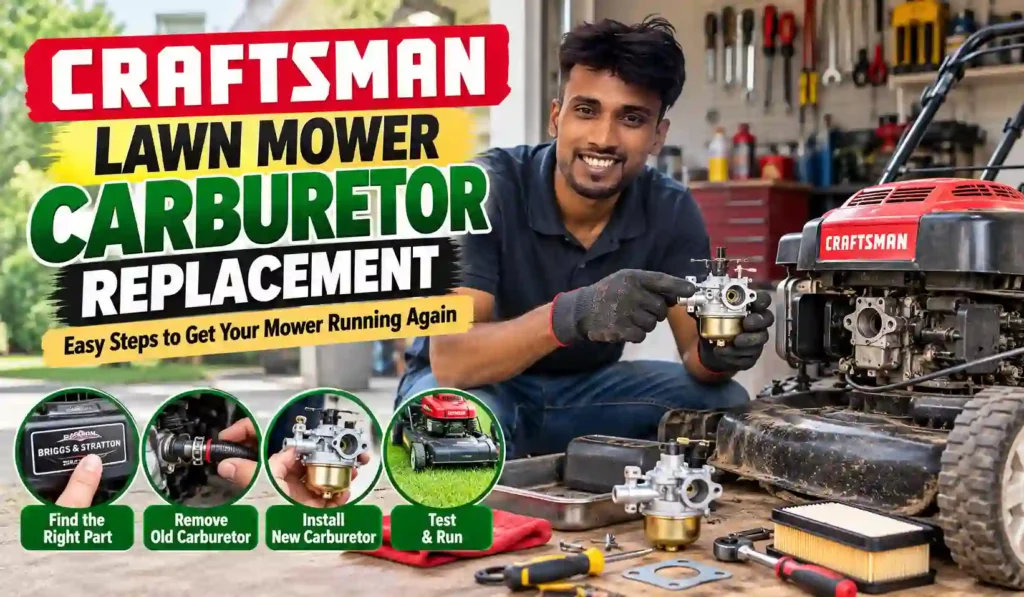
Quick Answer: How to Do a Craftsman Lawn Mower Carburetor Replacement
To finish a Craftsman lawn mower carburetor replacement, pull the spark plug wire, find your engine’s model, type, and code, and buy the matching carburetor. Then remove the air cleaner, unhook the fuel line and the throttle and choke linkage, and unbolt the old carburetor. Fit new gaskets, bolt on the new carburetor, reconnect everything, and test the engine.
What You’ll Need for a Craftsman Lawn Mower Carburetor Replacement
A Craftsman lawn mower carburetor replacement uses common tools. Gather everything before you start, so the engine is not sitting half apart while you hunt for a part.
Tools
- Socket set or nut driver set
- Torx bit set (some Briggs & Stratton carburetors mount with Torx screws)
- Flathead and Phillips screwdrivers
- Needle-nose pliers
- Fuel line pliers or a small hose clamp
- Drain pan
- A phone camera for photos of the linkage
Parts
- Replacement carburetor that matches your engine model, type, and code
- New carburetor mounting gaskets (many aftermarket carburetors include them)
- New air filter if the old one is dirty or oily
- A short length of fuel-rated hose and new clamps
- Fuel filter, if your engine has one
Materials
- Fresh regular gas with no more than 10% ethanol
- Clean rags and carburetor cleaner spray for the mounting surface
- Work gloves and safety glasses
- A zip bag for small screws and springs
Safety First
The main hazards in a Craftsman lawn mower carburetor replacement are fuel vapor and a surprise engine start. These precautions cover both.
- Pull the spark plug wire off the plug and tuck it away from the metal. This makes an accidental start impossible.
- Let the engine cool for at least 30 minutes. The muffler and cylinder stay hot long after you shut it off.
- Work outside or in a garage with the door open. Keep flames, pilot lights, and cigarettes far away from the fuel.
- Catch spilled fuel with a pan and rags. Let used rags dry outdoors before you throw them away.
- On a riding mower, disconnect the negative battery cable first. This protects you from sparks near the fuel line.
- Wear gloves and safety glasses. Old fuel lines can spray when you pull them off.
Before You Start
Set up the work area before you touch a wrench. A little prep saves you from the most common beginner problems.
- Park the mower on a flat, hard surface with good light.
- Run the tank down low, or plan to siphon it, so less fuel spills when you open the fuel line.
- Lay out a clean rag or tray for small parts.
- Take a wide photo of the engine from above before you remove anything.
- Have the engine label and your mower model number ready, since you will need both for Step 2.
A community repair guide rates a riding mower carburetor job at about one hour and moderate difficulty. Walk-behind mowers are usually simpler, with fewer cables and no battery.
Step 1: Confirm the Carburetor Is the Problem
Do not start a Craftsman lawn mower carburetor replacement until you rule out cheaper causes. Many starting problems come from old fuel, a clogged air filter, or a worn spark plug.
Check these in order:
- Fuel: Gas that sat for more than about 30 days can go stale, according to engine makers. Drain it and add fresh gas.
- Air filter: A dirty filter chokes the engine and can mimic a bad carburetor.
- Spark plug: Pull it, look for black crust or a cracked tip, and replace it if it looks worn.
- Fuel flow: Loosen the fuel line at the carburetor with the tank valve open. Fuel should flow freely.
If those all check out, look for carburetor symptoms: fuel dripping from the bowl or overflow, an engine that runs only with the choke on, surging at steady speed, or no start after a fresh tune-up.
You can try cleaning first. A basic cleaning costs little, but a varnished or corroded carburetor often needs replacement anyway.
Pro tip: If fuel leaks from the carburetor bowl or the overflow, the float needle may be stuck. A new carburetor fixes that, and so does a rebuild kit if the body is clean.
Step 2: Find Your Engine Model, Type, and Code
The engine label tells you exactly which carburetor you need. Do not order by the mower model number alone.
Craftsman mowers use engines from several makers, and the same mower model can carry different engines in different production years. Parts catalogs say the engine model, type, and code are the numbers that match carburetor, ignition, and fuel parts.
Where to look on a Briggs & Stratton engine
- Walk-behind mowers often have a metal tag directly above the rewind starter.
- Overhead valve engines are often stamped on the left side of the valve cover, below the exhaust and behind the air cleaner.
- Riding mower engines have the number stamped on the metal plate over the valve cover, sometimes under a plastic shroud.
Briggs & Stratton says you only need the first 10 characters of the model and type. If yours shows only 9, add a 0 at the start when you search.
Where to look on other engines
Kohler and Kawasaki engines carry a label or stamping on the shroud, blower housing, or near the starter. Write down every character exactly as printed, including dashes.
Common mistake: Reading the mower deck sticker instead of the engine tag. Craftsman model numbers often start with 917 on walk-behind mowers and 247 on lawn tractors, but they do not identify the engine.
Step 3: Buy the Correct Replacement Carburetor
For any Craftsman lawn mower carburetor replacement, match the new carburetor to your engine model, type, and code, then compare it to the old one before you pay. The part number on a listing alone is not proof of fit.
These examples show how one carburetor number can cover many engines. Treat them as starting points, not a guarantee.
| Carburetor part number | Commonly listed for | Notes |
|---|---|---|
| 799868 | Briggs & Stratton 122000-series engines, Craftsman 625-series walk-behind mowers | Replaces older numbers 498170 and 498254 |
| 799866 | 190cc Briggs & Stratton engines rated 6.5 to 7.25 HP on Craftsman and Toro walk-behind mowers | Also listed under 790845 and 799871 |
Pricing varies a lot. Aftermarket carburetors for push mowers usually run about $10 to $30 in MowerInsights’ estimate, based on current listings. Original-maker parts cost more, and a genuine Briggs & Stratton riding mower carburetor can top $150. Prices may vary by retailer and change over time.
A rebuild kit costs even less, often $10 to $25, but it only helps if the carburetor body is clean and undamaged.
Pro tip: Buy the carburetor before you take the old one off. If the part arrives and looks different, you can sort that out while the mower is still in one piece.
Step 4: Prepare the Mower and Drain the Fuel
Stop the engine, cool it, and remove the spark plug wire before any Craftsman lawn mower carburetor replacement work begins. This is the safety step that everything else depends on.
- Pull the spark plug wire and tuck it clear of the plug.
- Close the fuel shutoff valve if your mower has one.
- Tip the mower with the air filter and carburetor side facing up. This keeps oil from running into the air filter and cylinder.
- Place the drain pan under the carburetor.
- Drain or siphon the tank into a clean, approved gas can.
If your mower has a fuel valve, closing it saves a lot of mess. If it has none, use fuel line pliers to pinch the hose near the tank.
Common mistake: Tipping the mower with the carburetor side down. Oil can flood the air filter and make the engine smoke on the first start.
Step 5: Remove the Air Cleaner
The air cleaner sits on top of the carburetor and has to come off first in a Craftsman lawn mower carburetor replacement. Mounting varies by engine, but most use one or two screws or a wing nut.
- Remove the cover screw or knob and lift the cover off.
- Pull out the foam or paper filter and set it aside.
- Remove the base plate or air box, usually held by two screws or bolts.
- Some Briggs & Stratton models also have a small breather tube running from the air cleaner. Pull it off gently.
Inspect the filter. A filter that is soaked in oil or packed with grass is ready for the trash, and a new one is cheap.
Pro tip: Drop each set of screws into its own corner of the zip bag. Air cleaner screws are often shorter than carburetor screws, and mixing them up causes trouble later.
Step 6: Photograph and Disconnect the Linkage and Fuel Line
Take photos of the linkage from at least two angles before you disconnect anything. The throttle, choke, and governor parts look simple until they are in pieces on your bench.
A Craftsman lawn mower carburetor replacement almost always involves these connections:
- A governor link, a small metal rod that joins the carburetor throttle lever to the engine’s governor arm.
- A throttle or choke link, plus a spring on the throttle lever.
- A fuel line that feeds the carburetor from the tank.
How to disconnect each part
- Note where each spring hooks onto the carburetor.
- Unhook the governor link with needle-nose pliers.
- Release the throttle and choke links.
- Slide the fuel line clamp back with pliers and wiggle the hose off slowly. Expect some fuel to dribble out, so keep the pan underneath.
Riding mower and lawn tractor notes
- Disconnect the negative battery cable before you touch the fuel system.
- Many riding engines have a fuel shutoff solenoid on the carburetor bowl. Unplug its wire, and plan to move the solenoid to the new carburetor if it is not included.
- Riding mowers add a throttle cable and choke cable, so photograph where each cable clip sits.
Common mistake: Pulling the fuel line hard enough to crack the plastic fitting on the new carburetor later. Wiggle the hose, do not yank it.
Step 7: Remove the Old Carburetor
For a Craftsman lawn mower carburetor replacement, unbolt the old carburetor from the engine and lift it off with the gaskets and spacer still in place. Go slowly, because the carburetor sits close to hot parts and small springs.
- Remove the two mounting bolts or screws. One repair video uses a T30 Torx bit for a common Briggs & Stratton carburetor, but sizes differ by engine.
- Gently work the carburetor free of the intake. It may be stuck to an old gasket.
- Note which way the gaskets, spacer, and any heat shield were stacked.
- Set the carburetor down on a rag and look at the throttle shaft and choke plate.
Check the intake surface on the engine. It should be flat and clean, with no cracks or old gasket bits stuck to it.
Pro tip: Wipe the surface clean with a rag and a little carburetor cleaner. Owners who have done this repair report that an untreated, dry gasket on a clean surface seals well, so skip gasket sealant.
Step 8: Compare the Old and New Carburetor and Replace the Gaskets
In any Craftsman lawn mower carburetor replacement, hold the old and new carburetors side by side before you install anything. This is your last chance to catch a wrong part.
Check these points:
- The mounting holes line up in the same pattern.
- The fuel inlet and linkage levers sit in the same spots.
- The choke and throttle plates are the same shape and size.
- The new gaskets match the old ones.
Always use new gaskets. A used gasket is hard and flattened and often leaks air at the intake. An air leak makes the engine surge and run lean.
Some new carburetors arrive with a little gas residue in them from factory testing. This is normal. Wipe off any residue before you fit them.
Common mistake: Reusing the old gaskets or spacer because they “look fine.” Even a tiny air leak causes surging and hard starting.
Step 9: Install the New Carburetor
For this stage of the Craftsman lawn mower carburetor replacement, bolt the new carburetor to the engine using the gasket stack in the same order you removed it. Do not tighten fully until the linkage is in place.
- Put the spacer and new gaskets on the intake studs or surface.
- Hold the carburetor in place and hook the governor link and throttle spring to the correct levers. Use your photos.
- Start both mounting bolts by hand.
- Tighten the bolts evenly, alternating from one to the other.
- Move the throttle lever by hand through its full range.
Follow the torque value in your engine manual. If you do not have one, snug the bolts firmly but do not force them. Overtightening can crack plastic spacers or warp the carburetor flange.
The throttle should move smoothly with no sticking. If it binds, the linkage is probably crossed or a spring is hooked to the wrong hole.
Pro tip: Hook the governor spring onto the carburetor before the carburetor sits against the engine. It is much harder to do once the bolts are in.
Step 10: Reconnect the Fuel Line and Air Cleaner
Push the fuel line back onto the carburetor inlet and secure it with a fresh clamp. A tight hose fit prevents the most common leak after a carburetor swap.
- Check the old fuel line for cracks, hardness, or soft spots. Replace any hose that is stiff or damaged.
- Use fuel-rated hose and match the inside diameter of the old line. Small engines commonly use about 1/4 inch.
- If you have an inline fuel filter, replace it now.
- Reinstall the air cleaner base, filter, and cover with the correct screws.
- Plug the fuel solenoid wire back in on riding mowers, then reconnect the negative battery cable.
Open the fuel valve and watch the fuel line connection for a minute. If you see any drips, stop and fix them before you start the engine.
Common mistake: Reusing a rotted fuel hose. A new carburetor does not help if a cracked line leaks fuel or draws in air.
Step 11: Prime and Start the Engine
Reconnect the spark plug wire, add fresh gas, and start the engine outside to test your Craftsman lawn mower carburetor replacement. The first start can take a few more pulls than usual because the new carburetor bowl is dry.
- Refill the tank with fresh gas.
- Press the primer bulb 2 to 3 times if your engine has one.
- Set the choke to the start position when the engine is cold.
- Pull the starter rope or turn the key.
- Once the engine catches, move the choke off in small steps as it warms.
Let the engine run for a few minutes and watch for fuel leaks, smoke, or stumbling. Then engage the blade control and check that the engine holds speed.
If the engine does not start after five or six pulls, stop and check the basics. A dry carburetor can need a little time to fill, but a long cranking session floods the cylinder.
Pro tip: If the engine floods, wait 10 minutes, then try again with the choke off and the throttle set to fast.
Step 12: Adjust Idle Speed and Check the Governor
Check the idle and top speed after the engine warms up, since this is the last part of a Craftsman lawn mower carburetor replacement. A bad governor setting makes the engine race or bog under load.
Many modern push mower carburetors have no adjustment screws at all, so you may have nothing to tune. If yours has an idle speed screw, turn it slowly until the engine idles steadily without stalling. Do not touch a fixed main jet.
For engine governor speed, use the figure in your engine manual and a tachometer. The governor link and spring set the top speed, and a misplaced spring is the usual reason an engine runs wide open or hunts up and down.
If the engine surges at steady speed, recheck the mounting bolts and gaskets for air leaks before you change any settings.
Common mistake: Bending the governor link or adding extra spring tension to raise speed. Overspeeding an engine can damage it.
Common Problems After a Craftsman Lawn Mower Carburetor Replacement
Most issues after a Craftsman lawn mower carburetor replacement trace back to linkage, gaskets, or the fuel line. Use this table to match what you see to the likely fix.
| Problem | Likely Cause | Solution |
|---|---|---|
| Engine will not start | Fuel solenoid unplugged, no fuel flow, or spark plug wire off | Check the solenoid wire, open the fuel valve, and reconnect the plug wire |
| Engine runs only at full speed | Governor link or spring hooked to the wrong hole | Compare to your photos and reset the link and spring |
| Fuel leaks at the carburetor | Pinched or missing gasket, loose fuel line clamp | Replace the gasket and tighten the clamp |
| Engine surges at steady speed | Air leak at the intake or stale fuel | Check gasket seating and drain old gas |
| Black smoke or rough running | Choke stuck on, or a carburetor that does not match the engine | Check choke operation and compare part numbers |
| Throttle lever sticks | Linkage crossed or bent | Re-seat the linkage and check for bends |
Troubleshooting: If the Engine Still Will Not Run Right
If your Craftsman lawn mower carburetor replacement did not solve the problem, check these three failure points in order.
The engine will not start at all
Confirm the three basics: fuel, spark, and air. Pull the spark plug and check for a strong blue spark against the engine block with the wire reattached. Look inside the air cleaner for a blocked intake. Then check whether the fuel solenoid or shutoff valve is open.
The engine starts, then dies
A fuel starvation problem is the usual cause. Check for a kinked fuel line, a clogged fuel filter, or a vent in the gas cap that is blocked. Loosen the gas cap and see if the engine runs better.
The engine runs rough or leaks
Remove the carburetor and look at the gaskets. A bent or misaligned gasket lets air in at the intake. Also check that the bowl is on straight and the fuel line clamps are tight.
Expert Tips for Craftsman Lawn Mower Carburetor Replacement
- Replace the fuel line, fuel filter, and mounting gaskets at the same time as the carburetor. They cost a few dollars and prevent a repeat repair.
- Use fresh gas and a fuel stabilizer before storing the mower. Stale fuel leaves varnish that clogs small jets.
- Run the tank dry at the end of the season if you will not use a stabilizer. This leaves less fuel to break down in the bowl.
- Keep a short note of the engine model, type, and code on a sticker inside the garage. It saves you from hunting for the number every time.
- Aftermarket parts work well for a Craftsman lawn mower carburetor replacement on many older mowers, but compare the shape carefully. A close match is not the same as an exact match.

When to Call a Professional
A shop is the better choice if your Craftsman lawn mower carburetor replacement fights you at any stage. Stop and get help for these situations:
- Fuel is leaking from the tank, the line near the tank, or a part you cannot reach.
- The engine will not run even though the carburetor, spark, and fuel are all good. This points to a compression problem, a sheared flywheel key, or valve trouble.
- The mounting holes in the engine are stripped or the intake surface is cracked.
- You cannot get the governor link and spring to sit right and the engine runs wide open.
A shop job usually runs about $90 to $175 in MowerInsights’ estimate, depending on the part and local labor rates.
Frequently Asked Questions
How long does a Craftsman lawn mower carburetor replacement take?
Most walk-behind mowers take one to two hours at home, and a riding mower takes longer. A riding mower or lawn tractor can take a bit longer because of the extra cables, the battery, and the fuel solenoid. Allow extra time if this is your first carburetor job.
How much does a replacement carburetor cost for a Craftsman mower?
Aftermarket push mower carburetors usually cost about $10 to $30, and original-maker riding mower carburetors can pass $150. Rebuild kits cost less. Check your engine label before you pay for any part.
Can I clean the carburetor instead of replacing it?
Yes, if the body is clean, not corroded, and the float and needle move freely. Cleaning or a rebuild kit costs less than a new carburetor. If the jets are varnished shut or the body is pitted, replacement is the faster fix.
Will any Craftsman carburetor fit my mower?
No. Craftsman mowers use engines from several makers, so you need the engine model, type, and code from the engine label, not the Craftsman model number alone. Compare the old and new carburetors side by side before you install the new one.
Why does my mower still run badly after replacing the carburetor?
The usual causes are an air leak at the intake gasket, a misplaced governor spring, stale fuel, or a clogged fuel filter. Recheck the gaskets and linkage first. If those are right, test spark and compression.
Do I need to adjust a new carburetor?
Often no. Many walk-behind carburetors come pre-set and have no adjustment screws. If yours has an idle screw, adjust it only after the engine warms up, and follow your engine manual.
Final Takeaway
A Craftsman lawn mower carburetor replacement is a doable weekend repair if you match the part to the engine label and photograph the linkage before you disconnect it. Use new gaskets, replace a worn fuel line, and tighten the mounting bolts evenly. Test the engine outside and check for leaks before you mow. If the mower still will not run with a fresh carburetor, the problem is probably spark, compression, or fuel supply, and a shop visit is the next step.
Why Trust This Guide
MowerInsights.com is run by Siddik Kazi, who also runs a lawn mower repair service in Italy. That workshop work is where this guide’s focus on gaskets, fuel lines, and linkage comes from. Reviewed by Siddik Kazi.
Sources and methodology: this guide draws on engine maker support pages, parts catalog listings, published repair instructions, and owner-feedback analysis. Steps are written from those sources and common small engine practice. Always check your engine manual for model-specific details.