Adjust lawn mower governor settings when your engine surges, races, or bogs down the second the blade hits tall grass. Most governors never drift on their own. They fall out of adjustment after a carburetor rebuild, a bent linkage, or a governor arm that was removed and put back wrong.
This guide shows you how to reset the linkage, set top speed with a tachometer, and spot the cases where the real fault sits somewhere else.
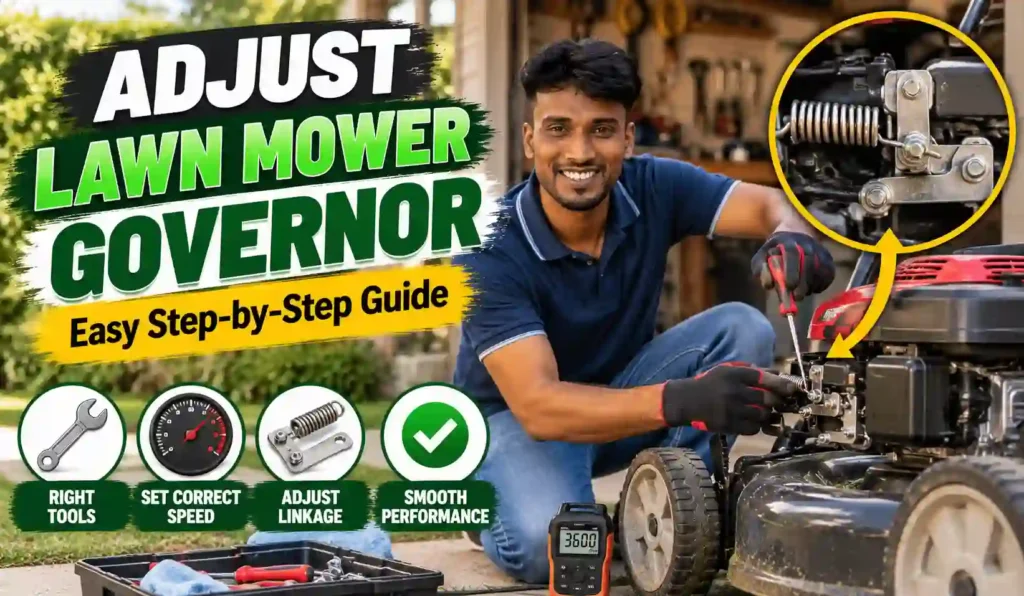
Quick Answer: How to Adjust a Lawn Mower Governor
To adjust lawn mower governor linkage, pull the spark plug wire, loosen the clamp nut on the governor arm, and hold the throttle wide open. Turn the governor shaft to its stop in the same direction the arm traveled, then tighten the nut. Finally, run the engine and bend the spring tang until top no-load speed matches your engine’s rated number.
What You Need to Adjust Lawn Mower Governor Settings
You need basic hand tools and one measuring tool. A wrench or socket, needle-nose pliers, a screwdriver, and a tachometer cover almost every job. Gather them first so you never leave the mower half apart while you hunt for a tool.
Tools
- A wrench or socket that fits the governor arm clamp nut (the size varies by engine)
- Needle-nose pliers for moving spring ends and bending the spring tang
- A flat-head and a Phillips screwdriver for the air filter cover and cable bracket
- A digital tachometer, either the clip-on type that reads through the spark plug wire or an optical type
- Safety glasses and work gloves
Parts
- A replacement governor spring, only if yours is stretched, rusty, or damaged
- A fresh air filter, if the current one is dirty, since you will remove it during the job
Materials
- Your engine’s model, type, and code numbers, plus the owner’s manual if you have it
- Shop rags and carburetor cleaner for wiping around the linkage
- A phone camera or paint marker to record where parts sit before you move them
Safety First: Rules for Working on Engine Speed
An engine that runs faster than its rating can throw parts, so safety comes before the first wrench turn. Disconnect the spark plug wire, work on a cool engine, and keep your hands away from the blade whenever the engine runs. Never push engine speed past the rated limit, even for a few seconds. Follow these rules every time you adjust lawn mower governor parts.
- Pull the spark plug wire off the plug and tuck it where it cannot touch the plug by accident.
- Let the engine cool until the muffler is safe to touch. A hot muffler causes burns fast.
- Work and test outdoors, or with the garage door fully open. Engine exhaust carries carbon monoxide.
- Wear safety glasses. Governor springs can slip off a hook and snap back.
- Park on flat ground with the area around the deck clear of kids, pets, and loose tools.
- Keep hands and feet away from the deck any time the engine is running.
Over-speeding is the biggest danger in this job. Small-engine service guidance warns that an engine running past its speed limit can break the magnet on the flywheel into many pieces that fly out at high speed. That is why you set speed with a tachometer instead of by ear.
Before You Adjust Lawn Mower Governor Settings: Quick Checks
Confirm three things before you touch the governor: which type you have, what top speed your engine is rated for, and whether the real fault is a dirty carburetor. Many surging problems have nothing to do with the governor. Ten minutes of checking can save an hour of wrong adjustments.
How to Tell a Mechanical Governor From an Air Vane Governor
A governor works like cruise control. It senses engine speed and opens or closes the throttle to hold that speed as the load changes. Engines use one of two designs, and the design decides which steps below apply to you.
| Governor Type | How It Senses Speed | What You See on the Engine | Common Fault |
|---|---|---|---|
| Mechanical (flyweight) | Weights and a gear spin inside the crankcase and push on a shaft | An arm clamped to a small shaft that sticks out of the engine block | Loose clamp nut, or broken plastic parts inside |
| Air vane (pneumatic) | A thin metal or plastic vane moves in the air stream from the flywheel | A vane near the flywheel, linked to the throttle by a spring | Blocked cooling fins, bent vane, wrong spring hole |
Both types use a spring that pulls the throttle open. The spring tension sets the speed you get when you adjust lawn mower governor settings. Your manual tells you which type your engine has.
Find Your Engine’s Rated Top No-Load Speed
Top no-load speed is how fast the engine spins at full throttle with the blade spinning freely and nothing cutting. The right number differs by engine. Look it up using the model, type, and code numbers stamped on the engine, then match it in the owner’s manual or the maker’s parts lookup.
Small-engine service guidance puts many mower engines somewhere between roughly 2,800 and 3,600 RPM at no load. One engine can sit near 3,300 while another is rated higher. Treat any range in an article, this one included, as a rough guide and use the number for your exact engine.
Rule Out the Carburetor First
A dirty or lean carburetor can mimic a bad governor. With the engine running, hold the linkage steady by hand. If the surging stops, the problem sits in the governor side or the linkage. If the engine still hunts, the carburetor is the likelier cause.
Service guidance also links high RPM to a carburetor that runs lean. A plugged idle circuit and worn throttle linkage show up as surging more often than a faulty governor does. Clean the carburetor first if the mower has sat with old fuel.
Step 1: Stop the Engine and Disconnect the Spark Plug Wire
Shut the engine off, let it cool, and pull the spark plug wire off the plug. This step stops the engine from starting while you adjust lawn mower governor parts near the linkage. It takes under a minute and prevents the most serious injuries in this job.
Close the fuel valve if your mower has one. Set the mower on level ground.
Pro tip: Slide the wire into a clean rag and tuck it behind the handle so it cannot spring back onto the plug.
Step 2: Clean the Engine and Remove the Air Filter Cover
Wipe dirt and grass from the carburetor and governor area, then remove the air filter cover and filter. This exposes the throttle linkage and spring you need to adjust lawn mower governor settings. Debris on the linkage can stop parts from moving freely and give you false readings.
Use a screwdriver for the cover screws or clips. Set the filter aside somewhere clean.
If the bracket that holds the throttle cable blocks your view, remove it too and note where it goes.
Common mistake: Brushing dirt into the carburetor opening. Cover the opening with a clean rag while you clean nearby.
Step 3: Photograph the Linkage and Spring Position
Take clear photos of the governor arm, the spring, the throttle cable, and every hole the spring hooks into. Governor arms often have several holes, and the one your spring sits in changes how the engine behaves. A photo lets you return to the starting setup in seconds.
Take one wide photo and two close-ups from different angles. Mark the arm and shaft with a paint marker if you can.
Pro tip: Photograph the spring from the same angle you will view it later, so you can compare tension by eye.
Step 4: Inspect the Spring, Throttle Cable, and Linkage
Look for a stretched, rusty, bent, or unhooked spring, a frayed throttle cable, and loose or worn linkage joints. These parts move the throttle, so any slop here changes engine speed. Fix them before you adjust anything else.
Check these points:
- The spring has even coils and no gap or stretched section.
- The spring ends sit fully inside their hooks or holes.
- The linkage rod moves freely with no sticking and no sideways wobble.
- The throttle cable reaches wide open when you move the control to full speed.
Replace a stretched or rusty spring instead of bending it back into shape. Service guidance for engine makers says to buy a new spring when tension is wrong, not to cut or stretch the old one.
Common mistake: Cutting the spring shorter to raise speed. It changes spring strength in ways you cannot measure and often causes surging.
Step 5: Run the Resistance Check on the Governor Arm
With the engine off and the plug wire disconnected, unhook the throttle linkage from the governor arm and move the arm by hand. A healthy mechanical governor gives some spring-like resistance. An arm that flops with no resistance at all points to broken parts inside the engine.
If the arm moves with no resistance, stop here. Internal parts such as the plastic spool or gear can crack with age, and no attempt to adjust lawn mower governor linkage from outside fixes that. See the troubleshooting and professional-help sections below.
If you have an air vane engine, check that the vane swings freely and returns without sticking, then go to Step 10.
Pro tip: Hook the linkage back on in the exact way your photo shows before you move on.
Step 6: Loosen the Governor Arm Clamp Nut
To adjust lawn mower governor linkage, find the nut or screw that clamps the governor arm to the shaft, and loosen it just enough that the arm turns on the shaft by hand. Do not take the nut off. You want the arm and shaft to move independently for the next step.
A snug-but-loose fit is right. If the arm slides off the shaft, you loosened too far, and you should back up and refit it.
Common mistake: Removing the nut completely, which lets the arm drop and makes it hard to restore the spline position.
Step 7: Hold the Throttle Wide Open and Turn the Shaft to Its Stop
Push the throttle lever on the carburetor to wide open and hold it there. While you hold it, turn the governor shaft as far as it will go in the same direction the arm moved to open the throttle. This is the core move when you adjust lawn mower governor linkage. It takes all the free play out of the system so the governor has its full range.
Direction depends on the engine and on how the shaft sits, so do not rely on memory. On many horizontal-shaft engines the shaft ends up turning clockwise, and on many vertical-shaft engines it often turns counterclockwise. Watch which way the arm travels, and match it.
You need two hands for this, or a helper. Hold the throttle open with one hand and turn the shaft with pliers or a screwdriver in the other.
Common mistake: Turning the shaft the wrong way. The engine then runs with too little throttle opening and feels weak under load.
Step 8: Tighten the Clamp Nut and Check Free Movement
While you keep the throttle wide open and the shaft at its stop, tighten the clamp nut firmly. Then release the throttle and move it from idle to full open a few times. It should travel freely and spring back to near closed without binding.
This finishes the part of the job that lets you adjust lawn mower governor linkage correctly. Snug is enough. Overtightening can strip the threads or crack the arm.
If the throttle sticks or feels stiff, loosen the nut and repeat Step 7, making sure both the throttle and the shaft stayed at their limits.
Pro tip: Mark the tightened nut and arm with a paint dot. If the dot ever splits, you will know something moved.
Step 9: Reconnect the Linkage and Refit the Air Filter
After you adjust lawn mower governor linkage, hook it back onto the governor arm, set the spring in its original hole, and refit the air filter, cover, and throttle cable bracket. Compare each part with your photos. Putting the spring in a different hole changes how the engine responds, so stay with the original for now.
Reinstall the filter before you start the engine. Running without a filter lets dirt in and can also change airflow past an air vane governor.
Common mistake: Leaving the air filter off for the test run. Dirt gets in fast, and an air vane governor reads airflow differently without the filter.
Step 10: Start the Engine, Warm It Up, and Measure No-Load Speed
Reconnect the spark plug wire, clip the tachometer on, and start the engine on level ground outdoors. Let it run about five minutes so it reaches normal operating temperature. Then move the throttle to full speed with no load and read the tachometer.
Measuring is the only reliable way to adjust lawn mower governor speed. Compare the reading with your engine’s rated top no-load speed. One user on a mower forum found a reading near 3,800 RPM and brought it down to 3,600 for a smoother sound. That shows how far off an engine can sit without anyone noticing by ear.
A reading within the rated range means you are done with speed. A reading well above rated speed means shut the engine off right away and go to Step 11 to lower it. A low reading also goes to Step 11.
Pro tip: Take three readings at full throttle and use the middle one. Tachometers can jump when the engine hunts.
Step 11: Adjust Lawn Mower Governor Top Speed by Bending the Spring Tang
Stop the engine and bend the tang that the spring hooks onto, a small amount at a time. More spring tension raises top speed and less tension lowers it. Use needle-nose pliers, restart, and read the tachometer again after each small change.
- To raise speed, move the tang so the spring pulls harder on the throttle.
- To lower speed, move the tang so the spring relaxes.
- Change one thing per test. Bend, restart, measure, repeat.
Some engines use a speed adjustment screw or lever instead of a bendable tang. If yours does, turn it in small steps and re-test the same way.
Do not use the spring hole to set speed. Moving the spring to a hole farther from the shaft makes the governor react less sharply. That is a surge fix, not a speed fix.
Common mistake: Bending the tang a big amount in one go. A few degrees of bend can shift speed by hundreds of RPM.
Step 12: Test Under Load and Re-Check Everything
Run the mower on grass and engage the blade. The engine should dip for a moment and then recover to a steady note. Then recheck no-load speed with the tachometer and confirm the clamp nut, spring, and cable are still in place.
Watch for these signs during the test:
- Smooth recovery means the governor is working.
- Surging up and down means go to the troubleshooting section.
- Bogging that never recovers means tension is too low or throttle travel is limited.
Cut a small patch first, then a longer one. A steady note under load is the sign that you did adjust lawn mower governor settings correctly. Shut the engine off and look the linkage over once more when you finish.
Pro tip: Test on thick grass for the load check. Thin grass hides a weak governor.
Common Problems When You Adjust Lawn Mower Governor Linkage
The table below lists the problems that come up most after a governor adjustment, what usually causes each one, and the fastest fix. Check the cheap causes first. A loose nut or a plugged carburetor passage is far more common than a failed governor.
| Problem | Likely Cause | Solution |
|---|---|---|
| Engine surges up and down | Plugged carburetor idle circuit, worn linkage, or spring in an over-sensitive hole | Clean the carburetor, replace worn linkage, then move the spring to a hole farther from the shaft |
| Engine races at full throttle with no load | Loose clamp nut, unhooked spring, or broken parts inside the engine | Redo Steps 6 to 8, confirm the spring, and see a shop if the arm has no resistance |
| Engine bogs when the blade engages | Spring tension too low, or throttle not reaching wide open | Reset top no-load speed and confirm full throttle travel |
| High speed started right after carburetor work | Governor arm disturbed during the job, or a lean mixture | Redo the static adjustment, then recheck the carburetor |
| Over-speeding on an air vane engine | Clogged cooling fins or a bent vane | Clean the fins and straighten or replace the vane |
| Throttle never reaches wide open | Slack in the throttle cable or a mispositioned bracket | Adjust the cable until the control matches full carburetor travel |
Troubleshooting: What to Do If You Adjust Lawn Mower Governor Settings and Nothing Changes
If the fault remains after the static reset and tachometer check, it usually falls into one of three patterns. Match your symptom below and fix the cause in order, starting with the cheapest check. Most of these come down to airflow, fuel, or a worn part rather than the governor setting.
The Engine Still Surges
Surging means the engine speeds up and slows down on its own. Service guidance says this is usually a partly plugged carburetor or worn linkage, not the governor itself.
- Clean the carburetor, paying attention to the idle circuit.
- Check linkage joints for slop and replace worn pieces.
- Move the spring to a hole farther from the shaft to make the governor less sensitive, or fit the spring the manual calls for.
The Engine Still Over-Speeds
If speed still climbs past the rating, the spring may be unhooked or the wrong one, or something inside the engine may be failing.
- Confirm the spring ends are seated and the spring matches your parts list.
- On an air vane engine, clean the cooling fins and check the vane. Debris blocks airflow and lets speed run up, since the spring is set for full airflow.
- Repeat the resistance check from Step 5. No resistance means internal damage.
The Engine Has No Power Under Load
If the engine idles well and then dies when you cut, the governor may not be opening the throttle enough.
- Repeat Step 7 and make sure both the throttle and shaft were at their limits.
- Check that the spring tension gives the rated top no-load speed.
- Replace a clogged air filter and check for stale fuel.
Expert Tips to Adjust Lawn Mower Governor Settings That Stay Put
These habits keep the setting from drifting and help you catch trouble early. Most of them cost nothing and take a few minutes each season.
- Take a photo of the spring hole and arm position before every carburetor or linkage job, so you can restore the setup exactly.
- Each time you adjust lawn mower governor settings, change one thing at a time and measure with the tachometer after each, so you always know which change did what.
- Clean the cooling fins and the area around the vane at the start of each mowing season, because an air vane governor reads airflow.
- Replace a stretched spring with the correct part instead of bending a worn one back into shape.
- Keep top speed within the rated number. Faster blade speed adds stress to the engine, the belts, and the drive parts.
When to Call a Professional
Stop and take the mower to a repair shop if the engine runs away and you cannot adjust lawn mower governor speed from outside. Opening the engine to replace internal governor parts is a bigger job. Most homeowners do not have the tools or manual for it.
Signs you have reached that point:
- The governor arm moves freely with no resistance when the linkage is off.
- The engine races to full speed immediately after you set the linkage correctly.
- You find plastic bits or metal fragments in the oil.
- The engine will not hold a steady speed even with a new spring and a clean carburetor.
- The repair would need you to split the crankcase or pull the flywheel.
Over-speeding can destroy an engine fast, so do not keep running one that will not hold its speed.
FAQs
How long does it take to adjust lawn mower governor settings?
Plan on 20 to 30 minutes for a first-time job, based on a MowerInsights estimate. The static reset takes a few minutes. The rest of the time goes to cleaning, warming up the engine, and taking tachometer readings.
Can I skip the static adjustment and only bend the spring tang?
Skip it only if the governor arm was never removed or moved. The static adjustment removes free play between the arm and shaft, and bending the tang cannot correct that. If the arm was off during carburetor work, do the static reset first.
What if the mower still surges or races after I adjust lawn mower governor settings?
Check the carburetor, the linkage, and the spring next, then adjust lawn mower governor linkage again if needed. Surging often traces back to a plugged idle circuit or worn linkage. Racing that survives a correct static reset can point to broken parts inside the engine, which needs a shop.
What RPM should a lawn mower run at?
It depends on the engine. Many mower engines fall between about 2,800 and 3,600 RPM at no load, but each engine has its own rated number. Look up your model, type, and code in the owner’s manual or the maker’s parts lookup.
Is it safe to raise governor speed for more power?
No. Raising speed above the rating adds stress to the engine, the blade, and the drive parts. It can also cause parts to fail at high speed. If the mower lacks power, look at the carburetor, air filter, fuel, and blade sharpness first.
How do I know if my mower has an air vane or a mechanical governor?
Look for a clamped arm on a shaft that comes out of the engine block, which marks a mechanical governor. A thin vane close to the flywheel marks an air vane governor. Your owner’s manual or the engine maker’s parts diagram confirms the type.
Final Takeaway
To adjust lawn mower governor settings, do two jobs in order. First reset the static linkage with the throttle wide open and the shaft at its stop, then set top no-load speed with a tachometer by bending the spring tang. Rule out the carburetor, keep the speed within your engine’s rating, and stop if the arm has no resistance. A mower that holds steady speed under load is a safer and longer-lasting mower.
Why Trust This Guide
The shop experience behind this guide comes from Siddik Kazi’s lawn mower repair service in Milan, Italy. Reviewed by Siddik Kazi.
Sources and methodology: this guide on how to adjust lawn mower governor settings draws on engine manufacturers’ published support guidance, small-engine parts and service documentation, and a review of existing repair guides. RPM ranges are general figures, so confirm the exact number for your engine in its manual.