A riding mower steering wheel hard to turn is a common problem, and it usually has a simple cause. Most stiff steering comes from low tire pressure, dry parts, or dirt packed around the steering linkage. This guide shows you how to find the cause and fix it in the right order.
Quick Answer
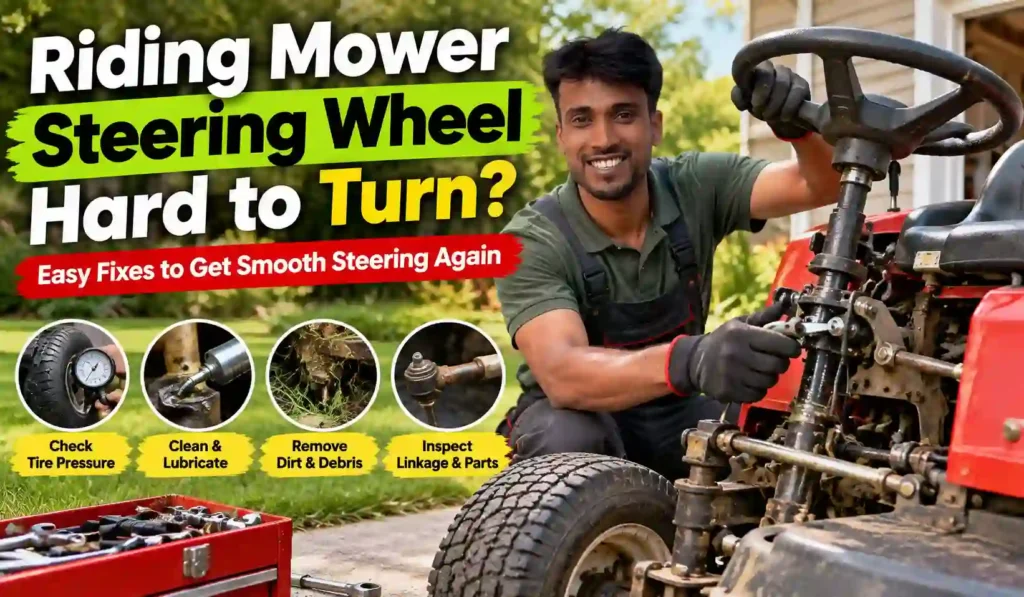
A riding mower steering wheel that is hard to turn is most often caused by low front tire pressure, a dry steering shaft or sector gear, packed-in grass and dirt, or a bent or worn linkage. Check tire pressure first, then clean and grease every steering pivot. Next, lift the front end and turn the wheel. If it is still stiff in the air, the steering parts are binding. If it turns easily in the air, the problem is tire grip, tire pressure, or weight on the front wheels. Some larger mowers also have hydraulic power steering, which needs the right fluid level and a clean filter.
Why Is My Riding Mower Steering Wheel Hard to Turn?
Your riding mower steering wheel gets hard to turn when something adds friction between the wheel and the front tires. The steering wheel turns a shaft. The shaft turns a small gear, called a pinion, that meshes with a larger curved gear, called the sector gear. The sector gear moves a linkage and tie rods that swing the front wheels.
Friction can build up at any of these points. Dry metal, packed dirt, worn bushings, and soft tires all make the wheel feel heavy.
The Two-Minute Test That Narrows It Down
Do this before you touch a wrench. Park on level ground, set the parking brake, turn the engine off, and remove the key. Raise the front end with a jack and support it on jack stands. Never work under a mower held up by a jack alone.
Now turn the steering wheel from stop to stop.
- Stiff even with the wheels off the ground: the problem is inside the steering system. Think dry shaft, bad gear mesh, binding linkage, or worn bushings.
- Easy in the air but heavy on grass: the problem is the load on the tires. Think low pressure, worn or hard tires, or a front end that carries too little or too much weight.
Many owners describe exactly this: steering that feels light when jacked up and heavy once the mower is back on turf. That pattern points away from the steering parts and toward the tires.
Main Causes of Stiff Steering
Eight causes account for most cases of a riding mower steering wheel hard to turn. They are listed here from easiest to check to hardest.
Low Front Tire Pressure
Soft front tires create a large, sticky contact patch, and turning them takes real effort. Riding mower tires run at much lower pressure than car tires, so a quick look is not enough. Read the recommended pressure on the tire sidewall or in the owner’s manual and check each tire with a gauge. Fill them to that number.
Dry Steering Shaft, Pivots, and Spindles
Dry metal on metal is the most common reason for a stiff wheel on an older mower. Look along the steering shaft, at the sector gear, at the front spindles, and at the axle pivot for grease fittings. Repair advice for this problem is consistent: pump grease into every fitting. Some newer mowers have no fittings at all. On those, spray lubricant on the pivots and work multipurpose grease onto the gear teeth by hand.
Packed Dirt, Leaves, and Grass
Wet clippings dry into a hard crust around the sector gear and tie-rod joints. That crust acts like sand in a hinge. Scrape the area clean with a stiff brush and a screwdriver. Look closely around the lower end of the steering shaft, since debris collects there first.
A Worn or Poorly Meshed Sector Gear
The pinion teeth must sit snug in the sector gear grooves. When the mesh is off, the steering can feel loose in one spot and locked in another. One owner described the steering becoming “almost non responsive” and found the shaft teeth not seating in the gear plate. Look for rounded teeth, missing material, or a shaft that rocks up and down. A badly worn gear or pinion has to be replaced.
Bent or Binding Linkage
A hit from a curb, root, or stump can bend the drag link or a tie rod. Old holes can also wear oval, and bent rods can cross over each other and lock. A loose bolt hanging down can snag the linkage too. Sight along each rod and look for kinks, and check every nut and bolt for tightness.
Worn Bushings and Steering Shaft Guides
Plastic bushings wear down and let parts shift out of line. The shaft then rubs the frame or binds in its guide. Check the bushings at the shaft and at each front spindle. They are inexpensive and bolt on easily.
Worn, Hard, or Smooth Front Tires
Old front tires can harden and lose their tread. One owner of a steering-wheel zero-turn cleaned and greased the whole front end, which cured the stiff steering. He then noticed that the hard, smooth tires slid instead of gripping in sharp turns. If your tires are bald or cracked, new ones can fix both stiffness and sliding.
Hydraulic Power Steering Problems
Some larger mowers and garden tractors use hydraulic power steering. On these models, stiff steering often means low or dirty hydraulic fluid. A technician answering one owner’s question on a 12-year-old mower said that steering and deck lift problems at the same time point to lost hydraulic pressure. The advice was to change the oil and filter before blaming the pump. Check your manual to see if your mower has this system.
Step-by-Step Solution
Follow these steps in order. Each one costs less time and money than the next.
- Make the mower safe. Park on level ground, set the parking brake, shut off the engine, and pull the key. Let the engine cool.
- Check tire pressure. Use a gauge on all four tires and fill each to the number on the sidewall or in the manual.
- Clean the steering area. Brush away grass, leaves, and dirt around the shaft, sector gear, tie rods, and spindles.
- Grease every fitting. Pump grease into each zerk fitting until fresh grease shows. On mowers without fittings, spray lube on pivots and apply multipurpose grease to the gear teeth.
- Lift the front end. Use a jack and jack stands, then turn the wheel stop to stop. Note whether it is stiff in the air.
- Spin each front wheel by hand. Both wheels should turn freely. A wheel that drags points to a dry or damaged spindle or hub.
- Inspect the linkage. Look for bends, oval holes, loose bolts, and rods that touch the frame.
- Inspect the gear mesh. Turn the wheel slowly and watch the pinion and sector gear. Look for skipped teeth, gaps, or a shaft that lifts away from the gear.
- Replace worn parts. Swap bushings, tie-rod ends, or gears that show play or damage. Lubricate the new parts before installing them.
- Check hydraulic fluid if equipped. Verify the fluid level and replace the filter if it has never been changed.
- Test drive slowly. Lower the mower, start it, and steer on a flat area at low speed. If the effort is still high, repeat the air test.
Important Tips
- Work the steering wheel back and forth several times after greasing so the grease spreads into the gear teeth.
- Turn while the mower is rolling, not parked. Turning a stopped mower on grass takes the most effort and wears the parts fastest.
- Grease fittings on a regular schedule, such as once a month during mowing season or at least twice a year.
- Keep wet grass off the steering area after each mow. A quick spray of air or a brush stops the buildup.
- Replace parts as a set when you can. Several joints usually wear at the same time, so fixing only one may leave play.
Common Mistakes
- Skipping the tire gauge. Tires that look fine can be several pounds low.
- Spraying only the top of the shaft. The gear teeth and spindles are where friction builds.
- Forcing a stuck wheel. Jerking the wheel bends linkage and strips gear teeth.
- Ignoring noise. Clunks and clicks mean loose or worn parts that will get worse.
- Overlooking the hydraulic filter. On power steering models, old fluid can mimic a failing pump.
When to Get Professional Help
Call a technician if the steering is stiff after greasing and tire checks, and you also see any of these signs:
- Hydraulic fluid leaking or foaming
- A whining pump or hoses that look cracked
- A sector gear with missing teeth
- A bent frame or steering column
- Steering that goes slack or locks without warning
A mower that does not turn when you ask it to is a danger on slopes and near obstacles. Stop mowing until it is fixed.
Related Questions
Why is my riding mower steering hard to turn only when it is not moving?
Turning with the mower stopped puts the most force on the tires and gears. Soft tires, dry spindles, and a worn sector gear all make it worse. Roll the mower slowly while turning, and fix the tire pressure and grease points to cut the effort.
Why does my riding mower steering feel stuck on sharp turns?
A bent linkage, a loose bolt snagging a rod, or a dry gear can cause this. Check for linkage that crosses over itself at full lock. Also check the front tires, since worn tires can add to the problem.
Why is my riding mower hard to steer in one direction?
A wheel that is easy one way and hard the other usually points to a binding spindle, a damaged tooth on the sector gear, or a limit stop that is out of place. On hydraulic models, it can also point to a fluid or pressure problem.
Can a riding mower steering wheel be hard to turn from a bad tie rod?
Yes. A bent tie rod or a seized end can bind the front wheels. Rock each wheel by hand and watch the joint for movement or binding.
FAQs
How much does it cost to fix a riding mower steering wheel that is hard to turn?
Most fixes cost very little. Grease, a tire gauge, and cleaning cost almost nothing. Tie-rod ends and bushings are inexpensive parts. A sector gear or a hydraulic pump costs more, and shop labor adds to the bill. Prices vary by brand and model.
Can I still mow with hard steering?
You can, but you should not. Stiff steering reduces your control on hills and near obstacles. Fix the cause first.
Should I use grease or spray lubricant?
Use grease on gear teeth and fittings, since it stays in place. Use spray lubricant on small pivots and rod ends. Do not use only spray on the gears, as it runs off quickly.
How often should I grease my riding mower steering?
Grease each fitting about once a month in mowing season, or at least twice a year. Check your owner’s manual for the exact schedule for your model.
Is hard steering normal on a mower without power steering?
Some effort is normal, especially when turning while parked. Steering that gets harder over time, or that suddenly changes, is not normal and needs a check.
Can wet grass make steering hard?
Yes. Wet clippings pack into the linkage and gear area, and wet or soft ground reduces tire grip. Clean the underside after mowing and avoid sharp turns on soggy turf.
Final Answer
A riding mower steering wheel hard to turn comes down to a short list: low tire pressure, dry or dirty steering parts, a worn gear, a bent linkage, or hydraulic trouble on power steering models. Check the tires, clean and grease the system, and run the jack test to see where the friction lives. Replace worn parts and have a technician look at anything hydraulic or structural.
Why Trust This Guide
MowerInsights.com is run by Siddik Kazi, who repairs and services lawn mowers at his own workshop. This guide is reviewed by Siddik Kazi. It draws on manufacturer-style repair guidance, analysis of owner feedback from repair forums, and a review of existing coverage on the topic.