When a riding mower won’t start just clicks, the problem is almost always in the battery or the starter circuit, not the engine. You turn the key, hear one click or a fast ticking sound, and nothing turns over. The click is useful news, because it proves the key signal is reaching the starter circuit. Many fixes cost under $100, and a basic multimeter can often find the fault in about 15 minutes.
Quick Answer
If your riding mower won’t start just clicks, the most likely cause is a weak battery or a dirty, loose battery connection. Rapid clicking points to low battery power. One loud click points to a bad starter solenoid or starter motor. Charge and test the battery first, clean the terminals, then test the solenoid and starter.
Why a Riding Mower Won’t Start Just Clicks: What the Sound Means
The click is the starter solenoid switching on. A solenoid is a heavy-duty relay, an electric switch that a small current flips to let a large current through. Think of it as a big light switch flipped by a tiny remote. The solenoid needs very little power to click, but the starter motor needs a lot to spin the engine. A weak battery can do the first job but not the second.
One Click vs. Rapid Clicking: What Each Sound Means
The sound pattern narrows the cause before you touch a tool. Use this table to decide where to start.
| What you hear | What it usually means | Check first |
|---|---|---|
| Rapid clicking or chatter | The battery is too weak or a connection is bad. The solenoid pulls in, voltage drops, it lets go, and the cycle repeats. | Battery voltage and terminals |
| One solid click, headlights stay bright | The solenoid contacts or the starter motor failed. | Solenoid output, then starter |
| One click, headlights dim hard | The battery shows voltage but cannot deliver current, or a cable has high resistance. | Load test and cables |
| Clicks only on cold mornings | An aging battery is losing cranking power. | Battery load test |
| No click at all | The start signal is blocked, often by a seat, brake, or blade switch. | A different problem, covered in a separate guide |
Main Reasons Your Riding Mower Won’t Start Just Clicks
A weak battery causes most clicking problems. Dirty or loose connections come next, then a failed solenoid, a worn starter, and, rarely, a locked engine. Check them in that order, because the cheap and fast tests come first.
Weak or Dead Battery
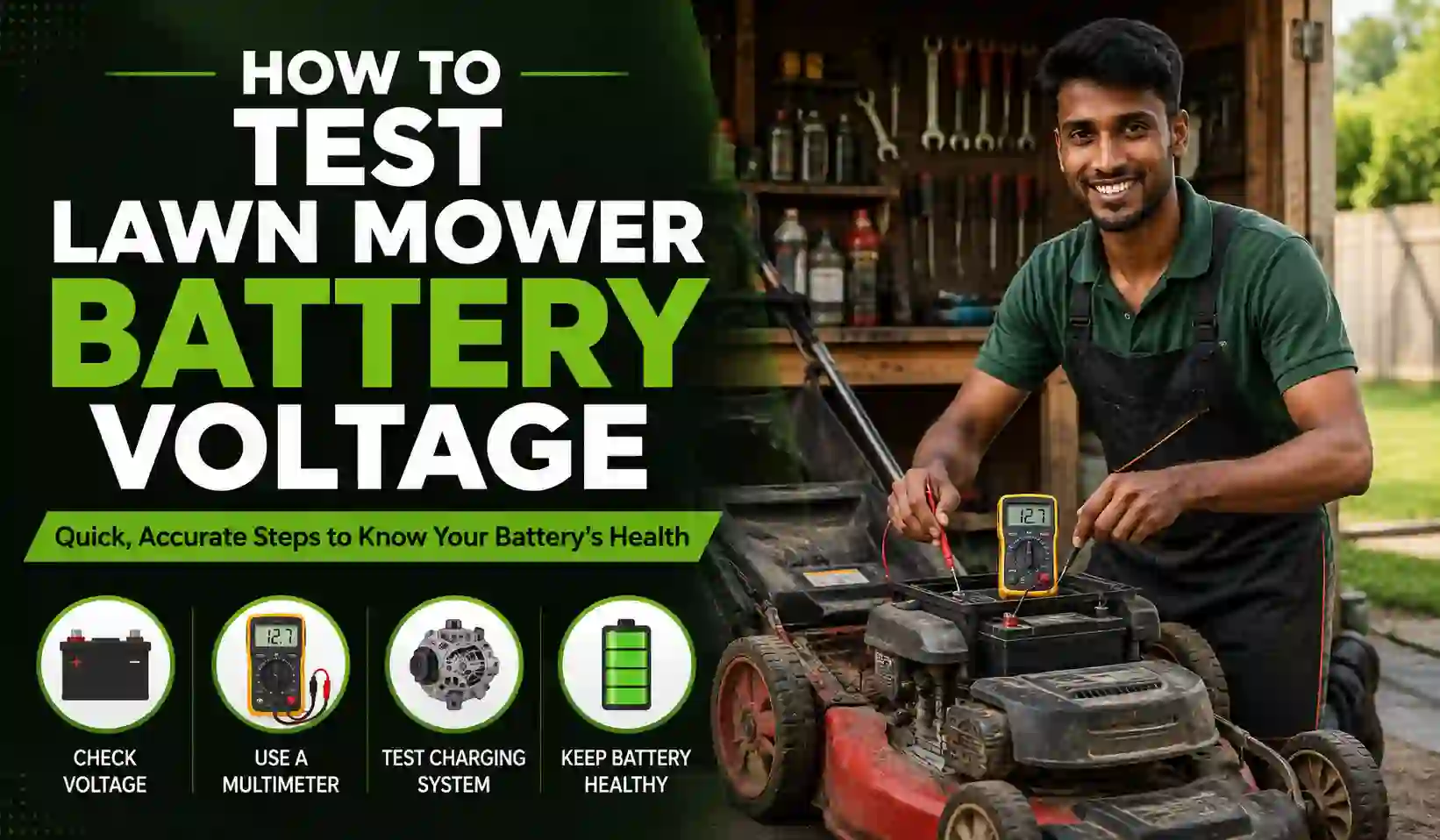
A battery that reads under 12 volts at rest is the top suspect. Mower batteries sit unused for months and slowly lose charge. Here is how to read the meter:
- A full battery reads about 12.6 volts at the posts.
- A reading below 12.0 volts means you should charge it fully and test again.
- A battery that stays near 11.5 volts after charging likely has a dead cell and needs replacing.
Dirty, Loose, or Damaged Battery Connections
Corrosion or a loose clamp blocks current even when the battery itself is good. Look for white or green crust on the posts and clamps. Grab each clamp and try to twist it by hand. Also check the cables for cracked insulation, because mice sometimes chew them over winter.
Bad Ground Connection
The negative cable must bolt to clean, bare metal on the frame or engine. Paint, rust, or dirt under that cable end creates the same clicking symptom. A mower can have a new battery and still click if the ground is poor.
Failed Starter Solenoid
If the battery tests fine and you hear one click, the solenoid is the next suspect. Its internal contacts burn over time and stop passing current to the starter. On some engines the solenoid is built into the starter. On others it is a small separate cylinder, often near the battery or under the seat.
Worn or Binding Starter Motor
A starter with worn brushes, worn bearings, or a sticking gear can click without turning. The gear on the starter can also bind against the flywheel and lock the two together. You can test for this by hand, as the steps below show.
Locked-Up Engine
If the starter gets full power but the engine will not move, the engine itself may be locked. One cause is hydro-lock, which happens when a leaking carburetor needle lets gas fill the cylinder so the piston cannot move. Signs include a high oil level, a gas smell in the oil, and white smoke from the muffler. A seized engine is the other cause, and it is rare.
Step-by-Step Fix When Your Riding Mower Won’t Start Just Clicks
Work through these eight steps in order. Each one takes a few minutes, and many clicking problems end by step 4. You will need a multimeter, a wire brush, baking soda, petroleum jelly, a socket set, a battery charger, work gloves, and safety goggles.
- Park and power down. Set the parking brake, turn the blades off, and remove the key. Lift the seat or hood to reach the battery. Keep sparks and flames away from the fuel tank.
- Measure battery voltage. Set the multimeter to DC volts. Touch the red probe to the positive post and the black probe to the negative post, not the cable clamps. Write down the reading.
- Charge the battery, then load test it. Charge it fully on a real battery charger, then measure again. Next, have a helper turn the key while you watch the meter. The voltage should stay above about 9.5 volts while cranking. If it falls below 9 volts, the battery is failing and needs replacing.
- Clean and tighten the connections. Disconnect the negative cable first, then the positive. Scrub the posts and clamps with a wire brush. Use baking soda mixed with a little water on any acid crust, and wear gloves and goggles. Wipe dry, coat the posts with a thin layer of petroleum jelly, and reconnect the positive cable first. Tighten both until the clamps do not move. Then unbolt the ground cable end, sand the contact point to bare metal, and bolt it back on.
- Test the cables for voltage loss. Touch the red probe to the red post on the solenoid and the black probe to the battery’s negative post. You should read more than 12 volts. Next, pull the spark plug wire so the engine cannot start. Put the red probe on the solenoid’s starter-side post and the black probe on the starter’s cable stud, then hold the key in the start position. A reading above 1 volt means the starter cable is damaged and needs replacing. Never let one probe touch both solenoid posts at the same time, or it will spark hard.
- Test the solenoid. Disconnect the starter cable from the solenoid’s starter-side post and put the red probe on that post. Clip the black probe to the negative battery post. Hold the key in the start position and listen for the click. If the meter shows no voltage when the solenoid clicks, replace the solenoid. Reconnect the cable afterward.
- Check that the engine turns by hand. Keep the spark plug wire off. Remove the plug from the flywheel screen, then turn the flywheel bolt clockwise with a socket wrench. If it will not move, stop and see the professional help section below. Also pull the spark plug: if gas pours out of the hole, you have hydro-lock. Crank with the plug out to clear the fuel, then fix the carburetor needle and change the oil.
- Confirm and replace the starter. If the battery, cables, and solenoid all pass and the engine turns freely by hand, the starter motor is the failed part. Replace it.
What the Parts Typically Cost
Here are typical US price ranges for the three parts most often behind a clicking mower.
| Part | Typical cost |
|---|---|
| Lawn and garden battery | $40 to $80 |
| Starter solenoid | $15 to $40 |
| Rebuilt starter motor | $80 to $150 |
Prices may vary by retailer and change over time.
Important Tips Before You Buy Any Parts
Test first, replace second. Most clicking problems come from the cheapest parts in the circuit, so the battery and cables deserve the first hour of your attention.
- Jump-start the mower if you have a 12-volt car nearby. If it starts, the battery needs attention, because the click-only fault is usually a battery problem.
- To jump-start, connect the car’s positive clamp to the mower’s positive post. Then clamp the car’s negative lead to bare metal on the mower, not the battery. Remove the cables in reverse order after the engine runs.
- Keep a smart charger on the battery over winter. A battery that is fully drained sometimes will not recover.
- Check the battery for leaks before any jump-start. Replace a leaking battery instead of jump-starting it.
- Service the cables at the start of every season. Mowers vibrate heavily, and clamps loosen over time.
Common Mistakes
The most common mistake when a riding mower won’t start just clicks is buying a starter before testing anything. Starters fail less often than batteries and cables, and they cost the most.
- Measuring voltage at the cable clamps instead of the battery posts hides a bad connection.
- Skipping the ground cable leaves a hidden fault that survives a new battery.
- Cranking the engine over and over drains whatever charge the battery has left.
- Jump-starting a swollen or leaking battery is a safety risk and fixes nothing.
When to Get Professional Help
Stop DIY work when the engine itself may be damaged, or when the wiring shows heat damage. Call a repair shop if any of these happen:
- The flywheel will not turn by hand.
- Gas keeps filling the cylinder after you fix the carburetor.
- A new solenoid and a new starter still only click.
- You smell burning, or see melted wires or smoke.
- The battery swells or leaks acid.
Related Questions
These are the questions riders ask most often after a riding mower won’t start just clicks.
Can you jump-start a riding mower that just clicks?
Yes. A flat battery is a more common fault than a bad starter, so a jump-start is a quick test. If the mower starts, replace or recharge the battery. If it still only clicks, move on to the solenoid and starter.
Why does my riding mower click once and not start?
One click means the solenoid switched on but the starter did not spin. The cause is usually a worn solenoid, a failed starter, or a bad ground. Test the solenoid output voltage first, as shown in step 6.
Why does my riding mower make a rapid clicking noise?
Rapid clicking means the battery cannot hold the solenoid in. The solenoid pulls in, voltage collapses, and it drops out again several times a second. Charge the battery and clean the terminals before testing anything else.
Can a bad alternator cause a riding mower to just click?
Yes, indirectly. A faulty voltage regulator or failed alternator diodes can overcharge or drain the battery over time. A damaged battery then clicks instead of cranking. If a new battery goes flat again within weeks, have the charging system checked.
FAQs
How much does it cost to fix a riding mower that just clicks?
Many repairs cost between $15 and $150 in parts. A battery runs about $40 to $80, a solenoid about $15 to $40, and a rebuilt starter about $80 to $150. A locked engine costs far more and is rare.
Can cold weather make a riding mower click and not start?
Yes. Cold lowers a battery’s cranking power, so an aging battery that worked in summer can fail on a chilly morning. If the clicking shows up mainly in cold weather, test the battery under load first.
Can a bad safety switch cause clicking?
Rarely. Seat, brake, and blade switches usually cause no click at all, because they block the start signal before it reaches the solenoid. If you hear clicking, the signal is already getting through.
How do I tell a bad starter from a bad solenoid?
Test the solenoid first. If it clicks but sends no voltage out, the solenoid is bad. If it sends full voltage and the engine turns freely by hand but the starter still does not spin, the starter motor is bad.
Final Answer
When a riding mower won’t start just clicks, start with the battery. Charge it, load test it, and clean every connection, including the ground. If the clicking continues, test the solenoid, then the starter. Turn the engine by hand before replacing any part, so you know it is not locked.
Why Trust This Guide
MowerInsights.com is run by Siddik Kazi, who repairs and services lawn mowers at his shop in Milan, Italy. The order of checks here follows the faults that come up most often in a repair shop. Reviewed by Siddik Kazi.
Sources and Methodology: this guide draws on manufacturer service guidance, published repair-shop diagnostics, and standard 12-volt battery testing practice. Voltage thresholds and part prices are typical ranges, not guarantees. No hands-on testing is claimed in this version.