Quick Answer
A corded mower costs less. It weighs less. It never runs out of power. But the cord holds you back. Your yard must be small, about 460 m² (5,000 sq ft) or less. The cord can trip you. It can get cut by the blade too. A cordless mower has no cord. You can move free. It works well on yards up to 930 m² (10,000 sq ft) per charge. It costs more to buy. The battery wears out in five to eight years. Pick corded if your yard is small and flat. Pick cordless if your yard is big, has trees, or you just want to move free.
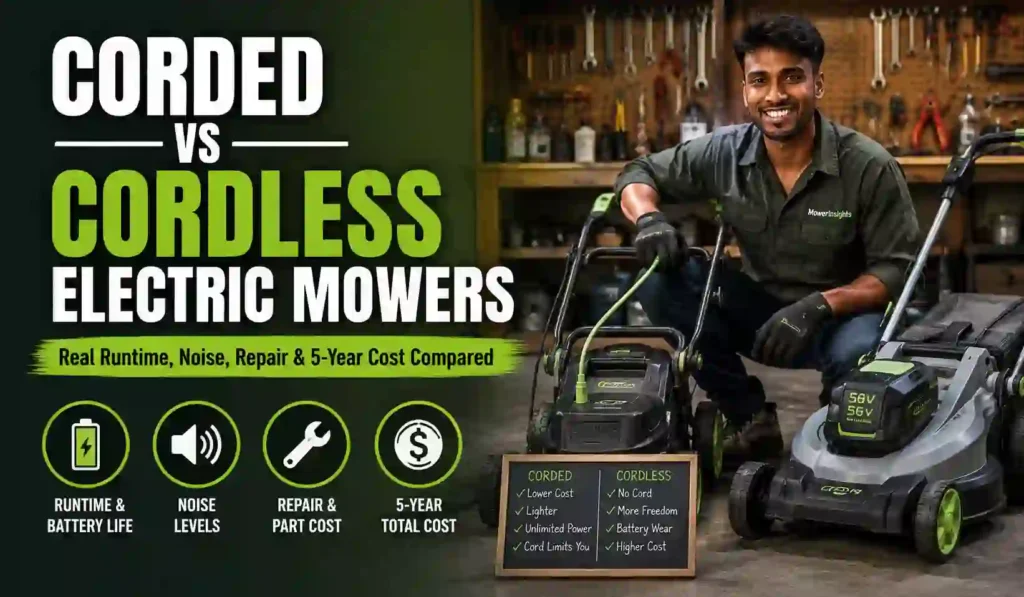
Corded vs Cordless: The Core Differences
The real gap is not just “has a cord or not.” It is how each mower gets and holds power. A corded mower pulls power from your wall. It never slows down. It never dies mid-mow.
A cordless mower runs on a battery pack. It lets you move free. But the battery has a limit. It also fades with age.
Both types skip the gas tank. Both skip oil changes. Both skip the pull-cord start. Both start with one push of a button. That is where the two paths split.
Comparison Table: Specs at a Glance
| Feature | Corded Electric | Cordless Electric |
|---|---|---|
| Power source | Wall plug (100-240V) | Battery pack (40V-80V) |
| Runtime | No limit | 30-60 min per charge |
| Yard size limit | Up to 460 m² (5,000 sq ft) | Up to 930 m² (10,000 sq ft) |
| Start price | $150-$300 | $300-$600 |
| Weight | 9-14 kg (20-30 lbs) | 14-20 kg (30-45 lbs) |
| Noise level | 75-80 dB | 78-85 dB |
| Battery life | Not needed | 5-8 years, then $150-$250 to swap |
| Charge time | Not needed | 1-2 hrs fast, 4 hrs slow |
| Best yard type | Small, open, near a plug | Any shape, big, with obstacles |
How Corded Electric Mowers Work
A corded mower plugs into a wall plug. You use a strong outdoor cord. The motor pulls power right through it. Cutting power never drops, even in thick grass.
In our shop, corded mowers come in the least. There is no battery to wear out. There is no fuel line to clog. The top issue we see is a cut cord. It is often from someone rolling the mower over it.
The catch is clear: you stay tied to a plug. Most corded mowers give you a 30-40 meter range (100-130 feet) with a rated cord. Go past that, and power starts to drop. That drop makes the motor weak.
Expert Tip: Use a 12-gauge outdoor cord. It should be rated for 15 amps or more. Thin cords cause power drop. That makes the motor work harder. It runs hot. We have opened more than one mower motor with burnt coils. The cause was a cord that was too thin.
How Cordless Electric Mowers Work
A cordless mower runs on a battery. It is the same base tech as a power drill or a phone, just bigger. You charge the pack. You snap it in. You mow with no cord to drag.
Runtime depends on the battery size and the grass. A 5.0Ah battery gives you 35-45 minutes on flat, dry grass. Thick or wet grass can cut that time by a third. The motor pulls more power to push through it.
Siddik’s test notes: on a mid-size 56V mower, he cut ankle-high grass after two weeks of rain. Runtime fell from a rated 45 minutes to about 28 minutes. The blade also slowed down twice. That is a clear sign the battery was pushed past its normal load.
Cordless mowers cost more up front. The battery is the reason. One 5.0Ah swap battery can cost $150-$220 on its own. That is close to half the price of a whole budget corded mower.
Best For X: Matching the Mower to Your Yard
- Best for small, flat yards under 460 m²: Corded. You will not run out of power. You will save $150-$300 up front.
- Best for yards with trees, beds, or fences: Cordless. A cord that wraps around trees gets old fast. A snagged cord can pull the blade near your feet.
- Best for renters or people who move a lot: Corded. It costs less. There is no battery to care for if it sits unused for a season.
- Best for bigger yards (700-930 m²): Cordless, with a spare battery. Swap packs mid-mow. This gets you past the runtime wall.
- Best budget pick: Corded. Basic corded mowers run $150-$200. A similar cordless model starts near $300.
- Best low-fuss pick: Cordless. No cord to wind up, store, or fix after it gets cut (this happens more than you think).
Head-to-Head Decision Logic
Use this simple rule to pick:
If your yard is under 460 m², is mostly flat, and has a plug within 40 meters of each corner, pick corded.
If your yard is 460 to 930 m², or has beds, trees, or fences that could tangle a cord, pick cordless.
If your yard is over 930 m², check if a cordless model can hold two batteries. If not, look at a gas mower or a riding mower. Two battery swaps still may not cover that much ground in one pass.
If you cut grass at a rental or a home you do not live at full time, corded is the safer pick for your wallet. You will not have to care for a battery you rarely use.
Total Cost of Ownership Over 5 Years
The price tag on day one is not the full story. Here is what each type costs over five years. This uses normal power rates and normal part swaps.
| Cost Factor | Corded Electric | Cordless Electric |
|---|---|---|
| Buy price | $200 (avg) | $450 (avg) |
| Power cost (5 yrs) | ~$15-$25 | ~$20-$35 (charge cost) |
| Cord swap | $20-$40 once | $0 |
| Battery swap | $0 | $150-$220 (near year 5-6) |
| Blade sharpen or swap | $30-$50 total | $30-$50 total |
| 5-Year Total (est.) | $265-$315 | $650-$755 |
The corded mower stays cheap through its whole life, not just at checkout. That gap matters most if you are on a tight budget. It also matters for a second home where the mower won’t get heavy use all year.
Common Repair Issues: What Breaks First
Corded mowers – top shop visits:
- A cut or worn power cord (often from rolling over it)
- Worn carbon brushes in the motor (a $10-$15 part, a 20-minute fix)
- A loose plug at the cord anchor clip
Cordless mowers – top shop visits:
- The battery will not hold a full charge (often a year 4-6 issue)
- Rust in the charge port from wet outdoor storage
- The motor board fails, often tied to mowing wet grass over and over
In our shop, cordless motor board fixes cost the most on electric mowers. Parts and labor often run $80-$150. Corded mower fixes are almost always under $40. The build is simpler. This is the clearest shop-floor proof that corded mowers cost less to own long-term. It is not just about the buy price.
Noise Levels: What the Numbers Actually Mean
Corded mowers run at 75-80 dB. That is close to a loud vacuum. Cordless mowers run a bit louder, at 78-85 dB. Many use a higher-power motor to make up for the battery’s volt limit.
For scale, 70 dB is close to normal talk. 85 dB is close to city traffic. Neither type comes close to a gas mower. Gas mowers often hit 95-100 dB.
Safety Notes for Both Types
Both types carry real risk if you skip a few basic rules.
For corded mowers: mow away from the plug. Keep the cord behind you, not under your feet. Use a GFCI plug outside. Do not mow wet grass with a corded mower. Water near a live plug is a shock risk.
For cordless mowers: pull the battery before you clear a clog. Pull it before you flip the mower to check the blade. The motor can still start from stored charge, even with the switch off.
Who Should Skip Electric Mowers Entirely
Electric mowers, corded or cordless, are not the right pick for every yard.
If you cut more than 1,860 m² (half an acre) each week, both types will fall short. A gas mower or a riding mower fits that size much better.
If you deal with thick, wet grass a lot, near a river or in a wet climate, a gas mower cuts through that load with more ease than either electric type.
Frequently Asked Questions
Is a corded or cordless electric mower better for small yards?
For yards under 460 m² (5,000 sq ft), corded is the better pick. It costs less. It weighs less. It never runs out of power mid-mow.
How long do cordless mower batteries actually last?
Most batteries last 5-8 years with normal use before they lose enough power to need a swap. Storing the battery at full charge in a hot garage speeds up that drop.
Can a corded mower handle a yard with trees and flower beds?
It can, but it takes more care. You must route the cord around each thing you mow past. This slows you down. It also raises the risk of a cut cord.
Are cordless mowers powerful enough for thick grass?
Most mid-size cordless mowers (56V and up) handle thick grass just fine. But runtime drops a lot, at times by a third, as the motor pulls more power to cut through it.
What’s cheaper to run over time, corded or cordless?
Corded mowers cost less over five years. This is mostly since there is no battery to swap. Plan on near $265-$315 total for corded. Plan on near $650-$755 for cordless, over five years.
Do electric mowers need regular upkeep like gas mowers?
Much less. Both types skip oil changes. Both skip spark plugs. Both skip air filters. The main task is to sharpen the blade once or twice a season. You should also clear grass buildup from the motor housing.
Key Takeaways
- Corded mowers cost less to buy and to own. But they fit only small, flat yards near a plug.
- Cordless mowers cost more. But they give you free movement. They fit yards with obstacles, up to 930 m².
- A battery swap is the biggest hidden cost of a cordless mower. It often hits in year 5-6.
- Corded mower fixes are simple and cheap. Cordless fixes, most of all motor board fails, cost more.
- Both types run quieter than a gas mower. Both need less upkeep too. But neither fits a yard over half an acre. Neither fits thick, wet grass well.