Quick Answer
A mulching mower cuts grass into small bits. It drops them back on the lawn as free food for the soil. A bagging mower catches clippings in a bag so you can remove them. Mulching is best for most weekly mowing on a healthy lawn. It saves time and cuts down on fertilizer use. Bagging is best when grass is tall, sick, full of weed seeds, or when you want a clean look right away. Most new mowers can do both. So the real choice is often just which mode you pick week to week.
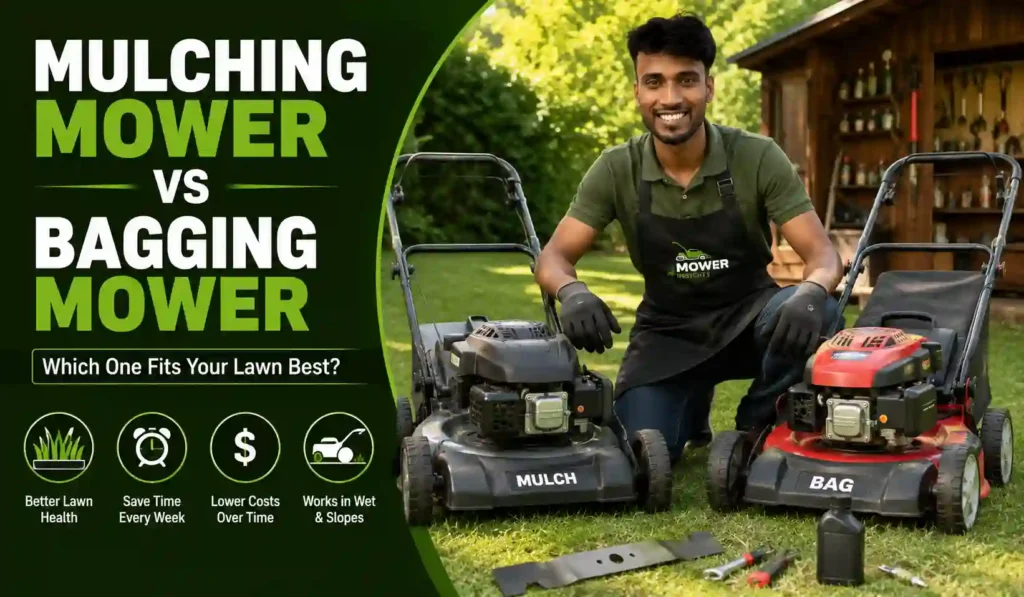
What Is a Mulching Mower?
A mulching mower cuts grass into tiny bits. It sends those bits back onto your lawn. It does not bag or toss the clippings out. The deck is shaped to hold clippings under the blade a bit longer, so they get cut small before they fall.
Most mulching mowers use a special blade. People call it a 3-in-1 blade or a gator blade. It has extra cutting edges along its length. That means each blade of grass gets cut two or three times, not just once.
You do not need a special mower to mulch. Many normal mowers let you mulch too. You plug the side chute and add a mulching blade. A mower built just for mulching still tends to cut finer bits. Its deck shape is made for that job from the start.
What Is a Bagging Mower?
A bagging mower is any mower with a bag that catches clippings as you cut. You do not leave clippings on the lawn. The blade cuts once. Air inside the deck pushes clippings out a chute and into the bag.
Bagging is the right call any time you need clippings gone. That means grass that got too tall while you were away. Fall leaf clean-up. A lawn being treated for disease. Any yard where loose clippings on a patio or pool deck would be a mess.
Bags on push and self-propelled mowers often hold 1.5 to 3 bushels. Riding mowers often use bigger 6 to 10 bushel twin bags. A full bag of wet clippings can weigh 25 to 40 pounds. That matters if you mow a big yard alone.
How Each One Cuts Grass
The real difference comes down to two parts. The deck shape. And the blade.
A mulching deck is domed and closed off where clippings would normally exit. This forms a small swirl of air under the housing. Clippings get pulled back past the blade again and again. Each pass makes them smaller. In time they are light enough to settle down between the grass blades.
A bagging deck is flatter. It stays open at the chute. Air and clippings move one way, straight out and into the bag. There is no plan to hold clippings back. That would slow the airflow and cause clogs.
The blade shape follows the same idea. A mulching blade has a longer edge with extra lift wings. Those wings keep clippings moving inside the deck. A bagging blade, often called a high-lift blade, is built to push air hard. That air carries clippings fast through the chute and into the bag.
This is why a blade swap alone will not fully turn one mower into the other. A mulching blade in a bagging deck still won’t cut as fine as a true mulching mower. The blade is only half the system. The deck matters just as much.
Mulching Mower vs Bagging Mower: Side-by-Side Comparison
| Factor | Mulching Mower | Bagging Mower |
|---|---|---|
| Clippings | Cut fine, dropped back on lawn | Caught in a bag |
| Best mow schedule | Weekly, cutting no more than 1/3 of grass height | Any time, even overgrown grass |
| Time per mow | Faster, no stops to empty a bag | Slower, more stops on big lawns |
| Look right after mowing | Slight texture, less “neat” | Clean and even, no clippings in sight |
| Soil and fertilizer | Feeds soil, can cut roughly a quarter of fertilizer need | No feed back, may need more fertilizer |
| Sick or weedy lawns | Not a good choice, can spread disease or seeds | A good choice, removes the problem |
| Wet or tall grass | Can clump and stick to the deck | Handles it better, but the bag fills fast and gets heavy |
| Body effort | Lower, no bag to carry and dump | Higher, you lift and dump the bag often |
| Extra cost | Mulch kit often runs $15 to $40 if not built in | Bags often come included, new bags run $30 to $70 |
| Common shop repair | Worn mulch blade, buildup stuck under the deck | Cracked bag frame, torn bag cloth, clogged chute |
When Mulching Is the Better Choice
Mulching fits best for most homeowners who mow every week and keep a healthy lawn. In our shop, this is the default pick, unless a customer has a clear reason to bag instead.
Good fit for mulching:
- You mow weekly and rarely let grass grow past 4 inches.
- Your lawn is not fighting disease or a heavy weed problem right now.
- You want to spend less time in the yard, since there is no bag to stop and empty.
- You want to spend less on fertilizer, since clippings give some nitrogen back.
Not a good fit for mulching:
- Your lawn has a fungal disease right now. Cutting up sick clippings and leaving them in place can spread the spores.
- You want a very formal, clean look and dislike any clipping texture on the lawn.
- Your yard has a lot of hard surface, like patios or pool decks, where stray clippings become a mess.
What to do right now: if your lawn is healthy and you mow weekly, switch your mower to mulch mode this season. Watch your fertilizer bill and see if it drops by fall.
When Bagging Is the Better Choice
Bagging fits best any time clippings need to fully leave the yard, not just vanish into the grass.
Good fit for bagging:
- Grass got tall from a trip, a rainy stretch, or a new mower bought mid-season.
- It is fall, and you are mowing leaves along with grass.
- You are treating for a lawn disease or a heavy weed problem and need clippings gone, not reused.
- You want a clean, striped look right after you mow.
Not a good fit for bagging:
- You mow a healthy lawn weekly and do not want the extra time and lifting that comes with emptying a bag.
- You have no compost pile, no yard-waste pickup, and no other plan for a full bag, since it has to go somewhere.
What to do right now: if you are catching up on tall grass, bag the first cut. Once you are back to a normal weekly height, switch to mulch mode.
Slopes, Wet Grass, and Thick Grass
Wet grass is the hardest test for both types, but it hits each one in a different way. On a mulching mower, wet clippings stick together instead of spreading out. Clumps sit on top of the lawn instead of settling down to the soil. That can smother the grass under them if you do not break the clumps up. On a bagging mower, wet clippings weigh more. They fill the bag fast and can clog the chute before the bag is even full.
Thick or tall grass strains both types too. A mulching deck has trouble cutting clippings fine when too much grass moves through at once. That is why the 1/3-height rule matters more for mulching than for bagging. A bagging mower handles tall grass better, since it just has to move clippings out, not spin them again. But you will stop to empty the bag much more often.
On slopes, the mower type matters less than the mower’s own balance and grip. Still, a full bag shifts a mower’s weight and adds bulk. That can make a self-propelled bagging mower a bit harder to control on a steep slope, compared to the same mower run in mulch mode with no bag on it.
Can You Switch a Mower From One Type to the Other?
Most gas and electric push mowers sold today are “3-in-1” mowers. They can mulch, bag, or side-discharge, based on which part is on and whether the chute is open or plugged. If your mower has a bag port and a cover you can pull off, it likely already does both jobs.
If your mower only bags, and it has no mulch plug, a mulch kit for your model often costs $15 to $40. It usually comes with the plug and, at times, a mulching blade. If your mower is built just for mulching, with a fully closed deck and no chute at all, it usually cannot switch to bagging. There is no path for clippings to leave into a bag.
Before you buy a mulch kit, check your mower’s manual or model number. Make sure a kit that fits your model exists. Generic kits exist too, but fit can be off. A loose-fitting plug is one of the top causes of clogging we see on mowers brought in for that exact problem.
Repair Costs and What Breaks First
The two mower types wear out in different ways. You can see it in what rolls through our shop door.
Mulching mowers most often come in with buildup stuck under the deck. Wet or damp clippings pile up in the curved zone over a season. That buildup blocks airflow until cuts start to look rough or clumpy. Clearing it out takes about five minutes with a scraper and a hose. Most owners skip this until the cut quality drops. Mulching blades also dull faster than plain blades, since they do more cutting work per pass. Plan to sharpen or swap them close to once a season with regular use.
Bagging mowers most often come in for two things. Cracked bag frames and torn bag cloth, usually from a full bag getting dropped. And clogged chutes, usually from mowing wet grass while bagging. A cracked frame is rarely worth fixing. You just buy a new bag, often $30 to $70 based on the model. A clogged chute is normally a quick clear-and-clean job, but repeat clogs over time can wear the chute opening enough to hurt the fit.
Expert tip: after you mulch wet grass, tip the mower on its side. First, pull the spark plug wire and keep the fuel cap tight. Then clear the underside while the clippings are still soft. Once they dry, they harden into a layer that is much harder to scrape off, and it starts to hurt cut quality within a few mows.
Total Cost Over Time
The buy price gap between a mulching mower and a bagging mower is often small, since most models now do both. But the costs over time do split a bit.
A mulch-first routine saves on fertilizer, since clippings give back some nitrogen over a season. It also saves on disposal, since there is no yard waste to bag and haul. The main added cost is faster blade wear, so plan on more sharpening or a new blade sooner.
A bag-first routine adds the cost of new bags over the mower’s life, often $30 to $70 every couple of seasons, based on use. It may also add yard-waste fees if your town does not offer free pickup. It brings back fertilizer cost too, since clippings no longer feed the soil.
Neither gap is big enough to be the main reason to choose one type. Pick based on your lawn’s real state and your mow schedule. Treat the cost gap as a small tie-breaker, not the main factor.
Which One Should You Buy?
Most homeowners with a healthy lawn on a weekly mow schedule should buy a mower that can mulch, and use that as the default mode. Make sure it also has a bag or bag port. That way you are set for the odd tall-grass cut, fall clean-up, or disease treatment, without buying a second mower.
If your yard often has heavy leaf litter, hard surfaces that clippings would mess up, or a lawn disease you are managing long-term, put bagging first. Pick a mower with strong bag airflow and a bigger bag size. Treat mulching as the backup mode instead.
Nearly every solid mower sold in 2026 does both jobs well. The choice that matters more than the spec sheet is which mode you use most weeks. That comes down to your lawn’s state, not the machine.
Frequently Asked Questions
Is mulching or bagging better for grass?
Mulching is better for grass health in most cases. It gives back nutrients and holds moisture in the soil. Bagging is better only when clippings need to leave the yard, such as during disease treatment or after heavy overgrowth.
Does mulching cause thatch buildup?
No, in most cases. Grass clippings are mostly water. They break down within one to two weeks, well before they could pile up into thatch. Thatch comes from a buildup of stems and roots below the grass line, not from surface clippings.
Can I switch between mulching and bagging on the same mower?
Yes, on most 3-in-1 or convertible mowers. You add or pull the mulch plug and, at times, swap the blade, to switch modes. Check your owner’s manual to be sure your model supports both.
How often should I bag instead of mulch?
Bag any time grass has grown quite tall, during fall leaf season, when you treat for lawn disease or heavy weeds, or any time you want a fully clean cut. The rest of the time, mulching works fine for weekly mowing.
Do mulching mowers need a special blade?
A mulching-only blade helps you get the best result, since it has extra cutting edges. But many bagging mowers can still mulch well with the chute plugged, even with a plain blade, just with slightly bigger bits.
Is a mulching mower more expensive than a bagging mower?
Not by much. Most home mowers today do both jobs at the same price point. Where a gap does show up, it is often the small cost of a mulch kit ($15 to $40) against the cost of new bags over time ($30 to $70 every couple of seasons).
Related Reading
Readers who compare mulching and bagging mowers often also want to know how lawn mowers work at a basic level, and how to time and pace regular lawn mowing. Both topics live elsewhere on MowerInsights.
Pingback: Should You Bag or Mulch Grass Clippings
Pingback: Toro TimeMaster 21199 vs Recycler 20340: The Real Verdict