Quick Answer
Load your riding mower on a trailer or truck bed ramp set at 15 degrees or less. Keep the mower in low gear or neutral with the park brake set. Use four straps, one at each corner, rated for at least twice the mower’s weight. Check the load again after the first five miles, since straps stretch and settle. Most tow-away accidents happen at the ramp, not on the road.
What You Need Before You Start
Gather these items before you start the mower. This saves time and cuts your risk of a rushed, unsafe load.
- A trailer or truck bed rated for the mower’s full weight, plus fuel and any bagger attachment
- A ramp rated for the mower’s weight, with a non-slip surface
- Four tie-down straps with ratchets, each rated for at least twice the mower’s weight
- Wheel chocks, two of them, for the trailer if it will sit still before or after the drive
- Work gloves, since strap hooks can pinch or cut
- A helper, if you can get one, to spot you while you drive up the ramp
Most riding mowers weigh between 400 and 800 pounds. A zero-turn mower with a bagger can push past 1,000 pounds. Check your owner’s manual or the weight sticker on the frame before you pick your straps and ramp.
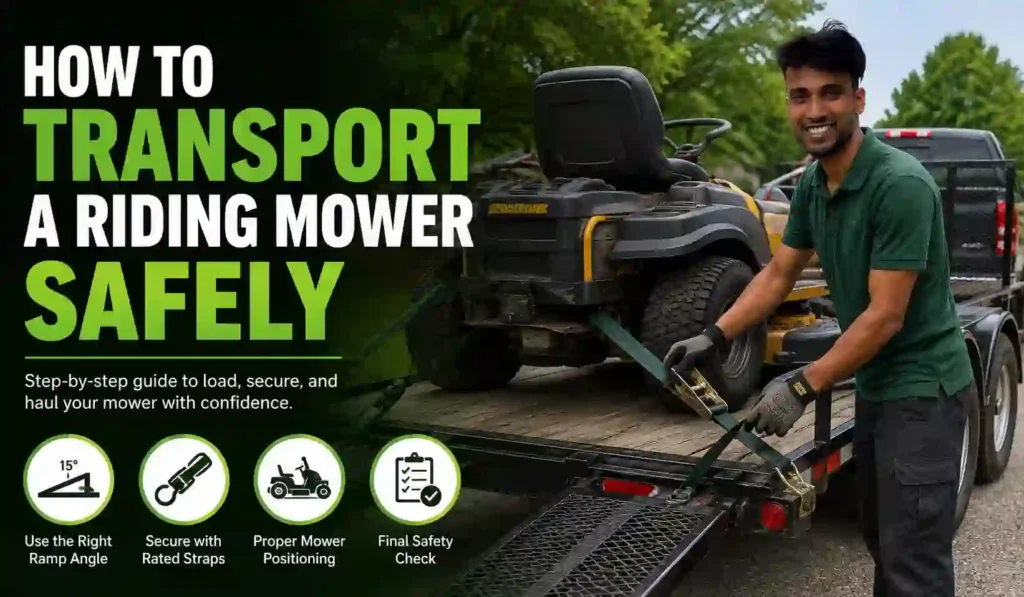
Step 1: Pick the Right Trailer or Truck Bed
Match the trailer or truck bed to the mower’s weight and footprint. A trailer that flexes or bounces under load makes every later step harder.
Open trailers work well for most riding mowers. Look for a flat deck at least 6 feet long and 4 feet wide for a standard riding mower. A zero-turn mower may need extra width.
If you use a truck bed, measure it first. Many full-size truck beds run 5.5 to 6.5 feet long. A riding mower with a 42-inch deck often just barely fits. Measure your mower’s full length, including the mower deck overhang, before you commit to a truck bed load.
Check your trailer’s weight rating, called the GVWR (Gross Vehicle Weight Rating). This number sits on a metal plate near the trailer’s tongue. Add up the mower’s weight, fuel, and any cargo. Stay under the rating by a wide margin, not right at the edge.
Step 2: Set Up the Ramp
Place the ramp so it forms a low, steady slope. A steep ramp is the top cause of tip-back accidents in our shop’s repair logs.
Aim for a ramp angle of 15 degrees or less. That means for every foot the ramp rises, it should run about 4 feet forward. A ramp that’s too short for the trailer height creates a steep angle, even if the ramp itself feels sturdy.
Check the ramp’s weight rating against your mower’s total loaded weight. A single ramp rated for 750 pounds will not hold a 900-pound zero-turn mower safely.
Make sure both ramp rails sit flat on the ground and flat against the trailer or tailgate. A gap at the top edge, even a small one, can catch a mower’s front tire and stop it mid-climb.
Expert Tip: In the shop, we see bent front axles from mowers that hit a ramp gap at speed. Walk the ramp by hand first, and press down on each rail near the top. If it flexes or shifts, reset it before you drive the mower up.
Step 3: Prep the Mower Before You Load It
Get the mower itself ready before it ever touches the ramp. A cold engine and a clear deck make the load far safer.
Let the engine run for a minute, then shut it off and let it cool for at least 10 minutes before loading. A hot engine and a fuel spill do not mix well on a ramp.
Clear grass clippings off the deck, tires, and mower blades. Wet clippings on the tires cut traction on a metal ramp fast. Siddik has pulled more than one mower off a ramp wall after a rider lost grip on a grass-slick tire.
Check tire pressure. Low tires shift a mower’s balance and make it wander on the ramp instead of tracking straight.
Fold down or remove any tall attachments, like a bagger chute or umbrella mount, that could hit an overhead obstacle on the tow vehicle or a low garage door.
Step 4: Drive the Mower Onto the Trailer
Drive the mower up the ramp slowly, in a low gear, using steady throttle. Jerky throttle or sudden stops on a ramp cause more tip-overs than any other single factor.
Line up the mower’s front tires with the ramp center before you start up. A crooked approach can walk a tire off the ramp edge halfway up.
Keep both hands on the wheel and both feet clear of the pedals except for light throttle. Do not ride the brake on the way up. A sudden stop mid-ramp can roll the mower backward.
If the mower has a hydrostatic transmission, use the lowest speed setting. If it has a gear-drive transmission, use first or low gear the whole way up.
Have your helper stand to the side, not behind the mower, and watch the rear tires as you climb. A spotter catches a slipping tire before it becomes a real problem.
Once all four tires clear the ramp and sit flat on the trailer deck, stop the mower fully before you shift into park or neutral.
Step 5: Position the Mower on the Deck
Center the mower on the trailer or truck bed, with weight balanced side to side and slightly forward of the axle.
A mower loaded too far back lifts weight off the tow vehicle’s rear tires and can cause trailer sway at highway speed. A mower loaded too far forward adds too much tongue weight and can strain the hitch.
Leave enough clearance around the mower for you to walk around it and reach every strap point. A mower jammed against the trailer’s front rail is hard to strap correctly.
Set the park brake. Shift into neutral for a hydrostatic mower, or leave a gear-drive mower in low gear with the brake set. Turn off the fuel valve if your mower has one.
Step 6: Strap the Mower Down
Use four straps, one at each corner of the mower, angled outward toward the trailer’s tie-down points. This four-point setup stops the mower from shifting forward, backward, or side to side.
Hook each strap to a solid part of the mower’s frame, not to plastic body panels, the mower deck, or the steering column. A plastic panel will crack under strap tension, and a steering column can bend, throwing off the mower’s alignment.
Run the straps at roughly a 45-degree angle from the mower to the trailer floor. A strap that runs straight up and down does little to stop forward or backward sliding.
Tighten each strap by hand first, then use the ratchet to snug it further. Stop once the mower’s suspension or tires compress slightly. Overtightening can bend a frame rail or crush a tire sidewall over a long drive.
Check that no strap crosses over a hot exhaust pipe or a sharp deck edge. Heat and sharp metal both wear through strap webbing fast, sometimes within a single trip.
Common Mistakes callout box
- Using only two straps instead of four, which leaves the mower free to rock side to side.
- Hooking a strap to the mower deck shell, which can crack under tension.
- Leaving straps at a straight vertical angle instead of the recommended 45 degrees.
- Skipping wheel chocks on the trailer, which lets the trailer itself roll while you’re loading.
Step 7: Do a Final Safety Check
Walk around the full trailer one more time before you pull onto the road. This last check catches the mistakes that cause roadside failures.
- Tug each strap by hand. It should feel tight with almost no give.
- Check that the mower’s park brake is still set and the transmission is in neutral or low gear.
- Confirm the trailer’s tail lights and turn signals work if it’s after dark or the trailer has its own lighting.
- Check the trailer hitch pin and safety chains are both secured.
- Look for any strap hook that sits loose or at risk of vibrating free.
Drive a short distance, then stop and recheck every strap. Straps settle and stretch slightly in the first few miles. This five-minute stop has saved more than one mower from sliding in our customers’ experience.
Common Mistakes That Cause Load Failures
Most load failures come from a short list of repeat mistakes. Fixing these up front prevents almost every roadside problem we see reported by customers.
- Using a ramp that’s too steep. A short ramp on a tall trailer forces a sharp angle that a mower’s low ground clearance can’t clear without scraping or tipping.
- Skipping the re-check after the first few miles. Straps loosen as they settle. A strap that felt tight at the driveway can be loose by the highway on-ramp.
- Loading with a full fuel tank and a hot engine. This raises fire risk and adds unneeded weight right at the tipping point of the ramp climb.
- Using worn or rusted strap hooks. A rusted hook can snap under load, sending a strap loose at speed.
- Guessing at ramp angle instead of measuring it. A ramp that looks fine by eye can still exceed 15 degrees, especially on a tall trailer.
Safety Notes for the Road
Drive slower than you would with an empty trailer. A loaded riding mower shifts your tow vehicle’s center of gravity and stopping distance.
Take turns wide and slow. A trailer with a top-heavy load, like a mower with a bagger still attached, can sway more in sharp turns.
Check your mirrors often for signs of trailer sway. If the trailer starts to fishtail, ease off the gas gently. Do not brake hard, since that can make the sway worse.
Stop and check the load at least once more if your drive is longer than 30 minutes. Heat, road vibration, and speed all work straps loose over time.
When to Call a Tow Service Instead
Some situations call for a professional tow service rather than a DIY load. Knowing when to make this call keeps you and your equipment safe.
Call a tow service if your mower weighs more than your trailer or ramp is rated to handle. Guessing at weight limits is how axles bend and ramps snap.
Call a tow service if the mower won’t start or won’t move under its own power. Winching a dead mower up a ramp with no engine braking is far riskier than driving it up under control.
Call a tow service if you don’t have a helper and the ramp angle is steep, since a solo load on a bad ramp raises your risk of a tip-back accident.
Troubleshooting: If the Mower Won’t Stay Put
If the mower shifts or rocks after you’ve strapped it down, work through these checks in order.
| Problem | Likely Cause | Fix |
|---|---|---|
| Mower rocks side to side | Only two straps used, or straps too loose | Add two more straps at the front and rear corners; retighten all four |
| Mower slides forward under braking | Straps too vertical, not angled | Reposition straps to a 45-degree angle toward the trailer floor |
| Strap keeps loosening on its own | Worn ratchet mechanism or frayed strap | Replace the strap; don’t reuse a strap with visible wear |
| Mower tips slightly on the ramp | Ramp angle too steep for the mower’s ground clearance | Use a longer ramp or a trailer with a lower deck height |
| Tires slip on the ramp mid-climb | Wet grass or debris on tires | Clean the tires fully and dry the ramp surface before retrying |
Frequently Asked Questions
How do I transport a riding mower safely?
Load it on a rated trailer or truck bed using a ramp angled at 15 degrees or less. Drive it up slowly in low gear, center it on the deck, then secure it with four straps at a 45-degree angle to solid frame points.
What is the safest ramp angle for loading a riding mower?
Keep the ramp angle at 15 degrees or less. This works out to roughly a 4-foot ramp run for every 1 foot of rise. A steeper angle raises the risk of the mower tipping back during the climb.
How many straps do I need to secure a riding mower?
Use four straps, one at each corner of the mower. Two straps leave the mower free to rock side to side, which is one of the most common causes of shifted loads we see in repair intakes.
Can I transport a riding mower with a full tank of gas?
It’s safer to run the tank down before loading. A full tank adds weight right at the ramp’s tipping point and raises fire risk if fuel spills during loading or a hard stop.
Do I need to check the straps again after I start driving?
Yes. Stop and recheck every strap within the first five miles. Straps stretch and settle once the load starts vibrating, so a strap that felt tight in the driveway can loosen on the road.
What’s the difference between securing a hydrostatic mower and a gear-drive mower?
A hydrostatic mower should sit in neutral with the park brake set, since its transmission doesn’t lock the wheels on its own. A gear-drive mower should stay in first or low gear with the park brake set, which adds an extra layer of hold.
Is it safe to transport a riding mower in a truck bed instead of a trailer?
Yes, if the truck bed is long and wide enough for the mower’s full footprint and the bed’s weight rating covers the mower’s total loaded weight. Measure both before you load, since many riding mowers barely fit a standard truck bed.
Summary
- Use a ramp angled at 15 degrees or less, and confirm it’s rated for your mower’s weight.
- Clear grass and debris off tires and the deck before you drive up the ramp.
- Center the mower on the trailer, set the park brake, and use low gear or neutral.
- Strap all four corners at a 45-degree angle to solid frame points, not plastic panels.
- Stop and recheck every strap within the first five miles of driving.
Trust & Testing Methodology: These steps come from Siddik Kazi’s repair-shop experience with riding mowers that arrive with tow-related damage: bent axles, cracked deck shells, and snapped tie-down brackets. The ramp angle and strap guidance reflect what actually prevents those repeat repairs, not just general towing advice.
In our shop, the most common reason a mower comes in after a transport job is a strap that pulled loose on a steep ramp climb, or a hook mounted to a plastic panel instead of the frame. Both are fully avoidable with the steps above. Where useful, MowerInsights also offers mower repair and maintenance service in Milan for anyone in the area who wants a professional check before or after a long haul.