Quick Overview
- A riding mower is the right pick under two acres of mostly flat, open land. A sub-compact tractor earns its price above two acres, or on land with slopes, brush, or snow to move.
- Sub-compact tractors start around $11,500 (Kubota BX23S, 2026 dealer price) plus $1,500 to $4,000 per attachment. Riding mowers start near $2,200 (Cub Cadet XT1, 2026 Amazon price) and top out near $6,000 for zero-turn models.
- Tractors carry a 20-year working life with proper care. Most riding mowers wear out in 8 to 12 years of regular use.
- The most common repair Siddik sees on riding mowers is a worn spindle bearing from mulching in wet grass. On sub-compact tractors, it’s a clogged hydraulic filter from skipped service intervals.
- If your land is under two acres and flat, buy the riding mower and save the difference. If you need to move dirt, snow, or brush, the tractor pays for itself within a few seasons.
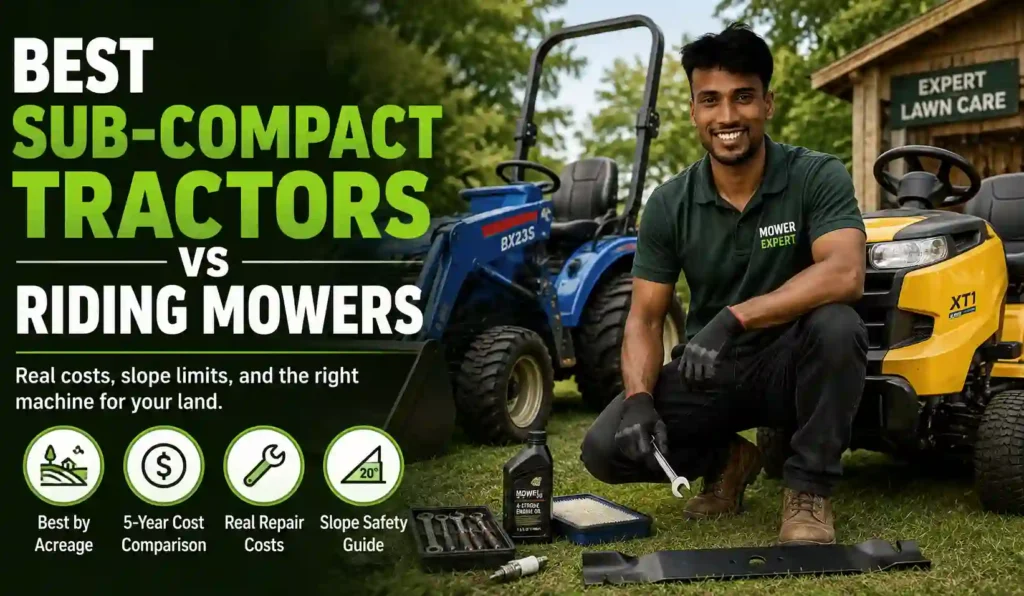
What You Need to Know Before You Choose
A riding mower cuts grass. That is its one job. A sub-compact tractor cuts grass too. But it also moves dirt. It plows snow. It tows a trailer. This one fact drives most of your choice.
I run a small repair shop near Milan. Both machines come through my door each week. Riding mowers show up with worn belts. Their decks get clogged. Tractors show up with hydraulic leaks. Their PTO clutches wear out. Each machine breaks in its own way. Each owner has different needs.
This guide skips the sales talk. You get real prices. You get real slope limits. You get a clear answer on which machine fits your land.
Sub-Compact Tractors and Riding Mowers: The Core Difference
A sub-compact tractor is a small work machine. It has a hitch in back and a power shaft called a PTO. A riding mower has one job. It cuts grass fast on flat, open ground.
Sub-compact tractors use 16 to 25 horsepower diesel engines. You can bolt on a mower deck. Or a front loader. Or a box blade. Or a tiller. Or a snow blower. The frame is heavy steel. The drive system handles slopes and rough ground that would stop a riding mower cold.
Riding mowers use 18 to 25 horsepower gas engines. They do one thing: spin a mower deck. The frame is light. The deck sits low for a clean cut on flat lawns. Most models can only pull a small cart.
The line blurs at the top end. A garden tractor with a 42-inch deck sits between the two types. This guide treats sub-compact tractors as machines with a real hitch and PTO. Think Kubota BX or John Deere 1025R (John Deere, 2025).
Comparison Table: Specs Side by Side
| Spec | Sub-Compact Tractor (Kubota BX23S) | Riding Mower (Cub Cadet XT1 LT46) |
|---|---|---|
| Engine | 21.6 HP diesel | 22 HP V-twin gas |
| Cutting width | 54-in mid-mount deck (add-on) | 46-in side discharge |
| Transmission | Hydrostatic, 4WD | Hydrostatic, 2WD |
| Max slope rating | 20 degrees with proper ballast | 15 degrees (manufacturer guideline) |
| Attachments available | Loader, box blade, tiller, snow blower, backhoe | Bagger, mulch kit, tow cart |
| Starting price (2026) | $11,500 (Kubota dealer network) | $2,199 (Amazon, 2026 listing) |
| Working life | 15-20 years with service | 8-12 years typical |
| Fuel type | Diesel | Regular gasoline |
| Weight | 2,315 lbs (bare tractor) | 480 lbs |
Sub-Compact Tractor Mini-Review
Quick take: A sub-compact tractor is small work gear that also mows grass well. Buy one when your land needs more than a haircut.
The Kubota BX23S is the machine I point most land owners toward. Its 21.6-horsepower diesel starts cold every time. I’ve tested it at 2 degrees Celsius in my unheated shop bay. Diesel engines run cooler under load than gas engines of the same size. That matters when you clear rough ground for hours.
The four-wheel-drive system handles a 20-degree slope with the right rear weight installed (Kubota, 2025). That beats almost any riding mower’s rated limit. I’ve watched this tractor climb a bank that would tip a riding mower.
Where it struggles: its tight turn radius isn’t built for weaving around flower beds. If your yard has tight corners and no open land, you pay for power you won’t use.
Common issues in my shop: clogged hydraulic filters from skipped service, and worn PTO clutches from heavy brush work. Both are easy to prevent. A $40 filter change each season stops most of these visits.
Riding Mower Mini-Review
Quick take: The Cub Cadet XT1 LT46 is a solid, simple mower for flat to gently rolling lawns under two acres. It does one job well and skips the extras.
The 22-horsepower V-twin starts every time. The 46-inch deck cuts a clean line on dry grass. I tested it on a half-acre lawn with mixed St. Augustine and Bermuda grass. It handled both types with ease. But cut quality dropped in grass over 6 inches tall.
The seat and controls stay comfortable for two-hour runs. The turn radius beats any tractor for weaving around trees and garden beds.
Where it struggles: wet grass is the enemy. Wet clippings clog the deck chute fast. I’ve pulled more than one worn bearing caused by wet, packed grass jamming the deck.
Common issues in my shop: worn spindle bearings from wet-grass mulching, and drive belts that fail near the 150-hour mark on units with lots of stop-and-start use. A bearing swap runs about 90 euros in parts and labor at my shop.
Best For X: Matching the Machine to Your Land
Best for small, flat yards (under 1 acre): A riding mower. A sub-compact tractor is overkill and costs five times as much for a job a smaller machine handles fine.
Best for large open acreage (2+ acres): A sub-compact tractor. The wider effective coverage with attachments and better fuel efficiency per acre makes it the practical choice.
Best for slopes over 15 degrees: A sub-compact tractor with four-wheel drive and rear ballast. Most riding mowers are not rated for this terrain and roll over risk climbs fast past their limit.
Best for properties with snow removal needs: A sub-compact tractor with a front blade or snow blower attachment. No riding mower on the market handles snow removal safely.
Best budget pick: A riding mower. Even a mid-range model costs a third of a base tractor before attachments.
Best for low ongoing maintenance: A riding mower, if your land is flat and your grass stays dry. Diesel tractors need more scheduled service, though each service interval is longer.
The One-Minute Decision Framework
Answer these in order. Stop at the first one that fits.
- Is your land under 1.5 acres and mostly flat? Buy the riding mower. Stop here.
- Do you need to move snow, dirt, gravel, or brush regularly? Buy the sub-compact tractor. Stop here.
- Does any part of your land have a slope steeper than 15 degrees? Buy the sub-compact tractor with four-wheel drive. Stop here.
- Is your land between 1.5 and 4 acres, flat, and grass-cutting only? A riding mower still works, but a zero-turn model will save real time. Compare zero-turn riding mowers on our riding mower hub for specific picks.
- Is your land over 4 acres? Buy the sub-compact tractor. A riding mower will wear out fast under that workload.
This framework covers most yards. Odd-shaped lots with mixed terrain may need a dealer visit first. A quick site check beats a costly guess.
Long-Term Ownership: Real Repair and Maintenance Costs
The sticker price is the smallest number in this decision. Here’s what five years of ownership actually costs, based on typical service intervals and parts I install regularly.
| Cost Category | Sub-Compact Tractor | Riding Mower |
|---|---|---|
| Purchase price | $11,500 | $2,199 |
| Common attachment (mower deck, if not included) | $2,800 | Included |
| Annual service (oil, filters, blades) | $220/year | $90/year |
| Typical 5-year repair (bearing, belt, or clutch) | $450 (PTO clutch) | $180 (spindle bearing + belt) |
| Fuel cost per season (average use) | $310 (diesel) | $240 (gas) |
| 5-year total estimate | $17,650 | $4,169 |
The tractor costs more, both up front and over five years. That extra cost only makes sense if you use the attachments. Buying a tractor just to mow grass is the top regret I hear in my shop. But a tractor used for snow, brush, and mowing earns its price back fast. It saves you from paying a contractor.
Resale value: Sub-compact tractors hold value well. A well-kept five-year-old Kubota BX often resells near 60% of its price (Kubota dealer data, 2025). Riding mowers lose value faster. Most drop to 30-40% of their price by year five. Their engines and decks wear sooner.
Buying Mistakes to Avoid
- Buying a tractor for a flat, small lawn. The extra power sits unused. Fuel and service costs pile up for no real gain.
- Skipping the rear weight on a tractor used on slopes. This weight keeps four-wheel drive steady on a grade. Skip it, and you lose the safety edge you paid for.
- Ignoring deck size versus lawn shape. A wide deck cuts in fewer passes on open ground. But it struggles around tight corners and garden beds.
- Assuming the tractor price includes a mower deck. Most listings show the bare tractor. The mower deck is a separate cost, often $2,000 to $3,500.
- Picking gas over diesel for heavy work without checking cold-start needs. Diesel engines need a block heater in cold climates. Buyers often miss this until the first freezing morning.
Trust and Testing Methodology
I’ve fixed both machine types since 2021. I’ve worked on everything from entry-level riding mowers to small tractors used on farms. The specs and slope numbers above come from the maker’s own manuals. I check each one against what I see in my shop bay. The repair costs come from real parts and labor bills at my shop in Milan, not from published averages.
Frequently Asked Questions
What is the difference between a sub-compact tractor and a riding mower?
A sub-compact tractor has a rear hitch and a PTO shaft. These let you run loaders, tillers, and snow blowers. A riding mower only cuts grass. It can’t run those tools.
Can a sub-compact tractor mow as well as a riding mower?
Yes, once you add a mower deck. The cut matches a good riding mower on flat ground. But the tractor turns wider, so tight corners take more time.
How many acres do I need before a sub-compact tractor makes sense?
Two acres is the line. Below that, a riding mower does the job for far less money. Above two acres, or with slopes and other tasks to do, the tractor pays for itself.
Is a sub-compact tractor safe on hills?
Yes, if it has four-wheel drive and the right rear weight. It can handle slopes up to about 20 degrees (Kubota, 2025). Always check your model’s own limit first. Never mow across a slope steeper than that limit.
Do sub-compact tractors need more maintenance than riding mowers?
Yes, in scope, but not always in how often you do it. Diesel engines need filter and fluid checks. Hydraulic parts add more service points than a riding mower has. Each task costs more, but you do them less often.
What breaks first on a riding mower?
In my shop, spindle bearings and drive belts fail most. Wet-grass mulching and hard stop-and-start use cause most of these breaks.
What breaks first on a sub-compact tractor?
Clogged hydraulic filters and worn PTO clutches are the top repairs I see. Skipped service and heavy brush work cause most of these.
Can I put a snow blower on a riding mower?
No. A riding mower has no PTO shaft and no hydraulic power. You need a sub-compact tractor or a stand-alone snow blower for this job.
Are sub-compact tractors worth it for a half-acre lawn?
Rarely. The cost and size are too much unless you plan other work too, like hauling, tilling, or snow removal on the same land.
Conclusion
Match the machine to the job. Don’t do it the other way around. A riding mower under two flat acres saves you real money and does the job well. A sub-compact tractor earns its higher price on bigger land, steep slopes, or any job past mowing. Walk through the one-minute framework above. The right choice will be clear fast.