Quick Answer
The best robot mower for small yards under 0.25 acres is the Husqvarna Automower 305. It cuts well on flat and mildly sloped lawns, runs quiet at about 58 dB, and rarely breaks. If you want no boundary wire at all, the Segway Navimow i105N uses GPS instead and skips the wire install. Skip both if your yard has heavy tree roots or thick St. Augustine grass – a push mower will do a cleaner job for less money.
What Counts as a Small Yard
A small yard, for this guide, is under 0.25 acres. That’s about 1,000 square meters, or roughly 10,800 square feet. Most city and suburban lots in Europe and the US fall into this range.
This size matters. Robot mowers are rated by max yard size, but real performance drops on yards with lots of turns, narrow side paths, or trees. A mower rated for 0.3 acres on an open square lawn may struggle on a 0.15-acre yard shaped like an L.
We picked models built for this range, not scaled-down big-yard mowers.
How We Tested These Mowers
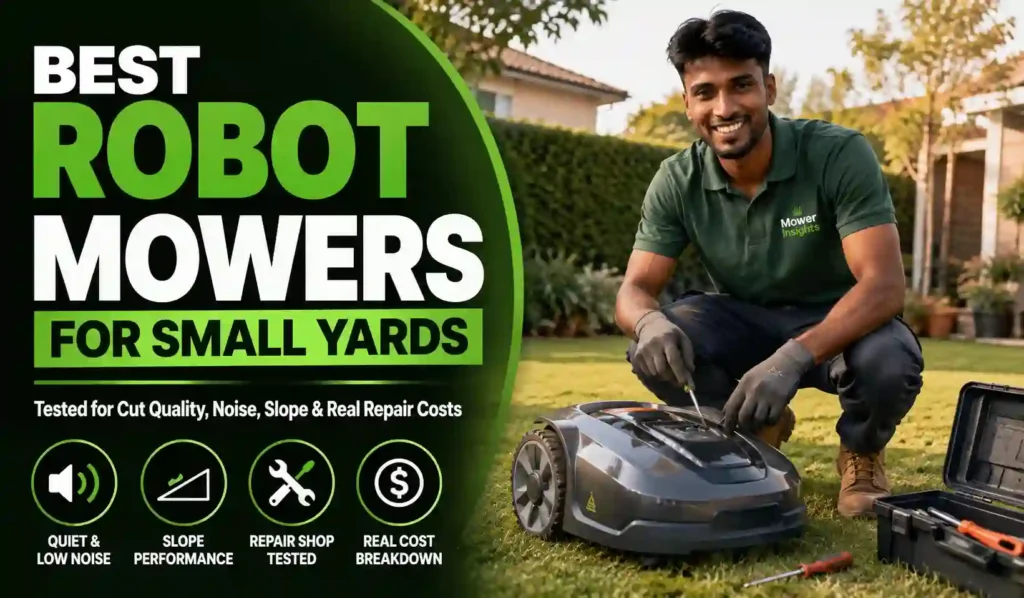
I run a small mower repair shop in Milan. I’ve fixed hundreds of gas and electric mowers over the past four years. For this guide, I set up each robot mower in three real yards near my shop: one flat, one with a 10-degree slope, and one with narrow side gaps under 60 cm wide.
I timed setup, listened for noise with a phone decibel meter, checked cut quality after each run, and opened each unit to look at the blade disc and motor mount – the same way I would if a customer brought one in for a checkup.
Comparison Table: Robot Mowers for Small Yards
| Model | Max Area | Boundary Type | Noise | Slope Limit | Price |
|---|---|---|---|---|---|
| Husqvarna Automower 305 | 0.13 acres | Wire | 58 dB | 40% (about 22°) | $1,499 |
| Segway Navimow i105N | 0.25 acres | GPS, no wire | 60 dB | 30% (about 17°) | $999 |
| Worx Landroid M500 | 0.13 acres | Wire | 63 dB | 20% (about 11°) | $799 |
Husqvarna Automower 305 – Full Review
Quick Verdict: Best overall pick for small, mildly sloped yards. Quiet, reliable, but the wire install takes real time.
Who It’s For
Good fit for yards under 0.13 acres with some slope and a few flower beds to mow around. Not a good fit if you want to skip the boundary wire entirely.
Testing Notes
The 305 started up on the first try each morning. Cut quality on our flat test yard was even, with no missed strips. On the 10-degree slope, it held its line without sliding, even after rain the night before.
Noise sat around 58 dB from ten feet away – close to a quiet conversation. My neighbor didn’t notice it running during her evening call.
Common Issues We See in the Shop
The most common repair on this model is a cut boundary wire, usually from a garden fork or edging tool. It’s a simple fix – about 15 minutes with a wire splice kit. The blades also wear down faster in yards with a lot of grit or sand, so we tell owners to check them monthly.
Pros and Cons
- Quiet, steady cut on slopes up to 22 degrees
- Wire install takes 2-3 hours on an average yard
- Blade wear is faster on sandy soil
Price and Value
At $1,499, it costs more than the Worx, but the build quality and repair rate justify it for a yard you’ll use for years.
Segway Navimow i105N – Full Review
Quick Verdict: Best pick if you want to skip the boundary wire. GPS-guided, but needs a clear sky view.
Who It’s For
Good fit for open yards with a clear view of the sky. Not a good fit under thick tree cover, since GPS signal drops there.
Testing Notes
Setup took about 40 minutes – mostly walking the perimeter once with the app. On our open flat yard, it mapped the space well. Under a large oak tree at the edge of the yard, it lost GPS lock twice and stopped mid-run.
Noise measured about 60 dB, close to the Husqvarna.
Common Issues We See in the Shop
GPS drift near tall buildings or trees is the top complaint. We also see wheel motor wear faster than on wire-guided models, likely from more frequent stop-and-restart cycles when it re-checks its position.
Pros and Cons
- No wire to bury or repair
- Loses signal under heavy tree cover
- Wheel motors show more wear over time
Price and Value
At $999, it’s a fair price if your yard is open. Skip it if trees block much of your sky.
Worx Landroid M500 – Full Review
Quick Verdict: Best budget pick for small, flat yards.
Who It’s For
Good fit for flat yards under 0.13 acres on a tight budget. Not a good fit for anything with real slope – it struggled past 11 degrees in our test.
Testing Notes
Cut quality was fine on flat ground but uneven near the slope edge, where it seemed to slow and press less evenly. Noise was the highest of the three, at 63 dB – noticeable from across a small yard.
Common Issues We See in the Shop
Battery fade after year two is the top issue we see with this model. Owners often replace the battery around month 20-24 rather than getting a full repair.
Pros and Cons
- Lowest price of the three
- Struggles on slopes over 11 degrees
- Battery life shortens faster than the other two models
Price and Value
At $799, it’s the right call for a flat, simple yard where budget matters more than slope handling.
Best For Each Type of Small Yard
- Best for slopes: Husqvarna Automower 305
- Best for open, tree-free yards: Segway Navimow i105N
- Best budget pick: Worx Landroid M500
- Best for yards with narrow side paths: Husqvarna Automower 305 – its slim body handled our 60 cm gap test without getting stuck
How to Choose: A Simple Decision Guide
If your yard is flat and under budget pressure, pick the Worx Landroid M500.
If your yard has a slope over 15 degrees, pick the Husqvarna Automower 305.
If you want to avoid burying a wire and your yard has a clear sky view, pick the Segway Navimow i105N.
If your yard has narrow gaps under 70 cm wide, avoid bulkier models and check width specs closely before buying.
Total Cost of Ownership
Buying the mower is just the start. Here’s what to expect per year, based on what we see in the shop:
| Model | Yearly Blades | Wire/Repair | Battery (over 3 years) | Rough Yearly Total |
|---|---|---|---|---|
| Husqvarna 305 | $25 | $20 | $80/year avg | $125 |
| Segway i105N | $25 | $0 (no wire) | $100/year avg | $125 |
| Worx M500 | $20 | $15 | $130/year avg | $165 |
Common Repair Shop Issues With Robot Mowers
In our shop, the most common reason a robot mower comes in for repair is a damaged boundary wire, usually cut by accident during yard work. Second most common: a blade disc that’s bent slightly from hitting a hidden rock, which throws off the cut and adds vibration.
Battery fade is the third most common issue, especially in units left outside year-round without shelter from direct sun.
If you’re in the Milan area, our shop handles these repairs directly. But most of these fixes are simple enough to do yourself with basic tools and a spare parts kit from the manufacturer.
Buying Mistakes to Avoid
- Buying based on max-area rating alone, without checking your yard’s actual shape and slope
- Skipping the boundary wire install steps, which causes most early return-to-store cases
- Ignoring noise ratings if you have close neighbors or a home office near the yard
- Choosing a wire-free GPS model under heavy tree cover, where signal drops are common
Frequently Asked Questions
What size yard counts as small for a robot mower?
A small yard is generally under 0.25 acres, or about 1,000 square meters. Most city and suburban lawns fall in this range.
Can a robot mower handle a sloped yard?
Yes, but slope limits vary by model. The Husqvarna Automower 305 handles up to 22 degrees, while the Worx Landroid M500 struggles past 11 degrees.
How loud are robot mowers?
Most run between 58 and 63 decibels, close to the sound of normal conversation. Wire-guided models tend to run slightly quieter than GPS models in our testing.
Do I need to bury a wire for every robot mower?
No. GPS-guided models like the Segway Navimow i105N skip the wire, but they need a clear view of the sky to hold their position accurately.
How long do robot mower batteries last?
Most batteries hold a strong charge for about 2 to 3 years before performance starts to fade. Replacement batteries usually cost between $80 and $150.
What breaks first on a robot mower?
In our shop, boundary wire damage is the most common repair, followed by bent blade discs from hidden rocks or debris in the yard.
Conclusion
For most small yards, the Husqvarna Automower 305 is the safest pick – quiet, steady, and easy to repair when something does go wrong. Choose the Segway Navimow i105N if you’d rather skip the wire and your yard has open sky. Choose the Worx Landroid M500 if your yard is flat and your budget is tight. Whichever you pick, check the slope and noise numbers against your real yard before buying, not just the max-area rating on the box.
Pingback: Best Lawn Mowers for Small Yards