For most yards under 1/4 acre (10,890 sq ft), the Ego Power+ LM2135SP is the best overall pick. It’s a self-propelled 21-inch cordless mower with enough runtime for a quarter acre on one charge and none of the pull-cord hassle of gas models. If your yard is flat and under 5,000 sq ft, the Fiskars StaySharp Max reel mower is a genuinely good, near-silent alternative for a fraction of the price. Budget shoppers should look at the Greenworks 40V 21-inch for a solid electric mower under $300.
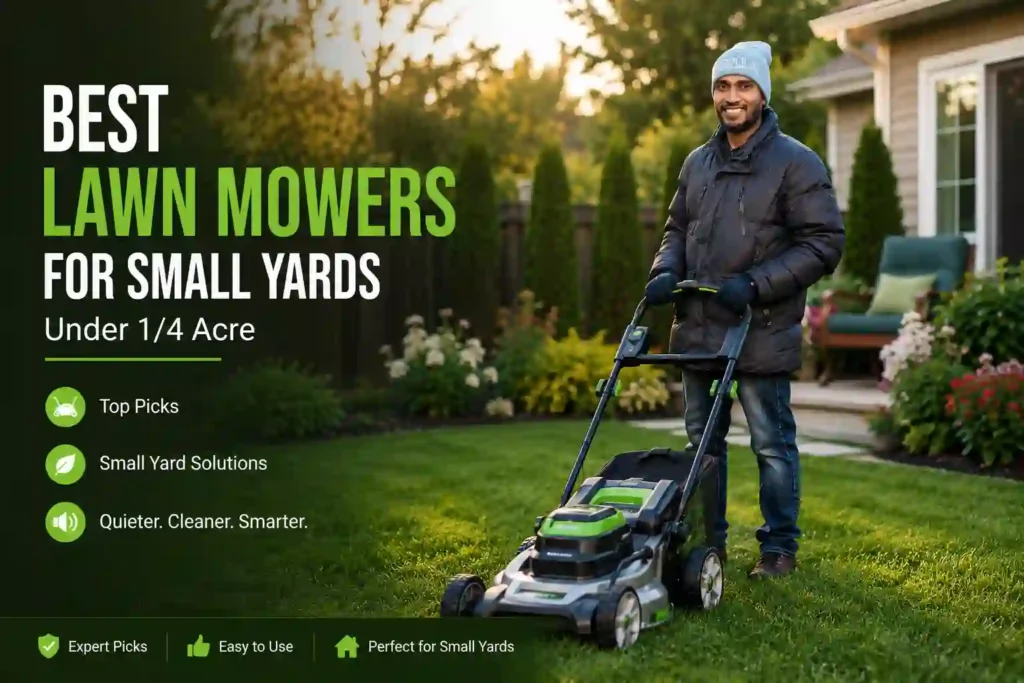
What Counts as a Small Yard (And Why It Changes What You Should Buy)
A “small yard” for mowing purposes is anything under 1/4 acre, which is 10,890 square feet or about 1,012 square meters. That’s roughly the size of a doubles tennis court and a half. Most suburban lots in the US with a separate front and back lawn fall into or near this range.
Yard size changes the math on what mower makes sense. A gas mower’s extra power and range exist to cover ground fast on large properties. Under 1/4 acre, that advantage mostly disappears, and you’re left carrying the downsides: pull-cord starting, oil changes, exhaust fumes, and engine noise in the 90-95 dB range at the operator’s ear (OPEI, 2023). A cordless electric mower or, for flat small lots, a reel mower closes that gap without the maintenance.
Shape and obstacles matter as much as raw square footage. A flat, rectangular 8,000 sq ft lot with no trees mows faster and easier than a 4,000 sq ft yard broken into three sections by flower beds, a shed, and a slope. If your yard has narrow side-yard access (under 30 inches), check the mower’s width before anything else on this list, since even the best small-yard mower is useless if it can’t get through the gate.
How to Think About This Purchase
Five factors decide the right mower for a small yard: power source, self-propulsion, cutting width, storage space, and noise tolerance. Get these right and almost any mower in this guide will serve you well for years.
Power source is the biggest fork in the road. Corded electric mowers are the cheapest and lightest option but tie you to an outlet, which works fine if your whole yard is within 100 feet of the house. Cordless (battery) mowers have replaced gas as the default recommendation for small yards because a single charge now covers a quarter acre on most 40V-56V models. Gas mowers still make sense if you’re mowing multiple properties or want zero dependence on battery charge cycles, but for one small residential lot the extra maintenance rarely pays off.
Self-propulsion matters less under 1/4 acre than it does on larger lots, since you’re not pushing far. A push (non-self-propelled) mower under 40 lbs is genuinely easy to maneuver on a flat quarter acre and costs $100-200 less than the self-propelled version of the same model. Self-propulsion earns its keep on slopes or if you have any mobility limitations.
Cutting width between 19 and 21 inches is the sweet spot for small yards. Wider decks (22 inches or more) cut fewer passes but are harder to turn in tight spaces and to store. Narrower decks (16-18 inches) shine in yards with lots of tight corners and obstacles.
Storage space is often the deciding factor homeowners forget until moving day. Check folded/vertical storage dimensions, not just the mower’s operating footprint. Reel mowers and 21-inch electrics with folding handles typically store in under 3 sq ft of floor space.
Noise tolerance should factor in if you live close to neighbors or mow early on weekends. Electric mowers run 75-80 dB at the operator’s ear versus 90-95 dB for gas (OPEI, 2023). Reel mowers are closer to 60-65 dB, quiet enough to hold a conversation over.
In our shop, the mowers that come in most often for small-yard owners aren’t broken from misuse. They’re broken from being stored wet, with clippings packed under the deck, which rusts the deck and seizes the blade bolt over a single winter.
Top Picks by Use Case
Best Overall: Ego Power+ LM2135SP
Price: $549
This is a 21-inch self-propelled cordless mower running on a 56V battery, and it’s the one Siddik recommends most often to homeowners with a standard quarter-acre lot. On a single charge with the included 7.5 Ah battery, it covers up to half an acre under normal conditions, which leaves real margin on a smaller lot even if the grass is thick or wet.
Starting is a single button press, no pull cord, no choke. Cut quality on dry grass is clean and even at 3 inches; on thicker, damp grass it needs the deck cleared more often than a gas mower would, which is typical of electric decks in general.
Good fit for: Homeowners who want gas-mower cutting performance without gas-mower maintenance, and who can charge a battery in the garage between uses.
Not a good fit for: Anyone mowing more than half an acre regularly, or anyone who wants a mower under $400.
Best Budget Pick: Greenworks 40V 21-inch Cordless Mower
Price: $299
The Greenworks 40V gives up some runtime and power compared to the Ego, but it cuts a standard quarter-acre lawn on a charge and costs nearly $250 less. The single 4 Ah battery included is the main limiting factor. Buying a second battery ($130-150) effectively doubles runtime for yards on the larger end of “small.”
It’s a push mower, not self-propelled, which is fine on flat ground but noticeably more work on any slope over about 10 degrees.
Good fit for: Flat, small lots on a tight budget.
Not a good fit for: Sloped yards or anyone who wants self-propulsion.
Best for Flat, Very Small Yards: Fiskars StaySharp Max Reel Mower
Price: $189
For lots under about 5,000 sq ft with minimal obstacles, a reel mower like the Fiskars StaySharp Max is worth serious consideration. There’s no motor, no battery, no charging, and almost no noise. The reel design also means no clipping discharge chute to clog.
The trade-off is real: reel mowers struggle with grass over 3 inches tall and with thick St. Augustine or Zoysia turf common in the South. They also require mowing more frequently, since letting grass grow tall between cuts overwhelms the blades.
Good fit for: Small, flat, obstacle-light lawns with cool-season grass (fescue, bluegrass) mowed weekly.
Not a good fit for: Thick warm-season grass, sloped yards, or anyone who mows less than once a week.
Best for Tight, Obstacle-Heavy Yards: Sun Joe MJ401E Corded Electric
Price: $139
At just 27 lbs and with a 14-inch cutting width, this corded electric mower is easy to muscle around flower beds, trees, and narrow side yards where a bulkier self-propelled mower becomes a liability. The 12-amp motor is enough for lawns under 5,000 sq ft.
Being corded means managing an extension cord, which takes some practice near obstacles, but it also means no battery ever needs replacing.
Good fit for: Small yards under about 5,000 sq ft with lots of tight corners and beds, where whole-yard cord reach is under 100 feet from the nearest outlet.
Not a good fit for: Yards larger than 5,000 sq ft or lots without a nearby outdoor outlet.
Best Self-Propelled for Slopes: Ryobi 40V HP 21-inch Brushless
Price: $449
Small yards with even a modest slope benefit from self-propulsion, and the Ryobi 40V HP delivers strong torque from its brushless motor without the weight of a gas engine. Variable speed control lets you slow down on the slope sections and speed up on the flat.
Good fit for: Small yards with slopes, terraces, or uneven grade.
Not a good fit for: Flat yards, where the extra cost of self-propulsion and torque goes unused.
Comparison Table: Small-Yard Mowers at a Glance
| Mower | Best For | Price | Power Source | Cutting Width | Self-Propelled |
| Ego Power+ LM2135SP | Overall quarter-acre lots | $549 | 56V battery | 21 in | Yes |
| Greenworks 40V 21-inch | Budget, flat lots | $299 | 40V battery | 21 in | No |
| Fiskars StaySharp Max | Very small, flat lots | $189 | Manual (reel) | 18 in | No |
| Sun Joe MJ401E | Tight, obstacle-heavy lots | $139 | Corded electric | 14 in | No |
| Ryobi 40V HP 21-inch | Small lots with slopes | $449 | 40V battery | 21 in | Yes |
Buying Mistakes to Avoid
Buying based on cutting width alone. A wider deck sounds like it means fewer passes and less time, but on a small yard with corners and beds, a wide deck often means more three-point turns, not less total time.
Skipping the storage check. Measure your actual storage spot (shed shelf, garage wall, side of the house) before buying. Folding-handle mowers vary from 2 to 5 sq ft of vertical storage footprint.
Ignoring battery runtime math on cordless models. Manufacturer runtime claims assume dry, short grass. Add 20-30% margin for real conditions, especially the first cut after a rainy week.
Assuming all reel mowers are the same. Cheap reel mowers dull quickly and struggle within a season. The Fiskars StaySharp Max and similar mid-tier models hold an edge noticeably longer, which matters since resharpening a reel mower isn’t a DIY-friendly job for most homeowners.
Choosing gas out of habit. For a lot under 1/4 acre, the annual cost of gas, oil changes, spark plugs, and air filters usually exceeds what an equivalent electric mower would cost in electricity over the same years, even before counting the time spent on maintenance.
Maintenance and Total Cost of Ownership
Purchase price is only part of what a mower costs over its life. Here’s what to expect for each type on a small yard mowed roughly weekly during the growing season.
Cordless electric mowers: Expect to replace the battery once every 4-6 years at roughly $150-250 depending on the pack size, since batteries lose meaningful capacity around that point. Blade sharpening once a year runs $15-25 if done by a shop, or a home-sharpening kit around $20 pays for itself after two sharpenings.
Corded electric mowers: No battery to replace, which is the main long-term savings. Budget the same $15-25 annual blade sharpening. Cords eventually need replacing if damaged, at $20-40 for a quality outdoor-rated extension cord.
Reel mowers: Almost no ongoing cost beyond occasional blade adjustment, which is free and takes 10 minutes with the tool that ships with the mower. Professional resharpening, needed every 2-4 years depending on use, runs $40-60.
Gas mowers: Oil changes ($10-15 twice a season), air filters ($8-12 annually), spark plugs ($5-10 annually), and fuel stabilizer for off-season storage add up to $60-100 a year in routine maintenance alone, before any repairs.
In our shop, the most common repair we see on cordless mowers under three years old isn’t the battery. It’s a stripped blade bolt from someone hitting a sprinkler head or exposed root and not stopping to check the blade afterward. A bent or chipped blade left spinning can crack the deck housing over time.
Who This Guide Is NOT For
If your lot is over 1/2 acre, you’re better served by a wider-deck self-propelled mower or a small riding mower, both covered in our riding and zero-turn mower guide, since a 21-inch deck on that much grass turns a 30-minute job into over an hour. If you’re mowing a commercial property or multiple lots on a schedule, gas or a walk-behind commercial mower will hold up to that duty cycle better than a residential cordless model.
Frequently Asked Questions
What size mower is best for a 1/4 acre yard?
A 19-21 inch cutting width self-propelled or push mower is best for a 1/4 acre yard. Anything wider becomes hard to maneuver around typical residential obstacles like beds, trees, and fences.
Are cordless mowers powerful enough for a small yard?
Yes. Modern 40V-56V cordless mowers cut through standard grass, including moderately thick St. Augustine or Bermuda, with enough runtime to finish a quarter acre on one charge under normal conditions.
How long does a mower battery last on a small yard?
A 4-6 Ah battery on a 40V-56V mower typically covers 1/3 to 1/2 acre per charge, which comfortably handles a quarter-acre lot with charge to spare, though wet or overgrown grass reduces runtime by 15-25%.
Is a reel mower worth it for a small yard?
A reel mower is worth it for flat lots under about 5,000 sq ft with cool-season grass mowed weekly, since it’s near-silent and needs no fuel or charging. It struggles on thick warm-season grass or lawns mowed on an irregular schedule.
How often should I sharpen my mower blade?
Sharpen a rotary mower blade once per season for most homeowners, or twice if you regularly hit debris, sticks, or sprinkler heads. A dull blade tears grass instead of cutting it, which leaves lawns with a brownish, ragged tip within a day or two.
Do I need a self-propelled mower for a small, flat yard?
No. On flat ground under 1/4 acre, a push mower under 40 lbs is easy to maneuver, and skipping self-propulsion typically saves $100-200 on the same model.
Conclusion
For most quarter-acre lots, the Ego Power+ LM2135SP delivers gas-level cutting performance without the maintenance, and it’s the mower Siddik recommends most often for this exact yard size. Flat, small lots have real budget-friendly alternatives in the Greenworks 40V and the Fiskars reel mower, while sloped or obstacle-heavy yards are better served by the Ryobi 40V HP or the compact Sun Joe corded model. Match the mower to your yard’s terrain and storage space first, and the size and price decisions get much easier.
Pingback: My Proven Best Battery-Powered Lawn Mowers
Pingback: Best Mowing Schedule for a Rental Property
Pingback: Best Vertical Mower Storage Racks for Small Spaces
Pingback: Honda HRX217VYA vs HRX217VLA My Expert Pick