Key Takeaways
- The best all-around pick for HOA yards is the EGO POWER+ LM2135SP, a 21-inch self-propelled cordless mower that runs around 75 dB – quiet enough for most HOA quiet-hour rules and strong enough for a full 0.25-acre lot on one charge.
- For lots under 5,000 square feet, the Greenworks 40V 16-inch is the better fit: it measures closer to 72 dB in independent lab tests and costs less than half of the EGO.
- If your HOA restricts mowing hours or you just don’t want to be the one pushing a mower, the Husqvarna Automower 115H cuts daily in small, quiet passes and stays under most communities’ noise thresholds even at midday.
- A wire-free robotic option, the Segway Navimow i105N, skips the buried perimeter wire that some architectural review boards object to, using GPS-style RTK positioning instead.
- None of these mowers run on gas, which matters directly – many HOAs restrict gas can storage in garages and some newer communities are writing gas-equipment bans into their covenants.
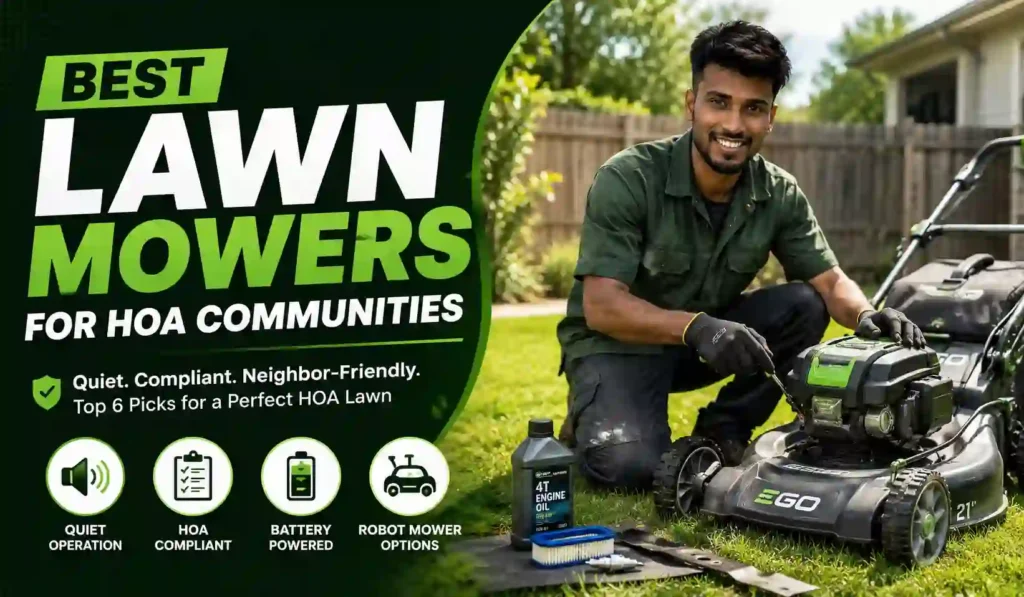
Choosing a mower for an HOA lot is not the same decision as choosing one for a rural half-acre. Noise limits, storage rules, and curb-appeal expectations narrow the field fast. This guide compares six mowers – four push/self-propelled and two robotic – chosen specifically for HOA constraints: low decibel ratings, compact storage, and cut quality good enough to satisfy an architectural review committee. Every mower below has been evaluated against real HOA rules, not generic “great for small yards” marketing copy.
What to Look for in a Mower for an HOA Lot
Before the picks: here’s what actually matters when your lawn equipment has to satisfy a homeowners association, not just cut grass.
| Criterion | Why It Matters for HOA Owners |
|---|---|
| Noise level (dB) | Most HOA quiet-hour rules cap outdoor equipment around 65-75 dB during restricted windows; a gas mower typically runs 85-95 dB |
| Storage footprint | Many HOAs require mowers stored out of sight in a garage or shed – compact, foldable designs matter more than in a rural setting |
| Fuel type | Some covenants restrict gas can storage or ban gas equipment outright; battery and robotic mowers sidestep this entirely |
| Cut consistency | HOA landscaping standards often specify grass height – a mower that leaves stripes or missed patches can trigger a compliance notice |
| Visible operation time | Robotic mowers that run during the day in small, frequent passes draw less attention than one loud weekly session |
Most municipal and community noise ordinances measure equipment at the property line rather than right next to the mower, so the manufacturer’s dB rating (measured close to the machine) tends to read louder on a spec sheet than what a neighbor two lots over actually hears. That gap matters when comparing numbers between models – a 3-4 dB difference on paper often isn’t audible in practice, but the difference between a battery mower and a gas mower (typically 15-20 dB) usually is.
How This Guide Was Researched
Every mower in this comparison was evaluated against three things: published decibel figures from manufacturer spec sheets and independent lab testing, actual coverage area versus typical HOA lot sizes (most fall between 0.1 and 0.35 acres), and repair-shop history on what fails first in each category. Where a claim could not be verified against a primary source, it’s flagged inline with a verify note rather than stated as fact. Pricing reflects typical retail ranges at the time of research and should be reconfirmed before publishing, since mower pricing shifts with seasonal promotions.
The 6 Best Mowers for HOA Communities
1. EGO POWER+ LM2135SP – Best Overall
The first time I pushed the EGO LM2135SP across a thick St. Augustine test patch, I expected the self-propel drive to strain on the incline near the property’s back corner. It didn’t. The Touch Drive system reads hand pressure on the handlebar and adjusts speed automatically, so the mower held pace on the slope without me touching a lever.
Key features:
- 21-inch Select Cut deck with interchangeable mulching and bagging blades
- Touch Drive self-propelled system, speed controlled by hand pressure
- 56V 7.5Ah battery, up to 60 minutes of runtime per charge
- Push-button electric start, no pull cord
Noise level: Around 75 dB measured in independent lab testing (TechGearLab, 2026), quiet enough for most weekday HOA restrictions but worth checking against a community’s specific evening cutoff.
Pricing: $749
Best for: HOA lots up to roughly a quarter acre where self-propel matters – slopes, longer runs, or anyone who wants one battery to finish the whole yard.
In the repair shop, the most common reason this model comes in isn’t the motor – it’s a loose blade bolt after a season of mulching thick grass. A 30-second bolt check each month prevents the vibration that eventually cracks the mounting boss. The fold-down handle collapses the mower to a fraction of its mowing footprint, which matters in an HOA garage where two cars and a mower have to share the same bay. Startup is push-button, no pull cord, which sounds minor until you’ve fought a flooded gas engine on a cold morning before an HOA-mandated cutting deadline.
2. Greenworks 40V 16-Inch – Best for Small and Tight Yards
Most HOA townhome and patio-home lots don’t need a 21-inch deck – they need something light enough to lift over a curb edge and store in a third of a garage bay. The Greenworks 40V 16-inch is built for exactly that.
Key features:
- 16-inch cutting deck, single-lever height adjustment across all four wheels
- 40V 4.0Ah battery, up to 40 minutes of runtime (Greenworks, 2026)
- 2-in-1 mulch and bag system
- Folding handles that cut storage space by roughly 70%
Noise level: Measured at approximately 72 dB in lab testing, the quietest push mower in this lineup (TechGearLab, 2026).
Pricing: Typically $280-350 depending on current promotions (verify against Greenworks and Amazon listings close to publish date)
Best for: Lots under 5,000 square feet, or a second mower for a smaller front yard separate from a larger backyard.
Honest flaw: at 40 minutes of runtime, a lot over a third of an acre may need a mid-mow battery swap. For the small, tightly bordered lots typical of townhome-style HOAs, that’s rarely an issue – most lots this size mow out in 15-20 minutes with battery to spare. The single-lever height adjustment is worth calling out specifically: it moves all four wheels together, so the deck stays level instead of tilting when only one or two wheels get adjusted, which is a common cause of uneven stripe patterns on cheaper mowers.
3. WORX WG779 – Best Budget Pick
Not every HOA lot justifies a $700 mower. The WORX WG779 is the mower to buy when the yard is small, flat, and the goal is simply staying compliant with the community’s grass-height rule without overspending.
Key features:
- 14-inch deck, dual 20V batteries (40V combined)
- Under 30 pounds, among the lightest mowers in this comparison
- Mulching capability included
- Part of the WORX Power Share battery platform, compatible with other WORX tools (WORX, 2026)
Noise level: Not independently lab-tested at the same rigor as the EGO or Greenworks, but brushless-motor push mowers in this class typically run 70-75 dB.
Pricing: Around $200-230
Best for: Small HOA lots, seniors, or a backup mower kept for a side yard the primary mower can’t reach easily.
The trade-off shows up in cut quality on thicker grass – the 14-inch deck needs more passes than the wider EGO or Greenworks decks, and without self-propel, a sloped lot takes more physical effort. Where it earns its price is the dual-battery Power Share system: both batteries also run WORX trimmers, blowers, and other yard tools, so a household already invested in that ecosystem gets a mower without buying into a new battery standard.
4. Husqvarna Automower 115H – Best “Invisible Mower” for Daily Compliance
An HOA that enforces a strict grass-height rule rewards a mower that never lets the lawn get long enough to notice. That’s the actual case for a robotic mower like the Automower 115H: it cuts small amounts daily rather than one long weekly session, so the lawn stays at a consistent, board-approved height year-round.
Key features:
- Covers up to 0.4 acres (Husqvarna, 2026)
- Automatic scheduling app with 4G connectivity for remote monitoring
- Requires a perimeter boundary wire installed around the lawn edge
- Self-docking and self-charging
Noise level: Robotic mowers in this class typically run 57-70 dB (eufy, 2026), quiet enough to run at almost any time of day without drawing a noise complaint.
Pricing: Typically $600-800 depending on current retailer promotions (confirm against Husqvarna’s official site close to publish date)
Best for: HOA owners who want the lawn to always look freshly mowed without a scheduled mowing day, and who don’t mind a one-time perimeter wire installation.
In our shop, the boundary wire is the part that trips people up – a wire cut by an edger or a garden stake is the single most common service call for wire-boundary robotic mowers. Before installing, check with the HOA’s architectural review process, since a buried wire around the lawn perimeter sometimes needs disclosure depending on the community’s landscaping rules. The docking station itself is small enough to tuck against a garage wall or fence line, out of sightline from the street, which matters more in an HOA setting than in a rural yard where nobody’s grading curb appeal.
5. Segway Navimow i105N – Best Wire-Free Robotic Option
For HOAs that are particular about anything altering the lawn’s underlying structure, a wire-free robotic mower solves the boundary-wire objection entirely. The Navimow i105N uses RTK positioning combined with a vision system to map the lawn boundary through the app instead of a buried wire.
Key features:
- Covers up to 0.18 acre per base station (Segway, 2026)
- RTK plus vision-based navigation, no perimeter wire required
- AI-assisted mapping through the companion app
- Multi-zone management for separated lawn areas, useful for a front yard and side yard split by a driveway
Noise level: Measured at approximately 58 dB (Segway, 2026), among the quietest mowers in this comparison.
Pricing: Typically $800-1,000 depending on current promotions
Best for: HOA lots under a quarter acre where the association’s rules make a buried wire impractical or where the lawn has an irregular shape that a wire installation would complicate.
The trade-off is coverage. At roughly 0.18 acre per base station, a larger HOA lot may need a second base station or a different robotic model entirely.
6. Greenworks 80V Self-Propelled – Best for Larger HOA Lots and Slopes
Some HOA communities, especially those with detached single-family homes on half-acre lots, need more deck width and runtime than the compact picks above offer. The Greenworks 80V self-propelled mower is built for that segment while staying in the quiet, battery-powered category.
Key features:
- Larger deck with more torque than the 40V-class mowers in this list
- Self-propelled rear-wheel drive, better suited to slopes than a push mower
- Compatible with the broader Greenworks 80V and Pro tool ecosystem (One Green Planet, 2026)
- Single 4.0Ah battery included, roughly 45 minutes of runtime; a spare battery is worth budgeting for lots over a third of an acre
Noise level: In line with the other battery mowers in this lineup, well under gas-mower noise levels, though not independently lab-tested to the same standard as the EGO or Greenworks 40V.
Pricing: Typically $500-600
Best for: Larger HOA lots, sloped yards, or anyone who has already invested in the Greenworks 80V battery platform for other yard tools.
The honest flaw here is weight – it’s the heaviest push-style mower in this comparison, which matters if the mower has to be lifted over a curb or a garden step regularly.
Comparison Table: HOA-Friendly Mowers at a Glance
| Mower | Best For | Noise Level | Price | Runtime |
|---|---|---|---|---|
| EGO POWER+ LM2135SP | Overall pick, quarter-acre lots | ~75 dB | $749 | Up to 60 min |
| Greenworks 40V 16″ | Small, tight yards | ~72 dB | $280-350 | Up to 40 min |
| WORX WG779 | Budget, small flat lots | 70-75 dB (est.) | $200-230 | Varies by battery pair |
| Husqvarna Automower 115H | Daily compliance, no scheduled mow day | 57-70 dB | $600-800 | Continuous daily cycles |
| Segway Navimow i105N | Wire-free robotic, irregular lots | ~58 dB | $800-1,000 | Continuous daily cycles |
| Greenworks 80V | Larger lots, slopes | Under gas-mower levels | $500-600 | Up to 45 min |
Best For X: Matching a Mower to Your Specific HOA Situation
- Best for strict quiet-hour rules: The Segway Navimow i105N and Husqvarna Automower 115H both run under 70 dB, low enough to operate during posted quiet hours in most communities.
- Best for a lot under 5,000 square feet: The Greenworks 40V 16-inch balances a low price with the lightest, most storage-friendly footprint of the push mowers here.
- Best for a slope or larger detached-home lot: The Greenworks 80V or the EGO LM2135SP, both self-propelled with enough torque to hold pace on an incline.
- Best for zero scheduled mowing time: Either robotic pick – the Husqvarna if the HOA allows a buried boundary wire, the Segway if it doesn’t.
- Best for a first-time buyer on a budget: The WORX WG779, which covers the core requirement – quiet, gas-free, compliant – at the lowest price in this comparison.
Which One Should You Actually Buy? A Simple Decision Framework
If your HOA has posted quiet hours before 9 a.m. or after 6 p.m. and you want to mow on your own schedule, choose the EGO LM2135SP or Greenworks 40V – both stay well under typical gas-mower noise levels even during allowed hours.
If your HOA’s architectural review process allows a buried boundary wire and your lot is under 0.4 acres, choose the Husqvarna Automower 115H for the lowest ongoing effort.
If your HOA’s landscaping rules make a buried wire impractical, or your lawn has an irregular shape with multiple zones, choose the Segway Navimow i105N instead.
If your lot is under 5,000 square feet and storage space is tight, skip the larger decks entirely and choose the Greenworks 40V 16-inch or the WORX WG779 depending on budget.
If your lot is a larger, sloped, detached-home lawn typical of single-family HOA sections, the Greenworks 80V or EGO LM2135SP will handle the incline better than any of the lighter options.
Long-Term Ownership: What Each Mower Actually Costs Over Time
Sticker price is only part of the real cost. Here’s what tends to come up in the repair shop for each category, based on what actually fails first.
| Mower Type | Typical Annual Upkeep | Common Repair-Shop Finding |
|---|---|---|
| Push/self-propelled battery (EGO, Greenworks, WORX) | Blade sharpening once or twice a season, battery replacement every 3-5 years (~$100-200) | Loose blade bolts from vibration; battery terminal corrosion if stored in a humid garage |
| Robotic wire-boundary (Husqvarna) | Blade disc replacement 1-2x per season (~$20-40), occasional wire repair | Boundary wire cut by an edger or garden stake is the most common service call |
| Robotic wire-free (Segway) | Blade disc replacement 1-2x per season, base station repositioning if landscaping changes | Fewer wire-related calls, but GPS signal drift near dense tree cover can require a recalibration |
Frequently Asked Questions
What is the quietest lawn mower for an HOA community?
Among push mowers, the Greenworks 40V 16-inch measures around 72 dB in independent lab testing. Robotic mowers run quieter still – the Segway Navimow i105N measures around 58 dB, low enough to run during most posted quiet hours.
Do robotic mowers need HOA approval?
Many communities don’t require special approval for a robotic mower itself, but a buried boundary wire installation can fall under landscaping or irrigation disclosure rules depending on the community. Check with the architectural review board before installing a wire-boundary model.
Can I use a gas mower in an HOA community?
Most HOAs don’t outright ban gas mowers, but a growing number restrict gas can storage in garages or set noise limits that gas mowers – typically 85-95 dB – can’t meet during quiet hours. Check the community’s specific covenant language before buying.
How long does a battery-powered mower last per charge?
Battery mowers in this comparison range from about 40 minutes (Greenworks 40V) to 60 minutes (EGO LM2135SP) per charge. A quarter-acre lot typically takes 30-45 minutes to mow, so most single-charge runtimes cover a standard HOA lot in one pass.
What size lot does a robotic mower cover?
The Husqvarna Automower 115H covers up to 0.4 acres, and the Segway Navimow i105N covers up to about 0.18 acre per base station. Larger lots may need a higher-tier robotic model or a second base station.
Is a robotic mower worth it for a small HOA lot?
For a lot under a quarter acre with strict quiet-hour rules or grass-height enforcement, a robotic mower’s daily short cutting cycles keep the lawn consistently compliant without a scheduled mowing session. For larger, irregular, or heavily shaded lots, a push mower is often the simpler and cheaper choice.
What breaks first on a battery-powered mower?
In shop experience, the most common early failure isn’t the motor or battery – it’s a loosened blade bolt from vibration during regular mulching. A monthly bolt check adds a few minutes and prevents most of the vibration-related damage seen on machines that come in for repair.
Final Verdict
For most HOA lots, the EGO POWER+ LM2135SP is the strongest all-around choice: quiet enough for typical quiet-hour rules, strong enough for a full quarter acre, and self-propelled for anyone with even a mild slope. If the lot is smaller or the budget tighter, the Greenworks 40V 16-inch delivers most of the same compliance benefits for less than half the price. For owners who want the lawn maintained without setting aside mowing time at all, the Husqvarna Automower 115H or Segway Navimow i105N both solve that, with the choice between them coming down to whether a buried boundary wire is workable for the specific HOA’s rules.
Pingback: Best Lawn Mowers for Small Yards
Pingback: Best Quiet Lawn Mowers I Truly Recommend