Quick Answer
- To adjust lawn mower carburetor idle speed, warm up the engine first. Then turn the idle speed screw in small steps until the engine holds a steady idle.
- Most mowers made after 2008 have a sealed, non-adjustable carburetor. This meets EPA emissions rules.
- A rough or stalling idle is often not a carburetor problem at all. Dirty air filters, old fuel, and bad spark plugs cause the same symptoms.
- Turn the idle screw clockwise to raise idle speed. Turn it counterclockwise to lower it. Small quarter-turns work best.
- If your mower idles fine but runs badly at full throttle, the fix is not idle speed. That points to the fuel mixture or a clogged carburetor.
Your lawn mower idle speed is the engine RPM at rest. This is the speed with the throttle released. A bad idle makes the engine stall or run rough. This guide shows you how to check, adjust, and test it the right way. It also covers when adjustment will not fix your problem.
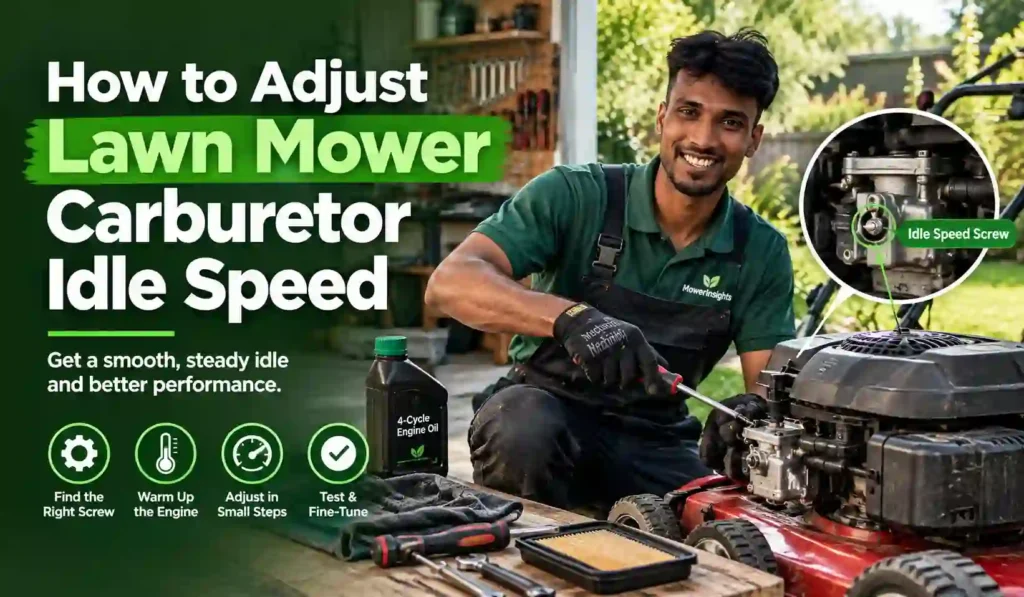
Warm up the engine for 3 to 5 minutes first. Find the idle speed screw. It sits near the throttle lever on the carburetor. Turn it clockwise in small steps to raise idle speed. Turn it counterclockwise to lower it. Stop once the engine holds a steady idle without stalling or racing. Many newer mowers have a sealed carburetor. On those, idle speed is not adjustable by design.
What You Need Before You Start
You do not need many tools for this job. Gather these first.
- A flathead screwdriver. Most idle screws use a narrow flat tip.
- Safety glasses. Small parts and grit can pop loose.
- Work gloves. Optional, but they help with hot engine parts.
- Your owner’s manual, if you still have it. It shows your exact screw locations.
- A clean rag. Carburetors get greasy fast.
- Fresh fuel. Old, stale gas causes idle problems that look like carburetor trouble.
You do not need a full tool kit. This is a five-minute job on most mowers, once the carburetor itself is clean.

Step 1: Check If Your Carburetor Is Adjustable
Look at your carburetor before you touch anything. Many mowers built after 2008 have a sealed carburetor. The idle speed screw may still turn. But the fuel mixture screw is often capped or welded shut. This is not a defect. It is a federal emissions rule.
Small engine makers must meet EPA emission rules. Factory workers set and seal these carburetors before they ship. Once sealed, the mixture is locked. It is not meant to move again. Opening or adjusting a sealed emissions part is against federal law. It can also lead to fines (Briggs & Stratton, 2026).
Here is what this means for you. You can almost always adjust idle speed. This screw sets RPM. It does not touch the fuel mixture. But you may not be able to touch the mixture screw. Some carbs hide it under a plastic limiter cap.
Older mowers work differently. Many pre-2008 carburetors have no seal at all. On those, a typical starting point puts the high-speed needle about one and a half turns out from lightly seated. The idle mixture needle often starts about one and a quarter turns out (Briggs & Stratton, 2026). Treat both numbers as a rough starting point only.
In our shop, this step gets skipped a lot. Homeowners see a mixture screw. They assume it needs a turn. On a sealed EPA carb, that screw is often just a plug. Forcing it can crack the carb body. That turns a five-minute job into a $60 part.
Step 2: Find the Idle Speed Screw and Mixture Screw
Your carburetor has up to two screws. Learn to tell them apart first.
The idle speed screw is usually the bigger one. It typically contacts the throttle lever or throttle plate directly, and it sets how fast the engine idles. Turning it moves the throttle plate itself. This raises or lowers your resting RPM.
The mixture screw is smaller. It often has a spring behind it and sits recessed into the carburetor body. This screw controls the fuel-to-air ratio at idle and low speed. It does not set RPM directly.
Mixing these two up is a common error. Adjusting the wrong screw first is one of the most common mistakes, and it just makes the job take longer. If you are not sure which is which, check your owner’s manual. Or take a clear photo before you turn anything.
Step 3: Warm Up the Engine First
Never adjust a cold engine. This is the step most guides gloss over, and it matters more than people think.
A cold engine runs richer than normal. This is normal and by design. It helps starting. But it means your idle will look wrong until the engine warms up. Run the mower for three to five minutes to reach full operating temperature before making any adjustment.
If your mower will not idle on its own while cold, that is fine. Hold the throttle open slightly by hand until the engine warms up enough to hold its own idle.
I have seen homeowners “fix” an idle in thirty seconds flat. The mower stalls again ten minutes later, once the engine reaches full heat. The screw was never wrong. The engine just was not warm yet.
Step 4: Set the Idle Speed
With the engine warm, you can now adjust idle speed. Work in small steps. Big turns overshoot the target fast.
- Release the throttle. Let the engine settle into its idle.
- Listen and watch. Does it stall? Does it sound like it is about to die?
- If it stalls or nearly stalls, turn the idle screw clockwise. Turn it in small increments, about a quarter turn at a time, until the engine holds a steady idle.
- If the engine idles too fast, turn the screw counterclockwise instead. On a walk-behind mower, the blade should never spin while the engine idles at rest. If it does, the idle speed is set too high. This is also a safety issue, not just a performance one.
- Stop once the idle holds steady. It should not surge. It should not sound like it might die.
There is no single correct RPM number that fits every mower. Idle speed and mixture specs vary by engine model, and your operator’s manual lists the exact target for your machine.
Step 5: Set the Fuel Mixture (If Your Carb Allows It)
Skip this step if your carburetor is EPA-sealed with no exposed mixture screw. Move straight to Step 6.
If you do have access to a mixture screw, this adjustment shapes how smooth your idle actually feels. Idle speed sets the RPM. Mixture sets the quality of the burn at that RPM.
- With the engine idling, turn the mixture screw clockwise. Go slowly, in quarter turns.
- Turning clockwise leans the mixture out, which means less fuel relative to air. As it leans out, the idle gets rough. It may start to hunt, meaning the RPM rises and falls on its own.
- The moment you hear that roughness, stop. Now reverse direction. Turn the screw counterclockwise instead.
- Keep turning past your starting point until the idle sounds smooth and steady. This is your target zone.
- Most mixture screws land somewhere between one and two turns out from lightly seated, but let the actual idle quality guide you rather than a fixed number.
A rich mixture (too much fuel) often shows black smoke and a rough, wet-sounding idle. A lean mixture (too little fuel) shows a high-pitched hunting sound and can run hot. Neither is what you want.
Step 6: Test the Idle and Fine-Tune
Do not call the job done yet. Test across the full throttle range first.
- Let the engine idle for 30 full seconds. It should hold steady the whole time.
- Snap the throttle open. Listen for a clean response, with no hesitation or bog.
- Let go of the throttle. It should drop back to a smooth idle without stalling.
- If the engine hesitates on throttle-up, the mixture likely sits too lean, so turn the mixture screw counterclockwise by a quarter turn and test again.
- If it surges or smokes at full throttle, the mixture is probably too rich, so turn the screw clockwise by a quarter turn and retest.
Change one thing at a time. Test after every change. Adjusting more than one screw at once makes it impossible to know which change actually helped.
Your adjustment is correct once the engine holds a smooth idle, throttles up cleanly, returns to idle without dying, and runs without excess vibration.
Common Mistakes That Cause Bad Idle Adjustments
These are the errors I see most in the shop, in order of how often they show up.
- Adjusting a cold engine. The idle looks fixed for ten minutes. Then it drifts once the engine warms fully.
- Turning screws too far, too fast. Big turns overshoot the target, while small quarter-turns with testing between each one get you there faster.
- Trying to adjust a dirty carburetor. Adjustment corrects settings, while cleaning removes blockages, and a gummed-up carburetor will not respond correctly to either screw until it is cleaned first.
- Changing both screws at once. You lose track of what actually fixed, or broke, the idle.
- Forcing a sealed EPA mixture screw. This can crack the carburetor body or void a warranty.
- Assuming idle problems are always the carburetor. A clogged air filter, a fouled spark plug, or stale fuel from last fall cause the exact same symptoms. In our intake logs, stale fuel accounts for more idle complaints than a true carburetor fault.
Safety Notes Before You Touch the Carburetor
A running mower engine is not a toy. Follow these rules every time.
- Keep hands, screwdrivers, and loose clothing clear of the blade area.
- Never adjust the carburetor with the mower tipped on its side and the engine running.
- Work in an open area. Gas engines release carbon monoxide, and that gas has no smell.
- Keep a fire extinguisher nearby when working near an open fuel bowl or fuel line.
- If your mower has an electric start battery, disconnect it before any carburetor work that does not require the engine running.
- Never bypass a safety interlock, like a blade-brake clutch handle, to make adjustment easier.
When to DIY vs. When to Call a Repair Shop
Most idle speed adjustments are a fair DIY job. Know when to stop and call a shop instead.
DIY is a good fit when:
- Your idle screw turns freely and the carburetor looks clean.
- The mower ran fine last season and just needs a small tune.
- You are comfortable with basic hand tools.
Call a shop when:
- The mixture screw will not turn, or feels seized.
- You smell raw gas, or see fuel leaking from the carb.
- The idle problem returns within a day of adjusting it.
- The engine surges badly even after a proper adjustment. This often points to a worn carburetor gasket, a bad governor spring, or an air leak.
In our shop, roughly one in four “carburetor adjustment” intakes turns out to be a different problem once we open the machine up. A clean carb that still surges usually has an air leak, not a mixture problem.
Total Cost: DIY vs. Professional Adjustment
| Option | Typical Cost | What’s Included |
|---|---|---|
| DIY adjustment | $0 (tools you likely already own) | Idle and mixture screw adjustment only |
| Shop idle/mixture tune-up | $35–$60 | Adjustment, quick idle test, basic inspection |
| Shop carb clean + adjustment | $80–$150 | Full carburetor cleaning, rebuild kit if needed, adjustment, test run |
| Full carburetor replacement | $60–$180 (parts) plus $40–$70 labor | New carburetor, install, adjustment, test run |
Prices are general U.S. market ranges as of 2026 and vary by shop, region, and engine size. Reconfirm current pricing close to publish date.
Idle Speed Troubleshooting
Use this table if a basic adjustment does not solve your problem.
| Symptom | Likely Cause | Fix |
|---|---|---|
| Engine stalls at idle even after adjustment | Idle speed set too low, or dirty carburetor | Raise idle screw slightly; clean carb if that does not hold |
| Idle races and won’t settle down | Idle screw turned in too far | Turn idle screw counterclockwise in small steps |
| Idle hunts up and down on its own | Fuel mixture too lean | Turn mixture screw counterclockwise a quarter turn at a time |
| Black smoke and rough idle | Fuel mixture too rich, or dirty air filter | Check and replace air filter first; then lean the mixture |
| Idle fine, but engine bogs at full throttle | Clogged main jet or fuel filter | Clean or replace the carburetor’s main jet and fuel filter |
| Idle was fine, now surges after sitting all winter | Stale fuel or gummed carburetor | Drain old fuel, refill with fresh gas, clean carb if needed |
| Mixture screw won’t turn at all | Sealed EPA carburetor | Do not force it; idle screw only, or replace the carburetor |
Who This Guide Is NOT For
This guide covers standard walk-behind gas mower carburetors with a float-type design. A few cases fall outside its scope.
- Battery and electric mowers. These have no carburetor. Idle issues do not apply.
- Fuel-injected riding mowers. Some larger riding and zero-turn engines use electronic fuel injection instead of a carburetor. Adjustment works differently on those.
- Robot mowers. No engine, no carburetor, no idle speed to set.
- Diesel commercial mowers. These use a different fuel delivery system entirely.
If your mower falls into one of these groups, this guide will not apply to your specific engine.
Expert Tip From the Shop
Here is something most guides miss. Before you touch any screw, tap the side of the carburetor bowl gently with a screwdriver handle while the engine idles. If the idle smooths out for a second, you likely have debris stuck in the jet, not a bad adjustment. A quick clean will fix it faster than any amount of screw-turning.
Frequently Asked Questions
What is the correct idle speed for a lawn mower?
Most walk-behind mower engines idle between 1,200 and 1,800 RPM. Your exact number is in your owner’s manual.
Why does my lawn mower idle rough after I adjust it?
A rough idle after adjustment often means the mixture is too lean or too rich. It can also mean the carburetor needs cleaning first. Adjustment alone will not fix a clogged carb.
Can I adjust the idle speed on a newer mower?
Yes, in most cases. The idle speed screw is usually still adjustable. The fuel mixture screw is often sealed on mowers built after 2008 to meet EPA rules.
How often should I adjust my mower’s carburetor idle?
Most mowers do not need regular idle adjustment. Check it once a season, or any time you notice stalling, surging, or a rough idle after storage.
Is it illegal to adjust a sealed EPA carburetor?
Yes. Tampering with emission control components on an EPA-regulated engine is illegal and can bring civil penalties. Idle speed screws are usually fine to adjust. Mixture screws under an EPA seal are not.
Why does my mower idle fine but stall when I engage the blade?
This usually points to idle speed set too low, not the mixture. Engaging the blade adds load, and a low idle cannot hold under that load. Raise the idle speed slightly and retest.
Can bad gas cause the same symptoms as a bad idle adjustment?
Yes, very often. Stale fuel is one of the most common causes of rough idle and stalling that homeowners mistake for a carburetor adjustment problem. Fresh fuel alone sometimes solves it.
Key Takeaways
- Idle speed and fuel mixture are two separate adjustments, made with two separate screws.
- Always warm up the engine for 3 to 5 minutes before adjusting anything.
- Turn screws in small quarter-turn steps, and test between each change.
- Many newer mowers have a sealed, non-adjustable mixture screw by law. Do not force it.
- If the idle problem returns fast, or the carb is gummed up, a repair shop can save you time and a cracked carburetor.