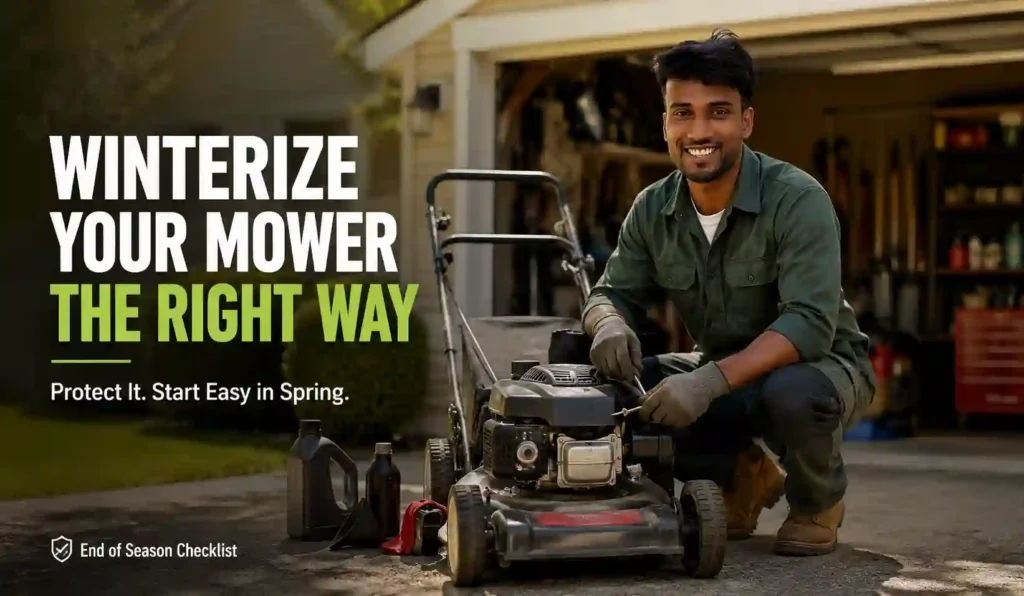
Winterizing a mower means draining or stabilizing the fuel, changing the oil, cleaning the deck, sharpening or replacing the blade, charging or storing the battery correctly, and storing the machine somewhere dry. Do this within two to three weeks of your last cut. Skip it and you’re looking at gummed-up carburetors, corroded decks, and dead batteries by spring, three of the top reasons mowers land on a repair bench in March.
When to Winterize Your Mower
Winterize as soon as you’re done mowing for the season, not after the first frost. In most of the U.S. and similar climates, that’s a two to three week window after your last cut, once grass growth has stopped for good.
Waiting too long is the single biggest reason gas mowers fail to start in spring. Ethanol-blended fuel starts breaking down within 30 days if left untreated, and the varnish it leaves behind clogs carburetor jets. In our shop, the majority of spring tune-up jobs trace back to fuel that sat in the tank all winter with no stabilizer.
What You’ll Need
- Fuel stabilizer (for gas mowers) or a plan to run the tank dry
- Fresh engine oil matching your mower’s spec (check the owner’s manual for viscosity)
- Oil filter, if your mower uses one
- Spark plug (a spare, or the correct gap tool to clean the existing one)
- Wire brush and putty scraper for deck cleanup
- Garden hose or pressure washer (low setting)
- Blade balancer and a mill file, or a replacement blade
- Torque wrench for the blade bolt
- Work gloves and safety glasses
- Battery charger appropriate for your mower’s battery chemistry, if applicable
- A tarp or breathable cover for storage
Step 1: Deal With the Fuel (10 minutes)
You have two options, and one is clearly better for most homeowners: add fuel stabilizer and run the engine for 10 minutes so it circulates through the carburetor, then top off the tank to reduce condensation. The alternative, running the tank completely dry, works but leaves the carburetor bowl empty and more prone to gasket drying and cracking over a long winter.
Use a stabilizer rated for ethanol blends (most pump gas in the U.S. is E10).
Step 2: Change the Oil (15 minutes)
Drain the old oil while the engine is still slightly warm from Step 1; it flows out faster and carries more sediment with it. Old oil left in the crankcase over winter holds moisture and combustion byproducts that accelerate internal corrosion on cylinder walls and bearings.
Refill with the oil grade listed in your owner’s manual, typically SAE 30 or SAE 10W-30 depending on climate. Check the dipstick level with the mower on level ground.
Step 3: Replace or Clean the Spark Plug (5 minutes)
Pull the plug and check the electrode gap against the manufacturer spec, usually 0.030 inches on small engines. A fouled or worn plug is cheap insurance against hard starting in spring; plugs cost $3 to $8 and take five minutes to swap. If the electrode is worn rounded or the porcelain is cracked, replace it rather than clean it.
Step 4: Clean or Replace the Air Filter (5 minutes)
Paper filters get replaced, not cleaned. Foam filters can be washed in warm soapy water, dried fully, and lightly re-oiled before reinstalling. A dirty filter restricts airflow and is one of the more common reasons a mower runs rough after winter storage even when the fuel and plug are fine.
Battery-Powered Mower Winterization Steps
Battery mowers skip the fuel and oil steps entirely, but the battery itself needs specific handling or it degrades faster than it should.
Step 1: Charge to the Storage Level Your Manufacturer Recommends
Lithium-ion batteries, which power most current cordless mowers, store best at roughly 40 to 60 percent charge, not full and not empty. Storing a lithium battery fully charged through a cold winter accelerates capacity loss. Check your specific model’s manual, since some brands build in storage-mode charging logic that manages this automatically.
Step 2: Store the Battery Separately, Indoors
Remove the battery from the mower and store it in a climate-controlled space, ideally between 50°F and 70°F. Lithium batteries left in an unheated garage or shed through a hard freeze lose capacity permanently, and repeated freeze-thaw cycles are worse than one cold snap.
Step 3: Wipe Down Contacts and Check for Corrosion
A dry cloth is usually enough. If you see white or greenish buildup on the battery contacts, that’s corrosion, and it’s worth cleaning with a contact cleaner before it spreads.
Step 4: Deck and Blade Care Still Applies
Battery mowers still need the same deck, blade, and undercarriage attention as gas mowers. Skip ahead to the next section for that.
Deck, Blade, and Undercarriage Care
Clean Grass Buildup From the Deck
Dried grass clippings trap moisture against the metal deck and are the leading cause of deck corrosion we see in the shop. Tip the mower so the spark plug faces up (gas models) or the battery bay faces up (battery models) to avoid oil or electrical contact with ground moisture, then scrape and hose off caked-on debris.
Sharpen or Replace the Blade
A dull blade tears grass instead of cutting it, which stresses the lawn and the engine both. Remove the blade, check it for cracks, bends, or excessive wear near the wing tips, and either sharpen it to a 45-degree bevel or replace it if it’s chipped or thinned unevenly. Reinstall with the torque spec listed in your manual, commonly 35 to 45 ft-lbs on residential push mowers.
Expert Tip: Balance the blade on a nail or blade balancer after sharpening. An unbalanced blade vibrates the whole deck at speed, and that vibration is what eventually cracks spindle bearings, a repair that costs far more than the blade itself.
Grease Zerk Fittings and Wheel Bearings
If your mower has grease fittings on the front axle or deck spindles, give each one a few pumps of general-purpose lithium grease. This is the step most homeowners skip entirely, and it’s why wheel bearings and spindle bearings show up so often on our repair bench by the third season.
Tire, Belt, and Cable Checks
| Component | What to Check | Why It Matters |
|---|---|---|
| Tires | Air pressure, cracking, dry rot | Flat-spotted tires from sitting all winter wear unevenly |
| Drive belt | Cracks, glazing, fraying | Belts that sit under tension all winter crack faster |
| Throttle cable | Smooth movement, no fraying | A stiff cable causes hard starting and inconsistent RPM |
| Self-propel cable | Adjustment, freedom of movement | Prevents the drive from binding when you pull it out in spring |
On self-propelled and riding mowers, release belt tension where the design allows it before long-term storage. A belt held under constant tension for months develops a flat spot that causes a thumping vibration until it wears back in, or sometimes never fully does.
Storage Setup That Actually Protects the Machine
Store the mower somewhere dry with stable temperature swings if possible. A garage or shed beats an open carport. Concrete floors are fine, but put a piece of plywood or a mat under the mower if the floor tends to hold moisture, since prolonged contact with a damp slab accelerates deck rust from underneath.
Use a breathable cover, not plastic sheeting. Plastic traps condensation against the metal and paint, which does more damage over a season than leaving the mower uncovered in a dry garage.
For gas mowers, store upright on wheels rather than on their side unless the manual specifically allows tipping. Storing on the side for months can let oil seep into the air filter or cylinder depending on engine orientation.
Good fit for this storage approach: anyone with an enclosed garage, shed, or covered porch with stable humidity.
Not a good fit: storing a gas mower in an unheated, uninsulated metal shed in a region with major freeze-thaw swings and high humidity; condensation cycling is worse there than in open, dry cold. If that’s your only option, prioritize the fuel stabilization step even more carefully and consider indoor battery storage if you run a cordless model.
Common Mistakes That Cause Spring Repairs
- Leaving old gas in the tank all winter. This is the single most common repair we see walk through the door in March: a gummed carburetor from untreated ethanol fuel that sat for four to six months.
- Skipping the oil change. Old oil left over winter holds acids and moisture that pit bearings and cylinder walls slowly, a problem that doesn’t show up as a symptom until a season or two later.
- Storing a battery mower’s battery fully charged in a cold garage. This quietly shortens battery life, and by the time the owner notices reduced runtime, the damage is already done.
- Not sharpening the blade before storage. A dull blade left on all winter means the first cut of spring tears the lawn and stresses the drive system right when everything else is also getting used for the first time in months.
- Ignoring deck rust until it’s a hole. Surface rust caught in fall is a five-minute wire-brush-and-touch-up-paint job. Left through a wet winter, it can eat through thin deck steel by the following year.
Safety Notes
Disconnect the spark plug wire before doing any blade, deck, or undercarriage work on a gas mower, and remove the battery on a cordless model before touching the blade. Wear gloves when handling the blade; even a dull one can cut skin. If you’re draining fuel, do it outdoors or in a well-ventilated space, away from any ignition source, and store the drained fuel in an approved container, not a household jug.
DIY vs. Calling a Repair Shop
Most of what’s in this checklist is DIY-friendly for anyone comfortable with basic hand tools: oil changes, spark plugs, air filters, blade sharpening, and deck cleaning all fall into that category.
Call a shop if you notice oil in the air filter housing (a sign of a bigger internal issue), a carburetor that’s already gummed from a previous season’s neglect, a battery that won’t hold any charge at all even after a full charge cycle, or a drive belt that’s slipping even after tension adjustment. These point to problems that go beyond routine winterization and are worth diagnosing properly before you put the machine away, not after you pull it out in spring and it won’t run.
If you’re in the Milan area, this is also the kind of pre-storage check we do at the shop directly, alongside the winterization service, so problems get caught in fall instead of turning into a bigger repair bill in spring.
Troubleshooting: If It Won’t Start in Spring
| Symptom | Likely Cause | Fix |
|---|---|---|
| Won’t turn over at all | Dead battery (electric start) or seized engine | Charge/replace battery; if seized, needs a shop diagnosis |
| Turns over but won’t fire | Old fuel, fouled plug | Drain and replace fuel, clean or replace plug |
| Starts, then stalls | Clogged carburetor jet from varnish | Carburetor cleaning, sometimes a full rebuild kit |
| Runs rough, low power | Dirty air filter, stale fuel mix | Replace filter, fresh fuel |
| Excess vibration | Unbalanced or bent blade | Rebalance or replace blade |
| No power at all (battery mower) | Over-discharged or cold-damaged battery | Try charging at room temperature; replace if it won’t take a charge |
Frequently Asked Questions
When should I winterize my lawn mower?
Winterize within two to three weeks of your last cut of the season, once grass growth has stopped. Waiting until the first hard freeze gives fuel more time to degrade and increases the odds of a hard-starting engine in spring.
Do I need to add fuel stabilizer if I only mow a small yard occasionally?
Yes. Fuel stabilizer matters regardless of how much you mowed that season; it’s about how long the fuel sits, not how much of it there is. Ethanol-blended gas starts breaking down within about 30 days whether the tank is nearly full or nearly empty.
Can I skip changing the oil if the mower only has a few hours on it?
No. Oil degrades with age and moisture exposure, not just hours run. Old oil left in the crankcase over a winter still holds contaminants that can pit internal components even on a low-hour engine.
How do I store a battery-powered mower’s battery over winter?
Remove the battery from the mower, charge it to roughly 40 to 60 percent, and store it indoors in a space between 50°F and 70°F. Avoid storing it fully charged or in an unheated shed, both of which shorten its usable life.
Is it bad to store a gas mower on its side?
It depends on the engine. Some manufacturers allow tipping to a specific side for maintenance access, but storing it tipped for months can let oil migrate into the air filter or cylinder on many engine designs. Check your owner’s manual, and when in doubt, store it upright on its wheels.
How often should I sharpen the mower blade?
Sharpen at least once a season, typically at winterization, and again mid-season if you mow rocky or debris-heavy terrain. A blade that’s visibly nicked, bent, or tearing grass instead of cutting it needs attention sooner.
What happens if I don’t winterize my mower at all?
Skipping winterization is the most common reason mowers fail to start reliably in spring. Untreated fuel gums up the carburetor, old oil accelerates internal wear, and an uncleaned deck corrodes faster, especially in wet climates. Most of these problems are preventable in under an hour of work each fall.
Summary
Winterizing a mower comes down to four things: handle the fuel, change the oil, care for the deck and blade, and store it somewhere dry with the battery managed correctly if it’s a cordless model. Do this within a few weeks of your last cut, not after the first freeze. The whole process takes under an hour for most gas mowers and even less for battery models, and it’s the difference between a mower that starts on the first pull in spring and one that ends up on a repair bench.
Pingback: How to Maintain a Zero-Turn Hydrostatic Transmission