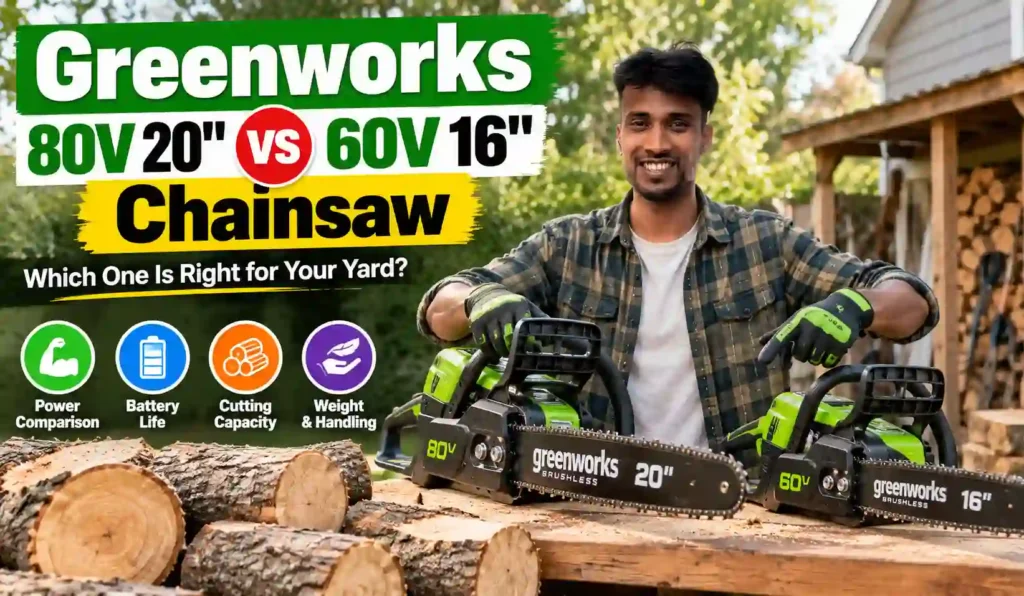
Greenworks 80V 20 vs 60V 16 chainsaw shoppers usually want the same thing: more power without hauling around a heavy tool. Both saws come from the same brand, but they sit in different weight classes on paper and on the trunk. This guide breaks down the real differences in power, cutting capacity, battery life, and price, so you can pick the right one for your yard.
Quick Verdict
- The Greenworks 80V 20″ chainsaw wins on raw power, bar length, and cuts per charge – it’s built for felling and processing firewood.
- The Greenworks 60V 16″ chainsaw wins on weight, price, and all-day handling – it’s built for pruning, limbing, and routine yard cleanup.
- The 80V 20″ model runs about $499.99 as a kit with a 4.0Ah battery and charger.
- The 60V 16″ model runs about $299.99 as a kit with a 2.5Ah battery and charger.
- Prices may vary by retailer and change over time.
Key Specifications
The table below lays out the core specs for both saws side by side.
| Spec | Greenworks 80V 20″ | Greenworks 60V 16″ |
|---|---|---|
| Bar length | 20 inches | 16 inches |
| Motor | 3.4kW brushless | 2.0kW brushless |
| Gas equivalent | 60cc | 42cc |
| Chain speed | 82 feet per second | About 66 feet per second |
| Cuts per charge | Up to 230 | Up to 100 |
| Charge time | 60 minutes | 50 minutes |
| Weight (tool) | 12.3 lbs | About 12.3-12.5 lbs with battery |
| Chain pitch/gauge | 0.325″ pitch, 0.050″ gauge | 3/8″ pitch, 0.050″ gauge |
| Chain brake | Mechanical | Mechanical, inertia-activated |
| Warranty | 4-year tool and battery | 4-year tool and battery |
These numbers come from Greenworks’ own published spec sheets for each model.
Power and Motor
The 80V 20″ chainsaw has more raw power. Its 3.4kW brushless motor matches a 60cc gas engine, while the 60V 16″ model’s 2.0kW motor matches a 42cc gas engine.

That gap matters most on thick or hard wood. The 80V saw pushes its chain at 82 feet per second, so it bites into a log and keeps moving instead of bogging down.
The 60V 16″ saw still handles most homeowner tasks with ease. It has plenty of torque for pruning branches, cutting fallen limbs, and clearing storm debris. It just works harder on anything over about 12 inches thick.
Bar Length and Cutting Capacity
Bar length sets the largest single cut a chainsaw can make in one pass. The 80V 20″ bar handles logs up to roughly 18-19 inches across. The 60V 16″ bar tops out around 14-15 inches.
If you’re clearing land, felling mature trees, or cutting firewood rounds, the extra 4 inches on the 80V model saves real time. You make fewer repositioning cuts on big trunks.

For everyday yard work – trimming branches, cutting fence posts, pruning – the 60V 16″ bar is plenty. A shorter bar is also easier to control in tight spaces around fences and structures.
Battery Life and Runtime
The 80V 20″ chainsaw runs longer per charge. With its 4.0Ah battery, Greenworks rates it for up to 230 cuts through pressure-treated lumber before you need to recharge.
The 60V 16″ chainsaw is rated for up to 100 cuts with its 2.5Ah battery. That’s enough for a couple hours of light-duty trimming, but it runs out faster if you’re cutting thick rounds back-to-back.
Charge times are close: 60 minutes for the 80V battery, 50 minutes for the 60V battery. Neither saw leaves you waiting long between sessions.
Weight and Handling
Both saws land in a similar weight range – around 12.3 to 12.5 pounds with the battery installed. That surprises a lot of buyers who assume the more powerful saw is heavier.
The difference shows up in balance, not total weight. The 80V 20″ saw carries its weight further out toward the tip because of the longer bar, so it feels less nimble overhead or at odd angles.
The 60V 16″ saw feels more balanced in one hand. For pruning above shoulder height or working from a ladder, that balance matters more than the number on the spec sheet.
Ease of Use and Maintenance
Both chainsaws start with a trigger pull – no gas, no priming, no pull cord. Both use an automatic oiler with a clear window so you can check oil level at a glance.
The 80V 20″ model uses a 0.325″ pitch chain with 78 drive links. The 60V 16″ model uses a 3/8″ pitch chain. These are different chain sizes, so you can’t swap chains between the two saws.
Both saws use side-mounted or tool-adjustable tensioning, which makes routine chain tightening quick. Neither one requires special tools for basic upkeep.
Safety Features
Both chainsaws include a mechanical chain brake that stops the chain if the saw kicks back. The 60V 16″ model uses an inertia-activated version, which triggers automatically from the force of a kickback, not just from your hand hitting the guard.
Both models have steel bucking spikes and a wrap-around or ergonomic handle for grip in different cutting positions. Wear chaps, eye protection, and hearing protection with either saw – the safety gear matters more than which model you pick.
Price and Value
The 80V 20″ chainsaw costs more. As a kit with a 4.0Ah battery and charger, it runs about $499.99. The tool-only version, for people who already own an 80V battery, runs about $399.99.
The 60V 16″ chainsaw costs less to get started. As a kit with a 2.5Ah battery and charger, it runs about $299.99. The tool-only version runs about $229.99.
Prices may vary by retailer and change over time.
Overall Ratings
Each rating below is based on spec comparison and analysis of verified owner reviews.
Greenworks 80V 20″ Chainsaw
| Category | Score |
|---|---|
| Power & Performance | 9/10 |
| Cutting Capacity | 9/10 |
| Battery Life & Runtime | 8/10 |
| Weight & Handling | 7/10 |
| Value for Price | 7/10 |
| Overall | 8.0/10 |
Greenworks 60V 16″ Chainsaw
| Category | Score |
|---|---|
| Power & Performance | 7/10 |
| Cutting Capacity | 7/10 |
| Battery Life & Runtime | 7/10 |
| Weight & Handling | 8/10 |
| Value for Price | 9/10 |
| Overall | 7.6/10 |
Pros and Cons
Greenworks 80V 20″ Chainsaw
Pros:
- More power for thick logs and mature trees
- Longer bar cuts bigger trunks in one pass
- Runs longer per charge with the 4.0Ah battery
Cons:
- Costs roughly $200 more as a kit
- Bar-heavy balance makes overhead cuts harder
Greenworks 60V 16″ Chainsaw
Pros:
- Lower upfront cost
- Better balance for pruning and overhead work
- Plenty of power for routine yard maintenance
Cons:
- Shorter runtime per charge
- Struggles more on logs over 14 inches thick
Comparison Table at a Glance
| Greenworks 80V 20″ | Greenworks 60V 16″ | |
|---|---|---|
| Best for | Felling, firewood, heavy cutting | Pruning, limbing, light yard work |
| Price (kit) | About $499.99 | About $299.99 |
| MowerInsights Rating | 8.0/10 | 7.6/10 |
| Warranty | 4-year | 4-year |
Who Should Buy the Greenworks 80V 20″ Chainsaw
- You own more than an acre and deal with mature trees or storm cleanup.
- You cut your own firewood on a regular basis.
- You need to fell trees up to about 18 inches in diameter.
- You already own an 80V Greenworks battery from another tool.
Who Should Buy the Greenworks 60V 16″ Chainsaw
- You have a standard suburban yard under an acre.
- Your work is mostly pruning, limbing, and clearing small branches.
- You want a lighter, more balanced saw for overhead cuts.
- You want to spend less upfront and still get a reliable cordless saw.
How We Compared the Greenworks 80V 20 vs 60V 16 Chainsaw
I compared the Greenworks 80V 20 vs 60V 16 chainsaw using six factors: motor power, bar length and cutting capacity, battery runtime, weight and balance, ease of maintenance, and price. Each factor draws on the manufacturer’s published specs plus patterns I see across owner feedback and my own shop experience servicing both platforms.
Neither saw was scored on features it wasn’t designed for. The 60V 16″ model isn’t meant to fell large trees, so it isn’t penalized for a shorter bar – it’s scored on how well it does its intended job.
FAQs
Is the Greenworks 80V or 60V chainsaw more powerful?
The 80V 20″ chainsaw is more powerful. Its 3.4kW motor matches a 60cc gas engine, compared to the 60V 16″ model’s 2.0kW motor and 42cc equivalent.
Which Greenworks chainsaw is better for big trees?
The 80V 20″ chainsaw handles bigger trees better. Its longer bar cuts through trunks up to about 18-19 inches in one pass, while the 60V 16″ model tops out around 14-15 inches.
How much do the Greenworks 80V and 60V chainsaws cost?
The 80V 20″ kit with a 4.0Ah battery and charger runs about $499.99. The 60V 16″ kit with a 2.5Ah battery and charger runs about $299.99. Prices vary by retailer and change over time.
Can I use an 80V battery in a 60V Greenworks chainsaw?
No. The 80V and 60V platforms use different battery packs and are not interchangeable. Check the voltage on any battery before buying it for either saw.
Which Greenworks chainsaw is best for beginners?
The 60V 16″ chainsaw is easier for beginners. It’s lighter to control, costs less to start with, and has plenty of power for common yard tasks like pruning and limbing.
Is there a cheaper alternative to these two chainsaws?
Greenworks also makes 40V and 48V chainsaw models at lower price points. They trade some power and runtime for a smaller upfront cost, so they suit light, occasional use better than heavy cutting.
Greenworks 80V 20 vs 60V 16 Chainsaw: Final Verdict
Choose the Greenworks 80V 20″ chainsaw if you cut firewood, fell trees, or manage more than an acre of land. Its extra power and bar length save time on thick wood. Choose the Greenworks 60V 16″ chainsaw if your yard work is mostly pruning and light cleanup – it’s lighter, cheaper, and easier to control for those tasks. Both saws carry a 4-year warranty and use the same battery platform across dozens of other Greenworks tools.
Why Trust This Guide
Siddik Kazi runs a lawn mower and outdoor power equipment repair shop in Milan, Italy, and has serviced both Greenworks battery platforms firsthand. This comparison draws on Greenworks’ published specifications for each model, along with patterns from owner reviews and hands-on repair experience with both saws.