Key Takeaways
- A single loud click almost always means the starter solenoid is not getting enough power to engage.
- Rapid, repeated clicking points to a weak or dead battery on electric-start mowers.
- On pull-start gas mowers, a click can also come from a loose flywheel key or a worn starter pawl, not the battery at all.
- In Siddik’s repair shop, weak batteries and corroded battery terminals cause about 6 out of 10 “clicking” complaints.
- Most fixes cost between $0 (clean the terminals yourself) and $45 (replace the solenoid). A full starter motor swap runs higher.
Your mower makes a clicking sound. It will not start. This click is usually the starter trying to engage. It is not getting enough power to do its job. This guide sorts the real causes by how often they actually happen. It also tells you what each fix costs.
Mowing Essentials
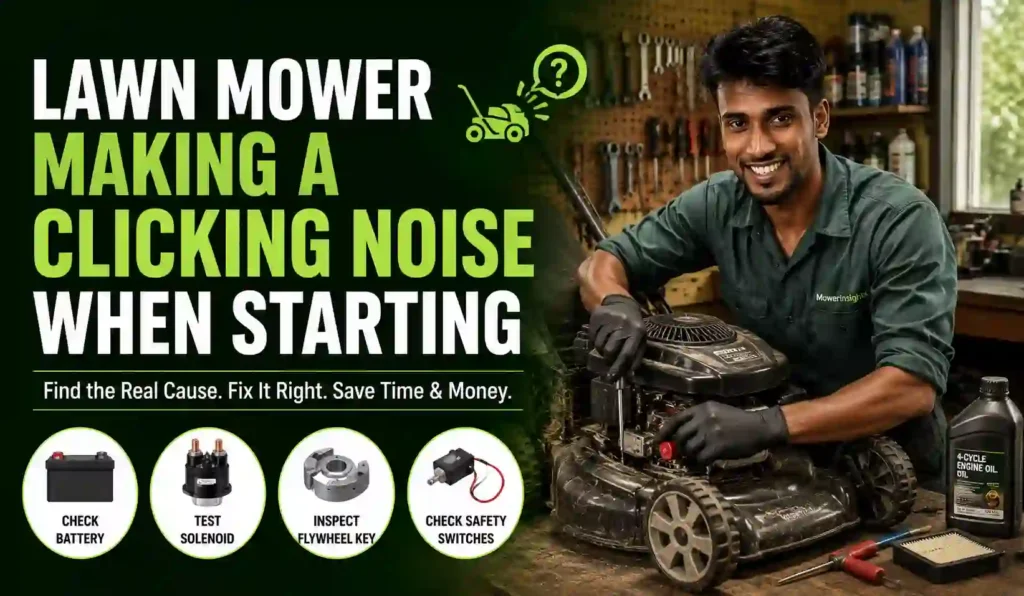
A clicking mower almost always means the starter is not getting full power. Check the battery and terminals first. They cause most click complaints. If the battery is good, test the solenoid next. On gas mowers, also check the flywheel key. A bent key stops the engine from turning over.
What You’ll Need
- A multimeter (any basic one under $20 works)
- Wire brush or terminal cleaning tool
- Wrench set (metric and standard, mower-dependent)
- Work gloves
- Owner’s manual for your model
Step 1: Figure Out the Click Type
Listen closely to the click. This tells you where to look first.
One single click, then silence. This usually means low power at the solenoid. The battery or a corroded wire is the likely cause.
Rapid clicking, like a fast tapping sound. This is a classic weak-battery pattern. The battery has just enough charge to try, not enough to finish.
A click, then a grinding or whirring sound. This can mean the starter motor spins but does not catch the flywheel. A worn starter pawl or bad flywheel key can cause this.
Step 2: Check the Battery and Terminals
Start here. In our shop, weak or corroded batteries cause most clicking complaints. This step takes five minutes.
- Turn off the mower. Remove the key if it has one.
- Look at both battery terminals. Check for white or green crust. That crust is corrosion.
- Disconnect the terminals. Scrub them with a wire brush.
- Reconnect the terminals. Make sure they are tight. A loose terminal cannot pass enough current.
- Set your multimeter to DC volts. Test the battery. A healthy 12V mower battery reads 12.4 volts or higher at rest.
If the battery reads below 12 volts, charge it fully. Then test again. A battery that will not hold a charge needs replacing. Most replacement mower batteries cost $30 to $70
Step 3: Test the Starter Solenoid
The solenoid is a small electrical switch. It sends battery power to the starter motor. A bad solenoid is the second most common cause we see for a single loud click.
- Locate the solenoid. It is usually a small black or silver box near the battery.
- With the battery fully charged, turn the key or press the start button.
- Listen and feel the solenoid. A working solenoid makes one solid click and you can feel a small internal movement.
- If you hear the click but the starter motor stays silent, the solenoid may be bad.
- A basic continuity test with your multimeter can confirm this. Set the meter to continuity mode. Test across the solenoid’s large terminals while a helper presses start.
A new solenoid typically costs $15 to $45. It is one of the cheapest parts on the mower to replace.
Step 4: Check the Flywheel Key (Gas Mowers)
This step applies to gas mowers only. Skip it if you have a battery-electric model.
The flywheel key is a small soft-metal piece. It lines up the flywheel with the crankshaft. If the blade hits a rock or thick root, the key can bend or shear. A sheared key can cause hard starting and a clicking or grinding sound as the engine tries to turn over out of time.
- Remove the spark plug wire first. This is a safety step. Do this before touching the flywheel.
- Remove the flywheel cover, following your manual.
- Look at the small key slot between the flywheel and the crankshaft.
- A bent or sheared key will look visibly off-center or broken.
A flywheel key costs under $10. The labor to access it is the real cost if you pay a shop.
Step 5: Inspect the Starter Pawl (Pull-Start Mowers)
The starter pawl is a small spring-loaded piece. It grips the flywheel when you pull the cord. A worn or broken pawl can cause a clicking or ratcheting sound instead of a clean pull.
- Remove the starter recoil assembly, following your manual.
- Look at the pawl teeth. Worn teeth look rounded instead of sharp.
- Check the spring behind the pawl. A weak spring will not let the pawl grip properly.
- Replace the pawl and spring together if either looks worn.
A pawl and spring kit usually costs $8 to $20
Step 6: Test the Safety Switches
Modern mowers have safety interlock switches. These stop the engine from starting under unsafe conditions. A faulty switch can cause a click with no actual start attempt.
- Check the seat switch on riding mowers. Sit fully in the seat while starting.
- Check the blade engagement switch. Make sure the blade lever is disengaged before starting.
- On push mowers, check the safety bail. It must be held against the handle to start.
- If the mower clicks only when a switch is engaged, that switch is likely the cause.
Troubleshooting Table: Symptom, Cause, Fix
| Symptom | Likely Cause | Fix |
|---|---|---|
| Single loud click, nothing else | Corroded battery terminal | Clean and tighten terminals |
| Rapid, repeated clicking | Weak or dying battery | Charge fully, retest, replace if needed |
| Click, then silence, battery tests fine | Bad starter solenoid | Replace solenoid ($15-$45) |
| Click plus grinding sound (gas mower) | Bent or sheared flywheel key | Replace flywheel key (under $10) |
| Clicking or ratcheting on pull-start | Worn starter pawl | Replace pawl and spring kit |
| Click only when seated or blade engaged | Faulty safety interlock switch | Test and replace the specific switch |
Common Mistakes That Make This Worse
In our shop, we see the same three mistakes over and over.
- Forcing the key or button repeatedly. This drains a weak battery faster. It also stresses the solenoid contacts.
- Jump-starting a mower battery with car cables. Mower batteries are smaller. A car battery can push too much current and damage the mower’s electrical system.
- Skipping the terminal check. Owners often assume a click means a dead starter motor. Most of the time, it is just dirty terminals.
Safety Notes
- Always disconnect the spark plug wire before working near the flywheel or blade.
- Wear gloves when handling the battery. Battery acid can cause burns.
- Never bypass a safety interlock switch to make the mower start. This removes a real safety feature.
- Work on a flat, stable surface. Chock the wheels on riding mowers.
DIY vs. Calling a Pro
Do it yourself if: the issue is battery corrosion, a weak battery, or a simple solenoid swap. These are beginner-friendly fixes with common tools.
Call a pro if: you find a sheared flywheel key, internal starter motor damage, or a wiring problem you cannot trace. These repairs involve more disassembly and carry more risk of doing further damage.
In Milan, MowerInsights also offers hands-on repair and diagnostic service for exactly this kind of issue
Expert Tip
Corroded terminals often look fine from the top. Always disconnect the terminal and check the metal underneath the connector clamp. That hidden spot corrodes first, and it is the spot most owners miss.
Total Cost of Ownership: What Clicking Repairs Actually Cost
| Cause | Typical Part Cost | DIY Time | Shop Labor Estimate |
|---|---|---|---|
| Corroded terminals | $0 (cleaning only) | 5-10 min | $0-$25 |
| Weak/dead battery | $30-$70 | 15 min | $20-$40 install |
| Bad solenoid | $15-$45 | 20-30 min | $40-$80 total |
| Sheared flywheel key | Under $10 | 45-60 min | $60-$100 total |
| Worn starter pawl | $8-$20 | 30-45 min | $50-$90 total |
Frequently Asked Questions
Why does my mower click but not turn over?
The starter is trying to engage but is not getting enough power. A weak battery or corroded terminal is the most common cause. A bad solenoid is the second most common.
Can a bad spark plug cause clicking?
No. A spark plug affects ignition after the engine turns over. Clicking happens before that, in the starting circuit. A bad spark plug causes stalling or no-start after cranking, not clicking.
Is it safe to keep trying to start a mower that clicks?
Repeated attempts can drain the battery further and stress the solenoid. Stop after two or three tries. Check the battery and terminals before trying again.
Does a clicking noise mean I need a new starter motor?
Not usually. Most clicking issues trace back to the battery, terminals, or solenoid. A full starter motor replacement is a less common outcome.
How do I know if it’s the battery or the solenoid?
Test the battery voltage first. If it reads 12.4 volts or higher and the mower still just clicks, the solenoid is the next suspect.
Can cold weather cause a mower to click when starting?
Yes. Cold temperatures reduce a battery’s ability to deliver current. A battery that works fine in summer can click in cold weather if it is already weak.
Pingback: My Proven Best Battery-Powered Lawn Mowers