Quick Overview
- Wet grass and a full bag cause most bagging problems. Check these two things first.
- Dull blades are the second biggest cause. Sharpen them every 20 to 25 hours of use.
- Low engine speed cuts suction power. Always mow at full throttle when bagging.
- On riding mowers, a worn belt or bad impeller often causes bagging loss.
- Most fixes cost under $35 in parts. Very few need a mechanic.
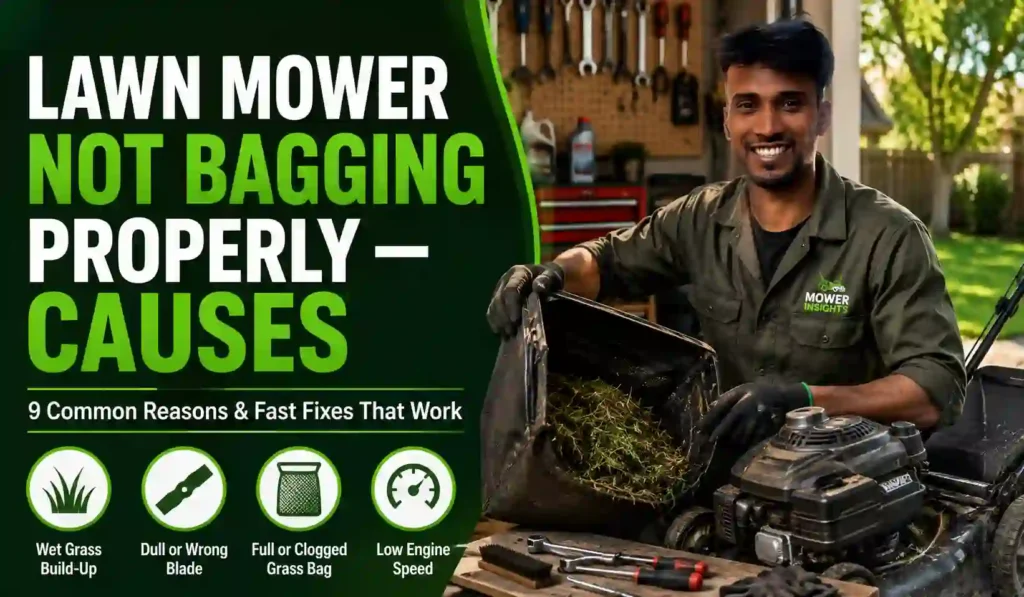
Your lawn mower is not bagging grass properly. That usually means wet grass. It could be a dull blade too. A full bag causes it often. So does low engine speed. This guide covers all nine common causes. It shows you how to check each one. Each check takes just a few minutes. It also shows real repair costs. These come from a working mower shop in Milan. Siddik fixes these same problems every week.
What You’ll Learn
Check these four things first. Empty the bag if it’s over half full. Feel the grass with your hand. If it’s wet, wait it out. You can also raise the deck height. Run the engine at full throttle. Never use a slower setting for bagging. Look under the deck too. Check for packed grass clumps there. These four checks fix most bagging problems. Most take under ten minutes. You won’t even need a tool.
What You Need to Check This
You don’t need much for this job. Grab these basics first.
- Work gloves. The blade stays sharp even when the mower is off.
- A putty knife or stiff brush. This clears packed grass fast.
- A tape measure. This checks your deck height setting.
- Your owner’s manual. This gives your exact RPM and torque numbers.
Lay these out before you start. You’ll move through the checks faster with everything in reach. None of these tools cost much. Most homeowners already own them.
Early Warning Signs Before Bagging Fails Completely
Bagging rarely fails all at once. It usually gets a little worse each time first.
Watch for a few small clumps. This can happen even when the bag looks fine. This is often the first sign of a dulling blade.
Watch for the bag filling slower than normal too. A slower fill can mean weak suction. Weak suction often points to low RPM or a packed deck.
Watch for a new sound. Listen for a faint squeal or rattle. If it wasn’t there before, check it. Catch it early, and the fix stays small and cheap.
Waiting for full failure costs more. A small check today beats a bigger repair next week.
What Bagging Failure Sounds and Feels Like
You can often tell the cause before you open the deck. Sound gives real clues. Feel does too.
A dull, muffled sound means a packed deck. A squeal at startup means a slipping belt. A steady rattle means a bent blade.
A sudden loss of push means low RPM. It can also mean a dirty air filter.
Vibration matters too. Light vibration is normal. A sharp, uneven shake means an unbalanced blade.
Learn your mower’s normal sound. Then a bagging problem becomes easy to trace.
Cause 1: Wet or Damp Grass
Wet grass is the single biggest cause of bagging problems. It clumps instead of flowing into the bag.
Water makes grass heavy. Heavy clippings stick to the metal deck. They also stick to the chute walls. This sticky buildup blocks the air. That air normally carries clippings into the bag.
In my shop, this is the first thing I ask. “Did you mow after rain or dew?” Nine times out of ten, yes. I’ve opened decks packed solid with wet green paste.
Wet grass smells different in a hot bag. It turns slimy fast. That smell means the mower bagged wet grass. It should have waited.
The fix: Wait until the lawn dries. Early afternoon works best. If you must mow wet grass, raise the deck one notch. This cuts less material per pass. Slow your walking pace too. This gives clippings more time to clear the chute.
Cause 2: Grass Packed Under the Deck
Grass builds up under the deck over many mows. This buildup blocks airflow. Without airflow, clippings can’t travel to the bag at all.
You’ll notice a change in sound first. A packed deck sounds duller, almost muffled. The engine also seems to work harder for a worse result. That mismatch is your first clue. Engine effort goes up, but cut quality doesn’t.
I see this most in customers who never tip their mower. Grass hardens into a crust over weeks. It can build up over an inch thick. That crust chokes airflow, like a blocked vacuum hose.
The fix: Turn off the mower first. Disconnect the spark plug wire for safety. Tip the mower on its side, spark plug facing up. This keeps oil from leaking into the air filter. Scrape the underside clean with a putty knife. A wire brush finishes stubborn spots. Do this every five to ten mowing sessions. Do it more often in wet seasons.
Cause 3: Dull or Damaged Blade
A dull blade tears grass instead of cutting it. Torn grass is ragged. Ragged clippings clump together instead of flowing smoothly into the bag.
Look closely at your lawn after mowing. Clean cuts look uniform and green across the top. Torn cuts look frayed and messy. The tips often turn brown within a day. This happens even right after mowing.
In the shop, dull blades are the second biggest cause of complaints. I run my thumb along the edge to check it. A sharp edge catches slightly. A dull edge feels smooth, like a butter knife.
The fix: Remove the blade with gloves on, always. Sharpen it with a file. Keep the same edge angle the whole time. Then balance the blade. Use a nail through the center hole. If one side dips, file that side down. Sharpen every 20 to 25 hours of use. For most yards, that’s about once a month.
Cause 4: Low Engine Speed
Your engine needs full power to create strong suction. That suction pulls clippings off the ground. It moves them into the bag.
Many owners mow at a lower throttle setting on purpose. They want less noise or better fuel use. This backfires badly if you’re bagging. Lower engine speed means weaker airflow. Weaker airflow means clippings drop to the ground. They don’t blow into the chute.
I’ve watched customers mow at half throttle for years. They wonder why bagging always fails. One throttle change fixed what they thought was a broken bag.
The fix: Always run at full throttle when bagging. Listen to the engine sound. It should stay strong, not choppy. A choppy sound usually means old fuel. It can also mean a dirty air filter. Fix those first. Then check the throttle is at max.
Cause 5: Full or Overloaded Bag
This sounds obvious. It’s still the top cause in shop intake notes. A full bag can’t hold more grass. Clippings fall out the back instead.
Thick, fast-growing grass fills a bag fast. It can happen in a single pass. Skipping a week of mowing has the same effect.
The fix: Empty the bag once it’s about two-thirds full. Don’t wait for it to overflow. Mow more often during peak growing season. Try twice a week instead of once. This keeps clipping volume lower on each pass. Your bag will fill slower, and your cut quality improves too.
Cause 6: Torn or Clogged Bag Mesh
Most bags use mesh fabric for their walls. Mesh lets air escape while trapping the clippings inside. A torn or matted mesh breaks that balance completely.
Small tears let clippings blow back out. A caked mesh blocks airflow too. It’s coated in old grass dust, like a clogged filter. Both problems look the same from a distance.
The fix: Check the whole bag for holes. Look closely near the seams. Wash a matted bag with a hose and a stiff brush. Let it dry fully first. Replace a torn bag rather than patching it. A universal bag runs about $20 to $45. An OEM bag runs about $35 to $70.
Cause 7: Worn Belt or Pulley
Self-propelled and riding mowers often use a belt. It drives the bagging blower. A worn or glazed belt slips under load. A slipping belt can’t spin the blower fast enough.
Listen for a squeal at startup. That’s often belt slip, not the engine. Customers usually blame the engine first. The belt is the real cause more often.
The fix: Check belt tension against your manual. Look for cracks or a shiny glazed surface. A glazed belt needs replacing, not tightening. A new belt costs about $15 to $35. Most owners can swap it in 20 to 30 minutes.
Cause 8: Damaged Impeller (Riding Mowers)
Riding mowers and tractors often use an impeller. It’s a spinning fan. It pushes clippings through a long discharge tube. This part spins fast and takes real abuse.
String or thick grass can wrap the impeller shaft. This wears out the bearing over time. A worn bearing lets the impeller wobble. A wobbling impeller loses blowing force.
In the shop, this repair takes the most work. It’s the toughest one on this list. It usually means removing the blower housing.
The fix: Inspect the impeller for wrapped debris and bent blades. Clear debris carefully. Engine off, key removed, every time. A cracked impeller needs full replacement. Parts cost about $30 to $80. Add one to two hours of labor. That’s if a shop does the work.
Cause 9: Wrong Blade Type Installed
Some mowers can run either blade type. A mulching blade recuts clippings into tiny pieces. It doesn’t move them toward a bag. Great for mulching. Bad for bagging.
Did bagging get worse right after a blade swap? This is likely why. I see this a lot with secondhand mowers. The old owner often left a mulching blade on.
The fix: Check your blade against your manual. Match the part number exactly. A “high-lift” or bagging blade creates stronger airflow. Swapping to the right blade often fixes weak bagging. No other repair needed.
Slope and Wet Grass: Why Bagging Gets Worse
Bagging problems often get worse on a slope. Most people never connect the two. Here’s why it happens.
A mower deck sits level on flat ground. On a slope, the deck tilts with the hill. That tilt changes how the blade cuts. One side cuts a touch lower.
Uneven cutting makes uneven clippings. Bigger, uneven clippings clog a chute faster. This is true even with a sharp blade.
Wet grass makes it worse. Damp clippings already stick together. Add uneven cuts, and clumps form even faster.
The fix: Mow slopes slowly, always. This gives clippings more time to clear the chute. Check your deck’s level setting if your manual allows one. Avoid wet slopes when you can. Slow and dry beats fast and wet on hills.
Push Mowers vs. Riding Mowers: Different Failure Points
Push mowers and riding mowers fail in different ways. Knowing the difference saves you time.
Push mowers rely on blade lift and chute shape. Their bagging problems are simple. Wet grass, dull blades, and packed decks top the list. Most fixes need only hand tools.
Riding mowers add belts, pulleys, and often an impeller. More parts mean more places to fail. A riding mower can bag well for years. Then it can fail fast. This happens once a belt or bearing wears out.
Self-propelled push mowers sit in between. They add a drive belt but skip the impeller. Belt wear is their main added risk.
| Mower Type | Extra Parts | Most Common Bagging Failure |
|---|---|---|
| Basic push mower | None beyond blade and chute | Wet grass, dull blade, packed deck |
| Self-propelled push mower | Drive belt | Slipping or glazed belt |
| Riding mower | Belt, pulley, impeller | Worn belt or damaged impeller |
A Real Repair Example From the Shop
A customer brought in a riding mower last spring. Bagging had stopped mid-season, with no warning.
He assumed the belt was worn. I checked it first, since that’s the easy part. The belt looked fine.
I pulled the blower housing next. String trimmer line had wrapped the impeller shaft. It had worn a small groove into the metal.
The fix took under an hour. A new impeller cost about $45. The lesson: check the easy parts first. But don’t stop if they check out clean.
How Often Each Cause Shows Up in the Shop
This table reflects patterns Siddik sees across bagging-related repair visits. It’s not a formal published study. It’s a working technician’s field experience. Use it to know where to check first.
| Cause | How Often It’s the Real Problem | Typical Fix Time |
|---|---|---|
| Wet grass or full bag | Very common | Under 5 minutes |
| Dull blade | Common | 15 to 20 minutes |
| Packed deck | Common | 10 to 15 minutes |
| Low engine RPM | Occasional | Under 5 minutes |
| Torn or clogged mesh | Occasional | 5 to 30 minutes |
| Worn belt | Less common | 20 to 30 minutes |
| Wrong blade type | Less common | 10 minutes |
| Damaged impeller | Rare, but costly | 1 to 2 hours |
Repair Cost Guide
Most bagging fixes are cheap. A few, mostly on riding mowers, cost more. Here’s what to expect in parts and labor.
| Fix | Parts Cost | Labor (If You Pay a Shop) |
|---|---|---|
| Blade sharpening | $0 DIY, or $10 to $15 at a shop | 15 to 20 minutes |
| New blade | $15 to $30 push, $25 to $50 riding | 15 minutes |
| New bag | $20 to $70 | 5 minutes |
| New belt | $15 to $35 | 30 to 45 minutes |
| Impeller repair | $30 to $80 in parts | 1 to 2 hours |
Neglect adds up fast over a season. A dull blade left unsharpened for two years often fails completely. It needs full replacement. That’s instead of a $10 sharpening. A belt run past its glazed stage causes more damage too. It can wear down the pulley. A $25 fix can turn into a $70 one. Small, regular checks stay far cheaper than one big repair bill.
Common Mistakes to Avoid
Homeowners make a few repeat mistakes with bagging problems. Watch for these five.
- Mowing wet grass to save time. This is the top cause of a sudden failure. Wait for dry grass instead.
- Ignoring blade sharpness. A blade can look fine from a few feet away. Check the actual edge up close.
- Running at partial throttle. This saves a little noise. It saves a little fuel too. It also kills the airflow bagging needs.
- Skipping deck cleaning. Packed grass builds up slowly. Most owners don’t notice until bagging fails.
- Guessing at the belt. A slipping belt often gets blamed on the engine instead. Check the belt first.
- Mowing too fast on slopes. Speed makes uneven cuts worse. A slower pass helps the deck clear clippings.
- Buying the wrong replacement blade. A mulching blade and a bagging blade often look alike. Match the part number, not just the shape.
When to DIY vs. Call a Pro
Most causes on this list are simple home fixes. Cleaning the deck needs no special skill. Neither does emptying the bag or sharpening a blade. Most owners finish these in under thirty minutes.
A belt swap is still DIY-friendly for most people. You’ll need basic hand tools and your manual open beside you.
Call a pro for impeller or blower housing repair. This job often means removing deck shielding first. It also risks damage if it’s done wrong. A shop visit usually costs less than a botched attempt.
When More Than One Cause Is Active
Sometimes two causes hit at once. This makes the problem harder to spot.
A dull blade paired with wet grass fails fast. Neither problem alone might stop bagging completely. Together, they often do.
A packed deck paired with low RPM behaves the same way. Airflow is already weak from the packed deck. Low engine speed weakens it further.
If one fix doesn’t solve the problem, don’t stop there. Check the next likely cause too. Many bagging failures in my shop are two small problems. Not one big one.
Troubleshooting Table
Use this table for a fast diagnosis. Match it to what you’re seeing right now.
| Symptom | Likely Cause | Fix |
|---|---|---|
| Clumps left on the lawn | Wet grass or dull blade | Wait for dry grass, then sharpen the blade |
| Bag fills but grass still on lawn | Torn bag mesh | Inspect the bag and patch or replace it |
| Grass blows out the side instead of into bag | Full bag or clogged chute | Empty the bag and clear the chute |
| Weak airflow, engine sounds fine | Packed deck underside | Tip the mower and scrape the deck |
| Squealing during mowing | Worn or slipping belt | Check belt tension and look for wear |
| Bagging worked, then suddenly stopped on a riding mower | Damaged impeller | Inspect the blower housing carefully |
| Bagging fine on flat ground, poor on hills | Uneven deck pitch on slope | Slow down and check the deck’s level setting |
How to Test Your Fix
Always test after any fix. This confirms the problem is solved.
Pick a small patch of dry grass. Run the mower at full throttle. Watch the bag fill as you mow. Check for even, clean clippings inside.
Stop and look at the lawn behind you. It should look clean, with no clumps. If clumps remain, one cause may still be active.
Test on a slope too, if you have one. Slope problems don’t always show up on flat ground. A full test covers both cases.
If the fix worked, mow your full lawn as normal. If it didn’t, go back to the troubleshooting table. Move to the next likely cause on the list.
How to Prevent Bagging Problems Before They Start
A short routine prevents most bagging problems. Build these habits into your normal mowing schedule.
- Mow at the right time. Choose dry hours. Mid-morning to early afternoon works best. Skip mowing right after rain or heavy dew.
- Check the blade monthly. Run your thumb along the edge. Wear gloves. Sharpen at the first sign of dullness.
- Empty the bag early. Don’t wait for it to overflow. Empty it once it’s about two-thirds full.
- Scrape the deck often. Do this every five to ten mows. Do it more in wet or thick-growth seasons.
- Confirm full throttle every time. Make this a habit. Do it every mowing session.
- Inspect the belt each spring. Look for cracks. Look for a glazed surface too.
Five minutes of prevention beats an hour of repair. Most of these checks take less time than starting the mower.
Simple Glossary of Terms in This Guide
A few terms in this guide might be new to you. Here’s what each one means. Knowing these makes the rest of this guide easier to follow.
- Deck. The metal cover under the mower. It holds the blade.
- Chute. The tube that carries clippings to the bag.
- Impeller. A spinning fan. It pushes clippings through the chute.
- Belt. A rubber loop. It transfers power from the engine to a part.
- RPM. Revolutions per minute. It measures how fast the engine spins.
- Mesh. The woven fabric on a grass bag. It lets air out.
- Throttle. The control that sets engine speed.
FAQ
Why is my lawn mower suddenly not bagging grass?
A sudden change usually means wet grass. It can also mean a full bag or a clogged chute. Check these three things first. They cause most sudden bagging failures. All three take under five minutes to check.
How often should I sharpen my mower blade for good bagging?
Sharpen your blade every 20 to 25 hours of mowing time. For most lawns, that’s about once a month. A dull blade tears grass instead of cutting it. Torn grass clumps in the bag.
Can a mulching blade cause bagging problems?
Yes. A mulching blade recuts clippings into small pieces. It doesn’t move them toward the bag. Did bagging get worse right after a blade change? Check for a mulching blade by mistake.
Does mesh size on a grass bag matter for bagging performance?
Yes. Finer mesh holds dry clippings well. It clogs faster in wet grass. Coarser mesh breathes better in wet grass. It can let fine clippings through, though. Match your mesh to your usual conditions.
Why does my riding mower bag worse on slopes?
Deck pitch shifts on a slope. This changes how the blade sits over the grass. Uneven cuts make uneven clippings. Uneven clippings clog a chute faster. Mow slopes slowly to help.
Is it normal for a new mower to bag poorly at first?
Some new mowers need the deck to season first. A light coat of dried grass helps airflow on some models. This is minor. It improves after a few mows. If it doesn’t, check blade type and RPM.
How much does it cost to fix a bagging problem?
Most fixes cost under $35 in parts. A blade sharpening costs $0 to $15. A new bag runs $20 to $70. The costliest repair is impeller damage. That’s a riding mower part. Parts alone run $30 to $80.
Should I clean my mower deck after every mow?
A quick check after every mow is smart. A full scrape isn’t always needed. Do a full cleaning every five to ten mows. Clean more often in wet or thick grass.
Can a bad spark plug affect bagging?
Not directly. But it weakens engine power. Weak power means weak suction. Weak suction means poor bagging. Check your spark plug if the engine runs rough.
Do electric mowers have the same bagging problems as gas mowers?
Mostly, yes. Wet grass causes problems on both types. So do dull blades and full bags. Electric mowers skip fuel issues entirely. A low battery can lower suction too.
What size bag do I need for a large yard?
Larger yards need a bigger bag. A bigger bag holds more before it needs emptying. Check your mower’s manual for the largest bag size it supports.
Can I use a mower without a bag at all?
Yes. You can mulch or side-discharge instead of bagging. Mulching cuts clippings small and drops them back on the lawn. Side-discharge tosses clippings out the side. No bag is needed at all.
Key Takeaways
- Check wet grass, bag fullness, and engine speed first. These three cause most problems.
- Sharpen blades every 20 to 25 hours of use, roughly once a month.
- Riding mower impeller damage is rare. It costs the most to fix.
- Most fixes cost under $35 in parts. Most take under 30 minutes.
- Call a pro only for impeller or blower housing work.
- Test every fix on a small patch first. Then mow the full lawn.
- Small, regular checks stay cheaper than one big repair.
Bagging problems almost always trace back to one cause. It’s one of these nine. Start with the simple checks. Wet grass, a full bag, and engine speed take the least time. They fix the most problems too. Work through the list in order. Do this if the simple checks don’t help. Most owners solve their bagging issue without ever calling a shop.