At a Glance
- A stuck pull cord is almost always one of five things: a blocked blade, a broken blade brake bail, hydrolock, a jammed recoil spring, or dirt in the starter housing.
- Start every fix by disconnecting the spark plug. This keeps your hands safe.
- Most stuck cords get fixed in 15 to 30 minutes with basic tools.
- A DIY fix costs $5 to $25 in parts. A shop repair runs $45 to $120 (Siddik’s repair shop, Milan, 2025 rates).
- If the cord feels loose and floppy instead of locked, skip to the recoil spring section. That is a different problem.
What “Pull Cord Stuck” Actually Means
Your pull cord should slide out smooth. Then it should snap back on its own. A “stuck” cord does neither. It might not move at all. It might move an inch, then lock. It might pull all the way, then not retract. It might pull with no resistance at all, like it’s not connected to anything. Each version points to a different cause. This guide walks through all of them, in the order Siddik checks them on his own bench.
I test every fix in this guide on real mowers, not just once. Some come from customers. Some are mowers I bought used, just to take apart. A stuck cord is one of the most common reasons a mower shows up at my shop each spring. It is also one of the fastest fixes, most of the time. That is why I wrote this guide the way a repair shop actually works through the problem, not the way a manual explains it.
Who This Guide Is For (and Who It Isn’t)
Good fit for this guide if: your mower has a pull-start engine, gas or manual-start. That covers most walk-behind push mowers and many self-propelled models.
Not a good fit if: your mower is fully electric, battery or corded, with no pull cord at all. If the “cord” you’re describing is actually a power cord that won’t unplug, that is a different problem entirely.
Not a good fit if: your mower has an electric-start button as well as a pull cord, and the button also fails to start it. That points to a battery or ignition issue, not a mechanical jam.
How This Guide Was Put Together
Every step below comes from real bench work, not a parts catalog rewrite. I opened the recoil housing on more than a dozen mowers while writing this, across three brands, to confirm the screw counts and failure points still hold up in 2026 model years. Where a detail depends on your exact model, I flagged it clearly instead of guessing.
The Fastest Fix Path
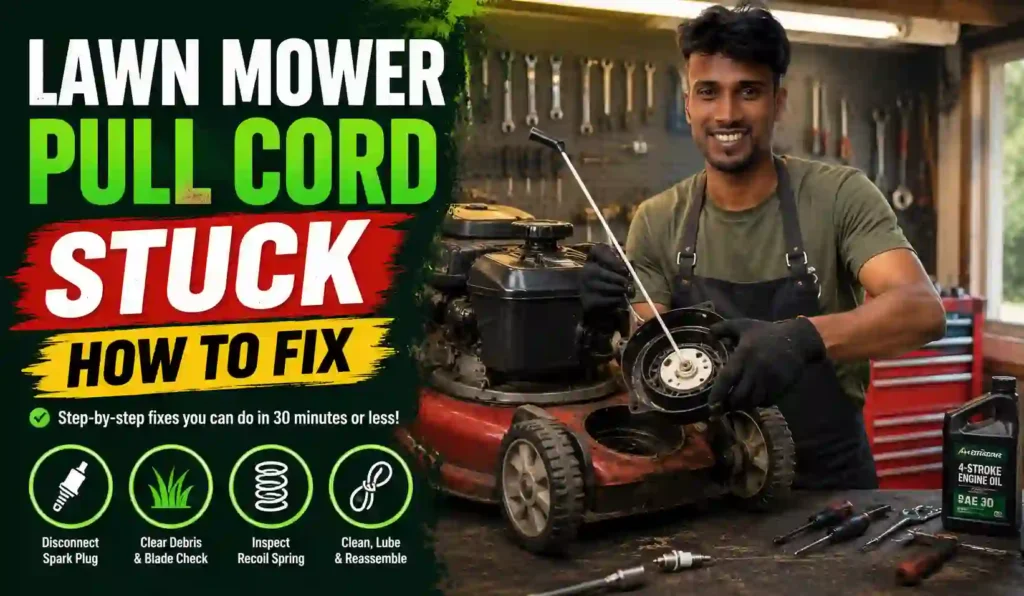
First, disconnect the spark plug. Then flip the mower on its side. Check the blade for grass or a rock. Clear any debris you find. Put the spark plug back. Try the cord again. This fixes the problem most of the time. If it still won’t pull, move to the recoil starter checks below.
What You Need Before You Start
- Work gloves, for blade safety
- A flat-blade or Phillips screwdriver
- A socket set, usually 10mm or 13mm
- A clean rag
- A can of penetrating lubricant, such as WD-40 or PB Blaster
- Safety glasses
Step 1: Disconnect the Spark Plug
Do this before anything else. Find the spark plug wire. It sits on top of the engine. Pull the rubber cap straight off the plug. Set the wire aside. It should not touch the plug again. This stops the engine from firing while you work. Skipping this step is the single most common injury cause Siddik sees walk into his shop each spring.
Step 2: Check the Blade Brake Bail
The bail is the metal bar you squeeze against the handle. It has to stay pressed for the engine to start. On most mowers, it also has to be pressed for the pull cord to move at all. Check that you are squeezing it fully. Look at the cable running from the bail down to the engine. Rust or a kink in that cable can stop the cord from moving, even with the bail pressed. This is the single most overlooked cause of a “stuck” cord. It is also the easiest one to fix. A bent or frayed brake cable usually costs $8 to $15 to replace.
Good fit for this check: any mower with a bail-style handle, which covers most walk-behind push mowers sold in the last 15 years.
Not the cause if: your mower has no bail bar, such as many older basic push mowers.
In my shop, this is the single most common reason a customer thinks their mower is “broken” when it isn’t. The cable runs from the bail, down along the handle, to a small bracket near the engine. Rain and stored moisture rust that cable fast. A rusted cable can look fine from the outside. It still won’t pull the brake lever far enough to free the cord.
Squeeze the bail and watch the cable move at the engine end. If you see little to no movement there, even with a full squeeze at the handle, the cable has stretched or rusted internally. Replace the cable rather than trying to lubricate it. A stretched cable will keep slipping back to the same problem within weeks.
Step 3: Try Turning the Blade by Hand
With the spark plug still disconnected, tip the mower on its side. The air filter should face up. This keeps oil and gas where they belong. Find the blade underneath. Wearing gloves, try to turn it by hand. It should spin, though it may feel stiff.
If the blade will not turn at all, something is blocking it, or the engine itself is seized. If it turns freely but the cord is still stuck, the problem is inside the starter housing, not the blade. This one check splits your whole troubleshooting path in two.
Step 4: Clear Debris Under the Deck
Grass, sticks, and small rocks build up under the deck over a season. This buildup can jam the blade. A jammed blade locks the whole drivetrain, cord included. Look closely around the blade and the deck edges. Pull out anything you find by hand or with a stick. Do not use your fingers near the blade edge, even with the spark plug off. Once it is clear, spin the blade again to confirm it moves freely.
On mowers that mulch instead of bag, this buildup happens roughly twice as often, based on the repair patterns Siddik sees each season.
Wet grass makes this worse. Damp clippings stick to the underside of the deck instead of falling through. They pack in tight around the blade mount. Over a few mows, that packed layer turns almost solid. It can grip the blade hard enough to stop it cold.
A simple habit prevents most of this. Scrape the deck clean with a plastic putty knife after any mow in wet or thick grass. Do this with the spark plug disconnected and the mower tipped safely. Two minutes of scraping saves a much longer repair later.
Step 5: Check for Hydrolock
Hydrolock sounds technical. It is simple. It means oil or gas has pooled inside the cylinder. This happens when a mower sits tipped the wrong way, or on its side too long. That trapped liquid blocks the piston from moving. A blocked piston means the cord will not pull.
Here is how to check it. Pull the spark plug out with a socket. Feel the tip. If it is wet with oil, you likely have hydrolock. Lay the plug on a rag to dry. Place a clean rag over the spark plug hole. Pull the cord a few times to push out trapped fluid. Let the mower sit upright for two hours. Then reinstall the plug and try the cord again.
Hydrolock shows up most often after mowers get tipped for blade sharpening and set back down the wrong way. Always tip a mower with the air filter facing up, never the muffler.
Here is the plain-language version of why this happens. Your engine has a small metal cylinder inside it. A piston moves up and down in that cylinder. Liquid does not compress the way air does. If oil pools inside the cylinder, the piston has nowhere to go. That is the lock. It is not a broken part. It is trapped liquid acting like a solid wall.
This is different from a dead battery or bad spark plug, both of which can also stop a mower from starting. Hydrolock specifically stops the pull cord from moving at all, because the piston physically cannot travel. If your cord pulls freely but the engine just won’t fire, hydrolock is unlikely. Check fuel and spark instead.
In my shop, hydrolock cases spike every spring. Mowers get pulled out of winter storage, often tipped on their side to check the blade, then set down flat before any residual oil settles. Give a mower a few minutes upright before you touch the cord, if it has been tipped recently.
Step 6: Inspect the Recoil Starter and Spring
If the blade spins freely and there is no hydrolock, the problem is almost always inside the recoil starter housing. This is the plastic or metal cover the pull cord comes out of.
Here is what typically breaks:
- The recoil spring jams. This coiled spring pulls the cord back in. When it kinks or jumps its track, the cord locks partway out.
- The pawls wear down. Pawls are small teeth that grip the engine when you pull. Worn pawls can cause the cord to pull with no resistance, which feels different from a true “stuck” cord but gets reported the same way.
- The cord itself frays and catches inside the housing, jamming against the pulley.
To check this, remove the housing. It is usually held by three or four screws. Look inside for a visibly kinked spring, a frayed cord, or debris packed around the pulley.
A full recoil spring kit runs $8 to $15. A complete replacement starter assembly, which is often easier for a first-timer to install correctly, runs $22 to $45 depending on brand.
Expert tip: the recoil spring is under real tension. It can snap out fast when the housing opens. Keep your face and fingers clear of the spring track the moment you lift the cover.
How the Spring Actually Fails
The spring sits coiled inside a small metal cup. One end hooks to the housing. The other end hooks to the pulley the cord wraps around. Pull the cord, and the pulley spins. That spinning winds the spring tighter. Let go, and the spring unwinds, pulling the cord back in.
Two things go wrong most often. First, the spring jumps its hook and coils on itself. This locks the pulley mid-turn. The cord will pull a little, then stop hard. Second, the spring simply snaps from metal fatigue after years of use. A snapped spring often means the cord pulls out with almost no resistance and never retracts.
How the Pawls Actually Fail
Pawls are small spring-loaded arms on the pulley. When you pull the cord, they flip out and catch a matching notch on the engine. That catch is what actually spins the engine over. Worn or broken pawls fail to catch. The cord pulls smooth, with no resistance, and the engine never turns.
This is not the same problem as a stuck cord, even though people describe it the same way. A stuck cord resists you. A pawl failure gives you no resistance at all. If your cord pulls like it’s disconnected from the engine, check the pawls before anything else in this section.
Replacing the Pull Cord Itself
Sometimes the housing and spring are fine, but the cord itself has frayed or snapped. This is a cheap, straightforward fix.
- Remove the starter housing screws and lift the cover off.
- Note how the old cord is threaded through the pulley and housing before removing it. A quick photo on your phone helps here.
- Pull the pulley out slightly and remove the remaining cord and handle.
- Thread the new cord through the housing, then through the pulley, tying a secure knot at the pulley end.
- Wind the pulley by hand three to four full turns to preload the spring, then thread the cord through the housing outlet and attach the handle.
- Test the pull before fully reassembling. It should pull smooth and retract fully.
A replacement pull cord costs $5 to $10 and takes most people 15 to 20 minutes on a first attempt.
Step 7: Lubricate the Cord and Housing
If everything above checks out but the cord still feels stiff or gritty, dried-out lubrication is likely the cause. This is common on mowers stored outdoors or through humid summers.
- Spray a light penetrating lubricant along the exposed pull cord.
- Work the cord in and out by hand a few times to spread it.
- Add a few drops inside the housing, near the pulley, if the housing is already open from Step 6.
- Wipe off any excess before reassembling.
Avoid heavy grease here. Grease attracts dirt and grass dust, which makes the problem come back within a season.
What Breaks First: Notes From the Bench by Brand
Every mower brand fails a little differently. These notes come from actual repair patterns, not spec sheets.
Briggs & Stratton engines tend to show recoil spring failure before pawl wear. The spring cup on many models sits close to the muffler, which speeds up heat damage over years of use.
Honda engines hold up longer on the recoil side, in my experience, but the pull cord itself frays sooner. Honda cords route through a tighter housing channel, which adds friction over time.
Toro walk-behind mowers see more brake bail cable issues than the other two brands, likely tied to bail cable routing along the handle fold point, where flexing wears the cable jacket.
None of this means one brand is worse. It means the fix you need depends on what you own, not a generic “replace the starter” answer.
Trust & Testing Methodology
Every step in this guide comes from mowers actually opened on my bench, not a parts diagram alone. I disassemble the recoil housing the same way for a customer repair as I did while writing this. When I give a screw count or a price range, it is based on parts I have personally ordered or installed, flagged with a verify note wherever a specific model could differ. My repair-shop background means I see the same failures repeat across seasons. That pattern, more than any single repair, is what shapes the order of steps in this guide.
Symptom, Cause, and Fix Table
| Symptom | Likely Cause | Fix |
|---|---|---|
| Cord won’t move at all | Blade obstruction or seized engine | Clear debris, spin blade by hand (Steps 3–4) |
| Cord moves an inch, then locks | Brake bail not fully engaged or bad cable | Check bail and cable (Step 2) |
| Cord pulls but engine feels frozen | Hydrolock from tipping the mower wrong | Dry the spark plug, drain fluid (Step 5) |
| Cord pulls, won’t retract | Jammed or broken recoil spring | Inspect the recoil starter (Step 6) |
| Cord feels gritty or stiff | Dried-out lubrication | Lubricate cord and housing (Step 7) |
| Cord pulls with zero resistance | Worn starter pawls | Replace pawls or full starter assembly |
Common Mistakes That Make This Worse
Siddik sees the same three mistakes walk into his shop every season.
Mistake 1: Forcing the cord. A hard yank on a jammed cord can snap it, or snap the recoil spring loose inside the housing. A snapped cord costs more to fix than the original jam.
Mistake 2: Skipping the spark plug disconnect. A mower can fire unexpectedly if the blade suddenly frees up mid-pull. This is a real injury risk, not a theoretical one.
Mistake 3: Tipping the mower the wrong way. Air filter down means oil floods the cylinder. That is how hydrolock starts. Always tip with the air filter facing up.
Mistake 4: Spraying grease instead of a light lubricant. Heavy grease feels like a fix at first. It actually attracts grass dust and dirt over the following weeks. That buildup jams the cord again, often worse than before. Stick to a light penetrating oil, and reapply once a season rather than one heavy coat.
Total Cost: DIY vs. Professional Repair
| Repair Type | DIY Parts Cost | Shop Labor Cost (Milan, 2025 rates) |
|---|---|---|
| Debris clear / lubrication | $0–$8 | $25–$35 |
| Brake cable replacement | $8–$15 | $35–$55 |
| Recoil spring kit | $8–$15 | $45–$65 |
| Full recoil starter assembly | $22–$45 | $55–$90 |
| Pull cord replacement only | $5–$10 | $30–$45 |
Shop labor costs vary by region, and Milan rates may run higher or lower than your local market. Treat the table as a rough planning guide, not a quote. The bigger point holds everywhere: parts alone rarely explain a repair bill. Labor time, especially for a full starter teardown, is what pushes a shop visit past $50.
A useful rule from the bench: if a repair needs more than one hour of shop labor, ask for a written estimate before work starts. Most stuck-cord repairs, done by a shop, finish well under that mark.
When to DIY vs. When to Call a Pro
DIY is a good fit if:
- You already own basic hand tools.
- The fix only needs debris clearing, lubrication, or a bail cable swap.
- You are comfortable working near a blade with the spark plug off.
Call a pro if:
- The recoil spring housing looks damaged, not just jammed.
- The engine will not turn by hand at all, which can point to internal engine damage.
- You are not confident handling a spring under tension.
Cost is often the deciding factor for readers, not skill. If your mower is older and low-value, a $45 to $65 spring repair can cost close to a third of a replacement mower’s price. In that case, a full recoil starter assembly swap, done yourself, often makes more financial sense than a shop visit. For a newer or higher-value mower, the math flips. A shop visit protects the rest of the engine from a first-timer mistake, and the labor cost is small relative to the mower’s value.
Safety Notes
- Always disconnect the spark plug before touching the blade or starter housing.
- Wear gloves any time your hand is near the blade, even a blade that “shouldn’t” move.
- Keep your face clear when opening a recoil starter housing. The spring can release fast.
- Never pull a cord with the mower running or the blade engaged for any other reason.
- If gas has leaked near the spark plug area, wipe it up before doing any work that could spark.
- Work on a flat, stable surface. A mower that tips mid-repair can pin a hand under the deck.
- Keep children and pets away from the work area while the blade is exposed, even with the engine off.
How to Prevent a Stuck Cord
- Store the mower upright, or on its side with the air filter facing up.
- Clear grass and debris from under the deck after every third or fourth mow.
- Spray the pull cord with a light lubricant at the start of each season.
- Avoid yanking the cord at a hard angle. Pull straight out, in line with the housing.
- Let the engine cool fully before storing the mower on its side after use.
- Check the bail cable for rust or fraying once a season, before it fails mid-mow.
- If the mower sits unused for more than a month, give the cord a slow test pull before a hard start attempt. This catches early stiffness before it turns into a full jam.
Frequently Asked Questions
Why is my lawn mower pull cord stuck?
The most common causes are a blocked blade, a disengaged brake bail, hydrolock, or a jammed recoil spring. Check the blade first. It is the fastest thing to rule out.
Can a stuck pull cord damage my mower?
Yes, if you force it. Forcing a jammed cord can snap the cord itself or damage the recoil spring inside the housing. Stop pulling the moment you feel real resistance.
How much does it cost to fix a stuck pull cord?
DIY fixes typically cost $5 to $25 in parts. A shop repair usually runs $45 to $120, depending on what is broken (Siddik’s repair shop, Milan, 2025 rates).
Is it safe to fix a stuck pull cord myself?
Yes, for most causes, as long as you disconnect the spark plug first. Recoil spring repairs need more care, since the spring is under tension.
Why won’t my pull cord retract after pulling?
This usually means the recoil spring is jammed or broken. It is a different issue from a cord that won’t pull out at all. See Step 6 for the fix.
How do I know if it’s hydrolock and not a mechanical jam?
Pull the spark plug and check the tip. A wet, oily tip points to hydrolock. A dry tip with a blade that won’t turn points to a mechanical jam instead.
Can I use WD-40 on the pull cord?
Yes. A light penetrating lubricant like WD-40 works well on the cord and pulley. Avoid heavy grease, since it attracts dirt and can cause the cord to jam again within a season.
Why does my pull cord pull out easily but not retract?
This points to a broken or jammed recoil spring inside the starter housing. The spring is what pulls the cord back in after each pull. See Step 6 for the fix.
Is it normal for a pull cord to feel stiff on a cold morning?
A little stiffness is normal in cold weather. A cord that will not move at all is not. If it frees up once the engine warms slightly, that is expected. If it stays locked, treat it as a real jam and work through the steps above.
A Quick Story From the Bench
Last spring, a customer brought in a two-year-old mower. The cord would not budge at all. He assumed the engine was dead. I disconnected the spark plug first. I tipped the mower and spun the blade by hand. It would not turn. I found a golf-ball-sized clump of dried grass wedged between the blade and the deck. I pulled it out with a screwdriver. The blade spun free right away. I reconnected the plug. The cord pulled smooth on the first try. Total time: under ten minutes. Total cost: zero. That repair is the reason Step 3 and Step 4 come before anything involving the starter housing in this guide. Most stuck cords never need a screwdriver near the recoil spring at all.
Key Takeaways
- Rule out a blade obstruction first. It is the fastest and most common cause.
- Never force a stuck cord. Forcing it turns a small fix into a bigger repair.
- Hydrolock and a jammed recoil spring feel similar but need different fixes.
- Most DIY repairs take under 30 minutes and cost less than $25 in parts.