Quick Answer
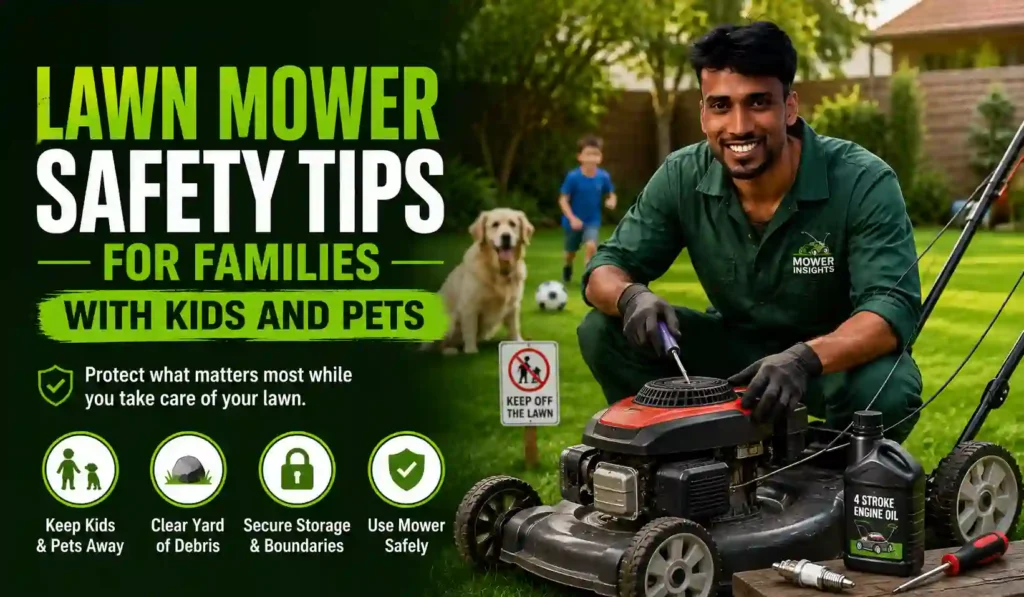
Keep kids and pets fully off the lawn while you mow. Do not just keep them nearby. Clear the yard of toys, sticks, and stones first. Never let a child ride on a mower, even for a quick lap. Most yard injuries come from thrown debris, not the blade itself. A cleared yard, a locked shed, and a strict “no one on the grass while it runs” rule stop most accidents before they start.
Why Mower Injuries Happen More Than Families Expect
Most mower injuries to kids and pets come from thrown objects. They do not come from the blade making direct contact. A rotary blade spins at roughly 3,000 RPM. At that speed, a small stone becomes a fast-moving object. It can travel 50 feet or more. That is the real danger zone. Most families miss it.
The Consumer Product Safety Commission, or CPSC, tracks mower injuries every year. Many involve children. Many require an emergency room visit. In our repair shop, we see the same story from a different angle. We see bent blades. We see cracked decks. We see damaged shrouds. These come from a hidden rock or a buried toy. If a rock can bend a steel blade, think about what it can do to a small hand or foot.
Pets face a different risk. Dogs often chase mowers. It is instinct for them. Their paws or tails can end up under the deck during a turn. Cats behave differently. They tend to hide instead of run. That means a cat can sit in a mower’s path and never be seen until it is too late.
Speed adds risk too. A mower does not need to move fast to cause harm. Even a slow pass at walking speed carries enough blade force to cause a serious cut. Do not let a slow-moving mower feel like a safe mower.
Before You Start: Clearing and Prepping the Yard
Walk the whole lawn before you mow. Do this every time, even if you mowed two days ago. Kids and pets add new hazards fast. A dropped ball. A buried bone. A garden hose left in the grass overnight.
What to remove before starting:
- Toys, balls, and sports equipment
- Sticks, fallen branches, and pinecones
- Rocks, garden edging stones, and loose mulch
- Hoses, extension cords, and pet leashes
- Dog waste (blades will spray it, and it can jam a mower deck)
Check the yard boundaries too. Look at fence gaps. Look at gate latches that do not fully close. Look for low spots under a fence. These are common spots where a small dog slips through mid-mow. Confirm the gate is latched, not just closed, before you start the engine.
Set a fixed mowing time if you can. Kids and pets learn patterns fast. If mowing always happens right after breakfast, a child learns to stay inside then. A pet learns the same. Random mowing times remove that built-in safety habit.
Keeping Kids Safe During Mowing
The biggest mistake we see is treating “kids are inside” as good enough when a door or window is open. Watching from the porch is not a safe distance either. Neither one keeps a child truly separated from the mower.
Core rules for kids during mowing:
- Kids stay indoors or in a fully separate, fenced area while the mower runs, not just nearby
- No child under 16 rides on a mower, including sitting on a parent’s lap on a riding mower
- No child operates a push or riding mower before the age ranges listed below
- Never let a child hand you something while the engine runs, even for two seconds. Shut it off first.
- Treat the mower like a kitchen knife. It is off-limits, not something to grow into casually.
The lap-riding habit deserves its own warning. It is common, and it is genuinely dangerous. A child on a parent’s lap can be thrown during a sudden stop. A small foot can slip toward the blade housing during a turn. Neither risk is worth a short ride.
Teaching Kids the Rules (Not Just Enforcing Them)
Rules work better when kids understand the reason behind them, not just the boundary itself. A short, honest explanation sticks longer than a bare “stay away.”
Show a child what a mower does to a pinecone or a small branch before you start. Let them see the debris fly, from a safe distance, with hearing protection on. That single demonstration often does more than a dozen verbal warnings.
Give younger kids a specific job away from the mower. A porch checklist works well: watch for the mower to stop, then come out. This gives them a role instead of just a restriction, and it keeps them physically apart from the machine.
Older kids who are close to the age where they will start helping should watch a full mowing session from a safe distance first. Let them see the whole routine: the pre-mow check, the start, the turns, the shutdown. Familiarity builds better habits than a rushed first lesson.
Keeping Pets Safe During Mowing
Dogs and cats do not understand the phrase “stay back.” Management works. Training alone does not.
Before mowing:
- Bring pets indoors, or crate them in a separate room, not just tied up outside
- If a pet must stay outside, use a secured pen or a leash tied well away from the mowing area, with a person supervising
- Check under bushes and low decks first. Cats especially like to hide rather than flee.
While mowing:
- Glance behind and to the sides before every turn, not just when moving forward
- If a pet gets loose in the yard, stop the mower completely and wait. Do not steer around them.
- Keep mowing sessions at a predictable time. Pets learn that the sound means “stay away” only if the pattern is consistent.
Repair-shop note: we regularly see deck damage from mowers that clipped a buried bone or chew toy at speed. That same impact force against a paw or tail causes real injury. It is not just a bent blade.
Small dog breeds face extra risk near riding mowers. A rider sitting high on the seat has a limited view of the ground right in front of the deck. A small dog can duck into that blind spot in under a second.
Age Guidelines: When a Kid Can Actually Help
These are general safety guidelines, not strict rules for every child. Treat them as a floor, not a target to rush toward.
| Age Range | Recommended Involvement |
|---|---|
| Under 6 | No involvement. Should not be in the yard while mowing happens. |
| 6-11 | Can help with pre-mow yard clearing (picking up toys, sticks) with adult supervision. No mower operation. |
| 12-15 | May operate a push (walk-behind) mower under direct adult supervision, with hearing and eye protection. Riding mowers still not recommended. |
| 16+ | May operate a riding mower with proper training, protective gear, and only after practicing on flat, clear ground first. |
Even at 12-15 with a push mower, a parent should stay within arm’s reach for the first several uses. Do not just watch from a window. Hand and foot placement near the discharge chute takes real repetition to get right.
Push Mower vs Riding Mower vs Robot Mower Safety
Each mower type carries a different risk to kids and pets. Treating them the same is a common mistake.
Push (walk-behind) mowers: Lowest overall risk to bystanders. Speed is slower, and the cutting path is smaller. The highest risk here is to the operator, if the mower is pulled backward over their own feet. Most walk-behind models include a blade-brake clutch, or BBC. This stops the blade within about 3 seconds of releasing the handlebar. It has been a required safety feature on new mowers in the US since the 1980s.
Riding and zero-turn mowers: Higher risk of rollover on slopes. Higher risk to bystanders too, from thrown debris, since decks are wider and blade speed is higher. Never allow a passenger on a riding mower, child or adult, unless the model is built as a two-seat unit.
Robot mowers: Lower supervision burden, since no one operates them by hand. But they bring a different hazard. A small child or pet can be struck, or have a limb caught, if the unit runs in a yard where kids are playing. Most robot mowers include a lift or tilt sensor. This stops the blade within about 1 second of the unit being lifted. That sensor does not replace fencing off the mowing zone during active mowing windows. Our Robot Mower section covers safe zone-setting in more depth.
Slopes, Wet Grass, and Other Terrain Risks
Terrain changes the safety math, and families often ignore this until it causes a problem.
Wet grass increases slip risk for both the operator and anyone standing nearby. It also increases the chance of clumping and clogging, which tempts an operator to reach toward the discharge chute while the engine still runs. Never clear a clog with the engine on, and never let a child or pet near a mower during a clog fix.
Slopes over roughly 15 degrees raise rollover risk on riding mowers significantly. On a push mower, a slope raises the risk of the operator losing footing and the mower sliding toward a bystander. Kids and pets should stay farther back than usual on any sloped section of yard, not the same distance you’d use on flat ground.
Thick or overgrown grass forces the blade to work harder and increases the chance of thrown debris, since more material moves through the deck at once. If a section of yard has been left uncut for weeks, treat it as higher risk and increase the clearance distance for kids and pets during that pass.
Common Mistakes Parents Make (Repair-Shop View)
In our shop, damage patterns tell us what actually goes wrong at home. They tell a different story than most safety guides assume.
Mistake 1: Mowing during nap time without checking the yard first. Parents assume a sleeping toddler means a safe window. Then a neighbor’s kid or the family dog wanders into an unfenced yard mid-mow.
Mistake 2: Letting the mower idle while distracted. A running mower left alone, even briefly to answer a door or phone, is a mower a curious child can reach.
Mistake 3: Assuming a quiet electric or battery mower is safer around kids. Blade speed and injury risk are the same as gas models. The real difference is fewer fumes and no hot exhaust part, which matters for burn risk but not blade risk.
Mistake 4: Skipping ear and eye protection for teen operators. We see teens handed a mower with zero protective gear more often than not. Debris in the eye and long-term hearing damage from repeated unprotected exposure are both real, and both build up over time.
Mistake 5: Backing up without checking behind first. This is the single most common cause of the pet-under-the-deck incidents we hear about from customers bringing in damaged mowers.
Mistake 6: Assuming a fenced yard means an unsupervised yard. A fence keeps a dog from leaving. It does not stop the dog from running behind a mower inside that same fence.
What to Do If an Injury Happens
Turn off the mower right away. Release the safety handle or shut off the key. Move clear of the blade before you check on anyone hurt. Do not try to restart or move the mower until everyone is clear.
For any injury involving the blade, deep cuts, or a suspected broken bone, call emergency services instead of driving to urgent care yourself. Mower cuts can cause fast blood loss, and a fast response matters more than a fast drive.
For debris strikes to the eye, do not rub it or flush it hard. Cover it loosely, and get medical attention right away.
This is a hard topic to think about. If you or someone you know has gone through an injury like this, it helps to talk it through with a medical professional, beyond what any single article can cover.
Storage and Access Between Uses
Safety does not end when the mowing stops. A mower parked in an open garage with a curious four-year-old nearby is still a hazard.
- Store mowers with the fuel shut off. For gas models, disconnect the spark plug wire if young kids have garage access.
- Keep the ignition key removed and stored apart from riding mowers, not left in the machine
- Store sharp tools like edgers and blade-removal tools out of reach, not just the mower itself
- Close and latch the shed or garage door fully after each use, not just partway
If storage space is tight, our Storage & Accessories section covers compact setups that keep equipment secured without needing a full shed.
Frequently Asked Questions
At what age can a child safely mow the lawn?
Most safety guidance places supervised push mower use starting around age 12-15, and riding mower use no earlier than 16. Even then, direct adult supervision for the first several sessions matters more than the age number alone.
Can a child ride on a riding mower with a parent?
No. Riding mowers are built for one operator, unless the model is made with a second seat. A child on a parent’s lap can be thrown, or their foot can slip toward the blade housing during a turn or a sudden stop.
How far away should pets be kept during mowing?
Pets should be fully separated from the mowing area. Keep them indoors, or in a secured pen well outside the yard being cut, not just tied up nearby. Thrown debris can travel 50 feet or more from the blade.
Are electric or battery mowers safer around kids than gas mowers?
Blade speed and cutting risk are the same across gas, electric, and battery mowers. Electric and battery models cut fume and hot-exhaust burn risk, but they do not cut blade or debris risk. The same yard-clearing and distance rules still apply.
What should I do if my child or pet gets hurt by a mower?
Turn off the mower right away, and move clear of the blade before you check the injury. For deep cuts, a suspected broken bone, or an eye injury, call emergency services instead of driving yourself, since these injuries can get worse fast.
Do robot mowers need the same safety steps as push mowers?
Yes, in a different form. Run a robot mower only during set windows when kids and pets are confirmed away from the yard. Its sensors cut the risk of contact, but they do not remove it, for a small child or pet in its path.
Is a slower mower safer for a yard with kids and pets?
Not by much. Even a slow-moving mower carries enough blade force to cause a serious injury on contact. Speed changes how fast an operator can react, but it does not change the force of the blade itself.
What safety gear should a teen operator actually wear?
Closed-toe shoes with a solid sole, safety glasses or goggles, and hearing protection rated for the mower’s noise level are the baseline. Long pants also help, since they reduce the chance of a minor scrape from thrown grass or small debris turning into a cut.
Should I mow at all if I can’t get kids or pets fully out of the yard?
No. Wait until the yard is clear. A short delay costs you a few minutes. A mower running near an unsupervised child or loose pet is not a risk worth taking for the sake of finishing on schedule. If the yard can’t be cleared right now, mow later in the day instead.
Setting Up a Kid-and-Pet-Safe Mowing Zone Long Term
A one-time safety talk fades fast. A physical setup lasts much longer, and it works even on the days when everyone forgets the rules.
Fencing and barriers: A low, visible barrier around the active mowing zone gives kids a clear line they can see, not just a rule they have to remember. This does not need to be permanent. A roll-out mesh fence works for the length of a single mowing session and packs away after.
Sound as a signal: Most kids and pets learn the mower’s sound within a few sessions. Use that. Start the mower a few seconds before you actually begin cutting, in the same spot each time, so the sound becomes a reliable early warning rather than a surprise.
A designated safe spot: Give kids one specific place to be during mowing, like a porch or a window seat, rather than a vague instruction to “stay inside.” A specific spot is easier for a young child to hold onto than an abstract rule.
Pet containment that doesn’t rely on obedience: A trained recall command can fail under excitement. A closed door or a latched pen does not. Build your pet safety plan around physical barriers first, and treat training as a backup, not the main defense.
Visitor and playdate rules: Other people’s kids and pets do not know your household’s mowing schedule. If you mow on a set day, let regular visitors know the time so they can plan around it, especially if your yard is a common playdate spot.
Trust & Testing Methodology
This guide draws on patterns we see again and again in our repair shop: what damage looks like after an object strike, which models trigger safety recalls, and what customers describe when they explain how an incident happened. It does not replace the safety manual that ships with your specific mower model. That manual should always come first for your machine.